Oh, it's been a quiet year. My only scholarly writings were the annual bibliography and my contributions to "The Year's Work in Tolkien Studies," both in the volume of Tolkien Studies that came out in 2025 but was dated 2024. I co-edited that volume, but as I've retired that'll be the last one. Though I've signed up to do the next bibliography, and I may be back in the "Year's Work," though that's going in abeyance for the next issue.
I also had a report on the Mythopoeic Society's online conference, copied from this blog and put in the Society's newsletter, Mythprint.
And 22 formal concert reviews published online, the last in October. There will be no more of those, at least for a while until my health gets sorted out.
Places I've stayed overnight away from home:
South San Francisco, CA
Pittsburgh, PA
Ashland, OR
Brisbane, CA
Santa Clara, CA
Two overnight trips up to the City, one for a conference and one for a series of concerts in close temporal proximity, both times staying in airport hotels just outside of the City where it's cheaper; one glorious trip to my brother's wedding far away, my only plane flights of the year; one drive to the Oregon Shakespeare Festival; and, sigh, another stay in the hospital.

Kalimac's corner: a journal by DB
Wednesday, December 31, 2025

Tuesday, December 30, 2025
year's last miscellanea
1. Here's an evaluation of all of Rob Reiner's movies, in which, if you follow along, you'll see that the authors consider his eight best movies to be eight of his first nine movies. (The clunker is, of course, North, and if it and The American President had been flipped chronologically, the best eight would have been the first eight.) So what happened? The authors think that the instincts that led Reiner right in his early days went wrong in his later ones.
I've seen six of the eight best (somehow I've missed The Sure Thing and I wouldn't see Misery on a bet) and enjoyed all six*; the only one of his later movies I've seen is LBJ, which was not bad but was carried mostly by Woody Harrelson's performance in the title role. The thing is that I never found Reiner a particularly good director in the technical sense - the climbing of the Cliffs of Insanity in The Princess Bride was embarrassingly clumsy - but in his good movies he was great in other ways: his versatility in genre (the guy who made Spinal Tap made A Few Good Men? Amazing), brilliant casting all around (that's what really knocked my socks off about Princess Bride in particular), and his ability to let the script and the acting shine through.
*Though I enjoyed When Harry Met Sally, I bristled at Harry's contention that all men are like him. If there's one thing I've learned from life, it's that people are different. Reiner and Nora Ephron may have based Harry on himself, but I am not like that and neither are most of the men I know.
2. Saw an article somewhere in which Sam Altman was quoted as saying that you can't raise a child without the help of A.I. Here's not the original article but a more critical commentary. Apparently the A.I.'s job is to reassure you that you're not screwing up. Dr. Spock said pretty much the same thing; why don't you just read him? Because you can be sure that, though he might be wrong, he's not just making crap up, which A.I. is prone to doing. When ChatGPT first showed up, I experimented by asking it some tough musical questions I knew the answers to, and it only seriously messed up some but rarely got everything totally right.
Once I learned what it does, I would never ask A.I. for advice on anything real. In practice, I use it only to remind me when I need a word I know but which has slipped my mind, which happens depressingly often these days, maybe once a month. The last one was "foyer." At least then I know the answer is right when I see it.
I certainly wouldn't ask it to draft any writings for me. I wonder if I would ask it to do so if I still had to write anything that I struggled with the wording of. But the writing I had most trouble with was job application letters, and that requires personalized stuff the A.I. wouldn't know. So probably not.
3. But one technical advance I am very happy with is the U.S. Post Office's "Daily Digest" which sends you an e-mail early each morning showing the envelopes you're expected to receive that day. (Mailers, magazines, and packages are excluded, though it does tell you how many packages to expect.) So if a bill doesn't come, that's because your delivery person is running behind, and if it doesn't come the next day, that's when you call the biller and ask them to send another copy.
I've seen six of the eight best (somehow I've missed The Sure Thing and I wouldn't see Misery on a bet) and enjoyed all six*; the only one of his later movies I've seen is LBJ, which was not bad but was carried mostly by Woody Harrelson's performance in the title role. The thing is that I never found Reiner a particularly good director in the technical sense - the climbing of the Cliffs of Insanity in The Princess Bride was embarrassingly clumsy - but in his good movies he was great in other ways: his versatility in genre (the guy who made Spinal Tap made A Few Good Men? Amazing), brilliant casting all around (that's what really knocked my socks off about Princess Bride in particular), and his ability to let the script and the acting shine through.
*Though I enjoyed When Harry Met Sally, I bristled at Harry's contention that all men are like him. If there's one thing I've learned from life, it's that people are different. Reiner and Nora Ephron may have based Harry on himself, but I am not like that and neither are most of the men I know.
2. Saw an article somewhere in which Sam Altman was quoted as saying that you can't raise a child without the help of A.I. Here's not the original article but a more critical commentary. Apparently the A.I.'s job is to reassure you that you're not screwing up. Dr. Spock said pretty much the same thing; why don't you just read him? Because you can be sure that, though he might be wrong, he's not just making crap up, which A.I. is prone to doing. When ChatGPT first showed up, I experimented by asking it some tough musical questions I knew the answers to, and it only seriously messed up some but rarely got everything totally right.
Once I learned what it does, I would never ask A.I. for advice on anything real. In practice, I use it only to remind me when I need a word I know but which has slipped my mind, which happens depressingly often these days, maybe once a month. The last one was "foyer." At least then I know the answer is right when I see it.
I certainly wouldn't ask it to draft any writings for me. I wonder if I would ask it to do so if I still had to write anything that I struggled with the wording of. But the writing I had most trouble with was job application letters, and that requires personalized stuff the A.I. wouldn't know. So probably not.
3. But one technical advance I am very happy with is the U.S. Post Office's "Daily Digest" which sends you an e-mail early each morning showing the envelopes you're expected to receive that day. (Mailers, magazines, and packages are excluded, though it does tell you how many packages to expect.) So if a bill doesn't come, that's because your delivery person is running behind, and if it doesn't come the next day, that's when you call the biller and ask them to send another copy.
Saturday, December 27, 2025
children's classics
British newspaper article by Anna Bonet, listing "The 14 children's classics every adult should read." Most of them British, of course. Organizing them by my experience with them, they are:
Read in childhood
The Hobbit by J.R.R. Tolkien
Watership Down by Richard Adams
Alice's Adventures in Wonderland by Lewis Carroll
The Little Prince by Antoine de Saint-Exupéry
The Railway Children by E. Nesbit
The Hobbit I encountered at 11, and it changed my life. I would not be most of the things I am today if I had not read The Hobbit. The Railway Children I remember enjoying at about the same age, but I haven't seen it since. I know Nesbit mostly through adult introduction to her as a foundational children's fantasist. Alice and The Little Prince were OK, but didn't really grab me. Watership Down wasn't published in the US until I was 17, but that was the perfect age to find it. Not even excepting Earthsea, which has a different feel, it is the only post-Tolkien epic fantasy with the same sweep and power. (Most of them are utter crap.)
Failed to read in childhood
Treasure Island by Robert Louis Stevenson
One of two classics I was given in childhood that I utterly bounced off of; the other was one of C.S. Forester's Hornblower novels. I did like Tom Sawyer.
First read in adulthood
Little Women by Louisa May Alcott
The Secret Garden by Frances Hodgson Burnett
The Wind in the Willows by Kenneth Grahame
The Lion, the Witch and the Wardrobe by C.S. Lewis
The Wind in the Willows, which I picked up at about 24, is the one children's classic that I didn't encounter until adulthood that has become as dear to me as my childhood favorites. I read the entire Narnian saga when I joined the Mythopoeic Society at 18, having previously ignored Lewis; I found them thin and not particularly appealing. The other two I don't remember when I read them, but only once each. They were OK, but I find I rather preferred their cinematic adaptations.
Not read
Ballet Shoes by Noel Streatfeild
The Enchanted Wood by Enid Blyton
Anne of Green Gables by L.M. Montgomery
My Family and Other Animals by Gerald Durrell
I think I may have picked up the Durrell at one point, but I didn't read much if so. I had a different encounter with Streatfeild, as I had another book of hers as a child, The Children on the Top Floor, which I did like very much (and still do, actually). Enid Blyton was completely unknown in the US in my childhood, though she's seeped in a little since then. I'd heard of Anne of Green Gables but never ran across it.
Read in childhood
The Hobbit by J.R.R. Tolkien
Watership Down by Richard Adams
Alice's Adventures in Wonderland by Lewis Carroll
The Little Prince by Antoine de Saint-Exupéry
The Railway Children by E. Nesbit
The Hobbit I encountered at 11, and it changed my life. I would not be most of the things I am today if I had not read The Hobbit. The Railway Children I remember enjoying at about the same age, but I haven't seen it since. I know Nesbit mostly through adult introduction to her as a foundational children's fantasist. Alice and The Little Prince were OK, but didn't really grab me. Watership Down wasn't published in the US until I was 17, but that was the perfect age to find it. Not even excepting Earthsea, which has a different feel, it is the only post-Tolkien epic fantasy with the same sweep and power. (Most of them are utter crap.)
Failed to read in childhood
Treasure Island by Robert Louis Stevenson
One of two classics I was given in childhood that I utterly bounced off of; the other was one of C.S. Forester's Hornblower novels. I did like Tom Sawyer.
First read in adulthood
Little Women by Louisa May Alcott
The Secret Garden by Frances Hodgson Burnett
The Wind in the Willows by Kenneth Grahame
The Lion, the Witch and the Wardrobe by C.S. Lewis
The Wind in the Willows, which I picked up at about 24, is the one children's classic that I didn't encounter until adulthood that has become as dear to me as my childhood favorites. I read the entire Narnian saga when I joined the Mythopoeic Society at 18, having previously ignored Lewis; I found them thin and not particularly appealing. The other two I don't remember when I read them, but only once each. They were OK, but I find I rather preferred their cinematic adaptations.
Not read
Ballet Shoes by Noel Streatfeild
The Enchanted Wood by Enid Blyton
Anne of Green Gables by L.M. Montgomery
My Family and Other Animals by Gerald Durrell
I think I may have picked up the Durrell at one point, but I didn't read much if so. I had a different encounter with Streatfeild, as I had another book of hers as a child, The Children on the Top Floor, which I did like very much (and still do, actually). Enid Blyton was completely unknown in the US in my childhood, though she's seeped in a little since then. I'd heard of Anne of Green Gables but never ran across it.
Friday, December 26, 2025
and it contained ...
The huge 'wine country gift box' I brought home from the Christmas gift exchange measures 23 x 12 x 10 with the lid closed, which was only possible to do after I removed all the wine bottles and those snacks I wouldn't care to eat (which I gave to B., figuring correctly that she'd like most of them, and the rest she could take to the snack table of her orchestral rehearsals). It was also so heavy that I shouldn't have carried it intact from the car into the house. It proved to contain:
6 bottles of wine (4 reds, 2 whites including a sparkling; 3 from Sonoma County and one each from Napa, Paso Robles, and Oregon)
8 boxes of various cookies
3 of biscuits, one with fruit filling (some of the cookies were also labeled biscuits, apparently in French)
6 of various crackers and hard breads
3 pastries
3 veggie snacks (2 asparagus, 1 olive)
1 each of madeleines, brownies, snack mix, kettle corn, jellies, ginger chews, lemon cakes, dip mix, dipping sauce, olive oil, hummus, and spreadable cheese
Most of the wine is probably destined to be regifted, but when will we manage to eat the rest of this stuff?
6 bottles of wine (4 reds, 2 whites including a sparkling; 3 from Sonoma County and one each from Napa, Paso Robles, and Oregon)
8 boxes of various cookies
3 of biscuits, one with fruit filling (some of the cookies were also labeled biscuits, apparently in French)
6 of various crackers and hard breads
3 pastries
3 veggie snacks (2 asparagus, 1 olive)
1 each of madeleines, brownies, snack mix, kettle corn, jellies, ginger chews, lemon cakes, dip mix, dipping sauce, olive oil, hummus, and spreadable cheese
Most of the wine is probably destined to be regifted, but when will we manage to eat the rest of this stuff?
Thursday, December 25, 2025
I'm dreaming of a wet Christmas
The downpour was severe most of the way up, and all the way back, to/from our niece T's house for Christmas dinner. This and the lighter rain we've been getting for the past week have been the first precipitation in over a month, so we ought to be glad to have it, local flooding nonwithstanding.
Inside, it was warm and cozy, though a bit underpopulated due to various constraints. Still, T's husband and both of their sons were there, including the one who's attending university a couple thousand miles away, and so were my brother and his wife, visiting from their home which is even slightly farther away. Another visitor was C., a supervisee of T's from work who's from Singapore and had no chance to celebrate with relatives, so she invited him over to her house.
T. insisted that we all participate in the all-food white elephant gift exchange, promising B. that she wouldn't get stuck with an assortment of hot sauce as happened one year. Most of the gifts were chocolate and/or wine. C. was mystified by opening presents in the presence of the giver, which is not the custom among his people. I got the last item nobody wanted to take, a huge 'wine country gift box' that T. was given as a reward for some professional service. It appears to have crackers and olive oil, among other things, in addition to wine. But I don't know what else is in it, because it's still out in the trunk of my car. Although it's wrapped in plastic, I didn't want to struggle in with it in the rain. Tomorrow is supposed to be lighter and the rain goes away after that.
For the dinner, I made my broccoli with garlic and cashews that had been such a success at Easter, and it was mostly devoured, despite being a large batch. So that was gratifying.
But now we're glad to have gotten safely home, and so are the cats, who'd been wondering when they were going to be fed.
Inside, it was warm and cozy, though a bit underpopulated due to various constraints. Still, T's husband and both of their sons were there, including the one who's attending university a couple thousand miles away, and so were my brother and his wife, visiting from their home which is even slightly farther away. Another visitor was C., a supervisee of T's from work who's from Singapore and had no chance to celebrate with relatives, so she invited him over to her house.
T. insisted that we all participate in the all-food white elephant gift exchange, promising B. that she wouldn't get stuck with an assortment of hot sauce as happened one year. Most of the gifts were chocolate and/or wine. C. was mystified by opening presents in the presence of the giver, which is not the custom among his people. I got the last item nobody wanted to take, a huge 'wine country gift box' that T. was given as a reward for some professional service. It appears to have crackers and olive oil, among other things, in addition to wine. But I don't know what else is in it, because it's still out in the trunk of my car. Although it's wrapped in plastic, I didn't want to struggle in with it in the rain. Tomorrow is supposed to be lighter and the rain goes away after that.
For the dinner, I made my broccoli with garlic and cashews that had been such a success at Easter, and it was mostly devoured, despite being a large batch. So that was gratifying.
But now we're glad to have gotten safely home, and so are the cats, who'd been wondering when they were going to be fed.
Wednesday, December 24, 2025
on Rob Reiner
45-minute CBS documentary on Rob Reiner. Really thoughtful and insightful views of the man, mostly from actors he directed in his films. A couple of them (both men, by the way) even break down in tears while talking about him. Also plenty of clips from interviews with Reiner, the movies, and All in the Family. Very much worth watching if you're at all interested in Reiner or his movies. It's amazing that the makers were able to put together such a polished and substantial piece of work in such a short time.
Tuesday, December 23, 2025
fame
John Scalzi is still on the comfort movie circuit, and last night's entry was Notting Hill. I've seen that movie, but only once when it was new, but Scalzi's essay is mostly about a principal topic of that movie, which is the effects of being famous, and I do have some thoughts about that.
I wouldn't go up and speak to a famous person I saw just because they were famous, but a couple times I've been in the presence of an actor or author I admired in a position where I ought to say something. So I just said, "I admire your work; thank you for doing it," because I couldn't go into any more detail without burbling.
By author I mean outside the sf/fantasy field, because there we're both parts of the community and can converse on a more equal basis, and some of them I'm friends with anyway. There are 3 or 4 notable fantasy authors, all women by the way, whom I was already friendly with before they'd ever published anything.
When I lived in Seattle in the early 80s, there were several authors who were part of a fairly close-knit fan community: F.M. Busby (who was called Buz), Vonda N. McIntyre, Joanna Russ. One time when I was visited by friends who were fans but not part of this particular community, I took them along to a fan-community party. I didn't tell them until we arrived that it was at Joanna Russ's house, and they were properly croggled. (I had of course gotten Joanna's permission to bring guests along.)
I've had one brief experience at being famous, within the environment I was existing in. I define topical fame as a situation where everybody's heard of you but few of them know you personally. This was when I was an invited guest speaker at a Tolkien conference at Marquette University, which holds his papers, in 2004. (And which gave rise to this proceedings.) Unlike at a Mythcon, where I know most of the attendees and consequently didn't feel "famous" even when I was Guest of Honor, here I didn't know much of anybody except the other presenters, but they all knew me.
It was a deeply weird experience, I found. People I didn't know kept wanting to come up and talk with me. It was within the context of the conference, so they weren't random accosters like the guy Scalzi describes making a pitch to Tom Hanks. And they had no self-aggrandizing agenda, they just wanted to talk about Tolkien, which I'm happy to do. I kept fretting inwardly over whether I was being polite enough. I'm rather introverted and not very socially adept, so I wasn't sure if I was being good at this. My biggest relief was when I left campus by myself and wasn't famous any more, which - as Scalzi points out - is exactly what the truly famous can't do.
It occurs to me that, instead of a movie about a famous person dating a random everyman, as in Notting Hill, we could have a story about a relationship between two famous people from totally different walks of fame. And we do: it's Katy Perry and Justin Trudeau. (I suppose Taylor Swift and Travis Kelce might qualify, too, though a sports star's fame isn't as different from a pop singer's as a politician's is, and I'm not sure how walk-down-the-street famous Kelce was before he and Swift started dating.)
I wouldn't go up and speak to a famous person I saw just because they were famous, but a couple times I've been in the presence of an actor or author I admired in a position where I ought to say something. So I just said, "I admire your work; thank you for doing it," because I couldn't go into any more detail without burbling.
By author I mean outside the sf/fantasy field, because there we're both parts of the community and can converse on a more equal basis, and some of them I'm friends with anyway. There are 3 or 4 notable fantasy authors, all women by the way, whom I was already friendly with before they'd ever published anything.
When I lived in Seattle in the early 80s, there were several authors who were part of a fairly close-knit fan community: F.M. Busby (who was called Buz), Vonda N. McIntyre, Joanna Russ. One time when I was visited by friends who were fans but not part of this particular community, I took them along to a fan-community party. I didn't tell them until we arrived that it was at Joanna Russ's house, and they were properly croggled. (I had of course gotten Joanna's permission to bring guests along.)
I've had one brief experience at being famous, within the environment I was existing in. I define topical fame as a situation where everybody's heard of you but few of them know you personally. This was when I was an invited guest speaker at a Tolkien conference at Marquette University, which holds his papers, in 2004. (And which gave rise to this proceedings.) Unlike at a Mythcon, where I know most of the attendees and consequently didn't feel "famous" even when I was Guest of Honor, here I didn't know much of anybody except the other presenters, but they all knew me.
It was a deeply weird experience, I found. People I didn't know kept wanting to come up and talk with me. It was within the context of the conference, so they weren't random accosters like the guy Scalzi describes making a pitch to Tom Hanks. And they had no self-aggrandizing agenda, they just wanted to talk about Tolkien, which I'm happy to do. I kept fretting inwardly over whether I was being polite enough. I'm rather introverted and not very socially adept, so I wasn't sure if I was being good at this. My biggest relief was when I left campus by myself and wasn't famous any more, which - as Scalzi points out - is exactly what the truly famous can't do.
It occurs to me that, instead of a movie about a famous person dating a random everyman, as in Notting Hill, we could have a story about a relationship between two famous people from totally different walks of fame. And we do: it's Katy Perry and Justin Trudeau. (I suppose Taylor Swift and Travis Kelce might qualify, too, though a sports star's fame isn't as different from a pop singer's as a politician's is, and I'm not sure how walk-down-the-street famous Kelce was before he and Swift started dating.)
Monday, December 22, 2025
piano recital: a review and an adventure
I attended a piano recital in San Francisco on Sunday. It just wasn't the piano recital I'd intended to go to.
The one I'd intended would have been Sarah Cahill playing music by Terry Riley in a meeting room of the main SF Public Library at 2 p.m. The occasion was to honor Riley's 90th birthday, which was last June. Riley was one of the founding fathers of the minimalist movement in the early 1960s, though he's reinvented himself several times since then, and Cahill is an indefatigable proponent of new and unusual music; she was, among other things, one of the tag team of pianists who played Philip Glass's complete Etudes some years back.
But when I got to the library I found the building closed due to a power outage. This, I eventually learned, had begun the previous evening, but I hadn't heard about it. This was irksome, especially as I'd checked the website that morning to confirm the concert was still on. The power outage was widespread, but in spots, and this particular spot covered just a few blocks around the library. Not a concert in sight.
But! Earlier, on my way to lunch, which I had at a Chinese place nearby but well outside the outage zone, I'd walked past a pizzeria which had, taped to its front window, a small notification of a concert of Bach on the piano, to be held at a church in the Mission District at 3 p.m. "Too bad Cahill's concert won't be over by then," I thought, but when I found the library closed, I simply changed my plans.
So instead of Riley I heard Bach's seven keyboard toccata suites (BWV 910-916) played on a Baldwin baby grand in a 19th-century Lutheran church across the street from Mission Dolores. The pianist, whose name was Michiko Murata, was really good. Too bad there were only about 20 people there to hear her.
She played crisply and emphatically, with clean separation of parts and with the call-and-response patterns so basic to Bach clearly enunciated. It was 90 minutes of the master of intricate counterpoint showing his chops, and with this clarity of enunciation it was sheer pleasure to hear.
Fortunately there was a brief intermission halfway through, and I returned from the long trudge to the men's room just in time to see Murata in the sanctuary's foyer, about to make her entrance. "You're back," she said to me. "I thought you'd left." This is something you can say when your audience is so small you can count them. "Oh no," I replied, "I've got to hear how this comes out." (With one of Bach's few excursions into the major mode, as it turned out.)
The one I'd intended would have been Sarah Cahill playing music by Terry Riley in a meeting room of the main SF Public Library at 2 p.m. The occasion was to honor Riley's 90th birthday, which was last June. Riley was one of the founding fathers of the minimalist movement in the early 1960s, though he's reinvented himself several times since then, and Cahill is an indefatigable proponent of new and unusual music; she was, among other things, one of the tag team of pianists who played Philip Glass's complete Etudes some years back.
But when I got to the library I found the building closed due to a power outage. This, I eventually learned, had begun the previous evening, but I hadn't heard about it. This was irksome, especially as I'd checked the website that morning to confirm the concert was still on. The power outage was widespread, but in spots, and this particular spot covered just a few blocks around the library. Not a concert in sight.
But! Earlier, on my way to lunch, which I had at a Chinese place nearby but well outside the outage zone, I'd walked past a pizzeria which had, taped to its front window, a small notification of a concert of Bach on the piano, to be held at a church in the Mission District at 3 p.m. "Too bad Cahill's concert won't be over by then," I thought, but when I found the library closed, I simply changed my plans.
So instead of Riley I heard Bach's seven keyboard toccata suites (BWV 910-916) played on a Baldwin baby grand in a 19th-century Lutheran church across the street from Mission Dolores. The pianist, whose name was Michiko Murata, was really good. Too bad there were only about 20 people there to hear her.
She played crisply and emphatically, with clean separation of parts and with the call-and-response patterns so basic to Bach clearly enunciated. It was 90 minutes of the master of intricate counterpoint showing his chops, and with this clarity of enunciation it was sheer pleasure to hear.
Fortunately there was a brief intermission halfway through, and I returned from the long trudge to the men's room just in time to see Murata in the sanctuary's foyer, about to make her entrance. "You're back," she said to me. "I thought you'd left." This is something you can say when your audience is so small you can count them. "Oh no," I replied, "I've got to hear how this comes out." (With one of Bach's few excursions into the major mode, as it turned out.)
Sunday, December 21, 2025
a movie called Wanda
John Scalzi's 'comfort watch' for yesterday was A Fish Called Wanda. I find I have some thoughts about that movie:
I agree with Scalzi that it's a fabulously funny movie, which I enjoyed tremendously on first watching. And for a long time afterwards, too, but on more recent rewatches I've found myself enjoying it somewhat less. (Except for Otto, a character so terminally stupid and fearlessly portrayed by Kevin Kline that way, that this still works.)
What I'm finding less appealing is what Scalzi calls the 'cringe humor.' Normally, like him, I dislike humor relying on embarrassing sympathetic characters, but Wanda was funny enough to immunize itself against this. But maybe as I've gotten more used to the scenario, the immunity wears off.
Scalzi mentions a couple forms of humor that probably wouldn't pass muster in a film made today. One is what he calls casual homophobia. I don't think that Otto trying to disconcert Ken by pretending to be sexually attracted to him is actually homophobic as the term is normally used. Ken isn't being repulsed at the existence of homosexuals, just at being propositioned himself. He's not shown as homophobic, just as emphatically not homosexual himself.
The line that Otto steps across is that of verbal sexual harassment, and that's objectionable regardless of the sexual orientation of anyone involved. If Otto were to treat a woman that way, it'd be perfectly understandable for her being as uncomfortable with it as Ken is.
The other problematic source of humor is Ken's stutter. Here again it's not that simple. The character who mocks Ken is Otto, and that's part of showing what a nasty and unsympathetic person Otto is. Wanda and George are comfortable dealing with Ken, whose stutter is less severe when talking with them - obviously it becomes stronger under stress.
Which leaves the encounter between Ken and Archie, when they're both frantic and accordingly Ken's stutter becomes very severe. It seems to me the source of humor here is not the stutter but Archie's frustration in dealing with it (his impatience, while understandable, is a flaw in his character). But I shouldn't be surprised if those with stutters disagree about that.
Scalzi says to ignore the plot, but there's a plot problem with the movie that weighs on me more over time. The reason Wanda seduces Archie is because Archie is George's lawyer and might know where George has hidden the diamonds. Perhaps it's Wanda's unfamiliarity, as an American, with the British legal system that trips her up here, because, as the barrister, Archie is merely a hired hand; he has little direct contact with George and is not in his confidence. The person who is in George's confidence is his solicitor, who is George's actual lawyer in the normal sense, and he does know about the diamonds, as is shown by his passing secret messages between George and Ken. It's the solicitor, not the barrister, whom Wanda should have seduced, but the solicitor is a minor character and, unlike Archie, he's not sexy, so there'd be no movie there.
I agree with Scalzi that it's a fabulously funny movie, which I enjoyed tremendously on first watching. And for a long time afterwards, too, but on more recent rewatches I've found myself enjoying it somewhat less. (Except for Otto, a character so terminally stupid and fearlessly portrayed by Kevin Kline that way, that this still works.)
What I'm finding less appealing is what Scalzi calls the 'cringe humor.' Normally, like him, I dislike humor relying on embarrassing sympathetic characters, but Wanda was funny enough to immunize itself against this. But maybe as I've gotten more used to the scenario, the immunity wears off.
Scalzi mentions a couple forms of humor that probably wouldn't pass muster in a film made today. One is what he calls casual homophobia. I don't think that Otto trying to disconcert Ken by pretending to be sexually attracted to him is actually homophobic as the term is normally used. Ken isn't being repulsed at the existence of homosexuals, just at being propositioned himself. He's not shown as homophobic, just as emphatically not homosexual himself.
The line that Otto steps across is that of verbal sexual harassment, and that's objectionable regardless of the sexual orientation of anyone involved. If Otto were to treat a woman that way, it'd be perfectly understandable for her being as uncomfortable with it as Ken is.
The other problematic source of humor is Ken's stutter. Here again it's not that simple. The character who mocks Ken is Otto, and that's part of showing what a nasty and unsympathetic person Otto is. Wanda and George are comfortable dealing with Ken, whose stutter is less severe when talking with them - obviously it becomes stronger under stress.
Which leaves the encounter between Ken and Archie, when they're both frantic and accordingly Ken's stutter becomes very severe. It seems to me the source of humor here is not the stutter but Archie's frustration in dealing with it (his impatience, while understandable, is a flaw in his character). But I shouldn't be surprised if those with stutters disagree about that.
Scalzi says to ignore the plot, but there's a plot problem with the movie that weighs on me more over time. The reason Wanda seduces Archie is because Archie is George's lawyer and might know where George has hidden the diamonds. Perhaps it's Wanda's unfamiliarity, as an American, with the British legal system that trips her up here, because, as the barrister, Archie is merely a hired hand; he has little direct contact with George and is not in his confidence. The person who is in George's confidence is his solicitor, who is George's actual lawyer in the normal sense, and he does know about the diamonds, as is shown by his passing secret messages between George and Ken. It's the solicitor, not the barrister, whom Wanda should have seduced, but the solicitor is a minor character and, unlike Archie, he's not sexy, so there'd be no movie there.
Friday, December 19, 2025
read these
1. My colleague Michael D.C. Drout on why The Lord of the Rings endures with readers. (If you don't have access to the NY Times, this link might get you there.) The essay takes a startling personal turn that may surprise readers who don't know Mike, but in the process it also reveals some of why Tolkien is such a moving and effective author. (And some of it is based on the lexomic analysis in the article Mike co-authored in the latest issue of Tolkien Studies.) It's a sad and beautiful article, like Tolkien's work itself.
2. What has become of NASA? Joel Achenbach's deep dive into the recent history and current state of the agency that's been mooting return flights to the Moon and also to Mars, and why it's not likely to happen, told with a clarity not always granted to such articles.
3. The angriest and hence best response to the thing that took to the airwaves to yell at America.
2. What has become of NASA? Joel Achenbach's deep dive into the recent history and current state of the agency that's been mooting return flights to the Moon and also to Mars, and why it's not likely to happen, told with a clarity not always granted to such articles.
3. The angriest and hence best response to the thing that took to the airwaves to yell at America.
Thursday, December 18, 2025
play reading
My online play-reading group has been exploring, among other things, 19th century English comedy. We've done most of Oscar Wilde's drawing-room comedies (I know, technically Wilde was Irish, but he worked in England) and wondered what else there was. We tried a play by Arthur Wing Pinero, since I knew he was popular at the time, and though the text was genteely anti-semitic (the moral lesson seemed to be that pushy Cockney Jews shouldn't try to socialize with titled gentry; they wouldn't enjoy themselves), but we did enjoy reading the play - it was called The Cabinet Minister - and will probably return to Pinero eventually.
But for our next venture in this area, I suggested that we try a play that I knew was a big hit comedy in its day, the laugh riot of the 1860s, but whose reputation has been besmirched by a tragic event that occurred during a performance. I refer, of course, to Our American Cousin by Tom Taylor, and if you want to read it, it's here.
It turned out to be fairly funny, itself, and again worth reading. As with the Pinero, it's about titled gentry facing money problems - this time they're being cheated by a crooked agent - who are also being faced by a visit by an American cousin who has become the heir to another relative's fortune.
The cousin is from Vermont, specifically Brattleboro, which is at the old, longer-settled end of Vermont, but he sounds and acts more like a Kentucky hillbilly. Before he arrives, another relative who'd gone out to see him writes that he's been out shooting with a party of the Crow people. In Vermont? The Crows live around Montana. Maybe they too were visiting for some unspecified reason, but evidently for Taylor, America is some kind of black box out of which anything can come.
Our member who read the part of Asa, the cousin, had a great time with it. My principal role was that of an inexplicable - there's no explanation of what he's doing there - nobleman called Lord Dundreary, who became the play's breakout character in the first production from a flamboyant performance by the actor. Lord Dundreary is both dimwitted and an inveterate punster, which I guess go together in some people's opinion, and I found it challenging to get across wordplay like this:
Why does a duck go under water? for divers reasons.
Why does a duck come out of the water? for sundry reasons.
According to the misspelling of his dialogue, Lord Dundreary suffers from both an interdental lisp (th for s) and rhotacism (w for r). Trying to perform both of these at once gave me an accent which sounded to me more Eastern European than English.
Interesting play; I'm glad we tried it. We're also finishing up the more obscure end of Shakespeare, our last venture having been Timon of Athens, which is also about a seemingly well-off man with money problems. When it turns out that his open-hearted generosity has left him broke, and none of his beneficiaries will now lend him money in his need, Timon suddenly switches personality and becomes a toxic misanthrope for the rest of the play. His encounter with another, more natively misanthropic character - dueling curmudgeons! - in Act 4 Scene 3 is one of Shakespeare's little-known gems.
But for our next venture in this area, I suggested that we try a play that I knew was a big hit comedy in its day, the laugh riot of the 1860s, but whose reputation has been besmirched by a tragic event that occurred during a performance. I refer, of course, to Our American Cousin by Tom Taylor, and if you want to read it, it's here.
It turned out to be fairly funny, itself, and again worth reading. As with the Pinero, it's about titled gentry facing money problems - this time they're being cheated by a crooked agent - who are also being faced by a visit by an American cousin who has become the heir to another relative's fortune.
The cousin is from Vermont, specifically Brattleboro, which is at the old, longer-settled end of Vermont, but he sounds and acts more like a Kentucky hillbilly. Before he arrives, another relative who'd gone out to see him writes that he's been out shooting with a party of the Crow people. In Vermont? The Crows live around Montana. Maybe they too were visiting for some unspecified reason, but evidently for Taylor, America is some kind of black box out of which anything can come.
Our member who read the part of Asa, the cousin, had a great time with it. My principal role was that of an inexplicable - there's no explanation of what he's doing there - nobleman called Lord Dundreary, who became the play's breakout character in the first production from a flamboyant performance by the actor. Lord Dundreary is both dimwitted and an inveterate punster, which I guess go together in some people's opinion, and I found it challenging to get across wordplay like this:
Why does a duck go under water? for divers reasons.
Why does a duck come out of the water? for sundry reasons.
According to the misspelling of his dialogue, Lord Dundreary suffers from both an interdental lisp (th for s) and rhotacism (w for r). Trying to perform both of these at once gave me an accent which sounded to me more Eastern European than English.
Interesting play; I'm glad we tried it. We're also finishing up the more obscure end of Shakespeare, our last venture having been Timon of Athens, which is also about a seemingly well-off man with money problems. When it turns out that his open-hearted generosity has left him broke, and none of his beneficiaries will now lend him money in his need, Timon suddenly switches personality and becomes a toxic misanthrope for the rest of the play. His encounter with another, more natively misanthropic character - dueling curmudgeons! - in Act 4 Scene 3 is one of Shakespeare's little-known gems.
Wednesday, December 17, 2025
retired
Yes, it's true, as announced yesterday: I'm retiring from my position as co-editor of Tolkien Studies. I've held this position for 13 years, and I was associated with the journal, mostly as author of "The Year's Work in Tolkien Studies," for 8 years before that, but is that long enough? No, I hope to continue to write for the journal - I just won't be editing it - as health permits.
Also for health concerns, I'm detaching myself from other long-term work-oriented commitments, because I don't want to cause a crisis if I'm suddenly unable to continue. You may not have noticed that I haven't published a professional concert review in two months. That's not too unusual a gap, especially as Christmas season is slow for the kinds of concerts I cover.
But what I've told my editors is to delete me from any coverage for the time being. If things go well, I may be back in the spring. In the meantime, I am attending concerts on my own as I can manage them. I'm hoping for one on the 21st, and my next ticket is for Jan. 15.
All this and some other similar matters makes me retired in a sense that I wasn't when I stopped working as a librarian, because then I had all these other things. So life feels a little vacant at the moment, but I'll go on writing here, and of course B. and I have a busy home life together - injured cat to the vet yesterday, turned out to be OK - so life will continue as long as it does.
Also for health concerns, I'm detaching myself from other long-term work-oriented commitments, because I don't want to cause a crisis if I'm suddenly unable to continue. You may not have noticed that I haven't published a professional concert review in two months. That's not too unusual a gap, especially as Christmas season is slow for the kinds of concerts I cover.
But what I've told my editors is to delete me from any coverage for the time being. If things go well, I may be back in the spring. In the meantime, I am attending concerts on my own as I can manage them. I'm hoping for one on the 21st, and my next ticket is for Jan. 15.
All this and some other similar matters makes me retired in a sense that I wasn't when I stopped working as a librarian, because then I had all these other things. So life feels a little vacant at the moment, but I'll go on writing here, and of course B. and I have a busy home life together - injured cat to the vet yesterday, turned out to be OK - so life will continue as long as it does.
Tuesday, December 16, 2025
Tolkien Studies: another announcement
Thirdly and finally, he said, I wish to make an ANNOUNCEMENT. He spoke this last word so loudly and suddenly that everyone sat up who still could.Though thirteen years is too short a time to live among such excellent and admirable hobbits, I regret to announce that, as of this year, I am retiring from the co-editorship of the journal Tolkien Studies: An Annual Scholarly Review.
Health concerns are the proximate cause for my retirement. But I will continue to be associated with and do work for the journal as availability permits.
My co-editors, Michael D.C. Drout and Yvette Kisor, have appointed as the new co-editor of the journal, with my enthusiastic approval, Kristine Larsen, noted and prolific Tolkien scholar, sometime contributor to TS, and professor at Central Connecticut State University.
They are hoping to send the next issue, Tolkien Studies 22, to press with our courteous publisher, West Virginia University Press, sometime in the spring of 2026.
- David Bratman, former co-editor, Tolkien Studies
Sunday, December 14, 2025
another day
Hanukkah tonight, but not a happy one. Some forty people shot, eleven of them killed, in an attack on a first-night Hanukkah celebration on a beach in Sydney, Australia. Anti-Semitism the apparent cause. Yes, again.
More celebratory news in the actor-comedian-dancer Dick Van Dyke reaching his centenary yesterday. He's good at what he does, I saw a couple of his movies when I was very small and enjoyed them, and that's about all I have to say about that. Such an intensely American figure should never have been asked to play a cockney chimney sweep in the first place, but his talent did a good job with the performance, accent or no.
Say, I've been to a couple of concerts. A Stanford student recital, various groups doing movements of chamber music pieces. The only work I knew well was Brahms's Op. 60 piano quartet, and I could hear how far the students had to stretch in this tumultuously dark work, but they tried hard. Most interesting was Chausson's Op. 3 piano trio, with its extremely strange first-movement ending. Two pianists playing a movement from a Rachmaninoff suite changed places with their page turners for the next movement; that was nice.
Up in the City, the Esmé Quartet was joined by Kronos cellist Paul Wiancko for Schubert's String Quintet, though the program book kept stating that it was a quartet. This was the last concert in the Robert Greenberg-curated series of morning Schubert concerts, and Greenberg had some useful things to say about how the piece is constructed from sub-ensembles: two overlapping quartets in the opening bars, a trio playing the theme in the slow movement with the first violin dancing descant above and the second cello providing pizzicato below. In that slow movement, when Schubert lowers the already pp volume to ppp, the softness and beauty were truly exquisite.
More celebratory news in the actor-comedian-dancer Dick Van Dyke reaching his centenary yesterday. He's good at what he does, I saw a couple of his movies when I was very small and enjoyed them, and that's about all I have to say about that. Such an intensely American figure should never have been asked to play a cockney chimney sweep in the first place, but his talent did a good job with the performance, accent or no.
Say, I've been to a couple of concerts. A Stanford student recital, various groups doing movements of chamber music pieces. The only work I knew well was Brahms's Op. 60 piano quartet, and I could hear how far the students had to stretch in this tumultuously dark work, but they tried hard. Most interesting was Chausson's Op. 3 piano trio, with its extremely strange first-movement ending. Two pianists playing a movement from a Rachmaninoff suite changed places with their page turners for the next movement; that was nice.
Up in the City, the Esmé Quartet was joined by Kronos cellist Paul Wiancko for Schubert's String Quintet, though the program book kept stating that it was a quartet. This was the last concert in the Robert Greenberg-curated series of morning Schubert concerts, and Greenberg had some useful things to say about how the piece is constructed from sub-ensembles: two overlapping quartets in the opening bars, a trio playing the theme in the slow movement with the first violin dancing descant above and the second cello providing pizzicato below. In that slow movement, when Schubert lowers the already pp volume to ppp, the softness and beauty were truly exquisite.
Saturday, December 13, 2025
drat
The crossword puzzle clue read "Get lost!" with the quotation marks around it, and the first three letters of the answer were GOF. I was hoping the fourth letter would be U and so on, but there weren't enough spaces for the expected conclusion of YOURSELF. It was when the cross word revealed that the fourth letter was in fact L that I realized the entire answer was GOFLYAKITE, which fit, but who says that any more?
Friday, December 12, 2025
John Varley
And so I see also that the SF writer John Varley has died. He burst upon the SF scene in the mid-1970s with a series of stories set in a future in which various planets and moons in our system are colonized, dubbed the Eight Worlds. Sex changes for aesthetic purposes, and artificial environments for artistic purposes, were common. The most famous of these stories was probably "The Phantom of Kansas." Several of these were Hugo nominees, but they didn't win, which frustrated me; at one point I called Varley the best SF writer currently operating who'd never won a Hugo.
He did finally get a Hugo in 1979 for a story outside that universe, a searingly memorable one called "The Persistence of Vision," which resembled Arthur C. Clarke's Childhood's End in being framed as a hopeful scenario but which really comes across as a horror story. I once quoted, purely as an allusion without identifying it, the memorable last line of this story in a post about my relief after having had to be talking all day, and someone caught the allusion, to my pleasure. His two successor Hugo winners, "The Pusher" and "Press Enter█", both from the 1980s, were also stand-alones and searingly memorable, the former also with a killer last line, which casts a chilling air back over the whole story; the latter more openly a horror story from early on, with a surprisingly intense Luddite air. All three of these stories were excellent of their kinds, and are the Varley stories I remember the best.
He also wrote novels, of which I've read two and a half. As with many SF writers, he was better at short fiction. Also like many SF writers, he turned mostly to novels in his later years, and I know nothing about those later works.
I met him a couple of times in the early days, in passing at conventions. He was tall and looming, with a full mustache, and latterly a beard. His middle name was Herbert, and he was known informally to friends as Herb, which confused people who didn't already know that. One time when he had two stories in the same issue of Asimov's, he used "Herb Boehm" as a pseudonym on one of them, "Air Raid", a particularly gruesome story about (to mischaracterize it wickedly) rescuing passengers from an airplane crash, which turned out to be by far the better-known of those two stories. But he quickly reprinted "Air Raid" under his usual byline, and later expanded it into a novel, Millennium, which I read (it wasn't as tight as the original story), which in turn was eventually made into a movie, which I haven't seen.
He did finally get a Hugo in 1979 for a story outside that universe, a searingly memorable one called "The Persistence of Vision," which resembled Arthur C. Clarke's Childhood's End in being framed as a hopeful scenario but which really comes across as a horror story. I once quoted, purely as an allusion without identifying it, the memorable last line of this story in a post about my relief after having had to be talking all day, and someone caught the allusion, to my pleasure. His two successor Hugo winners, "The Pusher" and "Press Enter█", both from the 1980s, were also stand-alones and searingly memorable, the former also with a killer last line, which casts a chilling air back over the whole story; the latter more openly a horror story from early on, with a surprisingly intense Luddite air. All three of these stories were excellent of their kinds, and are the Varley stories I remember the best.
He also wrote novels, of which I've read two and a half. As with many SF writers, he was better at short fiction. Also like many SF writers, he turned mostly to novels in his later years, and I know nothing about those later works.
I met him a couple of times in the early days, in passing at conventions. He was tall and looming, with a full mustache, and latterly a beard. His middle name was Herbert, and he was known informally to friends as Herb, which confused people who didn't already know that. One time when he had two stories in the same issue of Asimov's, he used "Herb Boehm" as a pseudonym on one of them, "Air Raid", a particularly gruesome story about (to mischaracterize it wickedly) rescuing passengers from an airplane crash, which turned out to be by far the better-known of those two stories. But he quickly reprinted "Air Raid" under his usual byline, and later expanded it into a novel, Millennium, which I read (it wasn't as tight as the original story), which in turn was eventually made into a movie, which I haven't seen.
Thursday, December 11, 2025
Arthur D. Hlavaty
Arthur was an old friend of mine, in both senses of the word. I'd known him through apas from 1978, and we met in person a couple years after that. But he was also older than most of his cohort in fandom, having entered with a splash with his first personalzine in the spring of 1977, when he was 34, an unusual age when most neofans were in their teens or early 20s. He died a couple days ago at 83, after long illnesses.
Living at first in Westchester County, New York, and then moving to Durham, N.C., to attend library school, he was geographically far removed from most of the members of the apas I knew him in. When one of the apas ran a photo-cover, Arthur submitted a picture taken in a photo booth which made him look like a gnome tucked in a corner. I attended the collation, and as members perused the completed mailing with its key to the cover photos, I heard occasional cries of "That's Arthur?"
Without physical presence, it was the quality of his writing that made him a valued member of both our apas and fanzine fandom in general. He wrote long and thoughtful essays, many informed by his reading of Thomas Pynchon, Ayn Rand, H.P. Lovecraft, and above all the Illuminatus! trilogy of Robert Shea and Robert Anton Wilson, all of which he took as very interesting and provocative, but none of which he viewed without a skeptical eye. Arthur was also a great quipster, leaving fanzines littered with witty and insightful bon mots. Someone sent him as a joke some volumes of treacly moral tales for children called Uncle Arthur's Bedtime Stories, and our Arthur used that as a fanzine title for a while.
He was full of wit and bon mots in person, also, in a light textured voice with a trace of New York accent, when I finally met him at a convention. Without the gnome extension, he looked like this - a little later on, after his dark hair and beard turned white. Earlier than that, in 1983, I actually ventured down to Durham to visit Arthur at home. By this time he had acquired a permanent romantic partner, an English lit grad student named Bernadette Bosky, whom Arthur had first met in the pages of a Lovecraft-oriented apa. She seemed so perfectly matched for Arthur's distinctive character that some of those reading about her from far away doubted that she could possibly be real, and one of my goals in traveling to Durham was to be one of the first outside fans to meet her and confirm her corporeal existence.
Later, after my visit, Arthur and Bernadette were joined by Kevin Maroney as a third for their romantic triad. I'm not the only observer who's frequently pointed at them as proof that such a relationship can be stable and permanent. Then they moved back up to Westchester, whence Arthur had originally come, and settled in a house in Yonkers they called Valentine's Castle (Valentine was the name of the street). Here they became much more personally active in fandom, going to conventions especially the ICFA in Florida. I never got to that, but I do cherish having introduced my own B. to all three of them at Nolacon in 1988. Meanwhile, they had founded their own apa and held private conventions for its members; and many people came to see them at home, including me. I think I stayed over twice, and I met their pet rats, which were actually quite cute and had rat-pun names.
I got to know both Bernadette and Kevin as individuals, but Arthur was always there, though receding in the background a little as age-related illnesses began to take over. I'm sorry that physical problems of my own prevented my attendance at a big party they held a couple years ago. And now Arthur is gone, but at least we still have vivid memories of him, and his fanzines to read.
Living at first in Westchester County, New York, and then moving to Durham, N.C., to attend library school, he was geographically far removed from most of the members of the apas I knew him in. When one of the apas ran a photo-cover, Arthur submitted a picture taken in a photo booth which made him look like a gnome tucked in a corner. I attended the collation, and as members perused the completed mailing with its key to the cover photos, I heard occasional cries of "That's Arthur?"
Without physical presence, it was the quality of his writing that made him a valued member of both our apas and fanzine fandom in general. He wrote long and thoughtful essays, many informed by his reading of Thomas Pynchon, Ayn Rand, H.P. Lovecraft, and above all the Illuminatus! trilogy of Robert Shea and Robert Anton Wilson, all of which he took as very interesting and provocative, but none of which he viewed without a skeptical eye. Arthur was also a great quipster, leaving fanzines littered with witty and insightful bon mots. Someone sent him as a joke some volumes of treacly moral tales for children called Uncle Arthur's Bedtime Stories, and our Arthur used that as a fanzine title for a while.
He was full of wit and bon mots in person, also, in a light textured voice with a trace of New York accent, when I finally met him at a convention. Without the gnome extension, he looked like this - a little later on, after his dark hair and beard turned white. Earlier than that, in 1983, I actually ventured down to Durham to visit Arthur at home. By this time he had acquired a permanent romantic partner, an English lit grad student named Bernadette Bosky, whom Arthur had first met in the pages of a Lovecraft-oriented apa. She seemed so perfectly matched for Arthur's distinctive character that some of those reading about her from far away doubted that she could possibly be real, and one of my goals in traveling to Durham was to be one of the first outside fans to meet her and confirm her corporeal existence.

Later, after my visit, Arthur and Bernadette were joined by Kevin Maroney as a third for their romantic triad. I'm not the only observer who's frequently pointed at them as proof that such a relationship can be stable and permanent. Then they moved back up to Westchester, whence Arthur had originally come, and settled in a house in Yonkers they called Valentine's Castle (Valentine was the name of the street). Here they became much more personally active in fandom, going to conventions especially the ICFA in Florida. I never got to that, but I do cherish having introduced my own B. to all three of them at Nolacon in 1988. Meanwhile, they had founded their own apa and held private conventions for its members; and many people came to see them at home, including me. I think I stayed over twice, and I met their pet rats, which were actually quite cute and had rat-pun names.
I got to know both Bernadette and Kevin as individuals, but Arthur was always there, though receding in the background a little as age-related illnesses began to take over. I'm sorry that physical problems of my own prevented my attendance at a big party they held a couple years ago. And now Arthur is gone, but at least we still have vivid memories of him, and his fanzines to read.
Wednesday, December 10, 2025
pulling up
Sean Duffy wants passengers to dress up for airplane flights, like they used to do in, I guess, the 1950s. OK, I'll do that if the airlines will resume treating passengers as they did then: in the way of diners in fancy restaurants, or passengers on luxury cruises. Then it would be appropriate. As it is now, it would be ludicrous.
He also wants them to exercise while waiting for their flights. In their dress clothes? RFK Jr demonstrated pull-ups while wearing a dress shirt and a tie, so I guess so. Especially from a man who's been known to pose shirtless.
That kind of exercise I wouldn't do, though, however dressed. I have never been able to do a pull-up, not even when I was a scrawny little kid, and I was a scrawny little kid. The other boys in the phys ed class, who could all execute a dozen without breaking a sweat, would stare in disbelief as I strained and strained and was not able to pull my head, let alone my chin, up to the bar.
I was also the slowest runner in the class. I was proud of getting the highest score in the 50-yard dash until I realized what that meant.
And DT wants visitors to the US to declare their social media use. Yet another reason to discourage visitors from coming here. My answer to that one would be a big MYOB. It doesn't say what counts as "social media," and lists I've seen usually don't include blogging platforms. Other than that, I've rarely indulged. I've left occasional comments on YouTube videos. I've been persuaded to get accounts on LinkedIn and Discord, both of which I've found pretty useless. I've never used Facebook or Twitter, but at least I've seen them and know what they are. Most of the rest, the likes of TikTok, Instagram, Pinterest (which I had to extract from a list as names I'd heard before), I've never seen and don't even know what specifically within the realm of social media they do. I may have been told but I can't maintain a memory of something that has no referent for me.
He also wants them to exercise while waiting for their flights. In their dress clothes? RFK Jr demonstrated pull-ups while wearing a dress shirt and a tie, so I guess so. Especially from a man who's been known to pose shirtless.
That kind of exercise I wouldn't do, though, however dressed. I have never been able to do a pull-up, not even when I was a scrawny little kid, and I was a scrawny little kid. The other boys in the phys ed class, who could all execute a dozen without breaking a sweat, would stare in disbelief as I strained and strained and was not able to pull my head, let alone my chin, up to the bar.
I was also the slowest runner in the class. I was proud of getting the highest score in the 50-yard dash until I realized what that meant.
And DT wants visitors to the US to declare their social media use. Yet another reason to discourage visitors from coming here. My answer to that one would be a big MYOB. It doesn't say what counts as "social media," and lists I've seen usually don't include blogging platforms. Other than that, I've rarely indulged. I've left occasional comments on YouTube videos. I've been persuaded to get accounts on LinkedIn and Discord, both of which I've found pretty useless. I've never used Facebook or Twitter, but at least I've seen them and know what they are. Most of the rest, the likes of TikTok, Instagram, Pinterest (which I had to extract from a list as names I'd heard before), I've never seen and don't even know what specifically within the realm of social media they do. I may have been told but I can't maintain a memory of something that has no referent for me.
Tuesday, December 9, 2025
registering a car
The dealer where I take my car for servicing now wants customers to go online to make service appointments. The last time I tried doing this, on the old system, it got terribly confusing and I gave up and went back to phoning, which has its own difficulties, as there's not always someone available to answer the phone.
But the new system is much clearer about making the appointments, and I did so successfully, but getting to that point was difficult. I had to create an account, which involved confirmations both by text and by e-mail, and then I had to register my car on the system. First they asked for its Vehicle Identification Number, which is a long alphanumeric thing. I had to go downstairs, our to the car, and grab the registration on which the VIN is printed. OK, that done, now it asks for the current mileage and estimated number of miles driven daily. Back down to the car to get the current mileage.
Now, how to estimate daily mileage? I don't have a regular driving schedule, like commuting to work. Some days I do local errands, some days I don't go anywhere at all, some days I go up to the City for a concert. Aha, I know how I'll do this. Below my odometer is a useful figure showing the approximate number of miles driveable on what's left in the tank. I know that, when it's full, it'll say about 350 miles. I always buy gas from the same credit card. If I go through the statements for this year, which are conveniently in one place, I can count up the number of days between fillings (which I usually get when it's down to about 30 miles). Average out the number of days, divide that by 320, and there's the answer, which turns out to be about 25.
But the new system is much clearer about making the appointments, and I did so successfully, but getting to that point was difficult. I had to create an account, which involved confirmations both by text and by e-mail, and then I had to register my car on the system. First they asked for its Vehicle Identification Number, which is a long alphanumeric thing. I had to go downstairs, our to the car, and grab the registration on which the VIN is printed. OK, that done, now it asks for the current mileage and estimated number of miles driven daily. Back down to the car to get the current mileage.
Now, how to estimate daily mileage? I don't have a regular driving schedule, like commuting to work. Some days I do local errands, some days I don't go anywhere at all, some days I go up to the City for a concert. Aha, I know how I'll do this. Below my odometer is a useful figure showing the approximate number of miles driveable on what's left in the tank. I know that, when it's full, it'll say about 350 miles. I always buy gas from the same credit card. If I go through the statements for this year, which are conveniently in one place, I can count up the number of days between fillings (which I usually get when it's down to about 30 miles). Average out the number of days, divide that by 320, and there's the answer, which turns out to be about 25.
Sunday, December 7, 2025
concert review: Harmonia California
I've been to a number of concerts by this nonpro string ensemble, conducted by Kristin Turner Link, and today was another one. They did a very nice job with Corelli's Christmas Concerto, and acceptably with Grieg's Holberg Suite. The other major work on the program was a tonal but astringent suite by a turn-of-the-20th composer named Mieczysław Karłowicz. The program said it was his Serenade No. 2, but I think they meant his Serenade, Op. 2.
Saturday, December 6, 2025
reading and eating
Our Mythie book-discussion group held its annual Reading and Eating meeting in the back room of the same Irish pub we've used the past two years. Three people showed up who hadn't been to the pub before, and one regular wasn't there (we saddled him with one of next year's discussion meetings anyway), so we had nine people instead of the previous seven. Hurrah.
Looking for something easily edible for lunch, I had the fish and chips. So did several others.
One of my readings came from a collection of letters to the Times of London. I was heartened to read that in 1949 a reader wrote in to protest a figurative use of "literally," and that this was followed over the next couple of weeks by nearly a dozen other letters recounting favorite examples of this, of which "Clemenceau literally exploded" (during an argument) and "for five years Mr Gladstone was literally glued to the Treasury Bench" were the funniest. You can use "literally" this way if you want to - it's a free language - but you have to expect that people will laugh at you and mock your clumsiness at writing.
As usual for a Saturday, the radio on the way up was emitting the weekly Met opera. This time B. recognized it right off. It was La Bohème.
Looking for something easily edible for lunch, I had the fish and chips. So did several others.
One of my readings came from a collection of letters to the Times of London. I was heartened to read that in 1949 a reader wrote in to protest a figurative use of "literally," and that this was followed over the next couple of weeks by nearly a dozen other letters recounting favorite examples of this, of which "Clemenceau literally exploded" (during an argument) and "for five years Mr Gladstone was literally glued to the Treasury Bench" were the funniest. You can use "literally" this way if you want to - it's a free language - but you have to expect that people will laugh at you and mock your clumsiness at writing.
As usual for a Saturday, the radio on the way up was emitting the weekly Met opera. This time B. recognized it right off. It was La Bohème.
Friday, December 5, 2025
why I wouldn't attend an arena concert
As for the music, the low-frequency kick of the bass - amplified by the subterranean setting, contained within SoFi's steep sides, and ricocheting off the E.T.F.E. roof - was crushingly loud. It penetrated to the bone. A friend who'd joined me ... retreated from the volume and sat in a chair next to the congealing remains of a spread of wings and sliders, her head in her hands. I sought refuge in the suite's private bathroom.
- John Seabrook, The New Yorker, 12/8/25
And this was a Beyoncé concert. Beyoncé. Not a heavy metal band or anything like it, the sort of thing I wouldn't listen to regardless of the volume.I would not have sat with my head in my hands or sought refuge in a bathroom. The moment this assault on the sense of hearing began, I would have stood up and walked right out of the stadium. Then, if possible, I would have gotten in my car and driven home.
The one time I actually heard a performer in an arena was back in the '90s when B. was working for AMD and they were riding high, so Jerry Sanders rented the local hockey arena for a big corporate party and put Faith Hill in it. The sound wasn't as bad as the above description, and the music as such was not at all objectionable, but I lasted about two minutes.
Thursday, December 4, 2025
on campus
So first I was listening to Rachel Maddow's podcast on the mysterious death of Senator Ernest Lundeen in 1940 and his connection to Nazi propagandists, and then I read Wikipedia's article on the America First Committee - which wasn't founded until just after Lundeen died - and saw a photo labeled "Students at the University of California (Berkeley) participate in a one-day peace strike opposing U.S. entrance into World War II, April 19, 1940."
I attended UC Berkeley myself 35 years later, so I was curious as to exactly where that photo was taken. I couldn't enlarge it more than this, but that was almost enough to read the signs on the shops at the far side of the photo. The sign on the corner building reads "Sather Gate Inn."
Aha. Sather Gate is a symbolic gateway on the bridge over Strawberry Creek. It's now well inside campus, but I knew that it was once the entrance to campus. Before 1960, Sproul Plaza, which leads from the edge of campus at Bancroft Way up to Sather Gate, was an additional street block of Telegraph Avenue, which now terminates at Bancroft. And the west side of that block, where the Student Union and Student Center which now stand there were built in 1960, had shops. This must have been the Sather Gate end of that block.
But wait! There's a street sign reading "Allston Way." Allston? Allston is a street in downtown Berkeley off to the west. It's that far north of Bancroft, but it didn't go up to Telegraph. Or did it?
With a little searching, I found a 1942 map of campus online (click on the image to enlarge it). And sure enough, what is now a pedestrian pathway tucked between the Student Center and the creek was then a street which bore Allston's name. The low-slung building behind the cars parked on the street must be the university YWCA shown on the map.
So this photo must have been taken from a perch up on Sather Gate (on the right side of the photo above), facing southwest (the map has east at the top). Here's a current photo taken from within where the crowd was in 1940, probably from about where the flag is, facing in the same direction. That's the Student Center cafeteria, The Golden Bear, in front, where Sather Gate Inn used to be, with the Student Union looming over to the left.
I find it fascinating to compare the 1942 map with a current map of campus. Many buildings built, some demolished (including the old Chemistry Building whose cupola is the only surviving relic). The chemists who were creating plutonium at about the time of the old map were working in the then-new chemistry building, Gilman Hall, which still stands: there's a plaque by the door of their lab.
The other thing I should note about the current map is the note "Closed for Construction" just below Bowditch Street near the right-side middle of the map. That's where People's Park used to be.
I attended UC Berkeley myself 35 years later, so I was curious as to exactly where that photo was taken. I couldn't enlarge it more than this, but that was almost enough to read the signs on the shops at the far side of the photo. The sign on the corner building reads "Sather Gate Inn."
Aha. Sather Gate is a symbolic gateway on the bridge over Strawberry Creek. It's now well inside campus, but I knew that it was once the entrance to campus. Before 1960, Sproul Plaza, which leads from the edge of campus at Bancroft Way up to Sather Gate, was an additional street block of Telegraph Avenue, which now terminates at Bancroft. And the west side of that block, where the Student Union and Student Center which now stand there were built in 1960, had shops. This must have been the Sather Gate end of that block.

But wait! There's a street sign reading "Allston Way." Allston? Allston is a street in downtown Berkeley off to the west. It's that far north of Bancroft, but it didn't go up to Telegraph. Or did it?
With a little searching, I found a 1942 map of campus online (click on the image to enlarge it). And sure enough, what is now a pedestrian pathway tucked between the Student Center and the creek was then a street which bore Allston's name. The low-slung building behind the cars parked on the street must be the university YWCA shown on the map.
So this photo must have been taken from a perch up on Sather Gate (on the right side of the photo above), facing southwest (the map has east at the top). Here's a current photo taken from within where the crowd was in 1940, probably from about where the flag is, facing in the same direction. That's the Student Center cafeteria, The Golden Bear, in front, where Sather Gate Inn used to be, with the Student Union looming over to the left.
I find it fascinating to compare the 1942 map with a current map of campus. Many buildings built, some demolished (including the old Chemistry Building whose cupola is the only surviving relic). The chemists who were creating plutonium at about the time of the old map were working in the then-new chemistry building, Gilman Hall, which still stands: there's a plaque by the door of their lab.
The other thing I should note about the current map is the note "Closed for Construction" just below Bowditch Street near the right-side middle of the map. That's where People's Park used to be.
Wednesday, December 3, 2025
smell of
Reading a news digest gives me my only glimpses into worlds like those of National Review, a contributor to which complained, "The U.S. has some of the greatest and most interesting cities in the world - New York, Chicago, San Francisco - and, over the last five or so years, almost all of them have become unpleasant to walk around in thanks to the ubiquitous smell of weed. Truly, it is everywhere - including, most distressingly, wafting through open-air restaurants and sidewalk cafes."
Really? In my college years, I hung around with people who smoked marijuana, though I never partook directly of it myself, so I know what it smells like. And I haven't encountered it lately in San Francisco, which I visit frequently.
The writer finds the smell of marijuana to be noxious, and I won't dispute someone else's personal tastes, but for me the smell is not particularly objectionable, in fact pleasantness itself next to the truly toxic, hellfireish stench of tobacco. Which used to be everywhere and completely inescapable. But, thanks to cultural change and anti-smoking laws, I haven't had to smell any, certainly not more than momentarily, for about 20 years. And I could go much longer than that.
Really? In my college years, I hung around with people who smoked marijuana, though I never partook directly of it myself, so I know what it smells like. And I haven't encountered it lately in San Francisco, which I visit frequently.
The writer finds the smell of marijuana to be noxious, and I won't dispute someone else's personal tastes, but for me the smell is not particularly objectionable, in fact pleasantness itself next to the truly toxic, hellfireish stench of tobacco. Which used to be everywhere and completely inescapable. But, thanks to cultural change and anti-smoking laws, I haven't had to smell any, certainly not more than momentarily, for about 20 years. And I could go much longer than that.
Tuesday, December 2, 2025
how it went down
FLUNKY: Mr. Secretary, there are still two survivors from the boat we attacked, clinging to the wreckage floating in the water.
PETE HEGSETH: I want you to kill everyone.
FLUNKY: Everyone?!?
PETE HEGSETH:
PETE HEGSETH: I want you to kill everyone.
FLUNKY: Everyone?!?
PETE HEGSETH:
Monday, December 1, 2025
AI Al
The Guardian has a long story about the development of artificial intelligence - and since much of it is going on in Silicon Valley and that's where the author did his research, it's full of Silicon Valley local color, focusing on the CalTrain line that many take to commute to work - I've commuted on it myself in time past.
But don't take it too much on trust: it's not "a short walk" to the Stanford campus from the Palo Alto station. Try to walk to the center of Stanford, where the work is going on, from the train station and you're in for a big surprise as you tromp for over a mile along the path paralleling a road running straight along a line of palm trees through a grove of oak and eucalyptus, the garish front of Stanford's Memorial Church growing faintly larger in the distance as you walk. You're on the Stanford campus, yes, but you're not there yet. This is why the university operates a shuttle bus line from the train station.
One thing the article doesn't mention is that the 101 freeway between Silicon Valley and San Francisco, another major commuter route, if one less drawing to a reporter from the UK where people are more likely to take the train, is littered with billboards with cryptic messages from AI companies. And almost every single one of those billboards is printed in sans-serif type. As a result of which, the initials "AI" look as if they say "Al" as in Al Gore or Al Haig.
This is annoying. I've started pronouncing it that way in protest. Whenever I see it without periods ("A.I.", which nobody uses) and without serifs, I'm saying "Al," the personal name.
2. Oh ghu, is this ever true.
3. Bruce Schneier, computer security expert, reports on a movement to ban VPNs. He doesn't tell you what a VPN is. If you Google VPN, the first entries and the Al responses don't tell you what a VPN is either. Eventually there are articles that do say what it stands for, but the explanations are aimed at people who already know what it means.
But don't take it too much on trust: it's not "a short walk" to the Stanford campus from the Palo Alto station. Try to walk to the center of Stanford, where the work is going on, from the train station and you're in for a big surprise as you tromp for over a mile along the path paralleling a road running straight along a line of palm trees through a grove of oak and eucalyptus, the garish front of Stanford's Memorial Church growing faintly larger in the distance as you walk. You're on the Stanford campus, yes, but you're not there yet. This is why the university operates a shuttle bus line from the train station.
One thing the article doesn't mention is that the 101 freeway between Silicon Valley and San Francisco, another major commuter route, if one less drawing to a reporter from the UK where people are more likely to take the train, is littered with billboards with cryptic messages from AI companies. And almost every single one of those billboards is printed in sans-serif type. As a result of which, the initials "AI" look as if they say "Al" as in Al Gore or Al Haig.
This is annoying. I've started pronouncing it that way in protest. Whenever I see it without periods ("A.I.", which nobody uses) and without serifs, I'm saying "Al," the personal name.
2. Oh ghu, is this ever true.
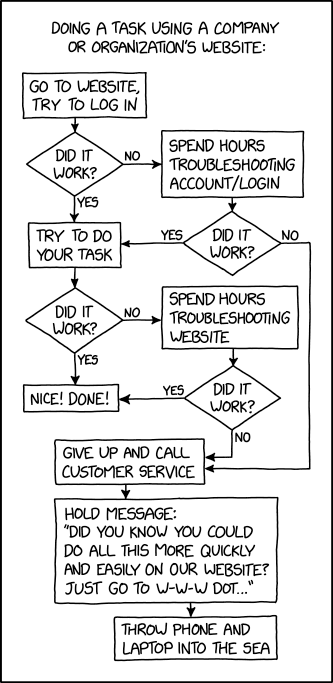
3. Bruce Schneier, computer security expert, reports on a movement to ban VPNs. He doesn't tell you what a VPN is. If you Google VPN, the first entries and the Al responses don't tell you what a VPN is either. Eventually there are articles that do say what it stands for, but the explanations are aimed at people who already know what it means.
Subscribe to:
Comments (Atom)