B. and I have long since learned that going out for dinner on Valentine's Day is a sucky thing to do, so we go on an adjacent night (trying out a new Indian place nearby tomorrow) and I was free to go up to the City for a concert tonight, eating at a Mission District taqueria, which I was sure wouldn't have any Valentine's doo-dads on its menu, though there were plenty of tables set up out on the street by entrepreneurs hoping to catch people who'd forgotten to buy flowers, or chocolate, on the way home.
So the concert featured a new piece called Quintet with Pillars by Sam Adams (son of John). This consisted of half an hour of the string quartet in a sequence of held chords while the piano had bright plunky exclamations or sequences above it. The music wasn't empty, but it was pretty much eventless. In fact, it sounded more like a very fast, very loud version of Morton Feldman - in other words, very slow and very quiet by anybody else's standards - more than anything else. I can't say I loved it, but I could have been itching with boredom but wasn't.
Also on the program, both of Mozart's piano quartets. These were driven by Joyce Yang's crisp and lively pianism, with the string players kind of tugging along in her wake. Putting the Adams between them made me wonder, as I sometimes do, what if somebody today decided to write with the vocabulary of Mozart? That would be really daring, and I'm sure all the critics who think Lutoslawski is a great composer would hate it.
Weather OK going in, but it was very very wet outside afterwards as I waited hopefully for a bus, which mercifully arrived after not too long and took me to a BART station.

Kalimac's corner: a journal by DB
Thursday, February 14, 2019

Wednesday, February 13, 2019
exhibiting hunting behavior
Some scientists wanted to find out if cats see the same optical illusions that humans do. So they printed out some patterns that give the illusion that they're moving, and put them in front of some cats.
Who batted at them, thus showing pretty effectively that the illusion is visible to cats.
What interested me is that, in the report, the scientists didn't say the cats were playing, which is what a cat owner would say. No, they're scientists, so they said that the cats were "exhibiting hunting behavior."
True enough, but what a way to put it. Ever since I read that, when one of our cats meows at me in that particular way, instead of saying, in that singy tone of voice owners use with cats, "Do you want to play?", I'll ask in the same tone, "Do you want to exhibit hunting behavior?"
Anyway, Tybalt, our new cat, loves to exhibit hunting behavior. He's already wrecked two consecutive toys-dangling-from-a-stick, by running off with the toy in his mouth and inadvertently destroying the stick as it dangles behind him. He clomps frantically around with his claws spread out as I scratch the end of a decapitated peacock feather around the floor. And I've introduced the laser pointer, which generates galloping runs across the room followed by the most puzzled looks of "where did it go?"
Tybalt's need to play - I mean, to exhibit hunting behavior - seems nearly constant, at least when I'm around, and my passing will cause him to wake up and emerge asking for more. Maia wants some too, but it's hard for her to get any attention when Tybalt is always butting in. Occasionally he's distracted by something else for a bit, or I've got Maia by herself in a room whose door can be closed.
And so my time is wrought.
Who batted at them, thus showing pretty effectively that the illusion is visible to cats.
What interested me is that, in the report, the scientists didn't say the cats were playing, which is what a cat owner would say. No, they're scientists, so they said that the cats were "exhibiting hunting behavior."
True enough, but what a way to put it. Ever since I read that, when one of our cats meows at me in that particular way, instead of saying, in that singy tone of voice owners use with cats, "Do you want to play?", I'll ask in the same tone, "Do you want to exhibit hunting behavior?"
Anyway, Tybalt, our new cat, loves to exhibit hunting behavior. He's already wrecked two consecutive toys-dangling-from-a-stick, by running off with the toy in his mouth and inadvertently destroying the stick as it dangles behind him. He clomps frantically around with his claws spread out as I scratch the end of a decapitated peacock feather around the floor. And I've introduced the laser pointer, which generates galloping runs across the room followed by the most puzzled looks of "where did it go?"
Tybalt's need to play - I mean, to exhibit hunting behavior - seems nearly constant, at least when I'm around, and my passing will cause him to wake up and emerge asking for more. Maia wants some too, but it's hard for her to get any attention when Tybalt is always butting in. Occasionally he's distracted by something else for a bit, or I've got Maia by herself in a room whose door can be closed.
And so my time is wrought.
Tuesday, February 12, 2019
concert review: Redwood Symphony
In later years, when reminiscing about his student days in Russia, Igor Stravinsky would recall the piece he wrote for the memorial concert after his teacher, Rimsky-Korsakov, died in 1908. But he had to search his memory for details, because the written music hadn't survived. The score had been lost in some later chaos, and as for the orchestral parts from the first performance, he said they were probably still at the conservatory in St. Petersburg where Rimsky had taught ... buried ... somewhere.
Four years ago - over 40 years after Stravinsky's death - the conservatory finally cleaned out all its archives, closets, and stashes of old music manuscripts - and found a box with the parts for Stravinsky's Rimsky elegy.
Unknown Stravinsky! It made a flurry of interest, was performed the next year, started making its way elsewhere, and on Saturday arrived in my neighborhood, so I got to review it.
As I noted in the review, you can't learn much about the eruption of Stravinsky's genius in 1910-13 from his earlier, student works. I spent some time before the concert listening to all the eo-Stravinsky I could get - most of it I'd heard before, but I could use the reminder - to confirm this and get my ears settled. He's obviously a talented young composer, and the music all sounds like The Firebird - which in turn sounds rather like Rimsky's more exotic later scores - but it's kind of stiff and pedestrian (especially that full academic symphony, a sorry sight): it doesn't have that touch of genius that makes The Firebird and The Rite of Spring great. So where did that suddenly come from? Most great composers you can hear getting better and better as they learn their craft. Not Stravinsky; he was born like Athena.
Still, it was interesting hearing the elegy. It has promise, and it has some interesting things that sometimes point in directions Stravinsky wasn't to follow - that weird sequence of shimmering chords near the end doesn't sound like typical Stravinsky; as Alex Ross suggests, it's more like some spooky moment from Wagner. Very interesting.
Four years ago - over 40 years after Stravinsky's death - the conservatory finally cleaned out all its archives, closets, and stashes of old music manuscripts - and found a box with the parts for Stravinsky's Rimsky elegy.
Unknown Stravinsky! It made a flurry of interest, was performed the next year, started making its way elsewhere, and on Saturday arrived in my neighborhood, so I got to review it.
As I noted in the review, you can't learn much about the eruption of Stravinsky's genius in 1910-13 from his earlier, student works. I spent some time before the concert listening to all the eo-Stravinsky I could get - most of it I'd heard before, but I could use the reminder - to confirm this and get my ears settled. He's obviously a talented young composer, and the music all sounds like The Firebird - which in turn sounds rather like Rimsky's more exotic later scores - but it's kind of stiff and pedestrian (especially that full academic symphony, a sorry sight): it doesn't have that touch of genius that makes The Firebird and The Rite of Spring great. So where did that suddenly come from? Most great composers you can hear getting better and better as they learn their craft. Not Stravinsky; he was born like Athena.
Still, it was interesting hearing the elegy. It has promise, and it has some interesting things that sometimes point in directions Stravinsky wasn't to follow - that weird sequence of shimmering chords near the end doesn't sound like typical Stravinsky; as Alex Ross suggests, it's more like some spooky moment from Wagner. Very interesting.
Monday, February 11, 2019
ecce homines, pars V
Continuing my three-volumes-at-a-time survey of the American Presidents series, edited by Arthur M. Schlesinger, Jr. This installment covers the presidencies of 1850-1861.
Unlike their immediate predecessors, these presidents were not so much obscure as they were bad presidents. The challenge in covering them, then, is to explain why they were bad, and also how they got to be president, especially as the first two had already been fairly obscure in their own lifetimes. Again unlike their immediate predecessors, who were all Southern slaveholders, these three were all of a political species known at the time as doughfaces, a term the authors apply to each of them. This term indicated the malleability of "Northern men with Southern principles," that is, men from free states who were sympathetic with the demands of the slaveholders, anxious to propitiate them, and hostile to Northern anti-slavery forces, particularly the (deliberately obnoxious) abolitionists but also the rising Republican Party (opposed to the growth of slave territory but not immediately abolitionist).
Paul Finkelman on Millard Fillmore is a legal historian who can spend several pages at a time explaining some legal or political issue of the day without mentioning Fillmore at all. (He's usually clear, but not on the Texas-New Mexico boundary dispute, which I thought I understood until now.) The problem is that Finkelman doesn't consider Fillmore very interesting. He judges Fillmore completely devoid of practical political savvy, despite his years in Congress and in the fulcrum of New York State politics. This experience is deemed of no importance, so the entire pre-presidential first half of the book feels rather pointless. Once president, Fillmore is mostly distinguished for his vehement prosecution of violations of the draconian Fugitive Slave Act of 1850, which Finkelman contrasts with Fillmore's lack of concern over the many freebooters caught trying to invade Cuba because they thought it would make a nifty additional slave state. Occasionally Fillmore does something of which Finkelman approves, like sending Perry to Japan, but though this series has previously shown you don't have to write a nugatory book about a nugatory president, this one is.
Michael F. Holt on Franklin Pierce judges Pierce's weakness to be his concern to hold the Democratic Party together, which did more to destroy it. Mostly Pierce did this by anxiously over-propitiating Southern views. As a state party boss, he would work to expel even nominated candidates who spoke a word against the Fugitive Slave Act, not that this loyalty prevented the South from being suspicious of him. As president, he ordered the American equivalent of a three-line whip in favor of the Kansas-Nebraska Act, on the grounds that western expansion would appeal to Democrats and unite them against Whigs who were opposed. But that didn't work because the issue of whether the new territories would be slave or free broke support along regional lines. Weirdly, as president Pierce had also tried to foster party unity by the opposite tack of spreading patronage among all factions, which only got everyone mad at him when they saw plum jobs going to their rivals. Holt is historian of the Whig Party, and even criticizes Pierce for not being a Whig. It's a pretty coherent book, though.
Jean H. Baker on James Buchanan is the best book of the three. Buchanan's reputation is as a weak, vacillating president, but Baker, also an academic historian, says no. He did go tharn in his last disastrous months as president, but Baker depicts Buchanan as an experienced and well-seasoned leader with a far more expansive view of presidential power than would become common until WW2. He had no hesitation, for instance, in sending troops to confront the insubordinate Mormon territorial government in Utah, and negotiating a settlement without military action. (There's also a brief reference to the Pig War, albeit not using that name, which was also settled without bloodshed, except to the pig.) But when the South began to rebel, Buchanan suddenly claimed he had no power to intervene, despite plenty of precedent from his adored Jackson among others. Baker intimates the reason is simply that Buchanan was too sympathetic to their cause. He seems to have considered himself a Southern gentleman who just happened to have born a few miles on the wrong side of the Mason-Dixon Line. But if Buchanan wasn't weak, he came close to being a traitor, and that judgment was a little hard for a healing post-Civil War nation to take. So weak is how he went down in history.
Unlike their immediate predecessors, these presidents were not so much obscure as they were bad presidents. The challenge in covering them, then, is to explain why they were bad, and also how they got to be president, especially as the first two had already been fairly obscure in their own lifetimes. Again unlike their immediate predecessors, who were all Southern slaveholders, these three were all of a political species known at the time as doughfaces, a term the authors apply to each of them. This term indicated the malleability of "Northern men with Southern principles," that is, men from free states who were sympathetic with the demands of the slaveholders, anxious to propitiate them, and hostile to Northern anti-slavery forces, particularly the (deliberately obnoxious) abolitionists but also the rising Republican Party (opposed to the growth of slave territory but not immediately abolitionist).
Paul Finkelman on Millard Fillmore is a legal historian who can spend several pages at a time explaining some legal or political issue of the day without mentioning Fillmore at all. (He's usually clear, but not on the Texas-New Mexico boundary dispute, which I thought I understood until now.) The problem is that Finkelman doesn't consider Fillmore very interesting. He judges Fillmore completely devoid of practical political savvy, despite his years in Congress and in the fulcrum of New York State politics. This experience is deemed of no importance, so the entire pre-presidential first half of the book feels rather pointless. Once president, Fillmore is mostly distinguished for his vehement prosecution of violations of the draconian Fugitive Slave Act of 1850, which Finkelman contrasts with Fillmore's lack of concern over the many freebooters caught trying to invade Cuba because they thought it would make a nifty additional slave state. Occasionally Fillmore does something of which Finkelman approves, like sending Perry to Japan, but though this series has previously shown you don't have to write a nugatory book about a nugatory president, this one is.
Michael F. Holt on Franklin Pierce judges Pierce's weakness to be his concern to hold the Democratic Party together, which did more to destroy it. Mostly Pierce did this by anxiously over-propitiating Southern views. As a state party boss, he would work to expel even nominated candidates who spoke a word against the Fugitive Slave Act, not that this loyalty prevented the South from being suspicious of him. As president, he ordered the American equivalent of a three-line whip in favor of the Kansas-Nebraska Act, on the grounds that western expansion would appeal to Democrats and unite them against Whigs who were opposed. But that didn't work because the issue of whether the new territories would be slave or free broke support along regional lines. Weirdly, as president Pierce had also tried to foster party unity by the opposite tack of spreading patronage among all factions, which only got everyone mad at him when they saw plum jobs going to their rivals. Holt is historian of the Whig Party, and even criticizes Pierce for not being a Whig. It's a pretty coherent book, though.
Jean H. Baker on James Buchanan is the best book of the three. Buchanan's reputation is as a weak, vacillating president, but Baker, also an academic historian, says no. He did go tharn in his last disastrous months as president, but Baker depicts Buchanan as an experienced and well-seasoned leader with a far more expansive view of presidential power than would become common until WW2. He had no hesitation, for instance, in sending troops to confront the insubordinate Mormon territorial government in Utah, and negotiating a settlement without military action. (There's also a brief reference to the Pig War, albeit not using that name, which was also settled without bloodshed, except to the pig.) But when the South began to rebel, Buchanan suddenly claimed he had no power to intervene, despite plenty of precedent from his adored Jackson among others. Baker intimates the reason is simply that Buchanan was too sympathetic to their cause. He seems to have considered himself a Southern gentleman who just happened to have born a few miles on the wrong side of the Mason-Dixon Line. But if Buchanan wasn't weak, he came close to being a traitor, and that judgment was a little hard for a healing post-Civil War nation to take. So weak is how he went down in history.
Sunday, February 10, 2019
The Adventures of Tybalt Underfoot
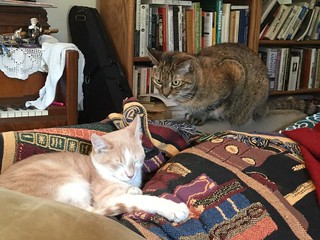
So yes, I've been spending the bulk of my time in the last week and more in my role as one of the humans adjudicating what has become once again a two-cat household, and not an entirely placid one. That's a typical scene, with Maia in the darker fur - not long ago our cute little overgrown kitten, now suddenly our hulking older cat - glaring at the invasion of the younger, cuter Tybalt.
It's strangely hard to take a photo of Tybalt, and not just because of the lighting. It's because he's always in motion, and a photo isn't, so it doesn't look like him. His coloring is identical to that of the long-departed Pandora, but he doesn't otherwise look like her, even bodily or facially. Yet photos of him look more like Pandora than they do him.
When I last wrote on Tuesday, we had just let Tybalt out of the recommended isolation for a brief run and he encountered Maia, and I was hoping for the best. We didn't get it for a while, especially after we let him out for good on Wednesday. Tybalt is so active and so friendly, and Maia was having none of it. Hiss, growl, and snarl were her responses when he came near. But over the last couple days she seems to have become a little less hostile.
I think the best way to describe things is to reproduce some of the e-mails I sent B. when she was at work on Wednesday and Thursday. (There were lots more on Monday and Tuesday, before we started letting Tybalt out, and Maia was just hunkering and glaring at the bathroom door.)
--
When I opened the bathroom door, T. immediately dashed out. I’m not sure I could have stopped him if I’d tried. But then he immediately dashed in again when he realized I was going to feed him. He ate a quarter, asked for a little petting, ate another quarter, and then the lure of the outside world became too much. I put the rest of the food away, and figured I’ll feed him again at noon. He wanted a little playing, but not much.
Otherwise things are going like they did last night. T. runs around, almost constantly trilling and meowing. Every time he gets near Maia, she hisses, and I heard one giant angry meow. Since he’s not craving attention when he’s out, I’m reluctant to try to lock him up, lest he get too wary too fast. I’d probably have to either chase him down – a very difficult task! – or else lure him in with food (when he wants it, because I don’t think the cat toy will do it now). He and Maia had just better get used to each other. I can’t do much with Maia when she’s glaring, just hold my finger out and hope she sniffs it.
I do hope this straightens out, because right now I feel stressed and helpless about it, and so do the cats.
--
The Adventures of Tybalt Underfoot
2. Human sorting through clothes looking for things to wash leads to cat frequently buried under dirty laundry being tossed back.
3. The liquid pouring into the toilet bowl is REALLY INTERESTING. (In the future I shall deprive cat of that pleasure.)
--
THURSDAY
I'm not sure if things are going better or worse.
When I'm out (i.e. not shut up in my room, on the computer, and when I'm there I have to be shut up, because otherwise T. climbs around over everything, even getting in the wastebasket), T. follows me around. Not so much underfoot as before, but if I'm upstairs he's upstairs, if I'm downstairs he's downstairs. If I go upstairs, he runs into the bathroom, because that's where the cat toy is. I've noticed he's more likely than before to play while lying down and waggling his legs in the air, Maia-style, which suggests that maybe he's just beginning to tire out. You say he likes to be chased, but that's pretty much out of my repertoire these days: disadvantage of an old owner and a young cat.
Meanwhile, while he's playing, Maia is sitting out in the hallway, glaring in at him. When he notices this, he looks nervous. She follows him around, I think to see what he's getting up to, which means lots of encounters between them, consisting of hiss, growl, or snarl from M. When I was in the kitchen, I heard various thunderings from the living room as the two larked about. I do hope this is the beginnings of getting along, or that T., who is trilling not quite so much as before, will take it as nominal.
So far I haven't been able to give any affection to Maia. She seems not to want to be approached while in growling mode. I'm hoping that later she'll go sit on the couch as she did yesterday and accept ministrations there.
--
Sigh. Maia wanted petting on the bed, but she was not purring at all, which is most unusual. I heard a sound behind me, and there was Tybalt, sitting in front of the closet, watching. Maia hopped on to the hamper and growled at him. I watched the standoff for a while and then said, "Well, cats, you can do this all day if you want, but I have to use the bathroom."
Much later on, while Tybalt was away unknown, probably sleeping since it was getting close to noon, an affectionate Maia came in and led me to the bedroom for what was a satisfactory petting session for about five seconds. Then Tybalt came out of your closet and sat down on the floor in the same spot. Resume previous scene. I shooed him out of the room, but Maia chose to follow.
[end]
It got better, it did. Maia has come for petting, and I'd close the door to keep Tybalt from wandering in. Meanwhile, his absolute demand for playing, the kind that extends to his clambering over whatever else you're doing instead, whether it be reading or cooking dinner, has calmed down to five or six times a day. We're still very much in new cat mode, but it's evolving, and while any cat experts reading this may be fainting, we may be able to socialize our cats without having kept him locked up for two weeks, which would have been impossible.
Thursday, February 7, 2019
concert review: San Francisco Symphony
(MTT conducted.) At the end of the opening piece, the world premiere of Steven Mackey's Portals, Scenes and Celebrations (But No Oxford Comma), the composer (tall, lanky) bounded down the aisle to take a bow with his shirt untucked.
That kind of summarizes the piece: relaxed, loose-jointed, not humorous but informal. It was lightly orchestrated, but with many things going on, sometimes at once but mostly in quick succession, feeling full of variety but not like a random potpourri box. The tone colors were unusually and strikingly bright. Many passages sounded like subtle evocations of existing styles: pop, jazz, folk, classic Americana, Stravinskian modernism, stereotypical "Oriental" music (as it would have been called then). There was even a passage strikingly recalling the Penguin Cafe Orchestra, and but for the lack of whimsicality in the tone I think it would appeal to a PCO audience. Without being at all retrograde or written down to its audience, this is the kind of new music that's appealing, because it isn't pretentious, it isn't ugly, it isn't vapid, and it isn't a waste of the listener's time. Polish modernists and atavistic serialists please take note.
Prokofiev's Violin Concerto No. 1 was taken in a similar spirit, especially with the great but completely unpretentious Gil Shaham as soloist. He lightly and casually pranced his way through it, unleashing vivid tone colors that sparkled throughout the work. Then he got Sasha Barantschik to stand up from the concertmaster's seat to share an encore with him, an 18th-century gavotte for two violins. As I said, Shaham is unpretentious; he's happy to share the applause.
The only way to have gotten a Tchaikovsky symphony with a similar spirit would have been to play the First or the Second. Instead, we had the Fourth. It's always the Fourth. The distinction of this performance was the slow sections, from the whole second movement down to little passages in the outers. They were lakes - no, whole other worlds - of calmness and serenity, completely isolated from what surrounded them.
What surrounded them didn't aim at any of the extremes that a performance of the Fourth can go for. It wasn't unusually powerful or grand or exciting or even rushed. It was just a good solid reading of the music.
That kind of summarizes the piece: relaxed, loose-jointed, not humorous but informal. It was lightly orchestrated, but with many things going on, sometimes at once but mostly in quick succession, feeling full of variety but not like a random potpourri box. The tone colors were unusually and strikingly bright. Many passages sounded like subtle evocations of existing styles: pop, jazz, folk, classic Americana, Stravinskian modernism, stereotypical "Oriental" music (as it would have been called then). There was even a passage strikingly recalling the Penguin Cafe Orchestra, and but for the lack of whimsicality in the tone I think it would appeal to a PCO audience. Without being at all retrograde or written down to its audience, this is the kind of new music that's appealing, because it isn't pretentious, it isn't ugly, it isn't vapid, and it isn't a waste of the listener's time. Polish modernists and atavistic serialists please take note.
Prokofiev's Violin Concerto No. 1 was taken in a similar spirit, especially with the great but completely unpretentious Gil Shaham as soloist. He lightly and casually pranced his way through it, unleashing vivid tone colors that sparkled throughout the work. Then he got Sasha Barantschik to stand up from the concertmaster's seat to share an encore with him, an 18th-century gavotte for two violins. As I said, Shaham is unpretentious; he's happy to share the applause.
The only way to have gotten a Tchaikovsky symphony with a similar spirit would have been to play the First or the Second. Instead, we had the Fourth. It's always the Fourth. The distinction of this performance was the slow sections, from the whole second movement down to little passages in the outers. They were lakes - no, whole other worlds - of calmness and serenity, completely isolated from what surrounded them.
What surrounded them didn't aim at any of the extremes that a performance of the Fourth can go for. It wasn't unusually powerful or grand or exciting or even rushed. It was just a good solid reading of the music.
Tuesday, February 5, 2019
when cat meets cat
So it's true, we have a new cat. He's one year old, buff and white (same colors as the late Pandora), with big golden eyes; seven pounds but very small - all muscle - and we have named him Tybalt. That's the name that Shakespeare took from a cat in the traditional cycle of Reynard the Fox fables, which is why the other characters in Romeo and Juliet make feline references about him.
Tybalt is quite a bundle to have taken on. Every other cat we've had has been shy when we first got them home, however briefly; Tybalt was game for attention and affection from the moment he came out of the cat carrier. He's also the highest-energy cat we've had. It was evening by the time we got him home from the Humane Society and shut up in the upstairs bathroom. After B. went to bed it was my turn to spend time with him, and I realized that he wasn't satisfied with the little toys, a ball and such, that he had. He needed a toy that would play with him. By this time the pet stores were closed, so I ran out to the big all-night supermarket in hopes they'd have some cat toys next to the pet food. They did, and I came back with a little plush fish on the end of a string on the end of a pole, which he's been chasing energetically and mauling ever since. (Which is why there are no photos of him yet: he won't stay still!)
And Maia, now our older cat? Previous new arrivals had been greeted by existing cats with emotions ranging from longing to indifference, but once Maia realized there was a cat behind that door, she got grouchy and would hiss once she heard a sound. Permanent hostility between cats is not something we wished to engender, and the recommended advice for cat socialization involves keeping the cats separated for over a week and then introducing them slowly; but our only lockable space is that bathroom (the bedroom doors don't close securely, and Maia would be distressed to be kept out), and high-energy Tybalt was going stir-crazy in there, even with the cat toy.
We let him out for upstairs exploration a couple times when Maia wasn't there, and then eventually B. just said the heck with it and let them meet. (Every cat behavior expert for miles around expires of shock.) There was one giant hiss from Maia, but so far it's going OK, I hope. Meanwhile, Maia has been extra solicitous of attention, and has even resumed her childhood habit of scampering over the big cat tree after a peacock feather. Perhaps Tybalt is making her feel young.
Tybalt is quite a bundle to have taken on. Every other cat we've had has been shy when we first got them home, however briefly; Tybalt was game for attention and affection from the moment he came out of the cat carrier. He's also the highest-energy cat we've had. It was evening by the time we got him home from the Humane Society and shut up in the upstairs bathroom. After B. went to bed it was my turn to spend time with him, and I realized that he wasn't satisfied with the little toys, a ball and such, that he had. He needed a toy that would play with him. By this time the pet stores were closed, so I ran out to the big all-night supermarket in hopes they'd have some cat toys next to the pet food. They did, and I came back with a little plush fish on the end of a string on the end of a pole, which he's been chasing energetically and mauling ever since. (Which is why there are no photos of him yet: he won't stay still!)
And Maia, now our older cat? Previous new arrivals had been greeted by existing cats with emotions ranging from longing to indifference, but once Maia realized there was a cat behind that door, she got grouchy and would hiss once she heard a sound. Permanent hostility between cats is not something we wished to engender, and the recommended advice for cat socialization involves keeping the cats separated for over a week and then introducing them slowly; but our only lockable space is that bathroom (the bedroom doors don't close securely, and Maia would be distressed to be kept out), and high-energy Tybalt was going stir-crazy in there, even with the cat toy.
We let him out for upstairs exploration a couple times when Maia wasn't there, and then eventually B. just said the heck with it and let them meet. (Every cat behavior expert for miles around expires of shock.) There was one giant hiss from Maia, but so far it's going OK, I hope. Meanwhile, Maia has been extra solicitous of attention, and has even resumed her childhood habit of scampering over the big cat tree after a peacock feather. Perhaps Tybalt is making her feel young.
Sunday, February 3, 2019
quiet day
After a meeting at work (we're all volunteers here, and Sunday turned out to be the best time to meet this month), I stayed on to get some more work done. Our children's librarian wants to separate out the board books and other impedimentia from the regular picture books, and we'll do so as soon as we can get new shelving installed in the area under the window newly vacated by unneeded cabinets. In the meantime, my job is to tag the relevant catalog records so we can batch re-label the books later.
Afterwards, I drove to a nearby city library to return some books about presidents, and then stopped at an upscale grocer's on the way out to see if there was anything good I could bring home. (Lesson: expensive gourmet tamales are nowhere near as good as the ones from storefront kitchens in the barrio.)
It was gratifyingly quiet and uncrowded doing all of this, and only later did I remember that the Super Bowl was on. A great time to go out and do errands, as the number zero does not do sufficient justice to the magnitude of my level of interest in the Super Bowl.
In the meantime, B's sister suffered a serious illness on board a Caribbean cruise and has been offloaded to a hospital in Belize. Belize! At least monoglot English speakers should not be totally out of communication with the locals there. She should be able to be transported home, and various relatives are converging on the place to help her do it.
Afterwards, I drove to a nearby city library to return some books about presidents, and then stopped at an upscale grocer's on the way out to see if there was anything good I could bring home. (Lesson: expensive gourmet tamales are nowhere near as good as the ones from storefront kitchens in the barrio.)
It was gratifyingly quiet and uncrowded doing all of this, and only later did I remember that the Super Bowl was on. A great time to go out and do errands, as the number zero does not do sufficient justice to the magnitude of my level of interest in the Super Bowl.
In the meantime, B's sister suffered a serious illness on board a Caribbean cruise and has been offloaded to a hospital in Belize. Belize! At least monoglot English speakers should not be totally out of communication with the locals there. She should be able to be transported home, and various relatives are converging on the place to help her do it.
Saturday, February 2, 2019
notes
1. Maia knows that Pippin is gone - she's been looking for him everywhere - but now she is perturbed because the upstairs bathroom door is closed and there are odd, possibly cat-like, sounds coming from behind it. She's been chittering at it, but no definitive results so far. More on this as Maia learns more about it.
2. On Yom ha-Shoah, I went, accompanied by an Athenais, to review a most somber-themed concert: four composers actually murdered in the Nazi Holocaust, one who escaped only to fall into the clutches of Stalin, and one post-war memorial of the world they lost. Summarizing the character of each work in a sentence or so, which is all the space I had after explaining the premise, was the challenge in this one.
3. Last Wednesday, a more whimsical errand: I've been reading Mark Evanier's blog for 15 years, so why not take the opportunity to meet him for the first time, when he was doing a comic-store signing as close as Santa Cruz? So I drove over, walked in and found him at a table, and introduced myself as a lurker on his blog, though we have friends in common. He had piles of his book on Jack Kirby on one side of the table and piles of the volumes of the collected Pogo, which he's helped edit, on the other. I'm much more interested in the latter than the former, so I bought and had signed volume one of that. I enjoyed our chat, and so did he, and so did auncient friend James L. who also came in on the same errand.
4. A visit to work was interrupted by the arrival of our program director with three new books needing quick cataloging for an ed session this weekend. They were all on transsexuals dealing with their Jewish identity, a new topic for our collection. I judged it best to invent a new classification number in our 30-year-old system. The subject headings in the books were "Transsexual persons" and "Transsexualism", but online I found that they'd been changed to "Transsexuals" and "Gender nonconformity". Much better.
5. Good New Yorker articles: on Kamala Harris and the challenges she faces; on William Goldman's forgotten children's book (no, it isn't The Princess Bride).
6. Here's a little item for Inklings fans going on in LA next month.
2. On Yom ha-Shoah, I went, accompanied by an Athenais, to review a most somber-themed concert: four composers actually murdered in the Nazi Holocaust, one who escaped only to fall into the clutches of Stalin, and one post-war memorial of the world they lost. Summarizing the character of each work in a sentence or so, which is all the space I had after explaining the premise, was the challenge in this one.
3. Last Wednesday, a more whimsical errand: I've been reading Mark Evanier's blog for 15 years, so why not take the opportunity to meet him for the first time, when he was doing a comic-store signing as close as Santa Cruz? So I drove over, walked in and found him at a table, and introduced myself as a lurker on his blog, though we have friends in common. He had piles of his book on Jack Kirby on one side of the table and piles of the volumes of the collected Pogo, which he's helped edit, on the other. I'm much more interested in the latter than the former, so I bought and had signed volume one of that. I enjoyed our chat, and so did he, and so did auncient friend James L. who also came in on the same errand.
4. A visit to work was interrupted by the arrival of our program director with three new books needing quick cataloging for an ed session this weekend. They were all on transsexuals dealing with their Jewish identity, a new topic for our collection. I judged it best to invent a new classification number in our 30-year-old system. The subject headings in the books were "Transsexual persons" and "Transsexualism", but online I found that they'd been changed to "Transsexuals" and "Gender nonconformity". Much better.
5. Good New Yorker articles: on Kamala Harris and the challenges she faces; on William Goldman's forgotten children's book (no, it isn't The Princess Bride).
6. Here's a little item for Inklings fans going on in LA next month.
Friday, February 1, 2019
concert review: San Francisco Symphony
Each year since he retired as SFS music director in 1995, Herbert Blomstedt has returned to guest-conduct two weeks of the canonic heavy classics (mostly German or Nordic) that he specializes in. This year he's 91, and his stint was cut down to one week. He shuffled a little getting over to the podium, but was all-in once the music started.
His repertoire was the two great early 19C Germanic landscape symphonies, Beethoven's Pastorale and Mendelssohn's Scottish. The Pastorale, which for the most part is the most relaxed and calm of all canonic symphonies, responded well to Blomstedt's formal and smooth approach. It was crisp and incisive.
But when we turned from Viennese meadows and streams to Mendelssohn's Scottish hills and seas, it wasn't the same. The Scottish responds well to a wild and wooly interpretation; Blomstedt neatened it up. The music alternated from the somnolent to the hasty. It was probably a valid interpretation, and the playing was certainly good, but I didn't find it as satisfying.
His repertoire was the two great early 19C Germanic landscape symphonies, Beethoven's Pastorale and Mendelssohn's Scottish. The Pastorale, which for the most part is the most relaxed and calm of all canonic symphonies, responded well to Blomstedt's formal and smooth approach. It was crisp and incisive.
But when we turned from Viennese meadows and streams to Mendelssohn's Scottish hills and seas, it wasn't the same. The Scottish responds well to a wild and wooly interpretation; Blomstedt neatened it up. The music alternated from the somnolent to the hasty. It was probably a valid interpretation, and the playing was certainly good, but I didn't find it as satisfying.
Subscribe to:
Comments (Atom)