Probably the most fun, and certainly the most anticipated, thing I did last weekend was to attend SJSU's production of Bernstein's Mass. This is not a work one gets to see staged often - this was the fourth time total for me - and never before for me in a college rather than professional production.
My editor had phoned to ask if I could cover some other concert that evening and I had to say, "Sorry, I'll be at SJSU for their Bernstein Mass." Then I thought for a moment and said, "Would you like me to review that instead?"
He said sure, so here it is. You may thank my resident Catholic, who was enthusiastically there with me, for the comments on liturgical significance (the shroud on the cross, the Celebrant's vestments), because that's not stuff I would know.
I took our two CDs of the work up to my office with me to help with the review. Then I put them back down on the rack in the kitchen where they came from. Now I can hear from downstairs that B. is listening to one of them while doing the post-dinner dishes. (Just as a reminder: I cook, she does the dishes.) We like this work. And I've started writing cat lyrics to it.

Kalimac's corner: a journal by DB
Tuesday, May 14, 2019

Monday, May 13, 2019
tiny tyrant
That's what B. called Tybalt when I came back to bed Saturday morning after a couple hours up early. "Did you feed the tiny tyrant?" she asked. Even before I got up, that active young cat was nibbling at our toes, licking our hair, even switching off the CPAP machine, and just causing chaos to our attempts to sleep in.
Tybalt isn't a hostile cat, though: he wants love. It's very frequent, while I'm working here at the computer, for him to squeeze in past the open arms of my office chair and sit next to me in the chair. If only he'd stay there. He's the only cat we've had since we've been together who likes to be picked up, and that's what happens next. He doesn't try to lie on my lap, either. He latches in and goes up my chest. As you can imagine, this feels considerably different depending on whether or not I'm wearing a shirt. What he wants is to sit on my chest, with me holding him up with one hand and petting him with the other. This is fine if I'm reading a long article or listening to music; not so great if I'm trying to write something or take notes.
Tybalt also ventures into places in the kitchen where no cat has gone before, specifically up on the counter, especially when I'm working there on dinner. At first I tended to ignore him, and even work over him, unless he actually threatened to stick his nose in the food (and probably eat it: he's eaten things like spicy potato chips off the floor). But now I'm trying to be more strict, and if he comes up, I scoop a hand under him and drop him back on the floor. Assuming, that is, that my hands aren't covered with something I don't want to get on a cat. Lesson does not usually get through, though in other ways I can see Tybalt modifying his behavior in light of the way things are done around here. But I'm often scooping 15 or 20 cats off the counter in the course of fixing one meal.
Tybalt isn't a hostile cat, though: he wants love. It's very frequent, while I'm working here at the computer, for him to squeeze in past the open arms of my office chair and sit next to me in the chair. If only he'd stay there. He's the only cat we've had since we've been together who likes to be picked up, and that's what happens next. He doesn't try to lie on my lap, either. He latches in and goes up my chest. As you can imagine, this feels considerably different depending on whether or not I'm wearing a shirt. What he wants is to sit on my chest, with me holding him up with one hand and petting him with the other. This is fine if I'm reading a long article or listening to music; not so great if I'm trying to write something or take notes.
Tybalt also ventures into places in the kitchen where no cat has gone before, specifically up on the counter, especially when I'm working there on dinner. At first I tended to ignore him, and even work over him, unless he actually threatened to stick his nose in the food (and probably eat it: he's eaten things like spicy potato chips off the floor). But now I'm trying to be more strict, and if he comes up, I scoop a hand under him and drop him back on the floor. Assuming, that is, that my hands aren't covered with something I don't want to get on a cat. Lesson does not usually get through, though in other ways I can see Tybalt modifying his behavior in light of the way things are done around here. But I'm often scooping 15 or 20 cats off the counter in the course of fixing one meal.
Friday, May 10, 2019
Tolkien: the bio-pic
When I wrote in March of my visit to New York, and the Morgan Library's Tolkien exhibit, and the two-day conference for which many distinguished Tolkienists gathered, I left something out.
Saturday morning, before any of the other conference events occurred, most of the conference presenters converged from various directions in the chilly quiet of a March weekend morning in New York, on an otherwise deserted (not yet open for the day) spacious multiplex movie theatre out on the far fringes of East Midtown. (I hadn't known there were any multiplexes in Manhattan, did you?) This was the first most of us had seen of each other on this visit, and it was a strange way to greet old friends. I was walking along a deserted street towards the theatre, for instance, when a man crossed the street and fell into step beside me to greet me: it was Peter Grybauskas. In the theatre were many more, including John Garth, the British scholar whose biography Tolkien and the Great War is the closest thing to a book equivalent to the movie we were there to see, which was of course the Tolkien biographical film which is just now hitting general release.
And the reason I haven't said anything about it until now is that we all had to sign embargo forms before entering the theatre. This didn't surprise me: I've previously been asked not to publish pre-release reviews of movies I've seen in private previews, though this was the first time I had to sign a form. Curiously, the form bore no date on which the embargo expired, so I wrote "until the film's general release" on the form before signing it. Others were less punctilious, but at least one person there blanched at the form and refused to sign it at all, and therefore (as far as I know) did not see the movie.
But now it's out so I may speak. So I'll tell you what I said. When the lights came up I turned to Janet Croft and David Emerson, who were seated near me, and said, "If they're going to make stuff up, why can't they at least make a coherent and interesting story out of it?" Only I didn't say "stuff."
The plot covers Tolkien's life from the time his family moved away from idyllic Sarehole (at which time Tolkien was 8, though he's played as a boy by a young man who was something like 16 at the time of filming) until his return from France during WWI, with a couple of later epilogues. The elements mostly come from his life, but by the time he gets to Oxford, the sequence and causality of the plot have departed sufficiently from historical fact that it's essentially made up. But if they're going to play so loose with history, why not include even any of the historically known ways that Tolkien's life inspired his fiction, let alone make any up which they were free to do?
The movie is being promoted as "explor[ing] how ... time spent in college and his service in the British army ... and other events influenced his classic works," but that’s exactly what it doesn't do.
For instance, in an epilogue title card we’re told that the names of Beren and Lúthien appear on Ronald and Edith’s tombstone, but nothing is said in the movie itself of the inspiration for that story. There's a brief shot of Edith dancing in the woods (at a different date than the occasion which actually inspired the story), but the allusion is left completely untouched.
I subsequently saw an interview with the director who said that he was trying to avoid the implication that Tolkien's fiction encoded his life. An admirable concern, but that ship has sailed. The only point in making a commercial movie of Tolkien's early life is to show how he became the man who wrote the fiction, and you can do that without reducing the fiction to a commentary on the life. See John Garth's book for a start.
But it's worse than lacking that connection. The movie keeps telling us that Tolkien was marvelously creative, but what it shows us is a man who's mostly inert or at best reactive (more often unreactive). There's a scene at the TCBS where the others ask Tolkien what he's written lately and he says he hasn't written anything. Why is this scene in the movie, then? There's another scene where he brings Edith to meet the TCBS (I don't think this ever actually happened) and the conversation is awkward at first, but as soon as Edith gets into a juicy discussion of Wagner with Christopher Wiseman, Tolkien jumps up and says they have to leave. Why does he do this? In the next scene Edith chews him out for it, but there's never any explanation or an attempt to fit this in to a larger pattern of behavior. There's almost as much attention in this movie to G.B. Smith's poetry as to Tolkien’s writings.
Nor does the movie entirely avoid showing Tolkien's creativity being inspired. But what it does show – fragments of some stories which have nothing to do with the legendarium; a hallucination of mounted knights clashing on the Somme; artwork pinned to Tolkien's walls that appears inspired by the Book of Ishness but is far grimmer than anything actually appearing there – is of a tenor to give more the impression that Tolkien is the author not of his books but of Peter Jackson's movies. At the end there's a casual attempt to wrap up every experience Tolkien has had and claim they went together to make up The Hobbit, but it's glib and the book doesn't carry that kind of weight.
I found this movie dull and meandering. By far the best acting in it came from by far the best-known actor in it, Derek Jacobi as Joseph Wright. Laura Donnelly (new to me) as Tolkien's mother shows some zest, and the bit in which she reads from Völsunga saga to her boys is my favorite scene in the movie, as well as the one most relevant to Tolkien's inspiration. Nicholas Hoult as the adult Tolkien looks pained a lot. Lily Collins as Edith pouts a lot. The actors playing the other TCBS members as adolescents have a liveliness to them which disappears when they're replaced by the actors who play them as adults. I don't anticipate this movie having a major impact on public perception of Tolkien, simply because it doesn't have the kind of appeal, as a film on its own account, that Peter Jackson’s Lord of the Rings movies certainly had.
Saturday morning, before any of the other conference events occurred, most of the conference presenters converged from various directions in the chilly quiet of a March weekend morning in New York, on an otherwise deserted (not yet open for the day) spacious multiplex movie theatre out on the far fringes of East Midtown. (I hadn't known there were any multiplexes in Manhattan, did you?) This was the first most of us had seen of each other on this visit, and it was a strange way to greet old friends. I was walking along a deserted street towards the theatre, for instance, when a man crossed the street and fell into step beside me to greet me: it was Peter Grybauskas. In the theatre were many more, including John Garth, the British scholar whose biography Tolkien and the Great War is the closest thing to a book equivalent to the movie we were there to see, which was of course the Tolkien biographical film which is just now hitting general release.
And the reason I haven't said anything about it until now is that we all had to sign embargo forms before entering the theatre. This didn't surprise me: I've previously been asked not to publish pre-release reviews of movies I've seen in private previews, though this was the first time I had to sign a form. Curiously, the form bore no date on which the embargo expired, so I wrote "until the film's general release" on the form before signing it. Others were less punctilious, but at least one person there blanched at the form and refused to sign it at all, and therefore (as far as I know) did not see the movie.
But now it's out so I may speak. So I'll tell you what I said. When the lights came up I turned to Janet Croft and David Emerson, who were seated near me, and said, "If they're going to make stuff up, why can't they at least make a coherent and interesting story out of it?" Only I didn't say "stuff."
The plot covers Tolkien's life from the time his family moved away from idyllic Sarehole (at which time Tolkien was 8, though he's played as a boy by a young man who was something like 16 at the time of filming) until his return from France during WWI, with a couple of later epilogues. The elements mostly come from his life, but by the time he gets to Oxford, the sequence and causality of the plot have departed sufficiently from historical fact that it's essentially made up. But if they're going to play so loose with history, why not include even any of the historically known ways that Tolkien's life inspired his fiction, let alone make any up which they were free to do?
The movie is being promoted as "explor[ing] how ... time spent in college and his service in the British army ... and other events influenced his classic works," but that’s exactly what it doesn't do.
For instance, in an epilogue title card we’re told that the names of Beren and Lúthien appear on Ronald and Edith’s tombstone, but nothing is said in the movie itself of the inspiration for that story. There's a brief shot of Edith dancing in the woods (at a different date than the occasion which actually inspired the story), but the allusion is left completely untouched.
I subsequently saw an interview with the director who said that he was trying to avoid the implication that Tolkien's fiction encoded his life. An admirable concern, but that ship has sailed. The only point in making a commercial movie of Tolkien's early life is to show how he became the man who wrote the fiction, and you can do that without reducing the fiction to a commentary on the life. See John Garth's book for a start.
But it's worse than lacking that connection. The movie keeps telling us that Tolkien was marvelously creative, but what it shows us is a man who's mostly inert or at best reactive (more often unreactive). There's a scene at the TCBS where the others ask Tolkien what he's written lately and he says he hasn't written anything. Why is this scene in the movie, then? There's another scene where he brings Edith to meet the TCBS (I don't think this ever actually happened) and the conversation is awkward at first, but as soon as Edith gets into a juicy discussion of Wagner with Christopher Wiseman, Tolkien jumps up and says they have to leave. Why does he do this? In the next scene Edith chews him out for it, but there's never any explanation or an attempt to fit this in to a larger pattern of behavior. There's almost as much attention in this movie to G.B. Smith's poetry as to Tolkien’s writings.
Nor does the movie entirely avoid showing Tolkien's creativity being inspired. But what it does show – fragments of some stories which have nothing to do with the legendarium; a hallucination of mounted knights clashing on the Somme; artwork pinned to Tolkien's walls that appears inspired by the Book of Ishness but is far grimmer than anything actually appearing there – is of a tenor to give more the impression that Tolkien is the author not of his books but of Peter Jackson's movies. At the end there's a casual attempt to wrap up every experience Tolkien has had and claim they went together to make up The Hobbit, but it's glib and the book doesn't carry that kind of weight.
I found this movie dull and meandering. By far the best acting in it came from by far the best-known actor in it, Derek Jacobi as Joseph Wright. Laura Donnelly (new to me) as Tolkien's mother shows some zest, and the bit in which she reads from Völsunga saga to her boys is my favorite scene in the movie, as well as the one most relevant to Tolkien's inspiration. Nicholas Hoult as the adult Tolkien looks pained a lot. Lily Collins as Edith pouts a lot. The actors playing the other TCBS members as adolescents have a liveliness to them which disappears when they're replaced by the actors who play them as adults. I don't anticipate this movie having a major impact on public perception of Tolkien, simply because it doesn't have the kind of appeal, as a film on its own account, that Peter Jackson’s Lord of the Rings movies certainly had.
concert review: Music@Menlo
So as I explained while reviewing their previous offering, Music@Menlo is trying out a new format for its winter concerts, Focus Residencies. And evidently they like it, because they've scheduled two more for next winter's season.
In these, one of Menlo's regular musicians is asked to serve as guest artistic director for a program. This person chooses a topical theme, selects appropriate repertoire, and assigns performers. The resulting concert is preceded by a lecture on the theme.
This time I got to attend both the concert and the lecture, Thursday and Friday of last week, and that was the first of my three weekend concerts. The Curator (that's what they're called) was regular Menlo violinist Arnaud Sussmann, who explained at both events that he started with the performers: he wanted to play with his violin mentor Pamela Frank, and with Menlo's pretty fabulous violist, Paul Neubauer.
And here they are at work, l. to r. Frank, Neubauer, and Sussmann.

So, then, what great music is there for two violins and a viola? Sussmann could think of two often-played pieces by Antonín Dvořák and one by Zoltán Kodály, though curiously they're never all played together. On further search he found a couple more good ones by Sergei Taneyev and Eugène Ysaÿe, which made enough to form a concert.
And then he had a theme, too, because Dvořák, Kodály, and Taneyev - Czech, Hungarian, and Russian respectively - had one thing in common, that they were nationalist composers inspired by their own countries' folk music.
So we had a nice little concert in the bright precincts of St. Bede's Church with Dvořák's Terzetto and Four Miniatures, Kodály's Serenade Op. 12, Taneyev's Trio in D Op. 21, and Ysaÿe's Le Londres. The Ysaÿe, the non-folkish one of the bunch, was a challenging, counterpoint-heavy work with a lot of imitative work and an entire fugato.
The other pieces, the folk-influenced ones, were more ingratiating. The Taneyev, a hefty four-movement work, was a real find. It starts out sounding like a pastiche of Mozart, and then shifts into a more typical circa 1900 Russian style, though less heavy or bear-like than Tchaikovsky or the Mighty Five would do it. Taneyev hasn't gotten much respect since Harold Schonberg dismissed him as a sterile academician, but Schonberg hadn't heard much of Taneyev's music.
The Kodály was most notable for a slow movement dialogue, which begins with Sussmann's violin audibly laughing at Neubauer's viola's emotional pretense, all over a continuous tremolo from Frank on the unheralded other violin.
And the Dvořák pieces were full of Czech intensity, double-stops, frequent key changes, expressiveness, and - in the slow movements - weeping hesitations. The Miniatures were thicker and more intense, the Terzetto more lively and friendly.
Patrick Castillo gave the introductory lecture the previous evening in Stent Hall on the Menlo School campus. (Martin, the usual lecture venue on campus, had to be abandoned because the school was rehearsing Bye Bye Birdie just outside, and I was thinking, do today's students even believe that there once existed the culture depicted in that show? I can barely remember it and I don't believe it.) Some of his musical examples were recorded, but those which could be played by the three musicians of the concert live, were. So we got a preview of the concert.
What I found most interesting in his talk was his addressing of the scoring problem. He viewed this kind of trio as like a string quartet with the cello missing. So what do you do without your bass line? Several possible ways. One, you can use the viola as the bass, and that's a highly recommended procedure when you have the powerfully strong viola voice of Paul Neubauer at your disposal. That type of scoring in the concert worked exceptionally well. Another is to thicken the texture by playing a lot of double-stops. Ysaÿe really went for that one. And a third is to exploit the fact that violin and viola have similar timbre, and cluster them together in a medium-high range, defying the lack of cello.
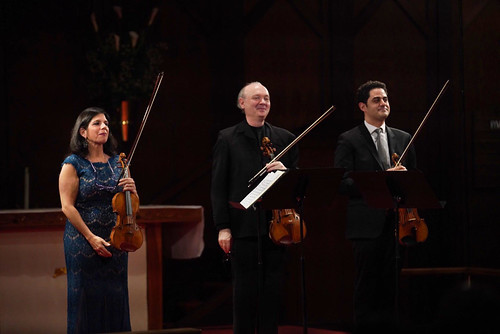
Oh yes, we heard all those things, brilliantly rendered. Here, all you fine performers, take a curtain call:
In these, one of Menlo's regular musicians is asked to serve as guest artistic director for a program. This person chooses a topical theme, selects appropriate repertoire, and assigns performers. The resulting concert is preceded by a lecture on the theme.
This time I got to attend both the concert and the lecture, Thursday and Friday of last week, and that was the first of my three weekend concerts. The Curator (that's what they're called) was regular Menlo violinist Arnaud Sussmann, who explained at both events that he started with the performers: he wanted to play with his violin mentor Pamela Frank, and with Menlo's pretty fabulous violist, Paul Neubauer.
And here they are at work, l. to r. Frank, Neubauer, and Sussmann.
So, then, what great music is there for two violins and a viola? Sussmann could think of two often-played pieces by Antonín Dvořák and one by Zoltán Kodály, though curiously they're never all played together. On further search he found a couple more good ones by Sergei Taneyev and Eugène Ysaÿe, which made enough to form a concert.
And then he had a theme, too, because Dvořák, Kodály, and Taneyev - Czech, Hungarian, and Russian respectively - had one thing in common, that they were nationalist composers inspired by their own countries' folk music.
So we had a nice little concert in the bright precincts of St. Bede's Church with Dvořák's Terzetto and Four Miniatures, Kodály's Serenade Op. 12, Taneyev's Trio in D Op. 21, and Ysaÿe's Le Londres. The Ysaÿe, the non-folkish one of the bunch, was a challenging, counterpoint-heavy work with a lot of imitative work and an entire fugato.
The other pieces, the folk-influenced ones, were more ingratiating. The Taneyev, a hefty four-movement work, was a real find. It starts out sounding like a pastiche of Mozart, and then shifts into a more typical circa 1900 Russian style, though less heavy or bear-like than Tchaikovsky or the Mighty Five would do it. Taneyev hasn't gotten much respect since Harold Schonberg dismissed him as a sterile academician, but Schonberg hadn't heard much of Taneyev's music.
The Kodály was most notable for a slow movement dialogue, which begins with Sussmann's violin audibly laughing at Neubauer's viola's emotional pretense, all over a continuous tremolo from Frank on the unheralded other violin.
And the Dvořák pieces were full of Czech intensity, double-stops, frequent key changes, expressiveness, and - in the slow movements - weeping hesitations. The Miniatures were thicker and more intense, the Terzetto more lively and friendly.
Patrick Castillo gave the introductory lecture the previous evening in Stent Hall on the Menlo School campus. (Martin, the usual lecture venue on campus, had to be abandoned because the school was rehearsing Bye Bye Birdie just outside, and I was thinking, do today's students even believe that there once existed the culture depicted in that show? I can barely remember it and I don't believe it.) Some of his musical examples were recorded, but those which could be played by the three musicians of the concert live, were. So we got a preview of the concert.
What I found most interesting in his talk was his addressing of the scoring problem. He viewed this kind of trio as like a string quartet with the cello missing. So what do you do without your bass line? Several possible ways. One, you can use the viola as the bass, and that's a highly recommended procedure when you have the powerfully strong viola voice of Paul Neubauer at your disposal. That type of scoring in the concert worked exceptionally well. Another is to thicken the texture by playing a lot of double-stops. Ysaÿe really went for that one. And a third is to exploit the fact that violin and viola have similar timbre, and cluster them together in a medium-high range, defying the lack of cello.
Oh yes, we heard all those things, brilliantly rendered. Here, all you fine performers, take a curtain call:
Monday, May 6, 2019
concert review: Symphony Silicon Valley
Proceeding backward through my weekend, then, we get to Saturday at Symphony Silicon Valley. I was there to review this, so there it is.
The program, of Petrushka (by Stravinsky) and Rach 2 (the piano concerto), is one I could have used a refresher on. I know these works, but not particularly well, and I'd have liked to have gone over each with a score and a recording beforehand. But there just wasn't time, what with spending Friday rushing off to libraries 50 miles away and going to another concert that evening (next up in this travelogue) and so forth.
So this was more impressionistally written than I'd intended, but at least it was written Saturday night when I got home, leaving me free for a packed Sunday. (The Cal Sym concert wasn't the half of it. More on that later too.)
The program, of Petrushka (by Stravinsky) and Rach 2 (the piano concerto), is one I could have used a refresher on. I know these works, but not particularly well, and I'd have liked to have gone over each with a score and a recording beforehand. But there just wasn't time, what with spending Friday rushing off to libraries 50 miles away and going to another concert that evening (next up in this travelogue) and so forth.
So this was more impressionistally written than I'd intended, but at least it was written Saturday night when I got home, leaving me free for a packed Sunday. (The Cal Sym concert wasn't the half of it. More on that later too.)
Sunday, May 5, 2019
concert review: California Symphony
I went to three concerts this weekend, but owing to logistics I'll probably be covering them in reverse chronological order. At any rate, third on the list was the California Symphony, under its music director, Donato Cabrera, on Sunday afternoon at Lesher in Walnut Creek.
Their current composer in residence, Katherine Balch, contributed a new violin concerto. Balch turns out to be an unreconstructed modernist. The soloist, Robyn Bollinger, her best friend since conservatory days - with friends like this, etc etc - sounded variously like a baby bird in pain, a mule in pain, a cow in pain, and a car alarm in pain. You know, it's still possible to write great music today, even great music which by no means sets out to soothe the listener, but this ain't it.
But that wasn't why I was here. I was here for Bruckner's Seventh. I'm always eager to hear what a second-tier orchestra will do with such a work. The big waves of sound lined up to crash across the dry and unresonant stage in a powerful but neatly-ordered fashion. It wasn't subtle, but it was sincere.
Lesher is still selling single-serving containers of ice cream at intermission, but there's been a change since the last time I was here and complained about this in a professional review. Now the ushers equip themselves with small trash bags so customers have a place to throw the empty containers away. Good going.
Their current composer in residence, Katherine Balch, contributed a new violin concerto. Balch turns out to be an unreconstructed modernist. The soloist, Robyn Bollinger, her best friend since conservatory days - with friends like this, etc etc - sounded variously like a baby bird in pain, a mule in pain, a cow in pain, and a car alarm in pain. You know, it's still possible to write great music today, even great music which by no means sets out to soothe the listener, but this ain't it.
But that wasn't why I was here. I was here for Bruckner's Seventh. I'm always eager to hear what a second-tier orchestra will do with such a work. The big waves of sound lined up to crash across the dry and unresonant stage in a powerful but neatly-ordered fashion. It wasn't subtle, but it was sincere.
Lesher is still selling single-serving containers of ice cream at intermission, but there's been a change since the last time I was here and complained about this in a professional review. Now the ushers equip themselves with small trash bags so customers have a place to throw the empty containers away. Good going.
Saturday, May 4, 2019
Colbert does it again
People have criticized me for unfairly ragging on Stephen Colbert's Tolkien spasms on his tv show, but this time ... this time he's really gone and done it. This time, nobody can say he's not totally mixed up.
So he's interviewing Nicholas Hoult and Lily Collins, the stars of the new bio-pic about Tolkien, and Colbert is saying Toll-kin with emphasis on the first syllable and they're saying Toll-keen with even emphasis on both syllables and they're saying that's right and that they learned it from listening to Judi Dench narrate a documentary, and they're trying to teach it to Colbert and he's having a hard time getting it.
And in fact they are right, -keen is the preferred second syllable.
And then Colbert tries to explain how he got it wrong. He says that in high school, the people who read Tolkien were much the same as the people who read science fiction (true enough, at least in his day and mine), so they would say Toll-kin because they said Robert A. Hine-lin because they're spelled the same.
What?
First off, they're not spelled the same. J.R.R. Tolkien. Robert A. Heinlein. I-E in one, E-I in the other. Unless Colbert is one of those cretins who spells it "Tolkein"?
Second, I don't know what they may have said down in South Carolina where Colbert comes from, but I've never heard anyone say Hine-lin. Where I've heard it, it's universally Hine-line. Even emphasis on both syllables, like Toll-keen. They're both German names, and that's the vowel in German; I-E is pronounced E and E-I is pronounced I. That's not how that combo is always in English, and some people with German names in the US reverse the pronunciation, but most don't.
The science-fiction writer they always get wrong is Fritz Leiber. Nobody misspells his name, like Tolkien's, but they say Lee-ber. That's wrong; it's Lye-ber. I have that from the man himself. I don't know why they get it wrong; it's the same combo as Heinlein. I've taken to referring to the latter as Heen-leen to mock this, but it doesn't help.
So, Colbert, what the bleeping bleep?
So he's interviewing Nicholas Hoult and Lily Collins, the stars of the new bio-pic about Tolkien, and Colbert is saying Toll-kin with emphasis on the first syllable and they're saying Toll-keen with even emphasis on both syllables and they're saying that's right and that they learned it from listening to Judi Dench narrate a documentary, and they're trying to teach it to Colbert and he's having a hard time getting it.
And in fact they are right, -keen is the preferred second syllable.
And then Colbert tries to explain how he got it wrong. He says that in high school, the people who read Tolkien were much the same as the people who read science fiction (true enough, at least in his day and mine), so they would say Toll-kin because they said Robert A. Hine-lin because they're spelled the same.
What?
First off, they're not spelled the same. J.R.R. Tolkien. Robert A. Heinlein. I-E in one, E-I in the other. Unless Colbert is one of those cretins who spells it "Tolkein"?
Second, I don't know what they may have said down in South Carolina where Colbert comes from, but I've never heard anyone say Hine-lin. Where I've heard it, it's universally Hine-line. Even emphasis on both syllables, like Toll-keen. They're both German names, and that's the vowel in German; I-E is pronounced E and E-I is pronounced I. That's not how that combo is always in English, and some people with German names in the US reverse the pronunciation, but most don't.
The science-fiction writer they always get wrong is Fritz Leiber. Nobody misspells his name, like Tolkien's, but they say Lee-ber. That's wrong; it's Lye-ber. I have that from the man himself. I don't know why they get it wrong; it's the same combo as Heinlein. I've taken to referring to the latter as Heen-leen to mock this, but it doesn't help.
So, Colbert, what the bleeping bleep?
Friday, May 3, 2019
unbelievable
I had one more research thing to do for the 30,000-word survey of a year's worth of recent Tolkien literature that's going to press next week: look up a few bibliographic references in a book I don't have. That's it.
Stanford has the book, or claims it does, but like all the recent lit crit it's in storage. So I ordered it up last Sunday. Supposed to arrive in the on-campus library by Tuesday afternoon.
I went in Wednesday morning. It wasn't there. Clerk told me something went wrong with the request. He re-ordered it under his own name. Supposed to arrive by Thursday afternoon.
Checked Thursday evening; still wasn't there. Friday morning delivery? No. What is wrong here? I've never had trouble with Stanford delivery before.
Time for Plan B, because I can't do this over the weekend and can't wait as long as Monday. Plan B is to visit the next nearest library with a copy. This is a junior college that I'd never heard of before, 50 miles away. I drive there in the late morning, before the afternoon commuter traffic kicks in. (And it's already kicking in, I see from across the freeway, at 1 PM as I'm driving back in the other direction.)
Friday's a quiet day on this little campus - it shuts down at 4 PM - and I find a parking space near the Learning Resource Center, which is junior college lingo for "library." (The implication that the rest of the campus is not a learning resource center is what's so quintessentially junior college about it.)
I've been in a lot of junior college libraries before, but never one whose stacks were so small, especially considering that they've got a book held by no other libraries for 50 miles around. I take note of the minitude of their Tolkien collection: 13 volumes altogether. Seven books about Tolkien, of which the one I need is the only one less than about 20 years old. They're all basically introductory books, none of them terrible, but Carpenter's biography is the only one on the essential reading list for students of the subject. They do not, for instance, have Kocher's Master of Middle-earth, a very old book which everybody has and everybody should have. One book is specifically about The Lord of the Rings. Two are specifically about The Hobbit. But they don't have The Hobbit. They have a 3-volume LotR, they have The Silmarillion, The Book of Lost Tales vol. 1, and The Treason of Isengard. Interesting selection.
I take the book I need down from the shelf. I copy down the half-dozen references. Takes less than ten minutes. All that trouble for just this. But it's done. I drive to a nearby shopping center in search of lunch. I find a Malaysian restaurant with more unusual food than you'd expect in a suburban shopping center. Makes the trip feel more worthwhile.
Stanford has the book, or claims it does, but like all the recent lit crit it's in storage. So I ordered it up last Sunday. Supposed to arrive in the on-campus library by Tuesday afternoon.
I went in Wednesday morning. It wasn't there. Clerk told me something went wrong with the request. He re-ordered it under his own name. Supposed to arrive by Thursday afternoon.
Checked Thursday evening; still wasn't there. Friday morning delivery? No. What is wrong here? I've never had trouble with Stanford delivery before.
Time for Plan B, because I can't do this over the weekend and can't wait as long as Monday. Plan B is to visit the next nearest library with a copy. This is a junior college that I'd never heard of before, 50 miles away. I drive there in the late morning, before the afternoon commuter traffic kicks in. (And it's already kicking in, I see from across the freeway, at 1 PM as I'm driving back in the other direction.)
Friday's a quiet day on this little campus - it shuts down at 4 PM - and I find a parking space near the Learning Resource Center, which is junior college lingo for "library." (The implication that the rest of the campus is not a learning resource center is what's so quintessentially junior college about it.)
I've been in a lot of junior college libraries before, but never one whose stacks were so small, especially considering that they've got a book held by no other libraries for 50 miles around. I take note of the minitude of their Tolkien collection: 13 volumes altogether. Seven books about Tolkien, of which the one I need is the only one less than about 20 years old. They're all basically introductory books, none of them terrible, but Carpenter's biography is the only one on the essential reading list for students of the subject. They do not, for instance, have Kocher's Master of Middle-earth, a very old book which everybody has and everybody should have. One book is specifically about The Lord of the Rings. Two are specifically about The Hobbit. But they don't have The Hobbit. They have a 3-volume LotR, they have The Silmarillion, The Book of Lost Tales vol. 1, and The Treason of Isengard. Interesting selection.
I take the book I need down from the shelf. I copy down the half-dozen references. Takes less than ten minutes. All that trouble for just this. But it's done. I drive to a nearby shopping center in search of lunch. I find a Malaysian restaurant with more unusual food than you'd expect in a suburban shopping center. Makes the trip feel more worthwhile.
Wednesday, May 1, 2019
Banff: the repertoire
As I've alluded to, I'm going back to the Banff International String Quartet Competition this summer. Ten string quartet ensembles will give 4 or 5 (depending on whether they make the finalists or not) performances each, grouped into 13 concerts over a week, and then a winner will be named.
Yesterday they've announced the competing quartets and what they'll be playing.
Usually at BISQC, one or two of the quartets are repeats from the previous competition - you're allowed two goes, unless you're one of the top two winners. Last time, unusually, everybody was new. This time there are two returns whom I heard last time, the Omer Quartet (whom I've also heard at Stanford in the interim) and the Ulysses Quartet. Neither have had any changes in personnel, I'm pleased to say, and I'm looking forward to hearing both again.
The Omer have been together for ten years; all the others have 3 to 6 years experience as groups. Their origins are mixed, almost all European or North American. So what are they playing?
Haydn - A gratifyingly varied list, and 4 of the quartets are from Opp. 20 or 33, which particularly pleases me.
Modern - Seven Bartoks. Last time eight, this time seven. Still, the folks who come here are really good at Bartok. Two Ligeti Firsts, a work I could live without, and one Szymanowski Second, which at least is different.
Romantic - Four Mendelssohns (3 Op. 80 and 1 Op. 13, my favorite); one Brahms, one late Dvorak, two Debussys, two Ravels.
Schubert - For one concert they're required to begin with the opening movement of one late Schubert quartet. We're getting 4 from the G Major and six from Death and the Maiden. Six renditions of that powerful movement. From six quartets. In one day. That'll be worth the trip all by itself.
Ad lib - And the rest of that concert they can fill with anything they want. We're getting quite a mixture here, including full quartets by a couple of composers I don't know, Salvatore Sciarrino and Thierry Escaich. Plenty of stuff I do know, though: Thomas Adès and Lera Auerbach among the living, and a few older famous names including one bit of Shostakovich.
Finals - The three groups that make the final round have to play one of the eight big Beethoven quartets, but all ten have picked their item, and eight of them have taken one of the same two, Op. 59/2 or Op. 132, wouldn't you know it. We could easily wind up hearing three performances of just one of those. Make it 59/2 in that case; Op. 132 is just too intense to listen to 3 times in a row.
So I'm looking forward to this, even if we only get one movement from a quartet by Shostakovich (and it's the Tenth).
Yesterday they've announced the competing quartets and what they'll be playing.
Usually at BISQC, one or two of the quartets are repeats from the previous competition - you're allowed two goes, unless you're one of the top two winners. Last time, unusually, everybody was new. This time there are two returns whom I heard last time, the Omer Quartet (whom I've also heard at Stanford in the interim) and the Ulysses Quartet. Neither have had any changes in personnel, I'm pleased to say, and I'm looking forward to hearing both again.
The Omer have been together for ten years; all the others have 3 to 6 years experience as groups. Their origins are mixed, almost all European or North American. So what are they playing?
Haydn - A gratifyingly varied list, and 4 of the quartets are from Opp. 20 or 33, which particularly pleases me.
Modern - Seven Bartoks. Last time eight, this time seven. Still, the folks who come here are really good at Bartok. Two Ligeti Firsts, a work I could live without, and one Szymanowski Second, which at least is different.
Romantic - Four Mendelssohns (3 Op. 80 and 1 Op. 13, my favorite); one Brahms, one late Dvorak, two Debussys, two Ravels.
Schubert - For one concert they're required to begin with the opening movement of one late Schubert quartet. We're getting 4 from the G Major and six from Death and the Maiden. Six renditions of that powerful movement. From six quartets. In one day. That'll be worth the trip all by itself.
Ad lib - And the rest of that concert they can fill with anything they want. We're getting quite a mixture here, including full quartets by a couple of composers I don't know, Salvatore Sciarrino and Thierry Escaich. Plenty of stuff I do know, though: Thomas Adès and Lera Auerbach among the living, and a few older famous names including one bit of Shostakovich.
Finals - The three groups that make the final round have to play one of the eight big Beethoven quartets, but all ten have picked their item, and eight of them have taken one of the same two, Op. 59/2 or Op. 132, wouldn't you know it. We could easily wind up hearing three performances of just one of those. Make it 59/2 in that case; Op. 132 is just too intense to listen to 3 times in a row.
So I'm looking forward to this, even if we only get one movement from a quartet by Shostakovich (and it's the Tenth).
Subscribe to:
Comments (Atom)