The Library of America is currently running through James Thurber pieces for their "story of the week" feature, and last week's was his "If Grant Had Been Drinking at Appomattox."
The introduction notes that this was a parody of a series of alternate-history articles that had been running in Scribner's Magazine in 1930, and which was quickly brought to a close with its third item after Thurber published his parody in The New Yorker. The implication is that Thurber embarrassed the series, whose items the intro claims were "quickly forgotten," into silence.
What the intro doesn't tell you is that all three items, plus eleven others, were published the next year, 1931, in book form, as If It Had Happened Otherwise, edited by J.C. Squire. Rather than being forgotten, this collection became a classic of alternate history. I have a copy of the 1972 reprint edition, which is available used, though since it runs about $200 a copy, it looks like time for another reprint.
The implication is that the "forgotten" essays are dull and pompous, but they're anything but. "If Booth had Missed Lincoln," which is by Milton Waldman (best remembered now as the editor to whom J.R.R. Tolkien sent a long explication of his mythology in 1950 when Waldman was trying to wrest the works away from Tolkien's previous publisher), takes the form of a review of an imaginary biography of Lincoln, and focuses on the peace-minded Lincoln having a postwar standoff with the Radical Republicans in Congress - which I agree would probably have happened, if not quite so gruesomely or with the tragic ending depicted here.
"If Lee Had Not Won the Battle of Gettysburg" by Winston Churchill (yes, the Winston Churchill), is a goofy attempt to write an alternate-history from the alternate-history's point of view, trying to imagine our history. Churchill quickly drops American affairs and turns to British politics, claiming that a Confederate victory in the war would have led to Gladstone and Disraeli exchanging parties, with the severe Gladstone reverting to his Tory origins and Disraeli leading the Radicals, and an end result of the squashing of the breakout of World War I. In contrast to the Waldman, I'm not sure I believe any of this, but it's an amusing notion.
"If Napoleon Had Escaped to America," by the noted historian H.A.L. Fisher, is written as a memoir by Napoleon's U.S. aide-de-camp, who follows the Emperor in his attempt to establish a new empire in South America. Like Waldman's Lincoln, the story terminates abruptly, but it's an amusing conceit.
Of the other eleven essays, only a couple, like Churchill's, deal with the all-too-common turning point of the losing of a war, and some are a bit imaginative, like "If Louis XVI had had an Atom of Firmness" (by André Maurois) or "If the General Strike [in the UK in 1926] had Succeeded," a rather nasty imaginary newspaper (set in newsprint type) by Ronald Knox. Most of the authors are notable: G.K. Chesterton and Hilaire Belloc, Philip Guedalla and Emil Ludwig. I won't go through them all, but I will point to my favorite: it's by the editor, John Squire, and it's the furthest removed from political history: "If It Had Been Discovered in 1930 that Bacon Really Did Write Shakespeare," which treats popular culture reaction to the news ("What does it matter who wrote such romantic and reactionary rubbish?" - Mr. G. Bernard Shaw), and is altogether to my taste the funniest piece of alternate-history I've ever read. Even funnier than Thurber's.

Kalimac's corner: a journal by DB
Thursday, December 12, 2019

Tuesday, December 10, 2019
clueless in techieland
I've had this question for years but it had never been in the forefront of my mind enough to ask it. But the same mysterious formulation that I've seen occasionally all that time is cropping up on political candidate signs, and I thought I'd ask about it.
It consists of an instruction, "Text [word] to [number]." For instance, on Elizabeth Warren's campaign signs, it reads "Text IOWA to 24477."
What does this mean? What is this number? It's usually five digits long, and it's printed without hyphens, so it's not a regular phone number. What kind of number is it, and by what means do you text to it? And what happens if you do? What sort of responses do these instructions generate, and by what means do they reach you?
It consists of an instruction, "Text [word] to [number]." For instance, on Elizabeth Warren's campaign signs, it reads "Text IOWA to 24477."
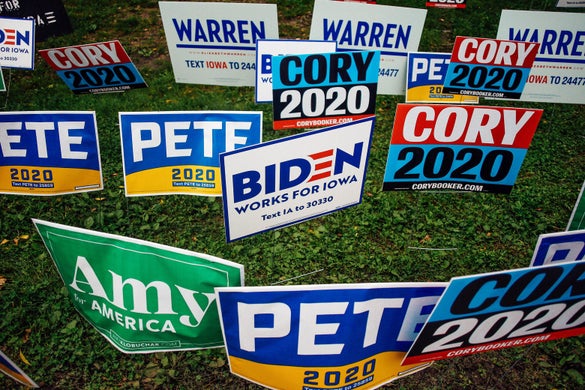
What does this mean? What is this number? It's usually five digits long, and it's printed without hyphens, so it's not a regular phone number. What kind of number is it, and by what means do you text to it? And what happens if you do? What sort of responses do these instructions generate, and by what means do they reach you?
concert review: Symphony Silicon Valley
Here's the review.
I knew exactly what I wanted to say here, but am not satisfied that I said it with any elegance or complete clarity. Especially with the Brahms. Did I convey what was odd about this performance? It's not that it was badly played, though there were more clams than in the other pieces, often a sign that the musicians haven't been fully inculcated into what the conductor wants them to do.
What he evidently wanted this time was the same kind of playing they gave Khachaturian and Glinka, which was fine for those pieces but doesn't really fit Brahms, like the wrong size clothes. But whether that was responsible for the enervated feeling in the opening movements, I'm not sure.
I am pleased that my editors let me get away with calling playing the Khachaturian piano concerto "exhuming" it. That kind of language is my critique of the modernist hegemony, which for decades buried works like this because they were too good: they show that standards other than severe modernism are still viable. This wouldn't be news in any other realm of music.
I had one research tickle here, when I looked up my old review of the SFS concert with a musical saw in it and confirmed that, yep, it was the same player. Since this concerto has been played with a saw or a flexatone or no added instrument at all, I wrote the orchestra management in advance to ask, and they told me their whole story.
And one challenge: I recognized the pianist's encore as a Strauss waltz, but I didn't know which one. Doubting that I'd be able to keep the tune in mind over the second half of the concert, I adopted something new to me as a memory device: I went outside during intermission, pulled out my phone, and sent myself a voicemail humming the melody. It was easy enough to look up in Barlow & Morgenstern when I got home.
I knew exactly what I wanted to say here, but am not satisfied that I said it with any elegance or complete clarity. Especially with the Brahms. Did I convey what was odd about this performance? It's not that it was badly played, though there were more clams than in the other pieces, often a sign that the musicians haven't been fully inculcated into what the conductor wants them to do.
What he evidently wanted this time was the same kind of playing they gave Khachaturian and Glinka, which was fine for those pieces but doesn't really fit Brahms, like the wrong size clothes. But whether that was responsible for the enervated feeling in the opening movements, I'm not sure.
I am pleased that my editors let me get away with calling playing the Khachaturian piano concerto "exhuming" it. That kind of language is my critique of the modernist hegemony, which for decades buried works like this because they were too good: they show that standards other than severe modernism are still viable. This wouldn't be news in any other realm of music.
I had one research tickle here, when I looked up my old review of the SFS concert with a musical saw in it and confirmed that, yep, it was the same player. Since this concerto has been played with a saw or a flexatone or no added instrument at all, I wrote the orchestra management in advance to ask, and they told me their whole story.
And one challenge: I recognized the pianist's encore as a Strauss waltz, but I didn't know which one. Doubting that I'd be able to keep the tune in mind over the second half of the concert, I adopted something new to me as a memory device: I went outside during intermission, pulled out my phone, and sent myself a voicemail humming the melody. It was easy enough to look up in Barlow & Morgenstern when I got home.
Monday, December 9, 2019
Tom Lehrer: The Next Generation
It's often been observed that Weird Al Yankovic is the Allan Sherman of his day, and I endorse that view (and would more enthusiastically were Weird Al more likely to parody songs I know, or which at least have an actual tune).
But what I hadn't seen was a successor to Tom Lehrer, the other humorous songsmith who was a star of my youth. Lehrer's distinctive characteristic, besides the fact that he almost always wrote his own tunes (rather than making parodies) and accompanied himself on the piano, was his utterly black sense of humor. He would take politically touchy or downright gruesome topics and treat them with light and fetching wit. Songs like "We Will All Go Together When We Go" (cheerfully mulling the prospect of World War III) or "Poisoning Pigeons in the Park" (self-explanatory) disgusted some people, but if you accepted Lehrer's sense of comedy they were hilarious.
Recently I had call to link to a video of Lehrer's "National Brotherhood Week" (wading boldly into a politically sensitive realm) and noticed in the YouTube comments several remarks to the effect that this was like Bo Burnham.
So who is Bo Burnham? Besides being the writer/director of the recent movie Eighth Grade (painfully realistic, and not as funny as it thinks it is), he's a stand-up comic whose specialty is ... writing his own songs, both words and melody, and accompanying himself on the keyboard. And doing so with a Tom Lehrer-like dark sense of humor.
I found that I only liked about half of the Bo Burnham songs I listened to online, which is a low percentage by Lehrer standards, but some of them were good, and the absolute winner was this one. Warning: if you do not like Tom Lehrer, do not listen to this song. You'll be horribly offended. (It's also more misogynist than the author probably realizes.) But the resemblance, not in style but in aesthetic approach, to Lehrer's most evil-minded moods is uncanny.
The title of that one would give it away, but I also enjoyed listening to "Lower Your Expectations," "From God's Perspective," and his parody of glossy commercial country music, "Pandering." He's been around for a bit but hadn't come to my attention.
But what I hadn't seen was a successor to Tom Lehrer, the other humorous songsmith who was a star of my youth. Lehrer's distinctive characteristic, besides the fact that he almost always wrote his own tunes (rather than making parodies) and accompanied himself on the piano, was his utterly black sense of humor. He would take politically touchy or downright gruesome topics and treat them with light and fetching wit. Songs like "We Will All Go Together When We Go" (cheerfully mulling the prospect of World War III) or "Poisoning Pigeons in the Park" (self-explanatory) disgusted some people, but if you accepted Lehrer's sense of comedy they were hilarious.
Recently I had call to link to a video of Lehrer's "National Brotherhood Week" (wading boldly into a politically sensitive realm) and noticed in the YouTube comments several remarks to the effect that this was like Bo Burnham.
So who is Bo Burnham? Besides being the writer/director of the recent movie Eighth Grade (painfully realistic, and not as funny as it thinks it is), he's a stand-up comic whose specialty is ... writing his own songs, both words and melody, and accompanying himself on the keyboard. And doing so with a Tom Lehrer-like dark sense of humor.
I found that I only liked about half of the Bo Burnham songs I listened to online, which is a low percentage by Lehrer standards, but some of them were good, and the absolute winner was this one. Warning: if you do not like Tom Lehrer, do not listen to this song. You'll be horribly offended. (It's also more misogynist than the author probably realizes.) But the resemblance, not in style but in aesthetic approach, to Lehrer's most evil-minded moods is uncanny.
The title of that one would give it away, but I also enjoyed listening to "Lower Your Expectations," "From God's Perspective," and his parody of glossy commercial country music, "Pandering." He's been around for a bit but hadn't come to my attention.
Sunday, December 8, 2019
reading and eating
Our Mythopoeic group had its annual yule-festive reading and eating meeting yesterday. It was kind of small. Our one new member didn't come, because when the hostess gave us an unusual date for the meeting I passed it along to him; this turned out to have been a mistake, but when I gave him the correction he neglected to put it on his calendar, so he didn't come.
For a food contribution, I made the same fresh green-bean-and-mushroom cream casserole that I'd made for Thanksgiving. It has mushrooms, right? We're supposed to be Tolkien fans, right? Hobbits love mushrooms, therefore we're also supposed to love mushrooms, so it's appropriate.
I don't actually see how that follows, since hobbits also love to smoke, but I don't see many Tolkien fans doing that. Furthermore, I don't love mushrooms. I can tolerate fresh ones, though, which unlike canned mushrooms haven't achieved a degree of sliminess that only Gollum could love, so I can eat these. B. is more stringent, and picks them out. Anyway, most of it got eaten and complimented, but there was enough for leftovers.
My readings this year were inspired by earlier ones. Last year, A.S. read a passage from Good Omens that declared a rule that any cassette tape left in your car turns into The Best of Queen. That reminded me of something, and I succeeded in digging it out because I'd once copied it for an apazine. It was a column from the heyday of the San Francisco Chronicle's great columnists. It was by Steve Rubinstein, not the better-remembered Jon Carroll, as Steve Rubinstein was more likely to write about music. (He once did a column, which I also kept, about going to the symphony, in which he called out a piece by Elliott Carter as the unintelligible and unappealing glop that it is, and didn't that generate furious letters from the modernist hegemony.)
This one dated from 1987, and dealt with that new technology, the compact disc. It tells of a friend who bought a James Brown CD but found when playing it that, contrary to the label and everything else, it was Beethoven's Emperor Concerto. ("This must be a new arrangement of 'Prisoner of Love,'" said Dan. He wasn't kidding.) And of how hard it is to convince anyone, from his friend to the clerk back at the record store, that the label is wrong.
We often get old classics at the meeting. This year, A.W. pleasurably reminded us of the opening of The Hobbit. One earlier year, she read Eliot's "Macavity," and I was interested in how different her style and emphasis were from the way I'd do it. So this year I did it, with appropriate dramatics. Comment afterwards was on how much my reading differed from the musical setting. Yes, well, I had Old Possum's Book half-memorized long before Cats ever came out, and while I like the musical, I'm not enamored of it enough to internalize the songs, so to me they're still poems, not song lyrics.
Had to leave fairly promptly, by which time the drizzling rain had erupted into a torrent, drop B. off at home and then head down to San Jose for a concert to review. More on that when it's published.
For a food contribution, I made the same fresh green-bean-and-mushroom cream casserole that I'd made for Thanksgiving. It has mushrooms, right? We're supposed to be Tolkien fans, right? Hobbits love mushrooms, therefore we're also supposed to love mushrooms, so it's appropriate.
I don't actually see how that follows, since hobbits also love to smoke, but I don't see many Tolkien fans doing that. Furthermore, I don't love mushrooms. I can tolerate fresh ones, though, which unlike canned mushrooms haven't achieved a degree of sliminess that only Gollum could love, so I can eat these. B. is more stringent, and picks them out. Anyway, most of it got eaten and complimented, but there was enough for leftovers.
My readings this year were inspired by earlier ones. Last year, A.S. read a passage from Good Omens that declared a rule that any cassette tape left in your car turns into The Best of Queen. That reminded me of something, and I succeeded in digging it out because I'd once copied it for an apazine. It was a column from the heyday of the San Francisco Chronicle's great columnists. It was by Steve Rubinstein, not the better-remembered Jon Carroll, as Steve Rubinstein was more likely to write about music. (He once did a column, which I also kept, about going to the symphony, in which he called out a piece by Elliott Carter as the unintelligible and unappealing glop that it is, and didn't that generate furious letters from the modernist hegemony.)
This one dated from 1987, and dealt with that new technology, the compact disc. It tells of a friend who bought a James Brown CD but found when playing it that, contrary to the label and everything else, it was Beethoven's Emperor Concerto. ("This must be a new arrangement of 'Prisoner of Love,'" said Dan. He wasn't kidding.) And of how hard it is to convince anyone, from his friend to the clerk back at the record store, that the label is wrong.
We often get old classics at the meeting. This year, A.W. pleasurably reminded us of the opening of The Hobbit. One earlier year, she read Eliot's "Macavity," and I was interested in how different her style and emphasis were from the way I'd do it. So this year I did it, with appropriate dramatics. Comment afterwards was on how much my reading differed from the musical setting. Yes, well, I had Old Possum's Book half-memorized long before Cats ever came out, and while I like the musical, I'm not enamored of it enough to internalize the songs, so to me they're still poems, not song lyrics.
Had to leave fairly promptly, by which time the drizzling rain had erupted into a torrent, drop B. off at home and then head down to San Jose for a concert to review. More on that when it's published.
Friday, December 6, 2019
news of the
1. The first sign of the impending Violins of Hope residency, as I previously reported on, has made its appearance: an exhibit of action photos taken at the shop of the Israeli luthier, the man who's collected and repaired all these violins. He's shown unpacking and evaluating a new arrival. He says from the pattern of wear on the fingerboard that it was a klezmer violin. I'm impressed one can tell.
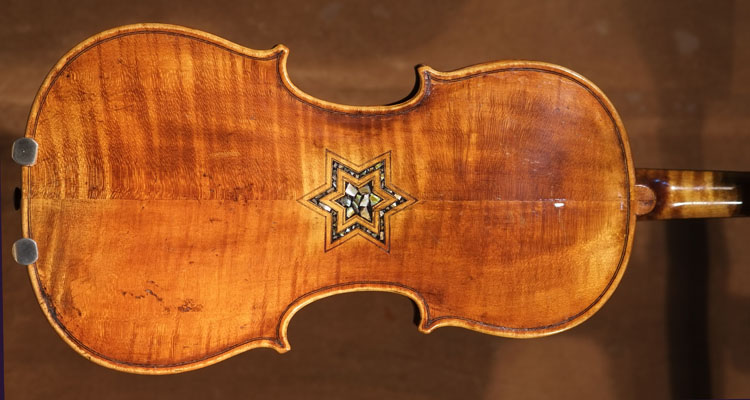
Some of the violins have a mother of pearl Mogen David on the back.
More disturbing is the photo of the dismantled interior of, I think, a different violin. Its Jewish owner was still in Berlin in 1936 when he took it in to a luthier there for an extensive tuneup. Taking the violin apart, the repairer inscribed on the inside, where he knew the owner wouldn't see it, the words "Heil Hitler" and a swastika.
The photos are posted on the corridor walls of the Peninsula Jewish Community Center, in Foster City.
2. Cats to the vet today. Tybalt was in when we first got him, nearly a year ago, but this time he knows what to expect and doesn't want it. Great effort and a blooding of poor B. get him into the cat carrier. In response to which he howls piercingly, and tries to break out by physical force. As the carrier shakes on the floor I think of our friends' application of Dunsany's "Chu-bu and Sheemish" to the relationship between their cats, and remember the line, "he had chosen a little earthquake as the miracle most easily accomplished by a small god."
Some of the violins have a mother of pearl Mogen David on the back.
More disturbing is the photo of the dismantled interior of, I think, a different violin. Its Jewish owner was still in Berlin in 1936 when he took it in to a luthier there for an extensive tuneup. Taking the violin apart, the repairer inscribed on the inside, where he knew the owner wouldn't see it, the words "Heil Hitler" and a swastika.
The photos are posted on the corridor walls of the Peninsula Jewish Community Center, in Foster City.
2. Cats to the vet today. Tybalt was in when we first got him, nearly a year ago, but this time he knows what to expect and doesn't want it. Great effort and a blooding of poor B. get him into the cat carrier. In response to which he howls piercingly, and tries to break out by physical force. As the carrier shakes on the floor I think of our friends' application of Dunsany's "Chu-bu and Sheemish" to the relationship between their cats, and remember the line, "he had chosen a little earthquake as the miracle most easily accomplished by a small god."
Thursday, December 5, 2019
sign of the
An article in the Guardian concerning a renewed exchange of incivilities between DT and Kim bears the headline: I shall taunt you a second time.
Thus proving both the cultural ubiquity of Monty Python and the Holy Grail and the extreme silliness of the subjects of the article.
(PS: And there's an article in the New Yorker this week which could have, after Tom Lehrer, been called "And the Hindus hate the Moslems ..." We've already had enough articles proving the truth of the next line.)
Thus proving both the cultural ubiquity of Monty Python and the Holy Grail and the extreme silliness of the subjects of the article.
(PS: And there's an article in the New Yorker this week which could have, after Tom Lehrer, been called "And the Hindus hate the Moslems ..." We've already had enough articles proving the truth of the next line.)
Tuesday, December 3, 2019
day-o
1. Kamala Harris has dropped out of the presidential race. Too bad, as she was our candidate. This is what happens when the race is all-in from the beginning, with debates this early out and so on: the sorting process occurs before anybody has had the chance to vote. There'll probably be only two or three candidates, excluding obscure cranks, left by New Hampshire, or by the day after.
2. Today is something called Giving Tuesday. Never heard of it, don't actually believe it. It seems merely an excuse for a lot of arts groups, that I don't want to block or unsubscribe to, to send me spam. I hope they stop quick.
3. I don't know if Americans reading this have heard the story of the heroic Lukasz, a Polish chef resident in London, who faced off the murderous terrorist at London Bridge armed with nothing but a narwhal tusk he'd grabbed from the wall. It's been making the rounds in Britain, even used as armament in the Brexit wars (see, immigrants! useful in an emergency!). But if you listen carefully to this account of the details, you'll be told that Lukasz and the guy wielding the narwhal tusk are TWO DIFFERENT PEOPLE. What Lukasz takes down from the wall is described as "a long stick" and later as a "pole". He fights off the terrorist by himself for a minute, and then is joined by two other guys, the one with the fire extinguisher (conspicuous in some of the video of the event) and the one who grabs the narwhal tusk. The transcript caption writes "animal" but the speaker clearly says "narwhal", and later he uses the word again in the same context. All of these defenders were heroic, but, if this is to be believed, the solo facedown with the narwhal tusk NEVER HAPPENED. He had some other long stick or pole instead, probably a lot larger. Even the person who put this on Twitter didn't notice that the story contradicts the popular narrative. Is the speaker confused, or has EVERYBODY ELSE got it WRONG?
2. Today is something called Giving Tuesday. Never heard of it, don't actually believe it. It seems merely an excuse for a lot of arts groups, that I don't want to block or unsubscribe to, to send me spam. I hope they stop quick.
3. I don't know if Americans reading this have heard the story of the heroic Lukasz, a Polish chef resident in London, who faced off the murderous terrorist at London Bridge armed with nothing but a narwhal tusk he'd grabbed from the wall. It's been making the rounds in Britain, even used as armament in the Brexit wars (see, immigrants! useful in an emergency!). But if you listen carefully to this account of the details, you'll be told that Lukasz and the guy wielding the narwhal tusk are TWO DIFFERENT PEOPLE. What Lukasz takes down from the wall is described as "a long stick" and later as a "pole". He fights off the terrorist by himself for a minute, and then is joined by two other guys, the one with the fire extinguisher (conspicuous in some of the video of the event) and the one who grabs the narwhal tusk. The transcript caption writes "animal" but the speaker clearly says "narwhal", and later he uses the word again in the same context. All of these defenders were heroic, but, if this is to be believed, the solo facedown with the narwhal tusk NEVER HAPPENED. He had some other long stick or pole instead, probably a lot larger. Even the person who put this on Twitter didn't notice that the story contradicts the popular narrative. Is the speaker confused, or has EVERYBODY ELSE got it WRONG?
not what it might look like
A potentially misleading entry in the contents list for Tolkien Studies 16, for instance as displayed here, has been brought to my attention.
In this display, the separated sub-entry for most of the article entries is the author of the article. Thus, Richard C. West is the author of this year's "In Memoriam," he is not the subject of it. The subject is the late scholar Jared C. Lobdell, who died in March of 2019. Richard West kindly supplied us a bio and appreciation. His authorship is not listed in the table of contents of our issue, but his byline does appear at the end of the obituary, so some enthusiastic analyzers of our issue (also breaking apart the book reviews section into individual contributions, which we also don't do) may have added this. (I haven't yet checked Project MUSE, our online distributor, to see if that's where this comes from.)
In this display, the separated sub-entry for most of the article entries is the author of the article. Thus, Richard C. West is the author of this year's "In Memoriam," he is not the subject of it. The subject is the late scholar Jared C. Lobdell, who died in March of 2019. Richard West kindly supplied us a bio and appreciation. His authorship is not listed in the table of contents of our issue, but his byline does appear at the end of the obituary, so some enthusiastic analyzers of our issue (also breaking apart the book reviews section into individual contributions, which we also don't do) may have added this. (I haven't yet checked Project MUSE, our online distributor, to see if that's where this comes from.)
Monday, December 2, 2019
silent night
The tree is up. The (non-fragile) ornaments are up. The cats are (mostly) leaving it alone. So far so good. On to other things,
seasonal,
1) Some carols and some more carols, played by an ensemble of four bass clarinets. Wild!
1a) The ensemble is named Edmund Welles. They don't say where they got that name from, but could it have been from here?
2) Some people wonder how to incorporate acknowledgement of Hanukkah into their holiday celebrations. Easy: Don't let Christmas co-opt Hanukkah. Don't treat Hanukkah as some exotic variety of Christmas, and don't act as if Christmas is the universal celebration and all the non-Christians ought to just join in. Here's a cautionary tale of how not to do it.
and not:
3) The state law to protect Uber and Lyft drivers that could affect my job too. It's all freelancers, and I'm a freelance journalist. It sets a limit of 35 bylines a year before you're a staffer. I think that leaves me all right, especially if (as implied) it means per client instead of total. Many are indignant, but I tend to think that if you're writing every week for a weekly paper, then you are a staffer and ought to be treated and paid like one. That doesn't mean you have to be full-time, as people apparently think.
4) What happens to children separated from their parents. This is about things like Trump's border patrols and Ceaușescu's orphanages, but I think of the time when, aged 2, I wandered away from home before my mother noticed. I was found on a nearby high-school campus by some students, who called the police who quickly restored me to my mother, but these days they'd probably suspect her of neglect and put me, at least temporarily, into foster care. Knowing myself as a small child, that would have been utterly traumatic and would probably have scarred me for life. And that's how they think they're protecting the children.
seasonal,
1) Some carols and some more carols, played by an ensemble of four bass clarinets. Wild!
1a) The ensemble is named Edmund Welles. They don't say where they got that name from, but could it have been from here?
2) Some people wonder how to incorporate acknowledgement of Hanukkah into their holiday celebrations. Easy: Don't let Christmas co-opt Hanukkah. Don't treat Hanukkah as some exotic variety of Christmas, and don't act as if Christmas is the universal celebration and all the non-Christians ought to just join in. Here's a cautionary tale of how not to do it.
and not:
3) The state law to protect Uber and Lyft drivers that could affect my job too. It's all freelancers, and I'm a freelance journalist. It sets a limit of 35 bylines a year before you're a staffer. I think that leaves me all right, especially if (as implied) it means per client instead of total. Many are indignant, but I tend to think that if you're writing every week for a weekly paper, then you are a staffer and ought to be treated and paid like one. That doesn't mean you have to be full-time, as people apparently think.
4) What happens to children separated from their parents. This is about things like Trump's border patrols and Ceaușescu's orphanages, but I think of the time when, aged 2, I wandered away from home before my mother noticed. I was found on a nearby high-school campus by some students, who called the police who quickly restored me to my mother, but these days they'd probably suspect her of neglect and put me, at least temporarily, into foster care. Knowing myself as a small child, that would have been utterly traumatic and would probably have scarred me for life. And that's how they think they're protecting the children.
Subscribe to:
Comments (Atom)