Stanford sponsored a couple of online talks that looked interesting.
The first one was by a calligrapher who's undertaking the job of reproducing, in fresh calligraphy on fresh vellum, the entire text of Beowulf. This seemed like a promising idea until my heart sank as the calligrapher revealed that 1) she doesn't read Anglo-Saxon; 2) she doesn't understand the script that Beowulf was written in. She just intends to reproduce verbatim the strokes of the original without having any idea what they represent.
That's bad enough, but then how do you do this for a text parts of which have been lost through decay and having the edges of the sheets burned off in an 18th century fire? You can research what scholars think the lost words and letters say, but without knowledge you can't make your own decisions about which ideas you think are right; and if you don't know the language or the script you can't possibly draw those characters in a way that will look real.
The second talk was by a pair of scholars on the intersection of art, sex, and the law. One was telling the story of NYC avant-garde artists in the 1960s (Nam June Paik and Charlotte Moorman) and their problems with obscenity prosecutions; further on how their archives have been mucked up by pandemic-forced moves and will take years to straighten out again. I was relieved when the start of the talk, giving the artistic context, was littered with the names of lots of other people I've heard of, from LaMonte Young to Yoko Ono, so I had a knowledge base to hold on to.
The other speaker was more academic in style and I had a harder time following her drift, but the main point seemed to be how NAFTA-initiated intellectual property restrictions are making it hard for Mexican trans people to import specific fashion and artistic supplies from the US. On top of the difficulties you can already imagine about being trans in Mexico. So that was interesting if regrettable to hear about.
This year's Mythopoeic Awards were announced today. The online awards ceremony was a glorious bouquet of mispronunciations, and the winners struck me as mixed. I was only able to vote in the Myth and Fantasy Scholarship category, and while Anna Vaninskaya's Fantasies of Time and Death was not my top choice, I considered the top three to be nearly equal in quality, and this was one. I was out on the Inklings Studies category because of having an essay in one finalist collection, but I did express my opinion on the other finalists, and I did not put Tolkien's Lost Chaucer by John M. Bowers on top. As a history of Tolkien's ill-fated scholarly Chaucer edition I thought it quite useful; as a description of Tolkien's unpublished Chaucer scholarship somewhat less so, and as a literary source study on Chaucerian influence on The Lord of the Rings, well, that part would better have remained unpublished. No, the outstanding books of the year were Catherine McIlwaine's Tolkien: Maker of Middle-earth (the Bodleian Library exhibit catalog) and John Garth's The Worlds of J.R.R. Tolkien, with the former taking the edge since this was its last year of eligibility.
B. was pleased when A Wizard's Guide to Defensive Baking by T. Kingfisher (Ursula Vernon) took the Children's Literature award. I'd read, or started to read, two of the Adult Literature finalists, but I didn't like the winner, The House in the Cerulean Sea by T.J. Klune, as much as Mexican Gothic by Silvia Moreno-Garcia. Bowers' and Klune's acceptance speeches in which they express wonderment that their work was considered worthy of the award may be more level-headed than they realize.

Kalimac's corner: a journal by DB
Sunday, October 17, 2021

Friday, October 15, 2021
concert review: San Francisco Symphony
My last previous SFS concert, 18 months ago, was Esa-Pekka Salonen's last appearance as a guest conductor before he was scheduled to take over as music director. Since then they had a few concerts last spring, none of which I attended, and we're now a few weeks into the next season, and on Thursday I got to hear EPS in his new capacity. (The initials have not yet taken over. His parking space in the executive lot has his last name on it, as does everyone else's; previously it read "MTT".)
Vaccination was required at the door and masks inside. Possibly due to the exotic repertoire, this concert was lightly attended. I was the only person in the 34-seat balcony side box where I normally sit, and I think that's the first time this has happened since they abandoned Wednesday concerts.
As in San Jose, the string and percussion players were all masked, the winds and brass not. EPS, also unmasked, came out to applause and stood motionless, arms by his sides, on the podium. Linda Lukas, the third flute and about the only one left (the first two flutes, a married couple, both retired last year and have not yet been replaced), sat equally motionless, instrument raised to her lips. This tableau lasted for a long time as silence seeped throughout the auditorium.
Then, without any signal from EPS, she began the opening solo of Debussy's Prélude à l'après-midi d'un faune. EPS started to conduct with a couple pickup bars before other players joined in. A delicately sumptuous, but vigorous and dramatic, performance of the work followed.
Connections between the concert's pieces were craftily planned. Where Debussy was inspired by a poem by Mallarmé, Kaija Saariaho (who turned 69 on Thursday - happy birthday!) was inspired by a poem by Saint-John Perse for her Aile du songe. This is functionally a brief flute concerto. The orchestra of strings and percussion (no winds) mostly hovered in the background, spectrally, while soloist Claire Chase, who came on stage with a bit of a Groucho walk, made her instrument jump around with various flute-like sounds and a few un-flute-like noises which sounded rather intestinal.
Perse's and hence Saariaho's work was intended to evoke birds, and so - as its title proclaims - was Olivier Messiaen's Oiseaux exotiques, which is functionally a brief piano concerto. Here the pianist, Jeremy Denk, and the orchestra (winds and percussion, no strings) were more in it together than in the Saariaho, but despite the claim of being based on birdsong, this hunk of angular modernism with post-Stravinsky whooping noises more evoked the sounds of a factory. I like some Messiaen, but not this one.
Lastly we returned to Debussy for a run through La mer. This rendition got warm applause from the audience but did not please me. The slow parts sounded tentative while the fast ones were increasingly hasty and brusque. I'm hoping for a better result when I return next week.
Vaccination was required at the door and masks inside. Possibly due to the exotic repertoire, this concert was lightly attended. I was the only person in the 34-seat balcony side box where I normally sit, and I think that's the first time this has happened since they abandoned Wednesday concerts.
As in San Jose, the string and percussion players were all masked, the winds and brass not. EPS, also unmasked, came out to applause and stood motionless, arms by his sides, on the podium. Linda Lukas, the third flute and about the only one left (the first two flutes, a married couple, both retired last year and have not yet been replaced), sat equally motionless, instrument raised to her lips. This tableau lasted for a long time as silence seeped throughout the auditorium.
Then, without any signal from EPS, she began the opening solo of Debussy's Prélude à l'après-midi d'un faune. EPS started to conduct with a couple pickup bars before other players joined in. A delicately sumptuous, but vigorous and dramatic, performance of the work followed.
Connections between the concert's pieces were craftily planned. Where Debussy was inspired by a poem by Mallarmé, Kaija Saariaho (who turned 69 on Thursday - happy birthday!) was inspired by a poem by Saint-John Perse for her Aile du songe. This is functionally a brief flute concerto. The orchestra of strings and percussion (no winds) mostly hovered in the background, spectrally, while soloist Claire Chase, who came on stage with a bit of a Groucho walk, made her instrument jump around with various flute-like sounds and a few un-flute-like noises which sounded rather intestinal.
Perse's and hence Saariaho's work was intended to evoke birds, and so - as its title proclaims - was Olivier Messiaen's Oiseaux exotiques, which is functionally a brief piano concerto. Here the pianist, Jeremy Denk, and the orchestra (winds and percussion, no strings) were more in it together than in the Saariaho, but despite the claim of being based on birdsong, this hunk of angular modernism with post-Stravinsky whooping noises more evoked the sounds of a factory. I like some Messiaen, but not this one.
Lastly we returned to Debussy for a run through La mer. This rendition got warm applause from the audience but did not please me. The slow parts sounded tentative while the fast ones were increasingly hasty and brusque. I'm hoping for a better result when I return next week.
Thursday, October 14, 2021
world according to cat
The most desirable thing in the world is getting under the bedsheet and wrapping yourself up in it, while the human is trying to make the bed. Being ferreted out and tossed off the bed shall not stop you from instantly resuming your appointed rounds.
Tuesday, October 12, 2021
medium entertainment
I discover TV shows by wandering into the living room and seeing what B. is watching. This time, a couple weeks ago, it was the second episode of a new drama called Ordinary Joe. B. lost interest but I've kept on through at least two more episodes. If I don't bother to watch at some future point, I'll know I'm done. More likely it'll be canceled.
Ordinary Joe's gimmick is not Joe, who though central is rather inert, nor the plot of his life, which is thoroughly mundane melodrama, but the fact that there's three of him. Joe faced a trilemma of what to do that afternoon after he graduated from college, and now ten years later each choice has led to a drastically different career, marriage to one of two different women or a single life, and lots of regrets over roads not taken. What's more, both of his wives are also active in his other two lives. So it's keeping track of what's going on as the three storylines jump back and forth that gives this otherwise dull story its slightly mind-bending appeal.
(e.g. which is the version of wife #2 who's having an affair with her boss? Is it the one Joe's married to, the single one, or the one who's married to Joe's best friend? Not clear at first, as the color-coding of the plot lines is not that consistent. But it turns out it's the single one.)
The other medium entertainment of the week came from the notification that Opera San Jose's first production of the season would be online only, meaning we could try out an opera of questionable charm without having to take the trouble of going there. It was a 40-minute, one-act, two-character drama by Rimsky-Korsakov titled Mozart and Salieri, after Pushkin's poem on the subject. No, Amadeus was not the first treatment, and in fact the plot is pretty much the same as Pushkin's. Salieri fumes at Mozart's superior talent and determines to do him in. In this one he invites him to lunch and gives him a slow-acting poison.
It was more talk than action, the music was mostly meandering recitative that didn't sound much like Rimsky, the singers were OK, there were a few snatches of genuine Mozart. But I couldn't share the enthusiasm of SFCV's review.
Ordinary Joe's gimmick is not Joe, who though central is rather inert, nor the plot of his life, which is thoroughly mundane melodrama, but the fact that there's three of him. Joe faced a trilemma of what to do that afternoon after he graduated from college, and now ten years later each choice has led to a drastically different career, marriage to one of two different women or a single life, and lots of regrets over roads not taken. What's more, both of his wives are also active in his other two lives. So it's keeping track of what's going on as the three storylines jump back and forth that gives this otherwise dull story its slightly mind-bending appeal.
(e.g. which is the version of wife #2 who's having an affair with her boss? Is it the one Joe's married to, the single one, or the one who's married to Joe's best friend? Not clear at first, as the color-coding of the plot lines is not that consistent. But it turns out it's the single one.)
The other medium entertainment of the week came from the notification that Opera San Jose's first production of the season would be online only, meaning we could try out an opera of questionable charm without having to take the trouble of going there. It was a 40-minute, one-act, two-character drama by Rimsky-Korsakov titled Mozart and Salieri, after Pushkin's poem on the subject. No, Amadeus was not the first treatment, and in fact the plot is pretty much the same as Pushkin's. Salieri fumes at Mozart's superior talent and determines to do him in. In this one he invites him to lunch and gives him a slow-acting poison.
It was more talk than action, the music was mostly meandering recitative that didn't sound much like Rimsky, the singers were OK, there were a few snatches of genuine Mozart. But I couldn't share the enthusiasm of SFCV's review.
Sunday, October 10, 2021
Beethoven half-marathon
I was up in the City again on Saturday for a musical event I couldn't resist, although less than 200 other people seemed interested enough to be there: the first day of a two-day marathon concert run through all 32 of Beethoven's canonical piano sonatas. Two concerts, each over three hours long, and I suspect the fourth concert on Sunday will be a lot longer than that.
Previous experience with listening through the entire cycle, both on recordings and in series of concerts (more spaced-out than this one) suggested to me that trying to take in the whole thing in two days would overwhelm my sensors, so with regret for missing the Waldstein and the Appassionata I just got tickets for the first day. But this event had what turned out to be a greater source of variety and refreshment than I'd expected: 12 different pianists (with another 5 to be added in on Sunday), where all my previous traversals through the canon had been by one pianist each. Most played one of the 15 sonatas each, with a couple returns, and several of them were due to reappear on Sunday. Only 2 of the 12 were women, though so were 4 of the 5 who didn't play on Saturday.
Ranging from distinguished names in the field (the most renowned I heard was Stephen Prutsman in Op. 7) down to conservatory students not quite ready for prime time, the pianists vied for titles like the most dramatic, the wittiest, the most transparent, the most lyrical, the deepest tone colors, and so on. If I were formally reviewing this I'd have taken notes and could go into detail.
But what a satisfying listening experience this was. One of the pandemic-canceled concerts I most regretted missing was Andras Schiff playing the four wonderful sonatas of Opp. 26-28, and that entire repertoire was just the second half of the second concert here. I'm sure I liked this a lot better than I would have Schiff, whom I've never been especially fond of as a pianist. Richard Raymond in Op. 27 No. 1 was quite extraordinary in his variety of expression, as was Mari Kodama in the intensity she brought to the "Moonlight" Sonata.
For some unfathomable reason, the concerts were in the SF Jazz Center, which has at least improved its acoustics since the last time I was there for a classical chamber concert. Seating was open and there was plenty of room to keep distanced. Having lunched beforehand, I drove up in just enough time for the 1 pm start. Forced by a weekend street closure on Hayes Street to go past the Grove St. garage, I decided just to park there. But a sign saying they closed for the night at 10 gave me pause, as I was quite sure we wouldn't be done with the evening 7 pm concert by then, nor were we. So after the first concert let out at 4.30, I hauled my car out and found a street space. Then I had to seek dinner. The concert hall had been strict about vaccinations and masks, my favorite nearby Thai restaurant was rather less so, but it was still pretty empty at 5.15. One healthy meal of crisp veggies, shrimp, and a little rice later, I was primed for another plunge into Beethoven.
Previous experience with listening through the entire cycle, both on recordings and in series of concerts (more spaced-out than this one) suggested to me that trying to take in the whole thing in two days would overwhelm my sensors, so with regret for missing the Waldstein and the Appassionata I just got tickets for the first day. But this event had what turned out to be a greater source of variety and refreshment than I'd expected: 12 different pianists (with another 5 to be added in on Sunday), where all my previous traversals through the canon had been by one pianist each. Most played one of the 15 sonatas each, with a couple returns, and several of them were due to reappear on Sunday. Only 2 of the 12 were women, though so were 4 of the 5 who didn't play on Saturday.
Ranging from distinguished names in the field (the most renowned I heard was Stephen Prutsman in Op. 7) down to conservatory students not quite ready for prime time, the pianists vied for titles like the most dramatic, the wittiest, the most transparent, the most lyrical, the deepest tone colors, and so on. If I were formally reviewing this I'd have taken notes and could go into detail.
But what a satisfying listening experience this was. One of the pandemic-canceled concerts I most regretted missing was Andras Schiff playing the four wonderful sonatas of Opp. 26-28, and that entire repertoire was just the second half of the second concert here. I'm sure I liked this a lot better than I would have Schiff, whom I've never been especially fond of as a pianist. Richard Raymond in Op. 27 No. 1 was quite extraordinary in his variety of expression, as was Mari Kodama in the intensity she brought to the "Moonlight" Sonata.
For some unfathomable reason, the concerts were in the SF Jazz Center, which has at least improved its acoustics since the last time I was there for a classical chamber concert. Seating was open and there was plenty of room to keep distanced. Having lunched beforehand, I drove up in just enough time for the 1 pm start. Forced by a weekend street closure on Hayes Street to go past the Grove St. garage, I decided just to park there. But a sign saying they closed for the night at 10 gave me pause, as I was quite sure we wouldn't be done with the evening 7 pm concert by then, nor were we. So after the first concert let out at 4.30, I hauled my car out and found a street space. Then I had to seek dinner. The concert hall had been strict about vaccinations and masks, my favorite nearby Thai restaurant was rather less so, but it was still pretty empty at 5.15. One healthy meal of crisp veggies, shrimp, and a little rice later, I was primed for another plunge into Beethoven.
Friday, October 8, 2021
after the concert
I got home about 10.30 on Thursday evening. B. was still up and told me with some tenseness to check my e-mail. That's how I came to spend the next half-hour writing a quick memoir of the late Mary Kay Kare, filled with regret and frustration at how I tried to be her friend, but full success at that was beyond my friendship skill set.
I've received a number of compliments on the excellence of this quick portraiture, and it's not the first time a hasty memorial that I've written in the first flush of grief has received such responses. I seem to have a knack for this, but I'd much rather not have to write them in the first place, wouldn't you agree?
So where had I been? For the first time in over 19 months since before the pandemic, I'd gone up to San Francisco for a concert. Aside from distance and time, it wasn't more difficult than going to San Jose. I picked up take-out on the way for a quick dinner, and parked in the garage a block from Herbst Theatre, which was masked, vaccination-required, and (unlike San Jose) firmly socially distanced in seating.
It was the first in a four-concert series from San Francisco Performances that I could not resist. The Catalyst Quartet, who are all I think Hispanic, decided to play a set of concerts of the music of historically important Black composers. I'd heard all these composers, I liked their music, and I wanted to get to know them better.
The main feature of the concert was the precocious (he was 18) Piano Quintet in G Minor (1893) of Samuel Coleridge-Taylor (yes, named in honor of the obvious person), which the performers in post-concert talk said was influenced by Dvorak, but I don't hear that: to me it's in a Brahmsian declamatory style, yet filled with un-Brahmsian touches throughout, like the florid flourishes in the piano in the first of four epic movements. Stewart Goodyear was the pianist, like SCT British and of half-Black half-white parentage.
We also had a set of 5 short quartet pieces by SCT, these more looking forward to Stravinsky than back to Brahms; and the full "Lyric" Quartet by George Walker, a notable African-American composer (first of that description to win the Pulitzer in music) whose music I've reviewed before. He wrote this in 1946 and it fits the same description as the Quartet of a decade earlier by Samuel Barber (about a decade Walker's senior). It has a famous central Adagio often played by itself with string orchestra, surrounded by faster and harsher outer movements. Except that Walker's movements fit better together, yet his Allegros are more diverse in style than Barber's. But like Barber, Walker wrote on the human scale that was being abandoned by many post-WW2 composers, and I'm grateful to have his work.
And so my soul was enriched by music and I was unknowingly readied to face our human mortality.
I've received a number of compliments on the excellence of this quick portraiture, and it's not the first time a hasty memorial that I've written in the first flush of grief has received such responses. I seem to have a knack for this, but I'd much rather not have to write them in the first place, wouldn't you agree?
So where had I been? For the first time in over 19 months since before the pandemic, I'd gone up to San Francisco for a concert. Aside from distance and time, it wasn't more difficult than going to San Jose. I picked up take-out on the way for a quick dinner, and parked in the garage a block from Herbst Theatre, which was masked, vaccination-required, and (unlike San Jose) firmly socially distanced in seating.
It was the first in a four-concert series from San Francisco Performances that I could not resist. The Catalyst Quartet, who are all I think Hispanic, decided to play a set of concerts of the music of historically important Black composers. I'd heard all these composers, I liked their music, and I wanted to get to know them better.
The main feature of the concert was the precocious (he was 18) Piano Quintet in G Minor (1893) of Samuel Coleridge-Taylor (yes, named in honor of the obvious person), which the performers in post-concert talk said was influenced by Dvorak, but I don't hear that: to me it's in a Brahmsian declamatory style, yet filled with un-Brahmsian touches throughout, like the florid flourishes in the piano in the first of four epic movements. Stewart Goodyear was the pianist, like SCT British and of half-Black half-white parentage.
We also had a set of 5 short quartet pieces by SCT, these more looking forward to Stravinsky than back to Brahms; and the full "Lyric" Quartet by George Walker, a notable African-American composer (first of that description to win the Pulitzer in music) whose music I've reviewed before. He wrote this in 1946 and it fits the same description as the Quartet of a decade earlier by Samuel Barber (about a decade Walker's senior). It has a famous central Adagio often played by itself with string orchestra, surrounded by faster and harsher outer movements. Except that Walker's movements fit better together, yet his Allegros are more diverse in style than Barber's. But like Barber, Walker wrote on the human scale that was being abandoned by many post-WW2 composers, and I'm grateful to have his work.
And so my soul was enriched by music and I was unknowingly readied to face our human mortality.
Thursday, October 7, 2021
Mary Kay Kare
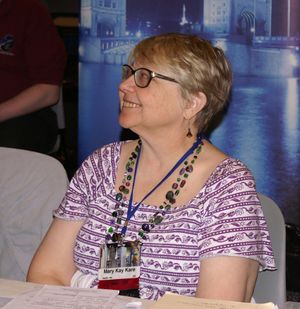 This is Mary Kay in happier times, about ten years ago I think. I'd like to remember that, because life was not always good to Mary Kay, most grievously to her when her beloved husband Jordin died unexpectedly after heart surgery four years ago. Since that time she had felt utterly bereft and was often incommunicato, to the distress and frustration of her friends, which is essentially why it wasn't realized immediately that she had died very recently of a blood infection. The news was passed on through a couple of hands and I don't know any more than that.
Mary Kay was from Oklahoma, and though she remained in touch with her family, she tended to describe home and family alike as something she was glad to escape from. A career as a catalog librarian was part of that escape; she worked for several years in quality control for OCLC (known to the general public as the proprietors of WorldCat) in Ohio. But as with a lot of us in that field, her career stalled when posts ran out and she fell out of the current swim. I was able to get her an interview for an open post once at a library where I was working, but it didn't get any further than that.
It was fandom which really caused Mary Kay to blossom. She was a conrunner, she was a smof, she was a Hugo administrator, she was an apahack, she was a filker, she was active in our local Mythopoeic Society discussion group, she was like many fans a loving cat-owner. She met Jordin at a Worldcon, and they were a devoted couple ever after. The only catch was that Jordin's work required him to spend a lot of time in Seattle, and Mary Kay was very sensitive to weather and could not handle the overcast climate. They tried a number of solutions - part-time here, part-time there; living separated part of the time; before finally being able to settle in San Jose several years back.
Mary Kay at her best was intelligent and invigorating and a great person for conversations about books and cats. I wish we could have done more to alleviate the depression and the self-deprecation that loomed over her so much, darkening even the earlier years and getting worse over time. But she could be hard to reach, both in terms of establishing conversation and in pursuing the conversation you're having. I'm sorry things didn't work out better for her.
temperate glory
The temperature has finally dropped to 70F for the first time since - let's see, I've been keeping a spreadsheet of the weather forecasts so I can be prepared for heat waves - since the end of April. Over 5 months. Maybe I can finally put away the fixings for chicken salad, which is my go-to dinner recipe on nights when it's too hot to cook, and bring back out the lentil soup which is a mainstay for winter.
Fortunately this summer the heat never got quite so continuously over 100F that I was forced to retreat to an air-conditioned hotel room as I was last year. Plus B's vigilance in running fans in open windows in the evening to cool the house down has been balm to our bodies even as it aggravates the electric bills. Fortunately we can afford to suffer through the latter.
In other news, one of the many great things about not being on FB is that I didn't even learn about the Great Outage of Monday until it was over. But now, thanks to the whistleblower, we're in for another orgy - for this has happened before - of social therapy for FB, where everybody goes around the circle and tells it what's wrong with it. And Z. issues heated denials that his company would ever do what the documents have just proved that it does do all the time.
In today's column, Leonard Pitts chides FB by pointing out that getting people to talk to one another doesn't necessarily bring them together, and he cites an interview his newspaper did 22 years ago with a historian pointing out the long history of the erroneous assumption that it does. But in fact knowledge that it's an error dates back in pop culture rather longer than 22 years:
Fortunately this summer the heat never got quite so continuously over 100F that I was forced to retreat to an air-conditioned hotel room as I was last year. Plus B's vigilance in running fans in open windows in the evening to cool the house down has been balm to our bodies even as it aggravates the electric bills. Fortunately we can afford to suffer through the latter.
In other news, one of the many great things about not being on FB is that I didn't even learn about the Great Outage of Monday until it was over. But now, thanks to the whistleblower, we're in for another orgy - for this has happened before - of social therapy for FB, where everybody goes around the circle and tells it what's wrong with it. And Z. issues heated denials that his company would ever do what the documents have just proved that it does do all the time.
In today's column, Leonard Pitts chides FB by pointing out that getting people to talk to one another doesn't necessarily bring them together, and he cites an interview his newspaper did 22 years ago with a historian pointing out the long history of the erroneous assumption that it does. But in fact knowledge that it's an error dates back in pop culture rather longer than 22 years:
Meanwhile, the poor Babel fish, by effectively removing all barriers to communication between different races and cultures, has caused more and bloodier wars than anything else in the history of creation.
Tuesday, October 5, 2021
concert review: Symphony Silicon Valley
On Saturday I did it. I went to a live symphony concert, my first in 19 months. The last one was the Bay Area Rainbow Symphony on 2/29/20, big work on the program Mendelssohn's "Scottish." This one was Symphony Silicon Valley, big work on the program Dvorak's "New World."
I was there to review it for SFCV. So that was another way in which this was a long-awaited refreshing.
SSV required masks and vaccination, but otherwise acted as if the pandemic was over. They didn't spatially separate the audience, they didn't forgo the pre-concert talk or an intermission. I decided not to trust to one of my interim cloth masks, but got one of the newly arrived 3M N95 masks I'd ordered online. It was actually more comfortable - the straps go over the head and under the chin instead of around the ears, and it's the only mask I've had yet which doesn't cause fogging up of the glasses.
I even treated myself to dinner out beforehand, at Poor House Bistro, which is about to be displaced by the encroaching Google Village, hopefully to reappear at another spot.
There will be more to come.
I was there to review it for SFCV. So that was another way in which this was a long-awaited refreshing.
SSV required masks and vaccination, but otherwise acted as if the pandemic was over. They didn't spatially separate the audience, they didn't forgo the pre-concert talk or an intermission. I decided not to trust to one of my interim cloth masks, but got one of the newly arrived 3M N95 masks I'd ordered online. It was actually more comfortable - the straps go over the head and under the chin instead of around the ears, and it's the only mask I've had yet which doesn't cause fogging up of the glasses.
I even treated myself to dinner out beforehand, at Poor House Bistro, which is about to be displaced by the encroaching Google Village, hopefully to reappear at another spot.
There will be more to come.
Saturday, October 2, 2021
card readers
Credit and debit cards - which have become more necessary lately, as the pandemic seems to have put an end to easy cash transactions even in smaller shops - have been getting more complicated and require savvy-computer-end-user levels of experience and awareness to use properly.
It used to be that all insert-card readers expected you to put the card in and then immediately pull it out. But it's increasingly common now to get ones requiring you to leave the card in until the DO NOT REMOVE CARD sign changes to REMOVE CARD, which are surprisingly easy to misread the one for the other. I suspect that's to do with the replacement of magnetic stripes with chips.
But then there are ones that not only expect you to pull the card straight out but which don't display anything on the screen until you do. So beware, the tired or distracted user.
Now there are the touchless or tap cards. Oh, watch out for those. I was purchasing groceries and preparing to run a card through the stripe-reader when suddenly the reader displayed "purchase approved" before I'd done anything. Ah, I'd also been holding my wallet and the reader had detected another, touchless card buried deep in a wallet pocket and plonked the purchase on that. Not the card I'd been intending to use.
So, another caution of modern life that they don't specifically warn you about so you have to learn it the hard way: don't let your wallet or other card-holder anywhere near the reader or you may make a surprise purchase.
It used to be that all insert-card readers expected you to put the card in and then immediately pull it out. But it's increasingly common now to get ones requiring you to leave the card in until the DO NOT REMOVE CARD sign changes to REMOVE CARD, which are surprisingly easy to misread the one for the other. I suspect that's to do with the replacement of magnetic stripes with chips.
But then there are ones that not only expect you to pull the card straight out but which don't display anything on the screen until you do. So beware, the tired or distracted user.
Now there are the touchless or tap cards. Oh, watch out for those. I was purchasing groceries and preparing to run a card through the stripe-reader when suddenly the reader displayed "purchase approved" before I'd done anything. Ah, I'd also been holding my wallet and the reader had detected another, touchless card buried deep in a wallet pocket and plonked the purchase on that. Not the card I'd been intending to use.
So, another caution of modern life that they don't specifically warn you about so you have to learn it the hard way: don't let your wallet or other card-holder anywhere near the reader or you may make a surprise purchase.
Subscribe to:
Comments (Atom)