Mark Evanier got asked a stupid question: "I'm expecting your usual infallible Super Bowl prediction that you won't be watching but I'm curious why. You're an American Male. How can you not be interested in football?"
I could have been asked the same question, and this is a perfect example of what's been frosting me about being a male, or for that matter being American, my entire life. Even as a child, I was never interested in most of the things that boys were supposedly interested in - sports, cars, dogs, saying naughty words ("telling dirty jokes" isn't accurate - most weren't funny, they just had naughty words in them), beating each other up, harassing girls. I just wanted to stay in the library and read a book, and for that I was called 'weird.' I didn't want to be a boy if that's what boys were, but I wasn't a girl either (these days I wonder if, in that situation, anybody might raise the idea that I was), so what was I? The answer, I eventually realized about the time I reached adulthood, was that there are more types of male, Horatio, than are dreamt of in your philosophy.
(One reads many reports of this kind of alienation from males who turn out to be gay, but I wasn't gay. To be sexually attracted to these males one found socially repulsive? That must be even more dissonant. I liked girls: I liked them as people, and I found them attractive. So one difficulty I was spared at least.)
At the same time I wasn't comfortable being a let-it-all-hang-out, hail-fellow-well-met American either. I'm an extreme introvert. I envied the idea of being a repressed Brit instead. It took me a while to get used to the idea, once I started meeting Brits socially, that many of them envied the idea of being loose and wild and American.
Ironically, I'm less uninterested in American football than in most other spectator sports. It has a plot - except for the half-time kickoff, every play arises from what happened in the previous play, unlike other sports which frequently clear the board of everything except the score. I understand most of the rules and can follow what's going on. But I only actually look at it when it's on a tv in front of my face in someone else's house, so I hardly ever do so. And any players I've ever heard of have long since retired.
For me what the Super Bowl means is it's a great time to go out shopping, because the stores are deserted of crowds. That's the only reason I have any interest in the question "What time does the game start?" I went out on some errands yesterday, and then picked up some takeout dinner and then went to a chamber music concert (review later).
When I got home, B. reported that she hadn't seen Tybalt in hours. (Don't worry, she had Maia.) Within a couple minutes after that, he was in my arms, demanding to be held and cuddled. See above list again: cats, those are the pets for me.

Kalimac's corner: a journal by DB
Monday, February 13, 2023

Sunday, February 12, 2023
spoiler alert book review
Who Killed Jane Stanford? by Richard White (Norton, 2022)
In the dictionary of contemporary terms, next to the entry for "TMI" is a picture of the cover of this book. It is absolutely drowning in detail concerning the question posed in its title.
Jane Stanford, widow, railroad heiress, co-founder of Stanford University, maintained power and influence over the university even after nominally ceding control to an academic president and a board of trustees. She died in 1905, and most people think she just died, but in fact she was murdered by strychnine in her bicarbonate of soda, a fact publicly known in the wake of the event but later hushed up. Even stranger, there'd been another attempt at the same thing a month earlier, which puzzled Jane. Like the Queen in the Dunsany play, she claimed to have no enemies, and couldn't imagine who'd want to kill her.
The first source of TMI in this book is the revelation of all the mismanagement and corporate politics in running the university. The president wanted to grow it into a major research institution - obviously this eventually succeeded - while Jane was having second thoughts about the whole co-ed university project and wanted to reduce the place into a boys' school for Christian moral training. On top of which the president was being accused of hiring professors on grounds of academic politics rather than quality of work, and refusing to fire ones who said things Jane didn't like, and so on. Jane was on the point of wanting to fire him.
The second source is the feuds and backbiting going on around Jane's household staff, often involving Jane as well. Some of the staff were Chinese immigrants, so we get some excursions into Chinese tong wars also.
And the third is the details of the poisonings. Who was what where when, do the stories of different people conflict, do one person's stories from different times conflict, are the newspaper reports which are often all that survive accurate, all gone over in painful detail.
The obvious candidate for poisoner is Jane's secretary, who was the only other person present for both incidents.* But where would she have gotten the pure strychnine used in the second poisoning? Most people could only get strychnine in rat poison without leaving a record of having bought it. White thinks he's solved the question when he notes the secretary's connection with an elusive druggist whose name appears only a few times, usually misspelled, in the surviving documents, after which he mysteriously disappears.
So White says the secretary, who lived out her life unmolested, did it, with the university president as accessory after the fact for hushing it up. But does he ever take the long way round, chronicling every step of the path, to reach that conclusion.
*So what would be her motive? That lies buried somewhere in the feuds and backbiting part of the tale. I didn't really follow all of that. I don't think the tong wars had anything to do with it, but in that case, what are they doing in the story?
Friday, February 10, 2023
musical chairs
I had to read the classical music blogs to learn that Gustavo Dudamel has been appointed next music director of the New York Philharmonic. After a meteoric rise to fame, as such things are counted within that world, Dudamel was appointed to his first directorship, of the Los Angeles Philharmonic, when he was only 26 (although he didn't take over for a couple more years). He's been there ever since, and I've been down there to hear him a couple of times. Now he's 42, pretty well established (though there are some critical circles who don't like him, as is always the way), but when his appointment takes effect in a couple more years, he'll be leaving for the greener pastures of New York. I'm sorry he's going, but on the other hand the NYP seems deliriously happy to have him, especially as their current leader turned out rather ehhh.
What I haven't seen mentioned is that Dudamel is following uncannily in the footsteps of Zubin Mehta, also a youthful sensation in his day, who also became music director in LA at the age of 26, who also had a huge impact on the orchestra, and who also decamped for the NYP at 42. (Though in his case those were the ages it actually happened.) Mehta then stayed in New York for 13 years, less time than he'd spent in LA but long by NYP standards, but I don't recall hearing much about his impact there. I have recordings he made in LA (I learned Holst's The Planets from one of his), but none from NY.
Thursday, February 9, 2023
in memoriam
I think the best words to memorialize Burt Bacharach are to quote William Goldman describing the hole he was leaving in the screenplay of Butch Cassidy and the Sundance Kid, that Bacharach and Hal David later filled with "Raindrops Keep Fallin' on My Head."
Musical Interlude Number One. There are going to be three of them before the film is over. This, the first, is a song sung while Butch and Etta ride the bike. The song will be sung by male voices, and the feel of it is terribly contemporary, because in fact, the sound of the songs of this period are shockingly close in feel to the popular music of today. ... The song that we hear will not be along the lines of 'A Bicycle Built for Two.' None of the songs in the film will make a literal comment on scenes, but rather an emotional one. This song, for example, will not be loud. But it will be poignant. And pretty as hell.And so it was.
Wednesday, February 8, 2023
massive book review
No, the book is massive, not the review. It's Watchmen Annotated, edited by Leslie S. Klinger (DC Comics, 2017). It's hardcover, 12 inches square, over one inch thick, and I felt as if I needed a handtruck to extract it from the public library. It contains the complete text and line drawing of the classic graphic novel by Alan Moore and Dave Gibbons - but not any of the color! - with wide margins to put the annotations in.
I view annotated editions with a skeptical eye. Too many of them are useless, omitting far too many useful points and including mostly superfluous ones. I once glanced at an annotated Sandman that fit that description. This one appeared somewhat better. Written without Moore's participation but with plenty of help from Gibbons, including access to his copies of Moore's scripts, it has lots of useful analysis from the point of view of the artist interpreting the script. There are many annotations pointing out small things in the background, giving full texts of headlines and posters and graffiti that you can't quite read on the page, occasional patterns in the art and layout, observations of the relevance of paintings on the walls of the rooms where the scene is taking place, and other matters easily overlooked by a casual reader. The sugar cubes in Dan's kitchen are a continuing theme of oddly emphasized importance.
Some annotations specifically mention the art. Klinger seems anxious to chart the change in the shape of Rorschach's word balloons depending on whether he's wearing his mask, and is even more determined to point out every one of the very occasional use of motion lines.
Changes in the script are sometimes noted (not always with an indication of who changed it), and quotations from Moore's descriptions of scenes are valuable for imparting knowledge of what he wants the viewer to get out of it, which isn't necessarily obvious. One wishes for more of that.
As the book goes on, more and more of the annotations are simply explanations of real-world things alluded to in the text or art. Most of these will not be needed by anyone who was already an adult in the 1980s when this was first published. To my knowledge they're mostly accurate, though a few are a little odd. When Laurie, out with Dan rescuing civilians from a fire, tells them she's "Smokey the Bear's secret mistress," there's an annotation whose main point seems to be that Smokey Bear and Smokey the Bear, though the same character, are completely different names. When Adrian famously tells Dan "I'm not a Republic serial villain," the annotation explains all about Republic Pictures but without saying a word confirming, denying, or expounding on their villains' purported tendency to reveal their secret plans to the heroes.
There isn't a lot expounding the plot, though there are a few rather coy references in the beginning to "the End-Is-Nigh man." My favorite annotation is at the point where Rorschach, encountering his landlady Mrs. Shairp, looks at her crying, snot-nosed kid and, perhaps remembering his own blighted childhood, leaves off berating her for traducing him. Klinger's annotation says, "This is a powerful moment, in which the uncompromising Rorschach ... remains silent. Perhaps his sessions with Dr. Long in prison had an effect after all."
The best anecdote in the book, in a footnote in the introduction, concerns not Gibbons or Moore at all but Neil Gaiman. Gaiman was at a party and met a literary editor who looked down on him when learning he wrote comic books, until realizing he was talking to the author of Sandman. "My dear fellow," he says, "you don't write comics, you write graphic novels."
Monday, February 6, 2023
concert review: David Finckel and Wu Han
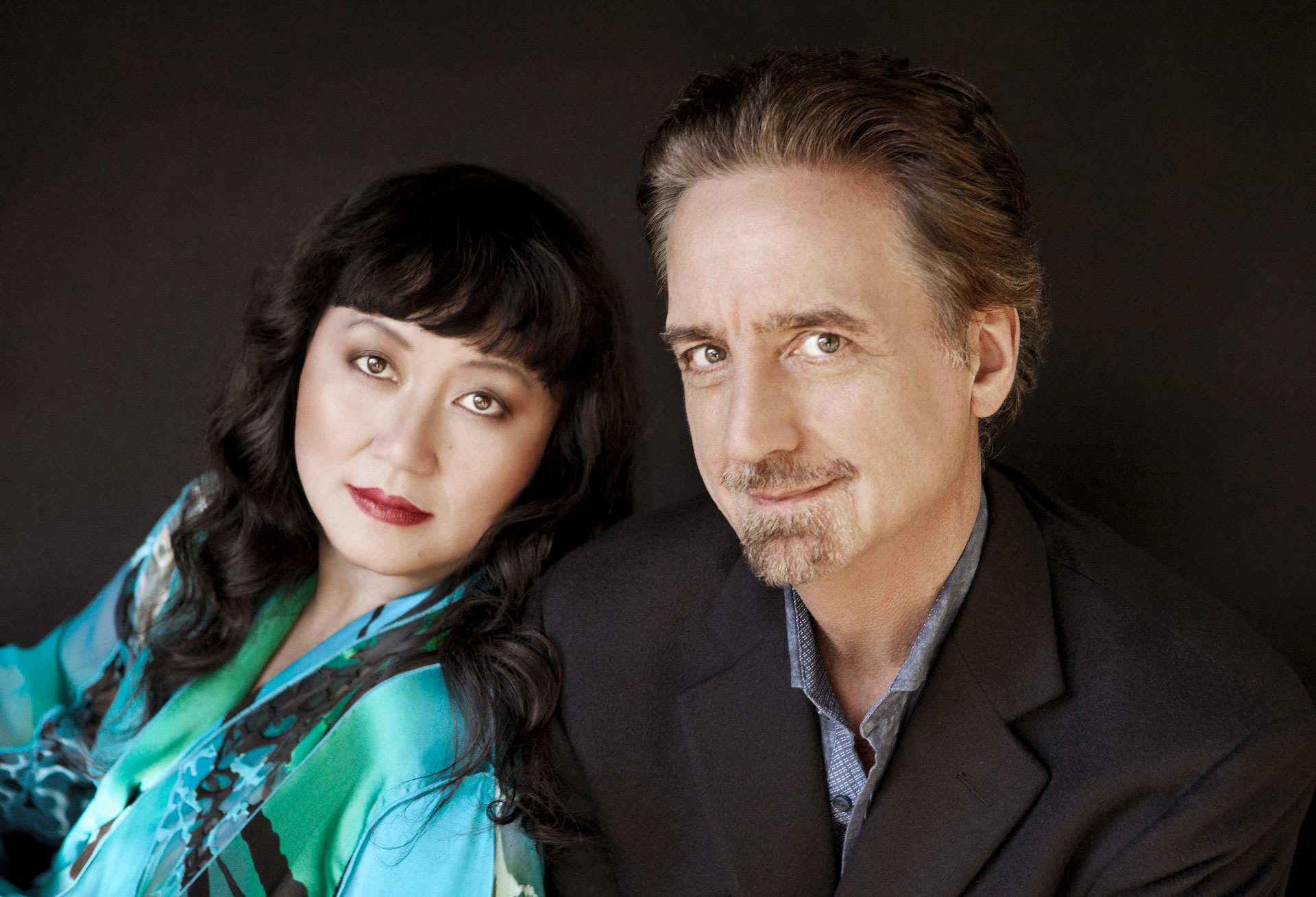 David Finckel and Wu Han are more than a duo who go around playing sonatas for cello and piano. Finckel was for many years the cellist of the renowned Emerson Quartet, and he left that group to spend more of his time playing other things, including recitals like this one, and to allow himself and Wu Han to focus further on their work as artistic administrators. They run the Music@Menlo festival out here in California every summer and also program the Chamber Music Society of Lincoln Center in NYC where they live. And they've been married for over 35 years. But they're both active as performers in their festivals, and they still play recitals also. I got to this one on Sunday in Hertz Hall at UC Berkeley - a favorite venue of theirs, Wu Han said in introducing the concert. It's a simple raked auditorium, small enough to project soloists to the top of the back where I was sitting, and the acoustics are good. It was pretty well packed for this concert.
Menlo concerts are usually for larger ensembles, but they're often like this: a lot of standard repertoire classics, something that ought to be a classic but you haven't heard it, and a bit of new music. Of the two 19th century works on this program, Brahms's Sonata No. 2 in F, Op. 99 is the standard, and Saint-Saëns's Sonata No. 1 in C minor, Op. 32 is the one I hadn't heard before. It's got more of the dark energy that animates a work like the Organ Symphony than do most of the other Saint-Saëns chamber works I've heard and consequently it could be as well German as French. Paradoxically it made the Brahms sound more superfluous than it does when played with the other Brahms cello sonata, Op. 38. Especially because of the similar procedure of each work's slow movement, with one instrument playing a lyric theme against a background of detached "raindrop" notes from the other. Saint-Saëns is more systematic about switching the two roles back and forth, and he's more clever and light-hearted about it, because who wouldn't be more of those things than Brahms? I like Brahms, but the Saint-Saëns was the more outstanding piece in this half.
Throughout both these works, Finckel kept the same sober, calm, rich and full tone coming out of his cello no matter what was going on, while Wu Han attacked the piano part with the animated blaze that always characterizes her playing.
The other half was more recent material. Shostakovich's Sonata in D minor, Op. 40 is actually an early work, just predating the first time the Soviet regime denounced his music, and consequently has a bit of an innocent air. This is especially obvious in the Largo, which is lyrical without the anguish that characterizes his later work. (A similar air suffused the encore, the Andante from Rachmaninoff's G minor Sonata, Op. 19, except that Rachmaninoff lets the piano go on a lot longer.) But Shostakovich's scherzo is every bit as violent as the later ones that are supposed to be portraits of Stalin, and the finale has the cheekiness that was in his work from the beginning. Wu Han gave this piece the same drive that she employed in the other works, while Finckel varied his cello tone more, giving a welcome expressiveness.
The concert was filled out with two movements from a work recently commissioned for these performers, Ephemeral Objects by Pierre Jalbert (US-American, Quebecois ancestry). The performers wanted a suite of seven movements contrasting sufficiently that any selection of them in any order could be put in a concert depending on what would fit. Jalbert went along with this utilitarian plan, and we heard two movements on Sunday: a slow one featuring Wu Han reaching into the piano to pluck or thump on the strings, and a jagged scherzo that outfoxed Shostakovich the way that Saint-Saëns outfoxed Brahms.
Have I conveyed just how skillful and experienced, in terms of knowing how to express the music, the playing was? This was a bit of a rarefied recital, though less so than some chamber music concerts I've heard at Hertz, but it was well worth the expedition into Berkeley for it.
Sunday, February 5, 2023
another useless list
Monarchs of England/Great Britain since the Conquest, in order of age at the time of accession.
0 Henry VI, 1422
9 Henry III, 1216; Edward VI, 1547
10 Richard II, 1377
12 Edward V, 1483
14 Edward III, 1327
18 Edward IV, 1461; Henry VIII, 1509; Victoria, 1837
21 Henry II, 1154
22 George III, 1760
23 Edward II, 1307
24 Charles I, 1625
25 Henry V, 1413; Elizabeth I, 1558; Elizabeth II, 1952
26 Mary II, 1689
26-31 William II, 1087 (birthdate uncertain)
28 Henry VII, 1485
30 Richard III, 1483; Charles II, 1660
31 Richard I, 1189; John, 1199
32 Henry I, 1100; Henry IV, 1399
33 Edward I, 1272
36 James I, 1603
37 Mary I, 1553; Anne, 1702
38 William I, 1066; William III, 1689
39 Stephen, 1135
40 George VI, 1936
41 Edward VIII, 1936
43 George II, 1727
44 George V, 1910
51 James II, 1685
54 George I, 1714
57 George IV, 1820
59 Edward VII, 1901
64 William IV, 1830
73 Charles III, 2022
Saturday, February 4, 2023
concert review: Remembering Geoff Nuttall
I've mentioned before about the death of Geoff Nuttall, first violinist of the Stanford-based St. Lawrence Quartet. He was one of those vital forces of nature who's really missed. Curious as to what the quartet was going to do about their next concert scheduled for Jan. 29, I checked their schedule and found they'd replaced it with a "Remembering Geoff Nuttall" event. I decided to go. It was ticketless but they asked for RSVPs, mostly to figure out what attendance would be. I signed up.
The day before the event, I got an e-mail from the sponsors. It said there would probably be more attendees than could fit in the hall. It said they'd put it on a screen in the lobby, and it also provided a private link to watch it at home. I'd been prepared to show up hours early and wait, but on this news I decided to stay home and watch it there. Good thing, too. It lasted 2.5 hours without intermission, and I favor breaks. I took one while some guy who did not identify himself was rambling on and on and on, and when I came back he was still rambling. I did miss the reception afterwards, but receptions with people I don't know personally have always been difficult for me, and tougher under covid.
There was a program list online with eleven musical items, and it turned out they were interleaved with talks between each pair of items. The first piece was a Haydn symphony movement with about 20 chamber musicians, all friends of Geoff - including all the other 6 people who've ever been long-time members of the St. Lawrence Quartet, one of them their first cellist who retired 20 years ago.
Then Geoff's wife, Livia Sohn, who was one of the violinists in the Haydn ensemble, stepped to a microphone and said that Geoff hadn't wanted a memorial but she talked him into permitting it. But he set a couple of conditions: nobody wears black - most had colorful shirts like Geoff himself liked to wear, and Livia was in a bright orange dress, his favorite color - and that there should be more music than talking.
That latter condition was not met. Some of the speakers went on awfully long. Others were good to hear from, like St. Lawrence violist Lesley Robertson, who unlike her colleagues never speaks to the audience at concerts. Some of what was said I jotted down and preserved in the review - really more a report - that I wrote for the Daily Journal and, if you can access it, is here.
Checking for other videos on Vimeo, I came across one recorded a couple years ago by Barry Shiffman, former second violinist with the quartet (he played in the memorial ensemble but didn't speak) talking about how the St. Lawrence would be appearing at some festival he runs (his main activity these days). And he said something about Geoff which captures his character:
There's nobody I know that loves the music of Joseph Haydn more than the first violinist of the St. Lawrence Quartet, Geoff Nuttall. There's an almost religious zeal that he has when he talks about Haydn. It's as though he knows him like his brother, like his best friend. And having been able to sit beside Geoff for years in the quartet, and feel that excitement that he has for this music, was one of the more exhilarating memories I have of my time in the quartet.There were no regular chamber ensemble pieces in the event. I think they wanted to avoid anything from which Geoff's absence would be too conspicuous. Livia was the only violinist who played a solo piece. There were a few cellists, and some singers. Besides a Purcell aria and a Rachmaninoff concert song, and the premiere of a Shelley setting by frequent St. Lawrence collaborator Osvaldo Golijov, who was there as was his piece (he's infamous for missing deadlines), there were a couple non-classical items. Tenor Paul Groves, who sang the Rachmaninoff, tried to rouse the audience up in "Don't Stop Believing" by Journey, but I don't know the song so I was unmoved. On the other hand, when Vienna Teng sat at the piano and sang her song "Level Up," despite her being unfamiliar to me I thought, I'd heard this song before. And yep, when I checked later I recognized having watched the video once, at somebody's recommendation. It was, in any case, appropriate for the Geoff Nuttall memorial, as it has the most determinedly upbeat lyrics of any song I've ever heard.
Friday, February 3, 2023
concert review: San Francisco Symphony
I'm not sure how to describe the piece I heard last night. The program notes call it a song cycle, but that's hardly an adequate description. Though the composer, Gabriel Kahane, is the son of conductor and pianist Jeffrey Kahane, his creative base is closer to popular music than classical, though this is not his first classical ensemble piece.
The title, pretentiously eschewing capital letters, is emergency shelter intake form, which sounds like some kind of post-nuclear holocaust hellscape, but it's actually a form that homeless people have to fill out to get a bed for the night, and that's what the piece is all about. The bulk of the text is questions from such a form, morphing into evocations of the emotional impact. "Have you ever been evicted? How many times? If yes, how did it feel to hold the pink paper as you stood in the melting snow where men in coveralls tossed your belongings onto the pavement?" This material was sung by mezzo Alicia Hall Moran, in an incongruously plummy tone, in a close to monotonic semi-chant. There was also a "Chorus of Inconvenient Statistics," three non-classical singers including the composer, who interjected into this, and also sang (as soloists) two long inserted songs, more in pop song style and with actual melodic content: one sarcastically attacking NIMBY opposition to affordable housing developments and the other telling the story of the sub-prime mortgage loan crisis, lengthily and incomprehensibly, as like all such tellings it assumes you already know what they're talking about. (e.g. "Say you've got yourself a pile of different loans ..." but who is "you"? It never says.)
Leaving aside the rants, the material in bureaucratic format, with the cruel conclusion ("For enduring this and more" we're offering you a bed for tonight "in a concrete church basement ... You will need to be gone by 6:30 AM") is an effectively bleak evocation of life at that level. The tone is similar to that of John Scalzi's piece "Being Poor." Overall, yes, it was an effective message work.
The orchestral accompaniment is in a style hard to describe. Except for a few deliberately dissonant spots, it's thoroughly tonal, but it's not like any other music I'm familiar with. It might be said to be distantly descended from mid-20C American nationalist music.
It lasted close to an hour, which isn't quite enough for an evening symphony concert, so they paired it with Gershwin's Concerto in F. The orchestra, led by Edwin Outwater, did well enough, but it was pianist Conrad Tao who really had the Gershwin swing. The music brightened up considerably whenever he began playing.
Wednesday, February 1, 2023
all sketchy ideas are contained in ...
I'm thinking of taking a trip. This would probably be in late May. This trip would require airplanes, two of them in each direction, with a layover. About 9 hours with the layover.
What I'd like the group wisdom on is, would this be a reasonable risk for somebody like myself - no longer young, no longer in robust health, and thus accordingly more vulnerable - to take who has not had the Covid and wishes not to get it?
I'm less concerned about another trip I'm thinking of with a short, single-hop flight, but the problems with this one are the 3 airports in each direction instead of 2 - I'm told the airports are more risky than the flights - and that I wouldn't be able to keep my mask on at all times, because I can't spend 12 hours (the effective length of the trip) without eating.
My heart wants to take this trip, but my head is skeptical of its feasibility. What do you think?
Subscribe to:
Posts (Atom)