Box score:
1st. Poiesis Quartet
2nd. Arete Quartet
3rd. Quartet KAIRI
And so it's over. A couple hours after the end of last night's final concert of the Banff International String Quartet Competition with all the competitors, the three finalists were announced. (The one time I saw this happen in person, the director just got up before a microphone at the campus bistro, where a lot of us were hanging out for the evening.) That led to a concert this afternoon with each of the three finalists taking a long set, and then after a couple more hours of cogitation, the formal announcement of the three-place results, this one on the concert hall stage with a lot of applause and handing out of certificates.
In past years, the finalist round has consisted of a full performance of a major Beethoven or Schubert quartet, but this year they moved the ad lib round into that place. Each finalist had 45 minutes to play whatever they wanted for string quartet, subject only to the provisios that 1) they had to include at least three different composers, 2) at least full movements, no excerpts, 3) nothing they'd previously played during the festival, 4) though they could choose works by any connecting principle or none, they had to write an essay explaining why they'd made that selection. These essays were distributed to the in-person audience as program inserts, but if they made it onto the website, I couldn't find it.
So here are the finalists, what I thought of their earlier performances, what they played in the finalist round and how it came out.
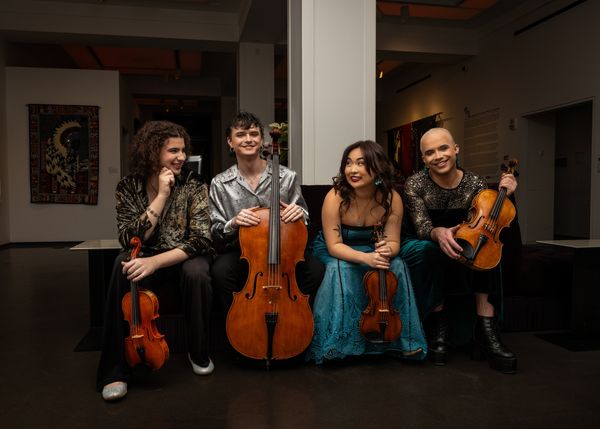
First place, winner of the 2025 competition, is the Poiesis Quartet, and I have to say I'm very pleased. I thought they were by far the best of the three finalists. Particularly fine were their outstanding Brahms and extremely good Bartók. I also liked their playful Haydn and their dramatic Beethoven. The only thing I found disappointing was their 21st century selection, which they may have played well but which was not interesting music. They were at least the most interesting looking of all the competitors. They eschewed standard concert wear entirely, and their dress and grooming were ... well, this photo gives a good idea. They also use more gender-neutral pronouns than all the other competitors put together. They're Americans who are all graduates of the Oberlin Conservatory, and it's been suggested they may have picked up some of their style there, or maybe that's the appeal that's the reason they went there.
Poiesis's finalist recital was also all living 21st century composers, but it came out very differently from the earlier round. All four of these works were very interesting, even at times captivating, if not ingratiating. Two of them were basically quiet. Jerod Impichchaachaaha' Tate is a composer of the Chickasaw Nation, whose work I've heard done by the Oakland Symphony. His Pisachi has some fast and dramatic sections, but is mostly slow held notes with a strong folk flavor perhaps inherited from the composer's people. An even more hushed piece titled Phosphorescent Sea was well described by its title. Its composer was Joe Hisaishi, much older than the other composers on Poiesis's list and best known as the house composer for Hayao Miyazaki's films. Brian Raphael Nabors, an African-American composer who's also going to be done by Oakland, offered the first faster piece, a quartet that's brisk and snappy, bristling with colorful effects. The Seventh Quartet by Kevin Lau, Canadian of Chinese birth, was also fast and lively if less colorful than Nabors. These were all strongly and intelligently played and well sold by the Poiesis Quartet.
Second place goes to the Arete Quartet, two women and two men from Korea. They did a fine Schumann, and I also liked their clean and elegant Haydn. They did a lively job on their 21st century selection, but I disliked the piece. But I found their Schubert wanting in coherence and their Berg bloodless and enervating; they got very bad ratings from me for those.
For the finalist round, Arete picked a more conventional 20C program, Britten's Three Divertimenti and the same Janáček First Quartet that Kairi and Cong already did. Arete went even further than Cong on this one, building up the dissonant squawks and sounding as if the consonant passages existed only to increase the contrast. And to provide a third composer, Arete played the Mozart movement whose weird introduction gives the K. 465 quartet the nickname "Dissonant."
Third place goes to Quartet KAIRI, which I'm not going to use the capital letters on all the time. This group consists of four men. They're Japanese or Chinese by origin, but they're all studying in Salzburg now, so they consider that their home base. Their best performance was their thick and resonant Haydn; they won a special prize for the best Haydn performance of the round. Their Mendelssohn and Schubert seemed to me adequate but not the outstanding work you expect here, and their Janáček First was the opposite of Arete, attempting to dampen down the dissonance in defiance of the composer's intent. Their 21C piece was a piece of retro modernism of the sort I find undesirable.
Kairi's finalist round, like Arete's, consisted of two standard 20th century works leavened with a little Mozart. One of the pieces was Landscape by Toru Takemitsu, whose shows its old modernist character by making its sound sheets full of stringent dissonance. Tate and Hisaishi don't do that. More to my taste was Shostakovich's Eighth Quartet, but I had a harder time parsing their slow and gentle approach to the outer movements. The Mozart was two movements from K. 575, one of the Prussian Quartets.

Kalimac's corner: a journal by DB
Sunday, August 31, 2025

Saturday, August 30, 2025
BISQC, day 6
The last round of the Banff International String Quartet Competition before the nine competitors are trimmed to three finalists was today. And it took pretty much all of today to play it.
Each contestant had to play 1) the first movement only of one of the big & great Beethoven or Schubert quartets: in practice, it was one of Beethoven's three Op. 59 quartets commissioned by Count Razumovsky, or one of Schubert's three last quartets; 2) a modern 20th century quartet selected from a curated list.
Magenta gave the First Razumovsky a strong and dedicated reading, while Viatores rendered it more crabbed and contrapuntal. Hana did the only Second Razumovsky, making it brisk and compact. Poiesis made the Third Razumovsky, like Magenta's First, big and dramatic, while Elmire's was more relaxed and expansive. For the Schuberts, Cong played the Rosamunde slowly and as gently as the music would permit. (Disaster struck when the violist broke a string just before the second theme. They stopped, left the stage, came back five minutes later and started over, even more slowly than before.) Kairi in Death and the Maiden were good but a little dry. Arete's G Major was frustrating: quiet parts were so slow and soulful as to lose the thread, while the dramatic parts were so frantic as to lose the thread in the other direction. Nerida also played the G Major, and they got the balance right, as well as equipping the piece with effective fluttering sounds for tremolos.
For the modern round, 3 of the 9 competitors chose a Bartók quartet. (My first time, it was 8 of 10.) Of these, the best was Poiesis's Fifth. It was wild and woolly and quite daring, fit to occupy a minor place among the great Banff Bartók performances of the past. Or at least what I heard of it was: a large part was ripped out of my livestream by an internet connection failure, and the recording isn't yet up on the website as I write. Elmire in the Second was interesting, finding an amazing amount of melodic grace in it but not neglecting that it's not all like that. And Hana's Third was just a typical Bartók performance, impressive but not exciting or ingratiating.
Two quartets picked another Banff modern favorite, Janáček's First. Kairi was determined to make it as lyrical as possible, even dampening out the dissonant squawks that litter parts of the piece. As with Nerida in Schubert, somebody else got the balance right: this time it was Cong, who were even lusher in places, but that only made for the better contrast between the elements.
The other four picked singletons. Of these, by far the best - to my considerable surprise, both because this group has been iffy and normally I detest this piece - was the Magenta in Ligeti's First. They found coherence in this random collection of ticks, and they made it fun to listen to. Nerida in Britten's First was impressive in this odd experimental composition, ranging from spooky to exciting. Hindemith's Fifth is the only one I'd never heard before, a cross between his early modernist and mid-period academic music which the Viatores seemed to handle pretty well. The disappointment was the Arete in Berg's Lyric Suite. I know this piece can be attractive, but their version was just cold and alienating atonality with no redeeming features.
The three finalists will probably be announced about an hour from now. Toting up my evaluations, I'd vote for Nerida and Poiesis, with probably Elmire or perhaps Magenta for a third. Based on past experience, maybe one of those will actually make it. The judges' criteria are different from mine.
ETA: The finalists are Arete, Kairi, and Poiesis. I'll have more to say about those choices in Sunday's post.
Each contestant had to play 1) the first movement only of one of the big & great Beethoven or Schubert quartets: in practice, it was one of Beethoven's three Op. 59 quartets commissioned by Count Razumovsky, or one of Schubert's three last quartets; 2) a modern 20th century quartet selected from a curated list.
Magenta gave the First Razumovsky a strong and dedicated reading, while Viatores rendered it more crabbed and contrapuntal. Hana did the only Second Razumovsky, making it brisk and compact. Poiesis made the Third Razumovsky, like Magenta's First, big and dramatic, while Elmire's was more relaxed and expansive. For the Schuberts, Cong played the Rosamunde slowly and as gently as the music would permit. (Disaster struck when the violist broke a string just before the second theme. They stopped, left the stage, came back five minutes later and started over, even more slowly than before.) Kairi in Death and the Maiden were good but a little dry. Arete's G Major was frustrating: quiet parts were so slow and soulful as to lose the thread, while the dramatic parts were so frantic as to lose the thread in the other direction. Nerida also played the G Major, and they got the balance right, as well as equipping the piece with effective fluttering sounds for tremolos.
For the modern round, 3 of the 9 competitors chose a Bartók quartet. (My first time, it was 8 of 10.) Of these, the best was Poiesis's Fifth. It was wild and woolly and quite daring, fit to occupy a minor place among the great Banff Bartók performances of the past. Or at least what I heard of it was: a large part was ripped out of my livestream by an internet connection failure, and the recording isn't yet up on the website as I write. Elmire in the Second was interesting, finding an amazing amount of melodic grace in it but not neglecting that it's not all like that. And Hana's Third was just a typical Bartók performance, impressive but not exciting or ingratiating.
Two quartets picked another Banff modern favorite, Janáček's First. Kairi was determined to make it as lyrical as possible, even dampening out the dissonant squawks that litter parts of the piece. As with Nerida in Schubert, somebody else got the balance right: this time it was Cong, who were even lusher in places, but that only made for the better contrast between the elements.
The other four picked singletons. Of these, by far the best - to my considerable surprise, both because this group has been iffy and normally I detest this piece - was the Magenta in Ligeti's First. They found coherence in this random collection of ticks, and they made it fun to listen to. Nerida in Britten's First was impressive in this odd experimental composition, ranging from spooky to exciting. Hindemith's Fifth is the only one I'd never heard before, a cross between his early modernist and mid-period academic music which the Viatores seemed to handle pretty well. The disappointment was the Arete in Berg's Lyric Suite. I know this piece can be attractive, but their version was just cold and alienating atonality with no redeeming features.
The three finalists will probably be announced about an hour from now. Toting up my evaluations, I'd vote for Nerida and Poiesis, with probably Elmire or perhaps Magenta for a third. Based on past experience, maybe one of those will actually make it. The judges' criteria are different from mine.
ETA: The finalists are Arete, Kairi, and Poiesis. I'll have more to say about those choices in Sunday's post.
Friday, August 29, 2025
BISQC, day 5
The most exotic part of the Banff International String Quartet Composition comes in the Canadian Commission round. The idea of this round is to face the performers with a work for which they have no previous knowledge or preconceptions whatever. The organizers of this Canadian festival commission a Canadian composer - a different one each time - to write a 9-minute work for string quartet which all the competing groups play in a single marathon concert.
Sitting through one of these events - and this is the fourth time I've done it, twice in person and twice livestreamed - is quite an experience. Despite the brevity of the composition, it takes close to 3 hours to do it. And there isn't much music, however agreeable, that you really want to hear nine or ten times in a row. This time, at least, I did enjoy the piece, and despite weariness I did like it better the more I heard it. The fun comes in evaluating the nine or ten different approaches to the music.
The music was Rapprochement (String Quartet No. 3) by Kati Agócs (pronounced a-goach, rhymes with coach). It's a largely consonant piece, more focused on ensemble work than solos, filled with melodic phrases, lots of rising glissandi, and outbreaks of snappy rhythm. The composer says, "The score leaves lots of room for the players to shape nuances of dynamics, articulation, balances and color, and it calls upon the four individuals to play transcendently as one."
What I found was that the big division was between the groups that did "play transcendently as one," with a rich unified sound, and those who played in a more separated, transparent style. I found the former gave off the air in some passages of Glassian minimalism, while Lisa of the Iron Tongue, with whom I've been having postmortem conversations about the concerts, heard in the second group occasional echoes of Debussy and Stravinsky, which fits with my impression of the air if not the compositional style of high modernism, quite different from the more unified performers.
What mystified Lisa was that the performances ranged in length from 8 to 9 1/2 minutes, an unusually large range for such a short work. We didn't have the score to study; were there sections marked as optional? There were things I heard in some performances but not in others; did I just miss them, due perhaps to differences in style, or were they cut out?
Combining my evaluations with those of Lisa and Bruce H., the other participant in our conversations, I'd say the most unified performance, evidently what the composer intended, was from the Nerida, with a similar approach from Viatores and Elmire. The Arete, Cong, and Hana were more detached or transparent. Magenta was perhaps somewhere in between. The liveliest and wittiest performance came from Kairi, and the most intensely emotional from Poiesis.
Sitting through one of these events - and this is the fourth time I've done it, twice in person and twice livestreamed - is quite an experience. Despite the brevity of the composition, it takes close to 3 hours to do it. And there isn't much music, however agreeable, that you really want to hear nine or ten times in a row. This time, at least, I did enjoy the piece, and despite weariness I did like it better the more I heard it. The fun comes in evaluating the nine or ten different approaches to the music.
The music was Rapprochement (String Quartet No. 3) by Kati Agócs (pronounced a-goach, rhymes with coach). It's a largely consonant piece, more focused on ensemble work than solos, filled with melodic phrases, lots of rising glissandi, and outbreaks of snappy rhythm. The composer says, "The score leaves lots of room for the players to shape nuances of dynamics, articulation, balances and color, and it calls upon the four individuals to play transcendently as one."
What I found was that the big division was between the groups that did "play transcendently as one," with a rich unified sound, and those who played in a more separated, transparent style. I found the former gave off the air in some passages of Glassian minimalism, while Lisa of the Iron Tongue, with whom I've been having postmortem conversations about the concerts, heard in the second group occasional echoes of Debussy and Stravinsky, which fits with my impression of the air if not the compositional style of high modernism, quite different from the more unified performers.
What mystified Lisa was that the performances ranged in length from 8 to 9 1/2 minutes, an unusually large range for such a short work. We didn't have the score to study; were there sections marked as optional? There were things I heard in some performances but not in others; did I just miss them, due perhaps to differences in style, or were they cut out?
Combining my evaluations with those of Lisa and Bruce H., the other participant in our conversations, I'd say the most unified performance, evidently what the composer intended, was from the Nerida, with a similar approach from Viatores and Elmire. The Arete, Cong, and Hana were more detached or transparent. Magenta was perhaps somewhere in between. The liveliest and wittiest performance came from Kairi, and the most intensely emotional from Poiesis.
Thursday, August 28, 2025
BISQC, days 3-4
In three concerts, two yesterday and one this morning, the nine contestants in the Banff International String Quartet Competition got through their second round, each playing one work of their choice from the 19th-century Romantic-era repertoire.
The most interesting contrasts came from paired works by the same composer. Claude Debussy wrote only one quartet, and his was the only single work played twice. If you like Debussy, you would have preferred the Viatores Quartet version, full of the lush, exotic Debussy sound. If, however, you prefer something drier, you might have liked the Cong Quartet, which played it strong and heavy part of the way but reverted to standard Debussy in the second half. I'm not a Debussy fan and wasn't really thrilled by either.
I do like Robert Schumann, however, and here we had a vehement contrast. Quatuor Magenta played his First Quartet with surprising vehemence, tough and even brutal. The one thing it didn't do was sound anything like Schumann. I found it very impressive in its own way, but less sure it was a way worth pursuing. The Arete Quartet, on the other hand, played a Third Quartet that sounded just like Schumann. It was slow and romantic in approach, and it had soul. The fast loud passages achieved intensity without vehemence, just to prove after Magenta that it could be done.
There were four quartets by Felix Mendelssohn. The big contrast here was between two quartets from his Op. 44 set. No. 3 from the Nerida Quartet was an ideal performance. Their Haydn had been lively and bustling, and their Mendelssohn was also lively and bustling in the same spirit. That works for Mendelssohn, and this was an outstanding job. Quatuor Elmire in No. 2 also did a good job, but their style seemed fussy and mechanical coming immediately after the Nerida. It wasn't bad, it just faded in comparison.
As for the other Mendelssohns, both Quartet Kairi in Op. 13 and Quartett Hana in Op. 80 were very good, Hana tighter in execution, Kairi a little sloppy except in the slow movement, which was their best part. My problem is that both these works have been spoiled for me by hearing truly great performances of each in the past that have stuck in my head, and however good you may be, if you can't match those it's going to sound like weak tea to me. Kairi was further cursed by a mishap not of their own making. Op. 13 begins with an introduction of slow, soft chords which repeat at the end. And both occurrences were marred by cell phones going off. And this after the competition director had, introducing the concert, warned yet again to turn those buggers off.
If the Nerida got second place in my ratings for the best performances of the round, first place definitely went to the one remaining entrant: the Poeisis Quartet in Johannes Brahms's Op. 67. I am a great partisan of Brahms chamber music, except for his string quartets which I find most performances of to be bland and rather boring. Not this one. It was lively and exciting, and most importantly it sounded like it was written by the same composer whose next opus would be his dramatic and intensely characterful First Symphony. This had that same character. It was, hands down, the best Brahms quartet performance I have ever heard.
Poeisis and Nerida both did among the best of the Haydn round. They're the best here. I'll be especially looking out for their work in the next two rounds.
The most interesting contrasts came from paired works by the same composer. Claude Debussy wrote only one quartet, and his was the only single work played twice. If you like Debussy, you would have preferred the Viatores Quartet version, full of the lush, exotic Debussy sound. If, however, you prefer something drier, you might have liked the Cong Quartet, which played it strong and heavy part of the way but reverted to standard Debussy in the second half. I'm not a Debussy fan and wasn't really thrilled by either.
I do like Robert Schumann, however, and here we had a vehement contrast. Quatuor Magenta played his First Quartet with surprising vehemence, tough and even brutal. The one thing it didn't do was sound anything like Schumann. I found it very impressive in its own way, but less sure it was a way worth pursuing. The Arete Quartet, on the other hand, played a Third Quartet that sounded just like Schumann. It was slow and romantic in approach, and it had soul. The fast loud passages achieved intensity without vehemence, just to prove after Magenta that it could be done.
There were four quartets by Felix Mendelssohn. The big contrast here was between two quartets from his Op. 44 set. No. 3 from the Nerida Quartet was an ideal performance. Their Haydn had been lively and bustling, and their Mendelssohn was also lively and bustling in the same spirit. That works for Mendelssohn, and this was an outstanding job. Quatuor Elmire in No. 2 also did a good job, but their style seemed fussy and mechanical coming immediately after the Nerida. It wasn't bad, it just faded in comparison.
As for the other Mendelssohns, both Quartet Kairi in Op. 13 and Quartett Hana in Op. 80 were very good, Hana tighter in execution, Kairi a little sloppy except in the slow movement, which was their best part. My problem is that both these works have been spoiled for me by hearing truly great performances of each in the past that have stuck in my head, and however good you may be, if you can't match those it's going to sound like weak tea to me. Kairi was further cursed by a mishap not of their own making. Op. 13 begins with an introduction of slow, soft chords which repeat at the end. And both occurrences were marred by cell phones going off. And this after the competition director had, introducing the concert, warned yet again to turn those buggers off.
If the Nerida got second place in my ratings for the best performances of the round, first place definitely went to the one remaining entrant: the Poeisis Quartet in Johannes Brahms's Op. 67. I am a great partisan of Brahms chamber music, except for his string quartets which I find most performances of to be bland and rather boring. Not this one. It was lively and exciting, and most importantly it sounded like it was written by the same composer whose next opus would be his dramatic and intensely characterful First Symphony. This had that same character. It was, hands down, the best Brahms quartet performance I have ever heard.
Poeisis and Nerida both did among the best of the Haydn round. They're the best here. I'll be especially looking out for their work in the next two rounds.
Wednesday, August 27, 2025
Tolkien Studies 21: an announcement
On behalf of myself and my co-editors, Michael D.C. Drout and Yvette Kisor, here are the expected contents of volume 21 of the journal Tolkien Studies: An Annual Scholarly Review. This issue will be dated 2024; we know we're behind. All of the works are now in the hands of our publisher, West Virginia University Press, and the volume is scheduled to be published in softcover and on Project MUSE in a few months. - David Bratman, co-editor
Tolkien Studies 21 (2024)
**
**
Notes and Documents
**
Book Reviews
**
Tolkien Studies 21 (2024)
- Alexandra Bolintineanu, "Tolkien's Elegiac Trees: Enta Geweorc and the Ents Across Time"
- Patrick J. Murphy, "The Riddles of The Hobbit, the Academic History of the Exeter Book, and the Invention of Tolkien's Ring"
- Anika Jensen, "'I Wonder If Any Song Will Ever Mention It': Locating Precarious Time in The Lord of the Rings"
- Eduardo Boheme Kumamoto, "The Allegiant Translator: J.R.R. Tolkien, Burton Raffel, and Verse Translation"
- John Garth and Peter Gilliver, "The Wanderer's Return: New Findings on Tolkien in Oxford 1918-19"
- Claudio A. Testi, "From 'The Tree' to 'Leaf by Niggle': Up to the Mountains and Beyond"
- Peizhen Wu and Michael D.C. Drout, "'The Course of Actual Composition': Analysis of some aspects of the revision history of The Lord of the Rings using 'Lexomic' digital methods"
- Łukasz Neubauer, "The 'Origin of Gandalf': Josef Madlener's Der Berggeist and the Transboundary Mountain Spirit Rübezahl as Purported Sources of Inspiration for Tolkien's Wizard"
- Matthew Thompson-Handell, "Reconsidering the Early Critical Response to The Lord of the Rings"
- Tolkien, Race, and Racism in Middle-earth, by Robert Stuart, reviewed by Yvette Kisor
- Representing Midle-earth: Tolkien, Form, and Ideology, by Robert T. Tally, Jr., reviewed by Douglas C. Kane
- Pity, Power, and Tolkien's Ring: To Rule the Fate of Many, by Thomas P. Hillman, reviewed by Clare Moore
- Theology and Tolkien: Practical Theology, ed. Douglas Estes, reviewed by Nick Polk
- How to Misunderstand Tolkien: The Critics and the Fantasy Master, by Bruno Bacelli, reviewed by Lori Campbell-Tanner
- Cami D. Agan, David Bratman, The Rev. Tom Emanuel, Jonathan Evans, Jason Fisher, and John Magoun, "The Year's Work in Tolkien Studies 2021"
- David Bratman, "Bibliography (in English) for 2022"
- Errata: TS 18
Tuesday, August 26, 2025
BISQC, day 2
Today at the Banff International String Quartet Competition, which I'm watching livestream, the other five competitors who didn't play yesterday got their turns to play one Haydn quartet and one work from the 21st century.
The Haydns spanned the range of aesthetic approach. The Cong Quartet (so named because they're from Hong Kong - I guess if they spelled it "Kong" people would think they were from Skull Island) played Op. 33/2, known as the "Joke" Quartet for its infamous fake-out ending, and they played it jokily. They got into the rhythmic swing of the work, all the way through and not just in the finale, and found the lively Haydn spirit there. The Poeisis Quartet in Op. 71/2 also caught the playfulness and spark of the music, though their approach was not especially witty, unlike the Cong or yesterday's Nerida.
The other three were more serious. Quartet KAIRI brought crispness and clarity to Op. 74/1. Their playing was rich, smooth, and resonant, even buttery. The Arete Quartet played the relatively early Op. 20/2 as if it were less a Sturm & Drang work than a Baroque one, clean and elegant, the more so as it has a fugue for a finale, here hushed and intricate. But by far the most serious-minded, sober and plain performance was Quatuor Magenta (pronounced MAH-zhen-tah - they're French) in Op. 76/3. This is the "Emperor" Quartet, the one whose slow movement is variations on a Haydn theme written as a hymn to the Holy Roman Emperor, and which eventually became "Deutschland über alles," as a result of which hardly anyone plays the quartet any more. So due credit to a French ensemble - of four women, yet - for taking it up.
Of the 21st century works, none really appealed to me, though at least they all sounded different, unlike the last festival where they all seemed much of a muchness. The most enjoyable was the Cong's performance of Quartet No. 7 by Lawrence Dillon. A clever and strongly rhythmic work, with lots of whining calls for individual instruments above the chattering of the group. Something similar was the case with Magenta in Pascal Dusapin's Quartet No. 5 - yes, that's the third time this piece has come up in two days. Magenta's rendition seemed more haunting and abstract than the Elmire's yesterday.
Kairi did Floral Fairy by Toshio Hosokawa, which put a wispy sound with lots of harmonics at the service of an abrupt, random, detached style that was far too reminiscent of Webern. This is the sort of modernism that I'd hoped was dead by now. And I can't say much more for Many Many Cadences by Sky Macklay, from Poeisis. With some variances later on, this consists of an endless repetition of a jerky descending motif ending in the tonic, so yeah it's a cadence though it doesn't approach it through a conventional harmonic sequence. And even less for the Arete's choice of Jörg Widmann's Hunting Quartet, which we also heard yesterday, the only difference being that, for this work requiring waving bows around a lot, the Arete's violins and viola, unlike yesterday's Viatores, stood up to play this piece.
Next up is a round from the romantic-era repertoire, with the nine quartets playing seven different pieces. This will also be spread over two days, but I probably won't write it up until it finishes on Thursday.
The Haydns spanned the range of aesthetic approach. The Cong Quartet (so named because they're from Hong Kong - I guess if they spelled it "Kong" people would think they were from Skull Island) played Op. 33/2, known as the "Joke" Quartet for its infamous fake-out ending, and they played it jokily. They got into the rhythmic swing of the work, all the way through and not just in the finale, and found the lively Haydn spirit there. The Poeisis Quartet in Op. 71/2 also caught the playfulness and spark of the music, though their approach was not especially witty, unlike the Cong or yesterday's Nerida.
The other three were more serious. Quartet KAIRI brought crispness and clarity to Op. 74/1. Their playing was rich, smooth, and resonant, even buttery. The Arete Quartet played the relatively early Op. 20/2 as if it were less a Sturm & Drang work than a Baroque one, clean and elegant, the more so as it has a fugue for a finale, here hushed and intricate. But by far the most serious-minded, sober and plain performance was Quatuor Magenta (pronounced MAH-zhen-tah - they're French) in Op. 76/3. This is the "Emperor" Quartet, the one whose slow movement is variations on a Haydn theme written as a hymn to the Holy Roman Emperor, and which eventually became "Deutschland über alles," as a result of which hardly anyone plays the quartet any more. So due credit to a French ensemble - of four women, yet - for taking it up.
Of the 21st century works, none really appealed to me, though at least they all sounded different, unlike the last festival where they all seemed much of a muchness. The most enjoyable was the Cong's performance of Quartet No. 7 by Lawrence Dillon. A clever and strongly rhythmic work, with lots of whining calls for individual instruments above the chattering of the group. Something similar was the case with Magenta in Pascal Dusapin's Quartet No. 5 - yes, that's the third time this piece has come up in two days. Magenta's rendition seemed more haunting and abstract than the Elmire's yesterday.
Kairi did Floral Fairy by Toshio Hosokawa, which put a wispy sound with lots of harmonics at the service of an abrupt, random, detached style that was far too reminiscent of Webern. This is the sort of modernism that I'd hoped was dead by now. And I can't say much more for Many Many Cadences by Sky Macklay, from Poeisis. With some variances later on, this consists of an endless repetition of a jerky descending motif ending in the tonic, so yeah it's a cadence though it doesn't approach it through a conventional harmonic sequence. And even less for the Arete's choice of Jörg Widmann's Hunting Quartet, which we also heard yesterday, the only difference being that, for this work requiring waving bows around a lot, the Arete's violins and viola, unlike yesterday's Viatores, stood up to play this piece.
Next up is a round from the romantic-era repertoire, with the nine quartets playing seven different pieces. This will also be spread over two days, but I probably won't write it up until it finishes on Thursday.
Monday, August 25, 2025
BISQC, day 1
It's time for the triennial Banff International String Quartet Competition, and I am not there in the Canadian Rockies, I'm at home watching/listening to the concerts on livestream.
For today's concerts, four of the competing quartets played one Joseph Haydn quartet and one work from the 21st century - it's a quarter-over now, there's enough music to choose from. Each work was of the group's choice. Tomorrow, the other five groups will have their chance.
What's great about listening to Haydn at Banff is that all the groups are good, but for different definitions of what's good. They all had distinctive styles. I was particularly impressed by the Quatuor Elmire in Op. 76/5. It was an old-fashioned performance, but sumptuously beautiful, especially the slow movement. Those tend to be the dull spots in Haydn performances, but here it was the highlight for elegance. The minuet also, courtly and graceful, and the rest of the same caliber.
But the best was probably the Nerida Quartet in Op. 54/2. They were the ones who found the wit and joy in Haydn, bouncing it along in a lively manner. Their slow movement was of organ-like sonorities behind first violin Jeffrey Armstrong presenting some spectacular displays. The Neridas looked like they were enjoying themselves, too, which is not an insignificant contribution to the whole, especially those lively facial expressions on second violinist Saskia Niehl.
The Viatores Quartet had a light and airy approach, particularly unusual since their work, Op. 33/1, is in a minor key. Except for the fast part of the finale, where they alternated between that style and a darker and grittier one. The Quartett HANA played Op. 74/1 in a more modern, rougher style, but they came first and I missed that part of the livestream, only watching it later on repeat, and by that time I was getting tired, so I didn't really absorb it.
The Elmire, who are French, chose a French composition for their 21C piece, the Fifth Quartet of Pascal Dusapin. I don't know his work, but it seemed to me that they brought the same sweet and gentle approach, rather against the grain of the music. This microtonal and rather querulous work was worth hearing once, but not twice. The HANA, on the same concert, also played it, but I skipped out on their rendition.
Nerida won my favor by playing Caroline Shaw's Entr'acte. I've heard this before, and Shaw is one of my favorite living composers. This performance seemed to me to emphasize the minimalist roots, with violist Grace Leehan sawing away in a Philip Glass style while the rest played holding chord sequences.
But the Viatores dismayed me with Jörg Widmann's Hunting Quartet. I'd heard this at BISQC once before, nine years ago when I was there in person. I thought this parody of 18C music consisting of making the instruments play very badly was a worthless piece of merde the first time, and my opinion hasn't gone up much. Widmann is not always a bad composer: it's just that he likes to follow entirely different compositional procedures on successive pieces, and this one didn't work.
I'm excited with what's in store for tomorrow.
For today's concerts, four of the competing quartets played one Joseph Haydn quartet and one work from the 21st century - it's a quarter-over now, there's enough music to choose from. Each work was of the group's choice. Tomorrow, the other five groups will have their chance.
What's great about listening to Haydn at Banff is that all the groups are good, but for different definitions of what's good. They all had distinctive styles. I was particularly impressed by the Quatuor Elmire in Op. 76/5. It was an old-fashioned performance, but sumptuously beautiful, especially the slow movement. Those tend to be the dull spots in Haydn performances, but here it was the highlight for elegance. The minuet also, courtly and graceful, and the rest of the same caliber.
But the best was probably the Nerida Quartet in Op. 54/2. They were the ones who found the wit and joy in Haydn, bouncing it along in a lively manner. Their slow movement was of organ-like sonorities behind first violin Jeffrey Armstrong presenting some spectacular displays. The Neridas looked like they were enjoying themselves, too, which is not an insignificant contribution to the whole, especially those lively facial expressions on second violinist Saskia Niehl.
The Viatores Quartet had a light and airy approach, particularly unusual since their work, Op. 33/1, is in a minor key. Except for the fast part of the finale, where they alternated between that style and a darker and grittier one. The Quartett HANA played Op. 74/1 in a more modern, rougher style, but they came first and I missed that part of the livestream, only watching it later on repeat, and by that time I was getting tired, so I didn't really absorb it.
The Elmire, who are French, chose a French composition for their 21C piece, the Fifth Quartet of Pascal Dusapin. I don't know his work, but it seemed to me that they brought the same sweet and gentle approach, rather against the grain of the music. This microtonal and rather querulous work was worth hearing once, but not twice. The HANA, on the same concert, also played it, but I skipped out on their rendition.
Nerida won my favor by playing Caroline Shaw's Entr'acte. I've heard this before, and Shaw is one of my favorite living composers. This performance seemed to me to emphasize the minimalist roots, with violist Grace Leehan sawing away in a Philip Glass style while the rest played holding chord sequences.
But the Viatores dismayed me with Jörg Widmann's Hunting Quartet. I'd heard this at BISQC once before, nine years ago when I was there in person. I thought this parody of 18C music consisting of making the instruments play very badly was a worthless piece of merde the first time, and my opinion hasn't gone up much. Widmann is not always a bad composer: it's just that he likes to follow entirely different compositional procedures on successive pieces, and this one didn't work.
I'm excited with what's in store for tomorrow.
Sunday, August 24, 2025
Guy H. Lillian III
A noted science-fiction fan from my day in the field died yesterday at 76. Guy was best-known for his large genzine (general-interest SF fanzine) Challenger, named in memory of the most infamous motor vehicle accident ever to occur in the state of Florida, where Guy was living at the time. It was a regular Hugo nominee for Best Fanzine during roughly the 2000-10 decade.
Before Guy was a genzine publisher, he was other things. He started as a comic book letterhack in the late 1960s, but a decade later I encountered him during his period as a prolific apahack (contributor to amateur press associations). Lists of apas he belonged to are long, but they usually exclude Lasfapa, which is the one he and I both belonged to. Guy was very active, he wrote long zines, but I never felt he really participated in the interpersonal conversations. A lot of us in the apa hung out together at conventions, but I never saw Guy there, and indeed, though he and I were occasionally in the same place at the same time, I don't think we ever actually met. I was surely a very minor figure from his point of view, so I never attempted to press. He was probably hanging out with people he knew from other apas.
I do remember one quip - about Guy, not by him - from the Lasfapa years. Guy was very proud of being Guy H. Lillian the Third, son of Guy H. Lillian Jr., and he would sometimes write, in his typically heartfelt style, of his desire to fulfill his genetic destiny by marrying and siring a son who would be Guy H. Lillian IV. (He did eventually get married, but I don't think the heir ever came to be.)
So someone asked in the comments, what would the name be if the child was a girl?
And someone else responded, it'd be Gal H. Lillian IV.
Before Guy was a genzine publisher, he was other things. He started as a comic book letterhack in the late 1960s, but a decade later I encountered him during his period as a prolific apahack (contributor to amateur press associations). Lists of apas he belonged to are long, but they usually exclude Lasfapa, which is the one he and I both belonged to. Guy was very active, he wrote long zines, but I never felt he really participated in the interpersonal conversations. A lot of us in the apa hung out together at conventions, but I never saw Guy there, and indeed, though he and I were occasionally in the same place at the same time, I don't think we ever actually met. I was surely a very minor figure from his point of view, so I never attempted to press. He was probably hanging out with people he knew from other apas.
I do remember one quip - about Guy, not by him - from the Lasfapa years. Guy was very proud of being Guy H. Lillian the Third, son of Guy H. Lillian Jr., and he would sometimes write, in his typically heartfelt style, of his desire to fulfill his genetic destiny by marrying and siring a son who would be Guy H. Lillian IV. (He did eventually get married, but I don't think the heir ever came to be.)
So someone asked in the comments, what would the name be if the child was a girl?
And someone else responded, it'd be Gal H. Lillian IV.
Saturday, August 23, 2025
people and cats
B. and I share our home with, of course, two cats, and I wouldn't have it any other way. They're fascinating and adorable if sometimes exasperating creatures who both give and receive love and are a constant source of conversational topics. I never had a cat when I was single - I was away from home too often for it to be fair to an animal - but B. had one when I met her, which was a strong point in her favor as far as I was concerned, and we've been cat-enabled ever since.
So are most of our friends. If they have pets, it's usually cats. Just an occasional dog here and there.
And that's common in society today. I've seen statistics that there are more pet cats than pet dogs in the US. But it didn't use to be that way, not at all.
In my childhood, it seemed that just about every household in the neighborhood had a dog. And those dogs ran loose, and whenever I rode by on my bicycle, or even walked innocently by on the sidewalk, each and every one of those dogs would run up and viciously bark at me at top volume, threatening my life. This was especially frightening if I hadn't seen the brute coming. That alone should be enough to explain my lifelong aversion to dogs. Being constantly under attack by dogs remained the case for me into early adulthood, but somewhere around 30 or 40 years ago people started keeping their dogs locked up.
If there were any other pets in the neighborhood, maybe there was a caged bird or a bowl of goldfish. Never a cat. I cannot recall ever coming across any - until I went to university and started hanging around with SF fans. They had messy and colorful abodes, which nobody in my childhood did, with books and papers scattered around everywhere, and they had cats. I was quickly smitten with these charming animals that did not bark or unprovokedly bite, and knew I was in the right place.
I recently came across written evidence of the unease and discomfort that past society felt for cats. It was in the autobiography of Eleanor Roosevelt. When she was a young woman and rather shy, one of her aunts suggested to her "that if I were stuck for conversation I should take the alphabet and start right through it," asking her interlocutor for her opinion on topics beginning with successive letters. For example, C was for cat, and the question was, "Do you have the usual feeling, Mrs. Jellyfish, about cats? Do they give you the creeps even when you do not see them?"
The usual feeling? The creeps? That is a deeply alien world that Eleanor was living in.
So are most of our friends. If they have pets, it's usually cats. Just an occasional dog here and there.
And that's common in society today. I've seen statistics that there are more pet cats than pet dogs in the US. But it didn't use to be that way, not at all.
In my childhood, it seemed that just about every household in the neighborhood had a dog. And those dogs ran loose, and whenever I rode by on my bicycle, or even walked innocently by on the sidewalk, each and every one of those dogs would run up and viciously bark at me at top volume, threatening my life. This was especially frightening if I hadn't seen the brute coming. That alone should be enough to explain my lifelong aversion to dogs. Being constantly under attack by dogs remained the case for me into early adulthood, but somewhere around 30 or 40 years ago people started keeping their dogs locked up.
If there were any other pets in the neighborhood, maybe there was a caged bird or a bowl of goldfish. Never a cat. I cannot recall ever coming across any - until I went to university and started hanging around with SF fans. They had messy and colorful abodes, which nobody in my childhood did, with books and papers scattered around everywhere, and they had cats. I was quickly smitten with these charming animals that did not bark or unprovokedly bite, and knew I was in the right place.
I recently came across written evidence of the unease and discomfort that past society felt for cats. It was in the autobiography of Eleanor Roosevelt. When she was a young woman and rather shy, one of her aunts suggested to her "that if I were stuck for conversation I should take the alphabet and start right through it," asking her interlocutor for her opinion on topics beginning with successive letters. For example, C was for cat, and the question was, "Do you have the usual feeling, Mrs. Jellyfish, about cats? Do they give you the creeps even when you do not see them?"
The usual feeling? The creeps? That is a deeply alien world that Eleanor was living in.
Friday, August 22, 2025
staying home
Still testing positive and feeling a bit cruddy, so I didn't attend the folk music concert I had a ticket for yesterday and stayed home instead. That enabled me to get a bit more work done, and also to attend two Zoom meetings - the virus can't be transmitted over Zoom, so far as we currently know - one of which fizzled out when the host lost her internet connection (see, B! we're not the only ones that happens to), and the other one of which was largely occupied with listening to an adjunct professor express distress with life at a budget-cutting university. I sympathize, but the detail, and repetition of same, was more than I needed.
Dinner was takeout from our favorite local Mexican place, closest thing to a meal out I've had in over two weeks, and again I couldn't eat more than half of it, something I'd never experienced with their food before. At least this time they gave B. the burrito she ordered, instead of one she didn't.
Next week is the Banff String Quartet Competition, which I'll be watching livestream - attending in-person, which I did twice in the old days, is so not on for me now - and I don't have to go anywhere for a week and a half, and that to a dentist appointment which I can always reschedule, having already done that once. Tickets for the fall season have begun trickling in, but that doesn't start for another two weeks after that, and the first concert doesn't much appeal to me.
And so we sit.
Dinner was takeout from our favorite local Mexican place, closest thing to a meal out I've had in over two weeks, and again I couldn't eat more than half of it, something I'd never experienced with their food before. At least this time they gave B. the burrito she ordered, instead of one she didn't.
Next week is the Banff String Quartet Competition, which I'll be watching livestream - attending in-person, which I did twice in the old days, is so not on for me now - and I don't have to go anywhere for a week and a half, and that to a dentist appointment which I can always reschedule, having already done that once. Tickets for the fall season have begun trickling in, but that doesn't start for another two weeks after that, and the first concert doesn't much appeal to me.
And so we sit.
Tuesday, August 19, 2025
realm of silence
I haven't had anything to post for several days because I've been in isolation mode, on two counts.
First, B. and I have contacted the covid. First time for either of us. We've been highly vigilant so far, but we relaxed enough to go unmasked to a family gathering just when we shouldn't have.
Covid symptoms vary in nature and severity. Mine have been mostly cold/flu-like symptoms, plus the interesting one of loss of appetite. I cannot eat more than half of what I usually do. B. is having it much worse. Due to our age and condition, we're both on paxlovid. Picking that up from the pharmacy was just about my only exit from the house lately. We've got plenty of food and we're isolating.
Simultaneously, my computer was in the shop for a much-needed overhaul, prompted by a catastrophic glitch. This also took several days, so at the same time as I was isolating, I was isolated from the online world. I had access to e-mail, more to read than to write it, but I couldn't do much of anything else. Whole lotta book-reading going on.
But now it's back, and I can start getting ramped back up on work. I'm feeling better - so is B. - but I'm going to stay isolated for at least another couple of days before I take another covid test to see how I'm doing.
First, B. and I have contacted the covid. First time for either of us. We've been highly vigilant so far, but we relaxed enough to go unmasked to a family gathering just when we shouldn't have.
Covid symptoms vary in nature and severity. Mine have been mostly cold/flu-like symptoms, plus the interesting one of loss of appetite. I cannot eat more than half of what I usually do. B. is having it much worse. Due to our age and condition, we're both on paxlovid. Picking that up from the pharmacy was just about my only exit from the house lately. We've got plenty of food and we're isolating.
Simultaneously, my computer was in the shop for a much-needed overhaul, prompted by a catastrophic glitch. This also took several days, so at the same time as I was isolating, I was isolated from the online world. I had access to e-mail, more to read than to write it, but I couldn't do much of anything else. Whole lotta book-reading going on.
But now it's back, and I can start getting ramped back up on work. I'm feeling better - so is B. - but I'm going to stay isolated for at least another couple of days before I take another covid test to see how I'm doing.
Wednesday, August 13, 2025
water valve
A few days ago, we got a dismaying notice: our water would be turned off today for a period of 5 hours during the daytime. Some work needed to done on the valve controlling the whole complex.
If we were working, we could have been gone the entire period, but as it is, we're home. What if we needed to flush a toilet more than once? So we filled every pot, basin, and pitcher we have full of water, and prepared.
Didn't need to worry. About an hour into the 5-hour period I turned on a faucet just to check. It was running. I went out to where the complex's valve is and found a repairman. He said he was almost done. The 5-hour period was just cautionary in case something went really wrong.
If we were working, we could have been gone the entire period, but as it is, we're home. What if we needed to flush a toilet more than once? So we filled every pot, basin, and pitcher we have full of water, and prepared.
Didn't need to worry. About an hour into the 5-hour period I turned on a faucet just to check. It was running. I went out to where the complex's valve is and found a repairman. He said he was almost done. The 5-hour period was just cautionary in case something went really wrong.
Tuesday, August 12, 2025
Music@Menlo: the last week
The Menlo Festival ended on Saturday, and today saw the publication of my review of the previous Sunday's concert. It was put off a week because it was a vocal program and the previous week's issue was clogged with three opera reviews. I had my review of Cabrillo in that issue instead. The put-off publication meant I had an extra day to write the review, which I appreciated after having just finished up the Cabrillo one.
I don't have much to add to it. My editors cut my 875-word review down to 650 words, mostly by cutting detail and context, but they left all my main points intact, so despite a few minor added glitches, I count this as good editing.
That Sunday concert was the last time I went up to Menlo this year. All the free concerts and coaching sessions I wanted to hear are online, and it's less time-consuming (a major issue for me right now) to watch them online than go up there. As for the two remaining mainstage concerts I wanted to hear, I bought livestream tickets for those and also appreciated them from home. Unlike the free concerts which are up permanently, these are available only to purchasers and just for a few days.
But it's fortunate you don't have to be live, because the first one took place on Friday while I was at Cabrillo. It was the Viano Quartet, old favorites from when they won the Banff competition six years ago, doing a standard program that even included an encore, which Menlo never does. I liked their crisp and witty Haydn Op 76/5 and their dark and wretched Shostakovich Ninth better than their attempt at jollity in Mendelssohn's Op 44/1 or the wet late-Romantic sop of a very young Anton Webern's "Langsamer Satz" (which means "slow piece," in case the German title impressed you into thinking it indicated something significant).
The other concert, on Saturday, was a must-hear for me because it featured my two absolute favorites of all string chamber music for larger ensembles. Brahms's Op 18 Sextet was a good performance, but I missed the sly and coy elements that make for a great version. First violist Tien-Hsin Cindy Wu showed just a little of the burning grit that enlivened her playing of the second viola part the last time I heard this piece here, four years ago. Mendelssohn's Octet, on the other hand, was all that could be asked for. The players were sorted as two quartets in dialog, which is how Mendelssohn wrote the piece, and the two quartets showed slightly different tone colors. First violinist Benjamin Beilman put all the necessary passion into his solos and drove the rest of the ensemble in speed and energy - with an unusual dark and mysterious quality to the slow and quiet passages.
Also on the program was 180 beats per minute by Jörg Widmann, which I heard here eight years ago in a student performance, at which time I called it "a concise technobeat moto perpetuo with some minimalist sensibility." The professionals put more heft into it than the teenage students did, but not more fire. (The student performance is still online, so I could make the direct comparison.)
Now all is over, and it will be quiet for two weeks until the beginning of Banff, which I'm also attending online only.
I don't have much to add to it. My editors cut my 875-word review down to 650 words, mostly by cutting detail and context, but they left all my main points intact, so despite a few minor added glitches, I count this as good editing.
That Sunday concert was the last time I went up to Menlo this year. All the free concerts and coaching sessions I wanted to hear are online, and it's less time-consuming (a major issue for me right now) to watch them online than go up there. As for the two remaining mainstage concerts I wanted to hear, I bought livestream tickets for those and also appreciated them from home. Unlike the free concerts which are up permanently, these are available only to purchasers and just for a few days.
But it's fortunate you don't have to be live, because the first one took place on Friday while I was at Cabrillo. It was the Viano Quartet, old favorites from when they won the Banff competition six years ago, doing a standard program that even included an encore, which Menlo never does. I liked their crisp and witty Haydn Op 76/5 and their dark and wretched Shostakovich Ninth better than their attempt at jollity in Mendelssohn's Op 44/1 or the wet late-Romantic sop of a very young Anton Webern's "Langsamer Satz" (which means "slow piece," in case the German title impressed you into thinking it indicated something significant).
The other concert, on Saturday, was a must-hear for me because it featured my two absolute favorites of all string chamber music for larger ensembles. Brahms's Op 18 Sextet was a good performance, but I missed the sly and coy elements that make for a great version. First violist Tien-Hsin Cindy Wu showed just a little of the burning grit that enlivened her playing of the second viola part the last time I heard this piece here, four years ago. Mendelssohn's Octet, on the other hand, was all that could be asked for. The players were sorted as two quartets in dialog, which is how Mendelssohn wrote the piece, and the two quartets showed slightly different tone colors. First violinist Benjamin Beilman put all the necessary passion into his solos and drove the rest of the ensemble in speed and energy - with an unusual dark and mysterious quality to the slow and quiet passages.
Also on the program was 180 beats per minute by Jörg Widmann, which I heard here eight years ago in a student performance, at which time I called it "a concise technobeat moto perpetuo with some minimalist sensibility." The professionals put more heft into it than the teenage students did, but not more fire. (The student performance is still online, so I could make the direct comparison.)
Now all is over, and it will be quiet for two weeks until the beginning of Banff, which I'm also attending online only.
Sunday, August 10, 2025
a Gilbert and Sullivan weekend
I went to two Gilbert & Sullivan performances this weekend. The first was a production by the Lamplighters, the premier G&S group around here, of H.M.S. Pinafore. Sometimes Lamplighters productions are superb; this one was merely quite good.
Lyric Theatre of San Jose is normally in a lower league, but they were absolutely spectacular this weekend in their gala anthology show, The Great Gilbert & Sullivan Sing-Off. The premise here is that three separate, and quite different, G&S groups are competing for a prize, going through one song of their choice in each of nine specified subject/ensemble rounds. Of course all the performers were pretty much the same people. (When one man appeared in two successive songs from different groups, the emcee asked, "Weren't you just in the last song?" and he replied, "That was my twin brother. We were exchanged at birth.")
The first group is a purist traditional group, and they did their songs straight. They were quite good, with special honors to the group's president, who was portrayed by Diane Squires, just about the most powerful soprano I've ever heard outside of a professional opera stage.
The second group likes to play around with the lyrics, the settings, or the singers. They're especially big on gender-swapping, and one of the best moments was when both they and the first group wanted to do "Poor Wandering One" in the same round, and their tenor (Eric Mellum) and Diane Squires traded off phrases, at first in feigned hostility and then coming together in harmony.
Funnier still was their penchant for doing SF versions. "I am the captain of the Pinafore" became the Trekkish "I am the captain of the Voyager" ("she's hardly ever de-evolved") and "Three little maids from school" became "Three little maids from space" with deely bobbers on their heads. Also, for Despard and Margaret's duet from Ruddigore ("I once was a very abandoned person"), they replaced the dance segments with wild abandon to tunes like "Hernando's Hideaway" and "Tea for Two."
But the third group was the silliest, being depicted as complete amateur beginners. They did "Never mind the why and wherefore" with Josephine (Leslie Oesterich) usurping the song from the Captain and Sir Joseph; they attempted "Tit-willow" without any accompaniment but didn't get very far; their Lady Jane ("Silvered is the raven hair") got into an argument with the supertitles which thought the song was ageist. But best of all was the Major General's Song, by a man pushed onto stage against his will, protesting that he didn't know the lyrics. He was played by Mark Blattel, actually a brilliant patter-song man who concocted the chaos that followed. He ad-libbed passages, he got the lyrics out of sync with the music, and he replaced bits with lyrics from other songs that might fit: the "matter matter" trio from Ruddigore, "Supercalifragilisticexpialidocious," and of course Tom Lehrer's "The Elements" which is actually set to the same tune. It was extraordinarily funny.
The whole show was performed with enormous joy and vigor, and the audience was enraptured.
Lyric Theatre of San Jose is normally in a lower league, but they were absolutely spectacular this weekend in their gala anthology show, The Great Gilbert & Sullivan Sing-Off. The premise here is that three separate, and quite different, G&S groups are competing for a prize, going through one song of their choice in each of nine specified subject/ensemble rounds. Of course all the performers were pretty much the same people. (When one man appeared in two successive songs from different groups, the emcee asked, "Weren't you just in the last song?" and he replied, "That was my twin brother. We were exchanged at birth.")
The first group is a purist traditional group, and they did their songs straight. They were quite good, with special honors to the group's president, who was portrayed by Diane Squires, just about the most powerful soprano I've ever heard outside of a professional opera stage.
The second group likes to play around with the lyrics, the settings, or the singers. They're especially big on gender-swapping, and one of the best moments was when both they and the first group wanted to do "Poor Wandering One" in the same round, and their tenor (Eric Mellum) and Diane Squires traded off phrases, at first in feigned hostility and then coming together in harmony.
Funnier still was their penchant for doing SF versions. "I am the captain of the Pinafore" became the Trekkish "I am the captain of the Voyager" ("she's hardly ever de-evolved") and "Three little maids from school" became "Three little maids from space" with deely bobbers on their heads. Also, for Despard and Margaret's duet from Ruddigore ("I once was a very abandoned person"), they replaced the dance segments with wild abandon to tunes like "Hernando's Hideaway" and "Tea for Two."
But the third group was the silliest, being depicted as complete amateur beginners. They did "Never mind the why and wherefore" with Josephine (Leslie Oesterich) usurping the song from the Captain and Sir Joseph; they attempted "Tit-willow" without any accompaniment but didn't get very far; their Lady Jane ("Silvered is the raven hair") got into an argument with the supertitles which thought the song was ageist. But best of all was the Major General's Song, by a man pushed onto stage against his will, protesting that he didn't know the lyrics. He was played by Mark Blattel, actually a brilliant patter-song man who concocted the chaos that followed. He ad-libbed passages, he got the lyrics out of sync with the music, and he replaced bits with lyrics from other songs that might fit: the "matter matter" trio from Ruddigore, "Supercalifragilisticexpialidocious," and of course Tom Lehrer's "The Elements" which is actually set to the same tune. It was extraordinarily funny.
The whole show was performed with enormous joy and vigor, and the audience was enraptured.
Saturday, August 9, 2025
Jim Lovell
Reported, the death of Jim Lovell, the astronaut who was the commander of Apollo 13, and one of the many heroes who saved that ill-fated mission. He lived to 97, same age as Tom Lehrer, and while I don't know how Lehrer did it, it's certainly true that you had to be incredibly fit and healthy to become an astronaut in Lovell's day, and most of them, those who weren't killed in accidents, had very long lives.
Still, Lovell was the last survivor of his group of nine who were picked in 1962, a group which also included Neil Armstrong. Apollo 13 was the last of his four spaceflights, a record at the time; he was also on two Gemini test flights, one of them with Buzz Aldrin, and the famous Apollo 8 ring-around-the-moon shot, in which he saw the Earth rising behind the Moon and encouraged Bill Anders to take that famous photo.
Lovell became additionally known as a result of the film of Apollo 13, in which he was played by Tom Hanks. I listened to Jim and Marilyn Lovell's commentary on the DVD of that film (are there still commentaries like that now that films have gone to streaming?), and Marilyn in particular was impressed by how many of Jim's mannerisms Hanks had picked up after a fairly brief personal acquaintance. Jim also pointed out, however, that he didn't look much like Tom Hanks, and wished he could have been played by Kevin Costner, because that's who he looked like, and I'd agree. That he looked like him, I mean; whether Costner would have done as good an acting job I'd prefer not to speculate on.
Still, Lovell was the last survivor of his group of nine who were picked in 1962, a group which also included Neil Armstrong. Apollo 13 was the last of his four spaceflights, a record at the time; he was also on two Gemini test flights, one of them with Buzz Aldrin, and the famous Apollo 8 ring-around-the-moon shot, in which he saw the Earth rising behind the Moon and encouraged Bill Anders to take that famous photo.
Lovell became additionally known as a result of the film of Apollo 13, in which he was played by Tom Hanks. I listened to Jim and Marilyn Lovell's commentary on the DVD of that film (are there still commentaries like that now that films have gone to streaming?), and Marilyn in particular was impressed by how many of Jim's mannerisms Hanks had picked up after a fairly brief personal acquaintance. Jim also pointed out, however, that he didn't look much like Tom Hanks, and wished he could have been played by Kevin Costner, because that's who he looked like, and I'd agree. That he looked like him, I mean; whether Costner would have done as good an acting job I'd prefer not to speculate on.
Friday, August 8, 2025
it's B's birthday
And it's a big round number birthday, but we're not doing anything special.
I've done three things that could be counted as getting presents: I baked her a cake (sugar-free chocolate with chocolate frosting), which I do every year - did it yesterday afternoon while she was out, which meant we could have some after dinner; I took her out for breakfast at our favorite pancake house this morning (she: pecan pancakes; me: Western omelette with cheese), which I also do every year; and got tickets for a Gilbert & Sullivan gala on Sunday afternoon. After which we're going to a niece & nephew's house for a family celebratory dinner.
Tonight for dinner, despite heat which usually drives me to fix cold chicken salad, I'm insisting upon making her favorite meal in my repertoire: turkey meatloaf and steamed brussel sprouts/broccoli.
And that's how we quietly celebrate.
I've done three things that could be counted as getting presents: I baked her a cake (sugar-free chocolate with chocolate frosting), which I do every year - did it yesterday afternoon while she was out, which meant we could have some after dinner; I took her out for breakfast at our favorite pancake house this morning (she: pecan pancakes; me: Western omelette with cheese), which I also do every year; and got tickets for a Gilbert & Sullivan gala on Sunday afternoon. After which we're going to a niece & nephew's house for a family celebratory dinner.
Tonight for dinner, despite heat which usually drives me to fix cold chicken salad, I'm insisting upon making her favorite meal in my repertoire: turkey meatloaf and steamed brussel sprouts/broccoli.
And that's how we quietly celebrate.
Tuesday, August 5, 2025
concert review: Cabrillo Festival Orchestra
I interrupted my Menlo Festival vigil on Friday for a visit to the opening night of another festival, Cabrillo, for an SFCV review. Much unlike Menlo, Cabrillo specializes in new, or newish, music for orchestra. It's also in Santa Cruz, which is a 30-minute drive over twisty mountain roads on the rare occasions when there's no traffic, but more usually an hour or more. So I had to leave early. Fortunately I received a final dismissal from a week's on-call for jury duty at noon on Friday, because if I'd had to go in during the afternoon it would have been tough.
The music was all new to me, though two of the three composers were familiar, but I listened to it all on YouTube beforehand. I got a definite sense of the particular performance at the concert, but packed all I had to say about that in the last paragraph. Most of my review attempts to describe the music, about half of which I'd thought up from the recordings.
But how much my preparations have changed since my early days. One of the very first pieces I ever reviewed was a concert adaptation of John Corigliano's music for the movie The Red Violin. I prepared for that by seeking, with some trouble, for a library VCR copy of the movie (that'll tell you how long ago this was) and watching it, to set the music in context.
This time, one of two pieces by Corigliano was a concert adaptation of his music for the movie Altered States (which is actually much earlier than The Red Violin). I did not watch the movie. I had no time for it, and Wikipedia informed me it was a horror movie, which crossed it off my list to see under any circumstances for any purpose.
Instead, in the review I made a virtue of my ignorance. Having noted that the concert work gives the "impression that it's trying to tell bits of a story," I described its contents: "Wind instruments honking in the style of Arab street music, French horns blatting like kazoos, or an out-of-tune offstage piano playing 'Rock of Ages' may communicate messages to listeners who've seen the movie." Implication that, if you haven't, they don't communicate anything, left unspoken.
I did not attempt to describe Jennifer Koh's hair (see photo with the review). I figured there'd be a photo, and feared that my vocabulary was not up to describing what color that was. (I'm very bad with colors.)
I managed to sneak into the review a brief description of the pre-concert event. Attendees were invited to arrive 90 minutes early and dine at tables set out in the street outside, and then listen to an interview with the conductor and concertmaster. (My editors added "the evening's" to "concertmaster"; actually he's been there for years.) You could bring your own food or buy meals from food trucks on site, or from nearby restaurants, some of which offered discounts. I got lamb ossobuco (neck meat, challenging to eat) from an Italian place a block away, brought it over, and sat down in one of the few available shady spots next to a group of locals.
One of them was a staff member for a local youth orchestra. She told the story of their attempt to find a new rehearsal venue, the church they'd been using having acquired new management which decided that hosting such rehearsals was not in their mission. So the orchestra located a private school which was willing, but there was a hitch. The school required the orchestra to have a $2 million liability insurance policy, but the orchestra's policy covered only $1 million. So they went to their agent and got an additional $1 million rider. This is where the story got really interesting, because that was not accepted by the school. So my interlocutor had to explain to them - to a school - that 1 + 1 = 2.
The music was all new to me, though two of the three composers were familiar, but I listened to it all on YouTube beforehand. I got a definite sense of the particular performance at the concert, but packed all I had to say about that in the last paragraph. Most of my review attempts to describe the music, about half of which I'd thought up from the recordings.
But how much my preparations have changed since my early days. One of the very first pieces I ever reviewed was a concert adaptation of John Corigliano's music for the movie The Red Violin. I prepared for that by seeking, with some trouble, for a library VCR copy of the movie (that'll tell you how long ago this was) and watching it, to set the music in context.
This time, one of two pieces by Corigliano was a concert adaptation of his music for the movie Altered States (which is actually much earlier than The Red Violin). I did not watch the movie. I had no time for it, and Wikipedia informed me it was a horror movie, which crossed it off my list to see under any circumstances for any purpose.
Instead, in the review I made a virtue of my ignorance. Having noted that the concert work gives the "impression that it's trying to tell bits of a story," I described its contents: "Wind instruments honking in the style of Arab street music, French horns blatting like kazoos, or an out-of-tune offstage piano playing 'Rock of Ages' may communicate messages to listeners who've seen the movie." Implication that, if you haven't, they don't communicate anything, left unspoken.
I did not attempt to describe Jennifer Koh's hair (see photo with the review). I figured there'd be a photo, and feared that my vocabulary was not up to describing what color that was. (I'm very bad with colors.)
I managed to sneak into the review a brief description of the pre-concert event. Attendees were invited to arrive 90 minutes early and dine at tables set out in the street outside, and then listen to an interview with the conductor and concertmaster. (My editors added "the evening's" to "concertmaster"; actually he's been there for years.) You could bring your own food or buy meals from food trucks on site, or from nearby restaurants, some of which offered discounts. I got lamb ossobuco (neck meat, challenging to eat) from an Italian place a block away, brought it over, and sat down in one of the few available shady spots next to a group of locals.
One of them was a staff member for a local youth orchestra. She told the story of their attempt to find a new rehearsal venue, the church they'd been using having acquired new management which decided that hosting such rehearsals was not in their mission. So the orchestra located a private school which was willing, but there was a hitch. The school required the orchestra to have a $2 million liability insurance policy, but the orchestra's policy covered only $1 million. So they went to their agent and got an additional $1 million rider. This is where the story got really interesting, because that was not accepted by the school. So my interlocutor had to explain to them - to a school - that 1 + 1 = 2.
Monday, August 4, 2025
Mythcon report
Since the pandemic, the Mythopoeic Society has moved its annual conference in alternating years online, and this year's online one was last weekend. I didn't get to much, being busy with reviews, but I did attend a couple panels and papers.
The theme of the conference was to celebrate the 10th anniversary of the publication of the Society's first anthology, Perilous and Fair: Women in the Works and Life of J.R.R. Tolkien. For a Guest of Honor speech, we had the two editors of the anthology, Janet Brennan Croft and Leslie A. Donovan, reminiscing about envisaging the anthology, putting it together, and publishing it. They also talked about their own personal experiences with Tolkien. Janet asked herself why, as a young female reader, she hadn't been irritated by a novel with so few female characters in it. She said she found the answer later when she read Melanie A. Rawls's essay on "The Feminine Principle in Tolkien" - an essay reprinted in Perilous and Fair, making it easier to find. Tolkien's favored male characters have traits associated with women: they're caring, introspective, intuitive. Both Elrond and Aragorn are healers. And so forth.
At the other end of the conference was a panel including several contributors to Perilous and Fair. They talked about what scholarly work they're doing now - often research into newer fantasy, much of which hasn't gotten much scholarly attention yet. Someone pointed to an article online which seemed to me, when I read it, to be reinventing Melanie Rawls's feminine principle. Great minds ... There was also news that more anthologies are in the works following on from what Perilous and Fair did. Tolkien is a multifarious author, and it's impressive how many readings of his work are possible without giving the sense that the scholar is stretching the text to fit.
There were several papers on the forgotten or little-known women of Tolkien's imagination: papers on Aredhel, Melian, the Corrigan (know who that is?), and Robert T. Tally's truly virtuoso paper on the unexaminable topic - because absolutely zero is known about them, but they must have existed - of Orc women. Rob used Tolkien's distasteful comment that Orcs physically resembled "Mongol-types" to extrapolate onto Orcs the customs of Mongols of the Genghis Khan era - if the men went to war, some women went too, and the rest stayed home and ruled the kingdom in the men's absence, applying that to Azog and his son Bolg - after Azog was killed, what role might Bolg's mother have played?
Saturday evening I got to the Tolkien trivia contest. Log on and the moderator would assign you to a team by sending you to a breakout room. I was a little late arriving and was gratified by my team's pleased reaction that I was joining them. We won the contest, too. And I didn't guess all the answers: it was someone else who remembered that the Westron name for Eregion was Hollin. But I knew that before Tolkien read chunks of The Lord of the Rings into a friend's tape recorder, what he first recited was the Lord's Prayer. To exorcise the machine, he said. And, being Tolkien, he recited it in Gothic.
The theme of the conference was to celebrate the 10th anniversary of the publication of the Society's first anthology, Perilous and Fair: Women in the Works and Life of J.R.R. Tolkien. For a Guest of Honor speech, we had the two editors of the anthology, Janet Brennan Croft and Leslie A. Donovan, reminiscing about envisaging the anthology, putting it together, and publishing it. They also talked about their own personal experiences with Tolkien. Janet asked herself why, as a young female reader, she hadn't been irritated by a novel with so few female characters in it. She said she found the answer later when she read Melanie A. Rawls's essay on "The Feminine Principle in Tolkien" - an essay reprinted in Perilous and Fair, making it easier to find. Tolkien's favored male characters have traits associated with women: they're caring, introspective, intuitive. Both Elrond and Aragorn are healers. And so forth.
At the other end of the conference was a panel including several contributors to Perilous and Fair. They talked about what scholarly work they're doing now - often research into newer fantasy, much of which hasn't gotten much scholarly attention yet. Someone pointed to an article online which seemed to me, when I read it, to be reinventing Melanie Rawls's feminine principle. Great minds ... There was also news that more anthologies are in the works following on from what Perilous and Fair did. Tolkien is a multifarious author, and it's impressive how many readings of his work are possible without giving the sense that the scholar is stretching the text to fit.
There were several papers on the forgotten or little-known women of Tolkien's imagination: papers on Aredhel, Melian, the Corrigan (know who that is?), and Robert T. Tally's truly virtuoso paper on the unexaminable topic - because absolutely zero is known about them, but they must have existed - of Orc women. Rob used Tolkien's distasteful comment that Orcs physically resembled "Mongol-types" to extrapolate onto Orcs the customs of Mongols of the Genghis Khan era - if the men went to war, some women went too, and the rest stayed home and ruled the kingdom in the men's absence, applying that to Azog and his son Bolg - after Azog was killed, what role might Bolg's mother have played?
Saturday evening I got to the Tolkien trivia contest. Log on and the moderator would assign you to a team by sending you to a breakout room. I was a little late arriving and was gratified by my team's pleased reaction that I was joining them. We won the contest, too. And I didn't guess all the answers: it was someone else who remembered that the Westron name for Eregion was Hollin. But I knew that before Tolkien read chunks of The Lord of the Rings into a friend's tape recorder, what he first recited was the Lord's Prayer. To exorcise the machine, he said. And, being Tolkien, he recited it in Gothic.
Saturday, August 2, 2025
Music@Menlo: wind chamber music
This actually took place before the vocal chamber music program, but my review of it wasn't published until today.
Part or all of a wind quintet (flute, oboe, clarinet, bassoon, and horn), with or without piano, played pieces by Beethoven, Mendelssohn, Mozart, and a couple lesser-known composers, with all the piquancy that these instruments can provide.
As with the vocal program, it was preceded a couple days earlier with a lecture, this one on the history of wind instruments, given by one of the actual performers at the concert, oboist James Austin Smith, who was witty and sly.
He made much of the fact that the wind instruments are all different, producing sound in different ways (suggesting that the single-reed clarinet, a relative latecomer to the ensemble, was invented by someone who found the double-reed oboe too difficult to play), noting that, because flutists blow wind across the mouthpiece, that the flute is the only instrument that can be played by sticking it out the window of a moving car. As a result, they all sound distinct.
In the Renaissance, he told us, wind instruments were often played in consorts, larger and smaller (and hence lower- and higher-pitched) versions of the same instrument playing together. And he played us a video of a crumhorn consort honking away. In the late 18th century, the most common form of wind ensemble was one formed of pairs of oboes, clarinets, bassoons, and horns, and Mozart wrote some memorable serenades for this combination or (in the Gran Partita) an extended version of it.
In the 19th century, wind chamber music became focused on the wind quintet, as we heard it in the concert, but there wasn't much music of this kind from major composers until the 20th century.
Part or all of a wind quintet (flute, oboe, clarinet, bassoon, and horn), with or without piano, played pieces by Beethoven, Mendelssohn, Mozart, and a couple lesser-known composers, with all the piquancy that these instruments can provide.
As with the vocal program, it was preceded a couple days earlier with a lecture, this one on the history of wind instruments, given by one of the actual performers at the concert, oboist James Austin Smith, who was witty and sly.
He made much of the fact that the wind instruments are all different, producing sound in different ways (suggesting that the single-reed clarinet, a relative latecomer to the ensemble, was invented by someone who found the double-reed oboe too difficult to play), noting that, because flutists blow wind across the mouthpiece, that the flute is the only instrument that can be played by sticking it out the window of a moving car. As a result, they all sound distinct.
In the Renaissance, he told us, wind instruments were often played in consorts, larger and smaller (and hence lower- and higher-pitched) versions of the same instrument playing together. And he played us a video of a crumhorn consort honking away. In the late 18th century, the most common form of wind ensemble was one formed of pairs of oboes, clarinets, bassoons, and horns, and Mozart wrote some memorable serenades for this combination or (in the Gran Partita) an extended version of it.
In the 19th century, wind chamber music became focused on the wind quintet, as we heard it in the concert, but there wasn't much music of this kind from major composers until the 20th century.
Friday, August 1, 2025
Music@Menlo: vocal chamber music
Thursday I attended one of Menlo's lectures, an introduction to vocal chamber music, prefatory to a concert of some I'll be attending on Sunday.
The lecture was given by the noted tenor Nicholas Phan (pronounced Pan, not Fan), who won't be performing on Sunday but who did illustrate his lecture with projected videos of himself performing works from throughout the history of the repertoire: not live, so he wouldn't have to wrangle on stage all the instrumentalists he was performing with.
Like the lecture on wind chamber music I attended last week (which I didn't describe here, but maybe later), it was divided into two parts: before the 19th century, when there was a kind of hole in the repertoire, and afterwards.
The hole came when the piano developed around 1800 into an instrument capable of virtuoso expressive shading, and the art song with piano became the default vocal chamber music genre. Before that time, music with a consort of lute and viol and other instruments was common. Phan spent a lot of time on the Baroque genre of the cantata, which is not just a sacred music form by Bach as we tend to think of it today; in fact Bach and other Lutheran composers had appropriated what was originally a secular form.
A cantata was typically 15-25 minutes long and consisted of a sequence of numbers in a variety of moods or styles for a single singer, often telling a story. What was really interesting was Phan's description of the revival of the cantata form in recent years, and he had a notable example of it.
It was by Viet Cuong, an American composer whose work I'm familiar with, as he was the composer in residence at the California Symphony a few years back. The title is A Moment's Oblivion, and the ensemble is of Baroque instruments: oboe, violin, viola da gamba, and harpsichord. Its story concerns a man who has lost his memory, but his family find a doctor who is able to restore it. This number presents the man, who - like Buffy after she's returned from the dead in the sixth season - turns out not to be pleased about his restoration. He was happier in bliss without memories.
Here's Phan singing the number. I thought it was a really striking piece of contemporary music.
The lecture was given by the noted tenor Nicholas Phan (pronounced Pan, not Fan), who won't be performing on Sunday but who did illustrate his lecture with projected videos of himself performing works from throughout the history of the repertoire: not live, so he wouldn't have to wrangle on stage all the instrumentalists he was performing with.
Like the lecture on wind chamber music I attended last week (which I didn't describe here, but maybe later), it was divided into two parts: before the 19th century, when there was a kind of hole in the repertoire, and afterwards.
The hole came when the piano developed around 1800 into an instrument capable of virtuoso expressive shading, and the art song with piano became the default vocal chamber music genre. Before that time, music with a consort of lute and viol and other instruments was common. Phan spent a lot of time on the Baroque genre of the cantata, which is not just a sacred music form by Bach as we tend to think of it today; in fact Bach and other Lutheran composers had appropriated what was originally a secular form.
A cantata was typically 15-25 minutes long and consisted of a sequence of numbers in a variety of moods or styles for a single singer, often telling a story. What was really interesting was Phan's description of the revival of the cantata form in recent years, and he had a notable example of it.
It was by Viet Cuong, an American composer whose work I'm familiar with, as he was the composer in residence at the California Symphony a few years back. The title is A Moment's Oblivion, and the ensemble is of Baroque instruments: oboe, violin, viola da gamba, and harpsichord. Its story concerns a man who has lost his memory, but his family find a doctor who is able to restore it. This number presents the man, who - like Buffy after she's returned from the dead in the sixth season - turns out not to be pleased about his restoration. He was happier in bliss without memories.
Here's Phan singing the number. I thought it was a really striking piece of contemporary music.
Subscribe to:
Comments (Atom)