The topic came up in a blog comment section of California students learning in school about the state's set of Franciscan missions, one of the most prominent activities, and one which has left a few intact artifacts till today, of the Spanish who first colonized this area.
Various Catholic religious orders founded missions in various far-flung corners of the Spanish new world empire - I know of ones in Arizona and Texas in the present U.S. (the Alamo was originally one) - with the purpose of converting the natives. Anyway, the Franciscans got Alta California, and started their project in 1769, eventually building 21 of them at regular intervals along a pathway dubbed El Camino Real (now mostly congruent with US 101) between San Diego and Sonoma. The missions were secularized in the 1830s, many of the buildings decayed, some were rebuilt as parish churches, but some of the originals are intact, and some that are not still being used as churches are now state parks. The best known are San Juan Bautista, near Hollister in northern California, setting for a memorable scene in Hitchcock's Vertigo, and San Juan Capistrano, near San Clemente, Nixon's one-time retreat, known for the swallows that nest there every summer.
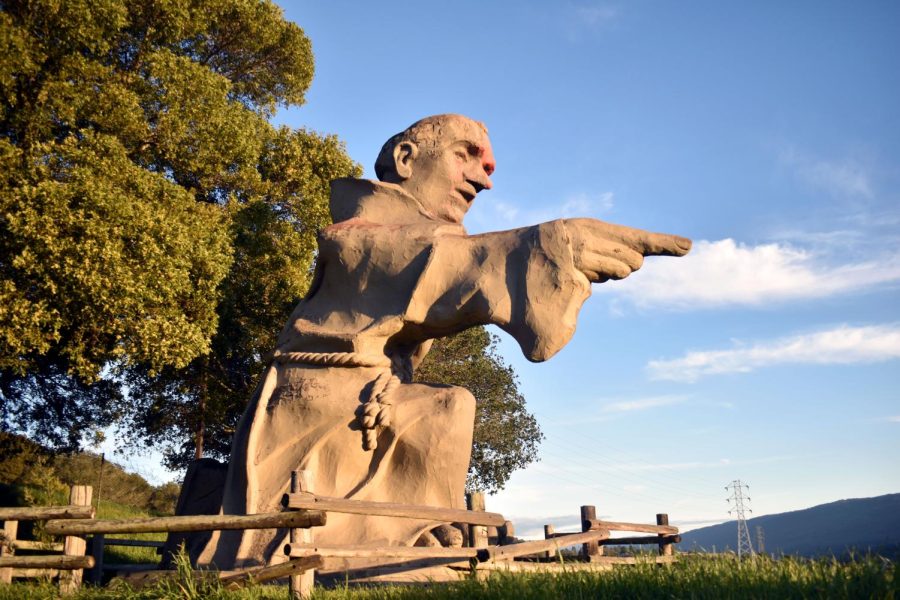
With the modern concentration on the fact - never hidden, but not previously emphasized - that the natives were mostly used for forced labor, and that many died, especially of diseases carried by the Spanish, the mission reputation has been blackened. Junipero Serra, the priest who began the establishment here, previously considered a hero of California history - and who still stands as one of California's representatives in the National Statuary Hall in the Capitol - is no longer viewed so favorably. A statue of him on a hill overlooking the freeway south of San Francisco (and with his hand pointing in the wrong direction) was recently removed. I'm sorry it's gone; it was a weird and grotesque little thing.
So I'm not at all sure if, or if so how, California students are still being taught about the missions. But we were in my day. In one class we were instructed to choose one of the missions and write a report on it. In the process, though not specifically instructed to do so, I found that I'd memorized the names and locations of all 21 of them, and I just checked and found I still have them memorized.
I think I've been to all of them at one time or another. And I've been to classical concerts in six of them. I've also been to a wedding in one (not one of the six).

Kalimac's corner: a journal by DB
Sunday, November 30, 2025

Saturday, November 29, 2025
Tom Stoppard
The great modern dramatist has passed on.
I've seen a number of his plays, but mostly when I was in college: I have this vague memory of signing on as an usher for a whole series of Stoppard plays in San Francisco. I don't remember them very well. The only ones I've seen more recently are Arcadia, The Invention of Love (which I saw in its first production in London, with John Wood in it), and Rosencrantz & Guildenstern Are Dead (most recently as a student production).
Besides the film of Rosencrantz, which I didn't think worked very well, I've seen two movies he contributed to the scripts of: Shakespeare in Love, which I cherish despite its playing with history in a way I normally find annoying - Stoppard is so clever with this I forgive him anything; and Brazil, a film I find fundamentally incoherent, though I doubt anyone would agree with me on this.
I started my play-reading group so that we could read Rosencrantz aloud, something I'd wanted to do for a long time. Four people: Rosencrantz, Guildenstern, The Player, and one for everything else, since everything else is just segments from Hamlet, plus stage directions.
I've seen a number of his plays, but mostly when I was in college: I have this vague memory of signing on as an usher for a whole series of Stoppard plays in San Francisco. I don't remember them very well. The only ones I've seen more recently are Arcadia, The Invention of Love (which I saw in its first production in London, with John Wood in it), and Rosencrantz & Guildenstern Are Dead (most recently as a student production).
Besides the film of Rosencrantz, which I didn't think worked very well, I've seen two movies he contributed to the scripts of: Shakespeare in Love, which I cherish despite its playing with history in a way I normally find annoying - Stoppard is so clever with this I forgive him anything; and Brazil, a film I find fundamentally incoherent, though I doubt anyone would agree with me on this.
I started my play-reading group so that we could read Rosencrantz aloud, something I'd wanted to do for a long time. Four people: Rosencrantz, Guildenstern, The Player, and one for everything else, since everything else is just segments from Hamlet, plus stage directions.
Friday, November 28, 2025
more thanks given, I guess
I went to the big family Thanksgiving gathering yesterday. People were glad to see me, and I was glad to see them, particularly the niece from Fresno with husband and three kids, all of them now in their teens - it'd been a while since I'd seen them.
Nonetheless I found it a difficult experience for other reasons. I was not feeling very well, and was worse after I got home - I left immediately after dinner, about 3 hours after arrival, while B. stayed on for another four hours and, by arrangement, was delivered home by nephew and niece who live vaguely in this direction. Also the heavy food was tough for me to handle. I've been living at home mostly on soup, baked fish, and other soft and gentle things. But we improvise! Now to make turkey noodle soup for dinner with some leftovers I brought home.
Nonetheless I found it a difficult experience for other reasons. I was not feeling very well, and was worse after I got home - I left immediately after dinner, about 3 hours after arrival, while B. stayed on for another four hours and, by arrangement, was delivered home by nephew and niece who live vaguely in this direction. Also the heavy food was tough for me to handle. I've been living at home mostly on soup, baked fish, and other soft and gentle things. But we improvise! Now to make turkey noodle soup for dinner with some leftovers I brought home.
Thursday, November 27, 2025
thanks, I guess
I suppose I should feel thankful for this outcome. Instead, it's just irritating.
Wednesday afternoon I came home from a long series of errands and took out my wallet to balance my sales receipts against my bank statement which had just come. It was then that I realized my mobile phone was not in the same pocket, where it belongs. Uh-oh. It must have fallen out of the pocket somewhere, which it has done before.
Not in the car. I hopped in and dashed back to all of the shops and libraries I'd been to. No luck. One shop had already closed for the holiday, which I'd known they would, but there were people inside, which I'd hoped there would be. I rapped at the glass door. They pointed towards the hours sign and made "we're closed" gestures. I nodded - "I know" - and kept rapping until someone came to the door and I could shout through it at her.
I came home dejected. Thursday is no good; Friday I'll have to go out and try to find another of those quaint flip-top phones I prefer and then get it set up. Which I last had to do a year and a half ago, so it's not unprecedented. I changed into my house trousers, the flannel ones that cinch up and don't require suspenders.
It was then I discovered that I'd never taken my phone out of the pocket from when I'd been wearing them that morning.
This is why I don't usually take anything out of the trousers I'm using until I'm ready to change them for another pair. Wallet, phone, keys, other impedimentia stay in the pockets where usually I can find them. But that morning I'd been expecting the possibility of a call, so I took the phone and then afterwards completely forgot I'd done so.
Speaking of which, I still haven't found the computer glasses I know I set down in an unusual spot a couple weeks ago, I just can't remember what the spot was.
In other nuisances, I want to watch something on Disney+ on my computer, but the sound doesn't work. AI is no help: it keeps telling me to check the sound settings on my system, even though I keep telling it there's nothing wrong with that, sound works fine for other apps, it's just Disney+.
Wednesday afternoon I came home from a long series of errands and took out my wallet to balance my sales receipts against my bank statement which had just come. It was then that I realized my mobile phone was not in the same pocket, where it belongs. Uh-oh. It must have fallen out of the pocket somewhere, which it has done before.
Not in the car. I hopped in and dashed back to all of the shops and libraries I'd been to. No luck. One shop had already closed for the holiday, which I'd known they would, but there were people inside, which I'd hoped there would be. I rapped at the glass door. They pointed towards the hours sign and made "we're closed" gestures. I nodded - "I know" - and kept rapping until someone came to the door and I could shout through it at her.
I came home dejected. Thursday is no good; Friday I'll have to go out and try to find another of those quaint flip-top phones I prefer and then get it set up. Which I last had to do a year and a half ago, so it's not unprecedented. I changed into my house trousers, the flannel ones that cinch up and don't require suspenders.
It was then I discovered that I'd never taken my phone out of the pocket from when I'd been wearing them that morning.
This is why I don't usually take anything out of the trousers I'm using until I'm ready to change them for another pair. Wallet, phone, keys, other impedimentia stay in the pockets where usually I can find them. But that morning I'd been expecting the possibility of a call, so I took the phone and then afterwards completely forgot I'd done so.
Speaking of which, I still haven't found the computer glasses I know I set down in an unusual spot a couple weeks ago, I just can't remember what the spot was.
In other nuisances, I want to watch something on Disney+ on my computer, but the sound doesn't work. AI is no help: it keeps telling me to check the sound settings on my system, even though I keep telling it there's nothing wrong with that, sound works fine for other apps, it's just Disney+.
Wednesday, November 26, 2025
varied books on music
Ian Leslie, John & Paul: A Love Story in Songs (Celadon Books, 2025)
John Lennon and Paul McCartney, of course. The subtitle was almost enough to put me off this book entirely, but I'm glad I read it. It's actually really insightful, and does not gloss over their conflicts, as the subtitle might imply or some reviews have suggested. The emphasis is not on the love but the musical collaboration. (George, Ringo, and George Martin get an occasional look-in.) There's relatively little on the details of the early period when Lennon & McCartney were writing songs together "eyeball to eyeball," perhaps because little is known of exactly how they did it. But after the Beatles stopped touring constantly, so John & Paul were no longer constantly in each other's company, their partnership mutated into each writing his own songs in dialogue with the other's, and this continued even into the nastiness of their early solo years. (Paul zings "Too Many People" at John, John ripostes with the brutal "How Do You Sleep?", Paul writes "Dear Friend" to make peace.) In these sections, Leslie is at his best. I was particularly taken with his analysis of "Tomorrow Never Knows." Lennon wrote this in response to McCartney's "Yesterday" (yesterday ... tomorrow ... that's only part of it) and "Eleanor Rigby," but the most striking point for me was the mutation of an influence from somebody else. The first line of the song, "Turn off your mind, relax and float downstream," is a direct quote from Timothy Leary's The Psychedelic Experience, which John had been reading, except that he added the word "and." A trivial change? Not at all. As a cited musicologist points out, that turns the line into iambic pentameter, the standard English verse meter. John may not have realized that that's what he was doing, but he'd been reading a lot of poetry, and, Leslie says, "it was part of his verbal muscle memory." There's lots more like this.
Leslie is adamant about two things: first, that whatever the conflicts in the later years of the Beatles, John and Paul were always happy to make music together (and that they continued to collaborate in the creation of even their most distinctive individual songs for the Beatles), and that the stereotypes of John the caustic rebel and Paul the smooth charmer are quite inadequate. Paul had his harsh side. In an interview, John said, "Paul can be very cynical and much more biting than me when he's driven to it ... He can carve people up in no time at all, when he's pushed." As for John, the later part of the book has a lot of psychological analysis, including the repeated statement that what John really wanted in those years was to be loved, and he felt Paul was turning cold and distant; meanwhile Paul had no idea what John was going through emotionally.
The book dribbles to a close with McCartney's comments on Lennon since Lennon's death, and the suggestion that he's been whitewashing some of the conflict between them. It's a very long journey through this book, nearly 400 pages of text, and the opening chapters go into tremendous detail on the events of the Beatles' early, struggling years. You have to be a real fan to want this book, but you'll get a lot out of it if you are.
Nancy Shear, I Knew a Man Who Knew Brahms: A Memoir (Regalo Press, 2025)
What a strange book. At age 14 in 1960, Shear attended a Philadelphia Orchestra concert and fell in love not just with the music, but with the guest conductor, Leopold Stokowski (then 78). Despite her age, she quickly turned her passion into a job as a librarian with the orchestra: duties, mostly copying conductors' notations from the score into the individual musicians' parts. Then she parlayed that into a position doing the same thing for Stokowski personally as he undertook various gigs. How did she manage this? Sheer gumption and dedication, I suppose. This book is mostly a hero-worshipper's gushing love letter to Stokowski's talent: Shear considers him a conductor of unmatched skill and insight, an opinion that will not earn universal agreement. There is a lot about technical musical points, however. How Stokowski would modify scores to fit modern instruments' capacities (a controversial practice); does the orchestra tune up as a whole or by sections? That sort of thing.
But what about ...? Though Stokowski had a reputation for numerous affairs, Shear insists he always acted as a gentleman towards her, though she admits one might not believe this, and she does print some pretty personal letters and she says he frequently touched her in what she insists was a non-sexual way.
The book is almost entirely just about Stokowski. Though Shear says she worked with many great musicians, only two others get more than a momentary glance. The cellist Mstislav Rostropovich, much more physically handsy than Stokowski, and Shear mentions only casually and incidentally that she did have a sexual affair with him. And Eugene Ormandy, Philadelphia's music director, whom she did not like either as a musician or a man. He did try once forcibly to kiss her, which in telling it she brushes off in a manner that was typical of older accounts but seems beyond quaint when so told in a post-#MeToo world.
And the man who knew Brahms? He makes just a cameo appearance on page 62. Shear gives his name - Raoul Hellmer - but nothing else about him. He's not a famous musician, just some guy who visited backstage for some reason and who, as a boy in Vienna, once delivered a pharmacy order to Brahms. He shakes hands with Shear and that's it. "I (briefly) met a man who (briefly) met Brahms" is more like it.
John Lennon and Paul McCartney, of course. The subtitle was almost enough to put me off this book entirely, but I'm glad I read it. It's actually really insightful, and does not gloss over their conflicts, as the subtitle might imply or some reviews have suggested. The emphasis is not on the love but the musical collaboration. (George, Ringo, and George Martin get an occasional look-in.) There's relatively little on the details of the early period when Lennon & McCartney were writing songs together "eyeball to eyeball," perhaps because little is known of exactly how they did it. But after the Beatles stopped touring constantly, so John & Paul were no longer constantly in each other's company, their partnership mutated into each writing his own songs in dialogue with the other's, and this continued even into the nastiness of their early solo years. (Paul zings "Too Many People" at John, John ripostes with the brutal "How Do You Sleep?", Paul writes "Dear Friend" to make peace.) In these sections, Leslie is at his best. I was particularly taken with his analysis of "Tomorrow Never Knows." Lennon wrote this in response to McCartney's "Yesterday" (yesterday ... tomorrow ... that's only part of it) and "Eleanor Rigby," but the most striking point for me was the mutation of an influence from somebody else. The first line of the song, "Turn off your mind, relax and float downstream," is a direct quote from Timothy Leary's The Psychedelic Experience, which John had been reading, except that he added the word "and." A trivial change? Not at all. As a cited musicologist points out, that turns the line into iambic pentameter, the standard English verse meter. John may not have realized that that's what he was doing, but he'd been reading a lot of poetry, and, Leslie says, "it was part of his verbal muscle memory." There's lots more like this.
Leslie is adamant about two things: first, that whatever the conflicts in the later years of the Beatles, John and Paul were always happy to make music together (and that they continued to collaborate in the creation of even their most distinctive individual songs for the Beatles), and that the stereotypes of John the caustic rebel and Paul the smooth charmer are quite inadequate. Paul had his harsh side. In an interview, John said, "Paul can be very cynical and much more biting than me when he's driven to it ... He can carve people up in no time at all, when he's pushed." As for John, the later part of the book has a lot of psychological analysis, including the repeated statement that what John really wanted in those years was to be loved, and he felt Paul was turning cold and distant; meanwhile Paul had no idea what John was going through emotionally.
The book dribbles to a close with McCartney's comments on Lennon since Lennon's death, and the suggestion that he's been whitewashing some of the conflict between them. It's a very long journey through this book, nearly 400 pages of text, and the opening chapters go into tremendous detail on the events of the Beatles' early, struggling years. You have to be a real fan to want this book, but you'll get a lot out of it if you are.
Nancy Shear, I Knew a Man Who Knew Brahms: A Memoir (Regalo Press, 2025)
What a strange book. At age 14 in 1960, Shear attended a Philadelphia Orchestra concert and fell in love not just with the music, but with the guest conductor, Leopold Stokowski (then 78). Despite her age, she quickly turned her passion into a job as a librarian with the orchestra: duties, mostly copying conductors' notations from the score into the individual musicians' parts. Then she parlayed that into a position doing the same thing for Stokowski personally as he undertook various gigs. How did she manage this? Sheer gumption and dedication, I suppose. This book is mostly a hero-worshipper's gushing love letter to Stokowski's talent: Shear considers him a conductor of unmatched skill and insight, an opinion that will not earn universal agreement. There is a lot about technical musical points, however. How Stokowski would modify scores to fit modern instruments' capacities (a controversial practice); does the orchestra tune up as a whole or by sections? That sort of thing.
But what about ...? Though Stokowski had a reputation for numerous affairs, Shear insists he always acted as a gentleman towards her, though she admits one might not believe this, and she does print some pretty personal letters and she says he frequently touched her in what she insists was a non-sexual way.
The book is almost entirely just about Stokowski. Though Shear says she worked with many great musicians, only two others get more than a momentary glance. The cellist Mstislav Rostropovich, much more physically handsy than Stokowski, and Shear mentions only casually and incidentally that she did have a sexual affair with him. And Eugene Ormandy, Philadelphia's music director, whom she did not like either as a musician or a man. He did try once forcibly to kiss her, which in telling it she brushes off in a manner that was typical of older accounts but seems beyond quaint when so told in a post-#MeToo world.
And the man who knew Brahms? He makes just a cameo appearance on page 62. Shear gives his name - Raoul Hellmer - but nothing else about him. He's not a famous musician, just some guy who visited backstage for some reason and who, as a boy in Vienna, once delivered a pharmacy order to Brahms. He shakes hands with Shear and that's it. "I (briefly) met a man who (briefly) met Brahms" is more like it.
Tuesday, November 25, 2025
more posthumous Le Guin
Ursula K. Le Guin, A Larger Reality, edited by Conner Bouchard-Roberts (Winter Texts, 2025), 339 p.
"A Larger Reality" is the title of an exhibit on UKL's life and work going on right now at the Oregon Contemporary Museum in Portland. Since I can't get there, I ordered this book, advertised as "the companion volume for the show," hoping that it would be the usual museum catalog of the exhibit.
It isn't. It's an anthology of UKL's writings, all previously published, with some interspersed essays by others, most of them also previously published though unseen by me. There are also some illustrations by UKL, possibly not previously published.
The contents include several stories - "The Day Before the Revolution" and "On the High Marsh" among them - some essays including "Science Fiction and Mrs. Brown," and three tranches of poetry from different spans of years. The essays by others include Harold Bloom's introduction to the Library of America edition of UKL's collected poetry, in which Bloom calls Yeats her major influence and quotes, in their entirety, some poems also included in the poetry sections of this book, so why didn't the editor make a different selection?
David Naimon also contributes a more impressionistic, less academic essay on Le Guin's poetry, and adrienne maree brown, who apparently spells it that way, includes in her essay a UKL letter to an unnamed local paper expressing her distress at the felling of a tree near her house - unmentioned in the commentary, this clearly is what's also commemorated in "The Aching Air," which I consider UKL's finest poem but which is not in this book.
Nisi Shawl writes about the story "Solitude," which story is also included, and the most interesting and useful essay is Mary Anne Mohanraj's on UKL rethinking her own work and publicly modifying her views when they've changed.
A list of UKL's other works includes six other "Winter Texts Collections," so this is evidently not this small press's first venture into repackaging Le Guin. It's a nice memento, and a convenient way to dip into some of her less-acclaimed work, but it's not what I was hoping for and not even an inadequate substitute for visiting the exhibit.
"A Larger Reality" is the title of an exhibit on UKL's life and work going on right now at the Oregon Contemporary Museum in Portland. Since I can't get there, I ordered this book, advertised as "the companion volume for the show," hoping that it would be the usual museum catalog of the exhibit.
It isn't. It's an anthology of UKL's writings, all previously published, with some interspersed essays by others, most of them also previously published though unseen by me. There are also some illustrations by UKL, possibly not previously published.
The contents include several stories - "The Day Before the Revolution" and "On the High Marsh" among them - some essays including "Science Fiction and Mrs. Brown," and three tranches of poetry from different spans of years. The essays by others include Harold Bloom's introduction to the Library of America edition of UKL's collected poetry, in which Bloom calls Yeats her major influence and quotes, in their entirety, some poems also included in the poetry sections of this book, so why didn't the editor make a different selection?
David Naimon also contributes a more impressionistic, less academic essay on Le Guin's poetry, and adrienne maree brown, who apparently spells it that way, includes in her essay a UKL letter to an unnamed local paper expressing her distress at the felling of a tree near her house - unmentioned in the commentary, this clearly is what's also commemorated in "The Aching Air," which I consider UKL's finest poem but which is not in this book.
Nisi Shawl writes about the story "Solitude," which story is also included, and the most interesting and useful essay is Mary Anne Mohanraj's on UKL rethinking her own work and publicly modifying her views when they've changed.
A list of UKL's other works includes six other "Winter Texts Collections," so this is evidently not this small press's first venture into repackaging Le Guin. It's a nice memento, and a convenient way to dip into some of her less-acclaimed work, but it's not what I was hoping for and not even an inadequate substitute for visiting the exhibit.
Monday, November 24, 2025
Obituary for Jill Flewett Freud. As a teenager during WW2, she was evacuated to Oxford and lived at the Kilns, the home of C.S. and W.H. Lewis. She became lasting friends with the Lewis brothers, and her memories have been a contribution to Lewis biography. Supposedly she was also an inspiration for the character of Lucy in the Narnia books, though not the only one (the name came from Lewis's goddaughter). She went on to become an actor and producer. More at the link.
Saturday, November 22, 2025
concert review: South Bay Philharmonic
The community orchestra for which B. plays in the viola section held a concert on Friday, in its usual church venue in west San Jose. Under music director George Yefchak, they gave a miscellaneous program, the best-played piece of which was the Mazurka from Delibes' ballet Coppélia. The brass drowned everyone else out, but that usually happens in this sort of item. An abridged version of Tchaikovsky's Romeo and Juliet also worked out pretty well. (Besides some judicious trimming elsewhere, the arranger cut out the recapitulation, except for the lush return of the love theme, which he stuck into the exposition.) But a full appreciation of the Adagio movements from Rachmaninoff's Second Symphony and Khachaturian's Spartacus was a bit beyond this orchestra's capacity.
There were a few hilarious date errors in the program book. It would have been difficult for Rachmaninoff to write that symphony in 1872, as he was not born until the following year, and Astor Piazzolla, also on the program, wasn't writing anything in 1892, as he wouldn't be born for decades. (I think they meant 1982.)
B. had a bit of a family audience this time. Her sister G., niece E. (G's daughter-in-law), and grand-nephew H. (G's grandson, E's nephew - my, family relationships can get complicated, can't they?) came along and sat in the audience right, from which they could best see B. on stage. I, partly in my role as B's sherpa, was sitting over on the left for tactical reasons. When a church representative asked the audience how they'd heard about the concert, "You're with the band" got the most raised hands. H. was new to this sort of event, I think, but afterwards he said he liked the music.
There were a few hilarious date errors in the program book. It would have been difficult for Rachmaninoff to write that symphony in 1872, as he was not born until the following year, and Astor Piazzolla, also on the program, wasn't writing anything in 1892, as he wouldn't be born for decades. (I think they meant 1982.)
B. had a bit of a family audience this time. Her sister G., niece E. (G's daughter-in-law), and grand-nephew H. (G's grandson, E's nephew - my, family relationships can get complicated, can't they?) came along and sat in the audience right, from which they could best see B. on stage. I, partly in my role as B's sherpa, was sitting over on the left for tactical reasons. When a church representative asked the audience how they'd heard about the concert, "You're with the band" got the most raised hands. H. was new to this sort of event, I think, but afterwards he said he liked the music.
Friday, November 21, 2025
another Tolkien review, if you want it
J.R.R. Tolkien,The Bovadium Fragments, edited by Christopher Tolkien (Morrow, 2025)
One more tiny fragment from Tolkien. Nothing to do with Middle-earth, it's a sour joke complaining about Oxford traffic in the format of a mock-medieval scholarly manuscript study. The main text by Tolkien, written about 1960, is maybe six thousand words, not counting some draft material, a fair amount of commentary by the editor - which, interspersed as it is with other layers of JRRT's fictional scholars commenting on the fictional manuscripts, is enough to make the head spin - and a background essay on the traffic problem and relief road proposals of the time, by Richard Ovenden of the Bodleian, that's twice as long as JRRT's text.
If it takes twice as long to explain a joke as it does to make it, it probably wasn't worth the trouble of reading. This book is only worthwhile if you're a Tolkien completist or really interested in the history of Oxford city planning. Weirdly, I am both, but there aren't many of me. A friend to whom Tolkien showed the story told him that readers would be put off by the large amount of Latin (though most of it is translated elsewhere in the text) and probably wouldn't get the point, so he gave up any idea of publishing it. Originally he'd wanted to send it to a literary magazine called Time and Tide, and we're told more than once that Tolkien inquired plaintively of his publisher to find out who the current editor was. He couldn't have found an issue and looked at the masthead?*
To my mind, as intimidating as the Latin is the weight of the highly true-to-life mock-scholarly commentary that Tolkien - a scholar of medieval texts himself - loaded the text down with, a trick he also pulled, though less weightily in relation to the 'manuscript' part, in The Notion Club Papers. The idea is that they're far-future scholars trying to understand these cryptic records of the fall of our civilization. That the scholars are named Sarevelk, Gums, Rotzopny, Dwarf, and Sugob (read them backwards) and that Bovadium is "Oxford" translated into Latin are the most amusing part.
The three fragments themselves tell, in a vaguely formal and distant but not strongly medieval style, of Bovadium being taken over by the rising tide of Motores, to which the people become less masters than servants - I remember reading an SF story also using that conceit - and leading to total gridlock. In one fragment the inhabitants all die of the fumes, and in another a gas tank explodes, leading to a city-wide conflagration. The End, and good riddance.
*Despite the extent of the commentary, this book doesn't explain that Tolkien had published a poem - "Imram," extracted from the also then-unpublished Notion Club Papers - in Time and Tide a few years earlier, but the long-time editor had since died, thus presumably Tolkien not knowing who'd taken over.
One more tiny fragment from Tolkien. Nothing to do with Middle-earth, it's a sour joke complaining about Oxford traffic in the format of a mock-medieval scholarly manuscript study. The main text by Tolkien, written about 1960, is maybe six thousand words, not counting some draft material, a fair amount of commentary by the editor - which, interspersed as it is with other layers of JRRT's fictional scholars commenting on the fictional manuscripts, is enough to make the head spin - and a background essay on the traffic problem and relief road proposals of the time, by Richard Ovenden of the Bodleian, that's twice as long as JRRT's text.
If it takes twice as long to explain a joke as it does to make it, it probably wasn't worth the trouble of reading. This book is only worthwhile if you're a Tolkien completist or really interested in the history of Oxford city planning. Weirdly, I am both, but there aren't many of me. A friend to whom Tolkien showed the story told him that readers would be put off by the large amount of Latin (though most of it is translated elsewhere in the text) and probably wouldn't get the point, so he gave up any idea of publishing it. Originally he'd wanted to send it to a literary magazine called Time and Tide, and we're told more than once that Tolkien inquired plaintively of his publisher to find out who the current editor was. He couldn't have found an issue and looked at the masthead?*
To my mind, as intimidating as the Latin is the weight of the highly true-to-life mock-scholarly commentary that Tolkien - a scholar of medieval texts himself - loaded the text down with, a trick he also pulled, though less weightily in relation to the 'manuscript' part, in The Notion Club Papers. The idea is that they're far-future scholars trying to understand these cryptic records of the fall of our civilization. That the scholars are named Sarevelk, Gums, Rotzopny, Dwarf, and Sugob (read them backwards) and that Bovadium is "Oxford" translated into Latin are the most amusing part.
The three fragments themselves tell, in a vaguely formal and distant but not strongly medieval style, of Bovadium being taken over by the rising tide of Motores, to which the people become less masters than servants - I remember reading an SF story also using that conceit - and leading to total gridlock. In one fragment the inhabitants all die of the fumes, and in another a gas tank explodes, leading to a city-wide conflagration. The End, and good riddance.
*Despite the extent of the commentary, this book doesn't explain that Tolkien had published a poem - "Imram," extracted from the also then-unpublished Notion Club Papers - in Time and Tide a few years earlier, but the long-time editor had since died, thus presumably Tolkien not knowing who'd taken over.
Thursday, November 20, 2025
sinkholes
Article on the hidden menace (because it doesn't get headlines much) of sinkholes in roads.
I'd thought this was mostly elsewhere, but we just got emergency notifications that one appeared in an intersection along the main artery through downtown of our city. The only good news is that I'm not going anywhere near there today; will be quite occupied elsewhere.
I'd thought this was mostly elsewhere, but we just got emergency notifications that one appeared in an intersection along the main artery through downtown of our city. The only good news is that I'm not going anywhere near there today; will be quite occupied elsewhere.
Tuesday, November 18, 2025
more things I don't understand
Why is everyone so shocked at the revelations about DT in the Epstein e-mails? This is exactly in keeping with his sordid, crass character as revealed in the Billy Bush tape, which came out before he was ever elected in the first place, and confirmed by everything he's done since. We can't say we weren't warned about what sort of man he is.
Then there's Larry Summers. It's news to us that he was pals with Epstein, but he's acting as if it's just as much a surprise to him as it is to everybody else. He didn't know that he was pals with Epstein??
Then there's Larry Summers. It's news to us that he was pals with Epstein, but he's acting as if it's just as much a surprise to him as it is to everybody else. He didn't know that he was pals with Epstein??
rain of errror
What the F is "cloudflare"? It's telling me there's an error and I can't get to half the websites I want to visit. Nothing wrong with the websites, it says, it's an internal error with them. What good is a security service that doesn't work?
Sunday, November 16, 2025
four concerts in just over one day
I had a string quartet concert at Herbst in the City on Friday evening, and another one on Saturday morning, so it made sense to stay up there overnight. I chose an airport hotel, less expensive than in the central city but still close enough to make driving in easy, especially on a weekend morning.
Then Saturday evening was the California Symphony out in Walnut Creek, which I determined to get to after I discovered that the Berkeley Symphony was holding an open rehearsal that afternoon, halfway between the other concerts both geographically and temporally.
Friday evening was the Modigliani Quartet, which played Haydn's Op. 77/2 with a brisk, clean-cut approach, devoid of emotional effect. None of the piece's humor came out either, but the clarity was striking. It may seem silly to talk about subtleties of instrumentation in a string quartet, but Haydn does some interesting things, and you could hear them here.
Then they played Beethoven's Op. 59/3 in exactly the same way, making it sound more like slightly larger-scale Haydn than Beethoven. Puzzlingly, they poured all the emotion they'd omitted from the main program into their encore, the Adagio from Beethoven's Op. 18/1, which they pointed out was written the same year as the Haydn but which, they said, opened up a new sound world - the world they'd done their best to omit from Op. 59.
(Also on the program, ten minutes of Webernian nonsense by György Kurtág, the most superfluous composer since the days of Baroque wallpaper. Why this dreck even bothers to exist in a universe with Haydn and Beethoven in it escapes me.)
Saturday morning, Robert Greenberg gives another lecture on Schubert followed by the Esmé Quartet playing the masterpiece which was the lecture's topic. This week, the G Major Quartet. Both lecture and quartet take about an hour each.
Greenberg is very good at structural analysis of the music, much less good at inventing biographical reasons for Schubert to have written it that way, which serve only to trivialize his genius. As for the music, the Esmé played it as if they were steering a sturdy ship firmly through rough waters. An hour with Greenberg was worth the price for such a fine hour with Schubert.
The Berkeley Symphony opened up their Saturday rehearsal because the Sunday concert, which I wouldn't have been able to make anyway, was sold out. Both rehearsal and concert are in Berkeley's First Congregational Church, a chamber with damp echoing acoustics that's no improvement over the Symphony's previous venue, the infamously dead Zellerbach Hall. The orchestra seems better than deserving this. Conductor Ming Luke devoted most of his attention to Richard Strauss's Four Last Songs, with Laquita Mitchell singing in a foghorn voice I find hard to credit deserving the label "soprano." Thanks to the acoustics, I could not make out a word she was singing, even with the lyrics open in front of me.
The California Symphony is at Lesher, where the seats are uncomfortable but the acoustics good, and the orchestra getting really impressive. Highlight of this concert under music director Donato Cabrera was Beethoven's Eroica, in an urgent, driven performance full of subtleties of dynamics from the strings, who were at the top of their game.
Also on the program, Mozart's "Elvira Madigan" concerto with the solo part played by Robert Thies in a cool and bloodless manner, and an overture by Jessie Montgomery, featuring lyric melodies played in the form of hideously dissonant chords. Not the most successful work of hers I've heard.
Meals on this trip were good. Dinner Friday at a grungy Chinese place in the Tenderloin with some of the richest and thickest wor won ton soup I've ever had. Breakfast Saturday included at the hotel, sausage and a little bell pepper omelet for me. Lunch, palak saag (spinach) at an Indian place a block from the Berkeley church. Dinner at the last remaining restaurant within walking distance of Lesher that I really like, a tapas place on Bonanza Street: little plates of shrimp and lamb were tasty and enough to eat.
Then Saturday evening was the California Symphony out in Walnut Creek, which I determined to get to after I discovered that the Berkeley Symphony was holding an open rehearsal that afternoon, halfway between the other concerts both geographically and temporally.
Friday evening was the Modigliani Quartet, which played Haydn's Op. 77/2 with a brisk, clean-cut approach, devoid of emotional effect. None of the piece's humor came out either, but the clarity was striking. It may seem silly to talk about subtleties of instrumentation in a string quartet, but Haydn does some interesting things, and you could hear them here.
Then they played Beethoven's Op. 59/3 in exactly the same way, making it sound more like slightly larger-scale Haydn than Beethoven. Puzzlingly, they poured all the emotion they'd omitted from the main program into their encore, the Adagio from Beethoven's Op. 18/1, which they pointed out was written the same year as the Haydn but which, they said, opened up a new sound world - the world they'd done their best to omit from Op. 59.
(Also on the program, ten minutes of Webernian nonsense by György Kurtág, the most superfluous composer since the days of Baroque wallpaper. Why this dreck even bothers to exist in a universe with Haydn and Beethoven in it escapes me.)
Saturday morning, Robert Greenberg gives another lecture on Schubert followed by the Esmé Quartet playing the masterpiece which was the lecture's topic. This week, the G Major Quartet. Both lecture and quartet take about an hour each.
Greenberg is very good at structural analysis of the music, much less good at inventing biographical reasons for Schubert to have written it that way, which serve only to trivialize his genius. As for the music, the Esmé played it as if they were steering a sturdy ship firmly through rough waters. An hour with Greenberg was worth the price for such a fine hour with Schubert.
The Berkeley Symphony opened up their Saturday rehearsal because the Sunday concert, which I wouldn't have been able to make anyway, was sold out. Both rehearsal and concert are in Berkeley's First Congregational Church, a chamber with damp echoing acoustics that's no improvement over the Symphony's previous venue, the infamously dead Zellerbach Hall. The orchestra seems better than deserving this. Conductor Ming Luke devoted most of his attention to Richard Strauss's Four Last Songs, with Laquita Mitchell singing in a foghorn voice I find hard to credit deserving the label "soprano." Thanks to the acoustics, I could not make out a word she was singing, even with the lyrics open in front of me.
The California Symphony is at Lesher, where the seats are uncomfortable but the acoustics good, and the orchestra getting really impressive. Highlight of this concert under music director Donato Cabrera was Beethoven's Eroica, in an urgent, driven performance full of subtleties of dynamics from the strings, who were at the top of their game.
Also on the program, Mozart's "Elvira Madigan" concerto with the solo part played by Robert Thies in a cool and bloodless manner, and an overture by Jessie Montgomery, featuring lyric melodies played in the form of hideously dissonant chords. Not the most successful work of hers I've heard.
Meals on this trip were good. Dinner Friday at a grungy Chinese place in the Tenderloin with some of the richest and thickest wor won ton soup I've ever had. Breakfast Saturday included at the hotel, sausage and a little bell pepper omelet for me. Lunch, palak saag (spinach) at an Indian place a block from the Berkeley church. Dinner at the last remaining restaurant within walking distance of Lesher that I really like, a tapas place on Bonanza Street: little plates of shrimp and lamb were tasty and enough to eat.
Friday, November 14, 2025
not missing it
What these all have in common is that anything that would have made me care about the new change ceased to be the case a long time ago.
1. I'm not going to miss the penny. Ever since the disappearance of the last penny gumball machines - which must have been over 30 years ago - the penny ceased to have any use in itself but only serves as a marker to accumulate larger sums.
That's true of all coins almost all the time now. Only with the rare parking meter that doesn't take cards, or the even rarer occasions when I need to use a laundromat, do I need a few quarters. I no longer regularly carry coins in my pocket. When I do get some, on the occasions I use cash at all, I just take them out when I get home. Self-service checkout at the supermarket takes coins, and I scoop them up to use there sometimes, because with multiple machines I'm not holding up anyone behind me as I get rid of the nuisances.
2. I'm not sorry about the closing of many outlets of Wendy's. Long ago I ate their burgers regularly, but I stopped after they changed the menu so that all the burgers have cheese on them. They're so used to doing that that they put the cheese on even if you say, "No cheese." A few instances of that and I gave up. Fortunately if I want a burger there's Five Guys, which is better than Wendy's was even at its best, and they follow customers' topping instructions meticulously.
3. I'm not upset about pop songs made with A.I. Electronic pop songs that sound as if they were made artificially have been a thing for decades now - remember Kraftwerk? - so why not actually do it?
1. I'm not going to miss the penny. Ever since the disappearance of the last penny gumball machines - which must have been over 30 years ago - the penny ceased to have any use in itself but only serves as a marker to accumulate larger sums.
That's true of all coins almost all the time now. Only with the rare parking meter that doesn't take cards, or the even rarer occasions when I need to use a laundromat, do I need a few quarters. I no longer regularly carry coins in my pocket. When I do get some, on the occasions I use cash at all, I just take them out when I get home. Self-service checkout at the supermarket takes coins, and I scoop them up to use there sometimes, because with multiple machines I'm not holding up anyone behind me as I get rid of the nuisances.
2. I'm not sorry about the closing of many outlets of Wendy's. Long ago I ate their burgers regularly, but I stopped after they changed the menu so that all the burgers have cheese on them. They're so used to doing that that they put the cheese on even if you say, "No cheese." A few instances of that and I gave up. Fortunately if I want a burger there's Five Guys, which is better than Wendy's was even at its best, and they follow customers' topping instructions meticulously.
3. I'm not upset about pop songs made with A.I. Electronic pop songs that sound as if they were made artificially have been a thing for decades now - remember Kraftwerk? - so why not actually do it?
Wednesday, November 12, 2025
honor and experience
I should have written this yesterday, because it's about a veteran, but though I read then the piece I'm going to write about, it was late in the day.
I'd gone down to the city library to return some books, figuring they'd be closed so the parking lot would be empty, but it turned out that, though it was a federal holiday, it wasn't a city holiday and the library was open. So I went inside and browsed around a little.
There I found, but didn't check out or remember the title of, a book of political commentary essays. One of the essays was a profile of John McCain from the time of his presidential run in 2008. In this profile, McCain is annoyed. Here he is, a heroic ex-POW who kept his honor by refusing early release, and subsequently an experienced legislator, and he's losing the election to ... what? An inexperienced community organizer? How can this be?
Allow me to explain how it could be, because McCain was operating on invalid assumptions. Sure, he was a POW hero. What should we do about that? We should honor him! But that doesn't mean he should be President. The presidency is not a reward for valor.
I voted in that election, and I chose Obama for a simple reason. I agreed with his policies and principles a lot more than I did with McCain's. Nothing more need be said, but it can be. For voters want not just policy agreements, but the ability to do the job. And Obama exuded the gravitas and sober approach that convinced me that he would know how to be president, how to communicate and delegate and the other tasks a president must perform. And indeed, he turned out to be just fine in those respects. Whereas McCain was famously impulsive and hotheaded, and was a 72-year-old man in dicey health who thought Sarah Palin would make a dandy successor if anything happened.
For experience can be overrated. No other job in government is like being president, and experience in other positions cannot always predict how well you'll do. The most experienced earlier president, with many years and varied positions in his résumé, was James Buchanan, not a sterling argument for the importance of experience.
Besides, was Obama's experience all that thin? Consider his résumé at the time he first ran for president. He was a lawyer from Illinois with a fair chunk of service in the state legislature and a couple of years in Congress. The previous time we'd elected a president with that résumé, he turned out to be pretty good.
That's not to say Obama was another Lincoln or anything like it. But it does show that the important thing is not experience, but what you make of it.
I'd gone down to the city library to return some books, figuring they'd be closed so the parking lot would be empty, but it turned out that, though it was a federal holiday, it wasn't a city holiday and the library was open. So I went inside and browsed around a little.
There I found, but didn't check out or remember the title of, a book of political commentary essays. One of the essays was a profile of John McCain from the time of his presidential run in 2008. In this profile, McCain is annoyed. Here he is, a heroic ex-POW who kept his honor by refusing early release, and subsequently an experienced legislator, and he's losing the election to ... what? An inexperienced community organizer? How can this be?
Allow me to explain how it could be, because McCain was operating on invalid assumptions. Sure, he was a POW hero. What should we do about that? We should honor him! But that doesn't mean he should be President. The presidency is not a reward for valor.
I voted in that election, and I chose Obama for a simple reason. I agreed with his policies and principles a lot more than I did with McCain's. Nothing more need be said, but it can be. For voters want not just policy agreements, but the ability to do the job. And Obama exuded the gravitas and sober approach that convinced me that he would know how to be president, how to communicate and delegate and the other tasks a president must perform. And indeed, he turned out to be just fine in those respects. Whereas McCain was famously impulsive and hotheaded, and was a 72-year-old man in dicey health who thought Sarah Palin would make a dandy successor if anything happened.
For experience can be overrated. No other job in government is like being president, and experience in other positions cannot always predict how well you'll do. The most experienced earlier president, with many years and varied positions in his résumé, was James Buchanan, not a sterling argument for the importance of experience.
Besides, was Obama's experience all that thin? Consider his résumé at the time he first ran for president. He was a lawyer from Illinois with a fair chunk of service in the state legislature and a couple of years in Congress. The previous time we'd elected a president with that résumé, he turned out to be pretty good.
That's not to say Obama was another Lincoln or anything like it. But it does show that the important thing is not experience, but what you make of it.
Tuesday, November 11, 2025
Death by Netflix
I started to watch Netflix's Death by Lightning, its dramatization of the events of US politics of 1880-81. It's framed by interleaving the stories of James A. Garfield, who was elected and then served as President, and of Charles Guiteau, the weirdly upbeat loser who broke a mental gear and assassinated him.
I got about one and a half episodes in before coming to a screeching halt, which is about one episode further than I usually get in tv series.
Visually it's very impressive, filmed in Hungary no doubt not just for the cost (and a complete lack of concern about supporting an autocracy) but because you couldn't possibly find cityscapes that look like that in the US any more. The beards do not look as if they were casually slapped on the actors' faces with a dab of glue, a common failing in film set in this period (the movie Gettysburg was particularly bad in that respect).
The most distinctive characteristic of the acting is the extremely flat midwestern accents in some of the voices.
The script felt mannered and off in various ways, but differently from the usual. Except in the Republican convention scenes in episode 1, there was very little over-explanation for the audience's sake that I hate so much. For instance there are several references to Hancock without anybody saying, "He's the Democratic nominee, you know." You have to either already know that or pick it up. That's good. But the very 21st century use of powerful swear words in public grates, and much of the character depiction lacks subtlety. Garfield was reluctant to be nominee, yes, but did he express it that crassly? I don't think so. And the relationship between Arthur and Conkling, though based on reality, treats it ham-handedly.
What brought me to a screeching halt, though, was a scene in episode two featuring the thing I hate most in historical drama. And that is when a character shows up to preach 21st century morality at historical characters. Moral debates in historical drama should be conducted in the terms and contexts used at the time; it's not impossible to depict - the musical 1776 did it magnificently for the slavery question - and if it shows the characters as imperfect by our standards, they're less imperfect than they look when confronted by what are effectively time travelers from the present. If I can get the viewer app to tiptoe past the rest of that scene, I might continue, because I am curious as to how the script will handle the titanic conflict between Garfield and Conkling which was the main feature of the administration. But not right now.
I got about one and a half episodes in before coming to a screeching halt, which is about one episode further than I usually get in tv series.
Visually it's very impressive, filmed in Hungary no doubt not just for the cost (and a complete lack of concern about supporting an autocracy) but because you couldn't possibly find cityscapes that look like that in the US any more. The beards do not look as if they were casually slapped on the actors' faces with a dab of glue, a common failing in film set in this period (the movie Gettysburg was particularly bad in that respect).
The most distinctive characteristic of the acting is the extremely flat midwestern accents in some of the voices.
The script felt mannered and off in various ways, but differently from the usual. Except in the Republican convention scenes in episode 1, there was very little over-explanation for the audience's sake that I hate so much. For instance there are several references to Hancock without anybody saying, "He's the Democratic nominee, you know." You have to either already know that or pick it up. That's good. But the very 21st century use of powerful swear words in public grates, and much of the character depiction lacks subtlety. Garfield was reluctant to be nominee, yes, but did he express it that crassly? I don't think so. And the relationship between Arthur and Conkling, though based on reality, treats it ham-handedly.
What brought me to a screeching halt, though, was a scene in episode two featuring the thing I hate most in historical drama. And that is when a character shows up to preach 21st century morality at historical characters. Moral debates in historical drama should be conducted in the terms and contexts used at the time; it's not impossible to depict - the musical 1776 did it magnificently for the slavery question - and if it shows the characters as imperfect by our standards, they're less imperfect than they look when confronted by what are effectively time travelers from the present. If I can get the viewer app to tiptoe past the rest of that scene, I might continue, because I am curious as to how the script will handle the titanic conflict between Garfield and Conkling which was the main feature of the administration. But not right now.
Monday, November 10, 2025
introvert glasses
Like me, John Scalzi has two eyeglass prescriptions: one for general-purpose glasses (which in my case I use just for driving), and one for close-up glasses (which in my case I use just at the computer - or I did until I misplaced them last week).
He calls them his extrovert and introvert glasses, because he uses the former when interacting with the world and nobody (outside his family, I suppose) sees him wearing the latter.
I wouldn't use that terminology. I'm still an introvert even when I'm out interacting with the world, which yes makes interacting with the world a bit of a challenge, and people do see me wearing the computer glasses. I wear them when I'm on Zoom sessions (or I did until ... see above), and people have seen me then.
My latest Zoom session was my play-reading group. We've progressed far enough in Shakespeare to reach Timon of Athens. This is, as I well knew from having seen it on stage, an absolutely dandy play, delightful to read, yet hardly anyone knows it.
He calls them his extrovert and introvert glasses, because he uses the former when interacting with the world and nobody (outside his family, I suppose) sees him wearing the latter.
I wouldn't use that terminology. I'm still an introvert even when I'm out interacting with the world, which yes makes interacting with the world a bit of a challenge, and people do see me wearing the computer glasses. I wear them when I'm on Zoom sessions (or I did until ... see above), and people have seen me then.
My latest Zoom session was my play-reading group. We've progressed far enough in Shakespeare to reach Timon of Athens. This is, as I well knew from having seen it on stage, an absolutely dandy play, delightful to read, yet hardly anyone knows it.
Sunday, November 9, 2025
concert review: Poiesis Quartet
The Poiesis Quartet are the young ensemble who won first prize at this year's Banff International String Quartet Competition. I watched the whole competition on video broadcast and was deeply impressed by this ensemble. So I couldn't miss the opportunity to hear them in person, in the Noe Music series in a small but acoustically and aesthetically impressive neighborhood church in San Francisco. And one reason this small local series was able to nab the Banff winner, a hot ticket as classical ensembles go, is that they'd booked them before Banff. So, great perspicacity on the part of the Noe director-programmers.
Poiesis will occasionally play a "classic," but they're dedicated to more modern music, especially recent work. Their program included four contemporary works, all completed within the last 12 years, and the two most recent of which they commissioned themselves. They'd played all four* at Banff, but the experience of hearing them over an electronic connection on that occasion paled against the vivid, arresting quality of hearing them live now. This was the kind of playing where it was easy to tell how great the players are even without knowing the music well enough to evaluate it.
The four pieces had distinct individual styles, but there was a general family resemblance between them: excursions into lyrical tonality were separated by complex querulous sections without the grinding dissonance that once would have been obligatory in such works; plenty of exclamations of the kind of startling metallic effects (ponticello was a favorite) typical in the quartets of Bartók or Janáček, whom I think must be the patron saints of the composers represented here - that is to say, the composers seemed to be thinking, "Those are the kind of quartets I want to write."
To finish up, a modern quartet that's on the verge of hoary classic status, Prokofiev's Second. This was played with a firm, compelling hand that got across this rather difficult piece - I've rarely heard a satisfactory performance - more coherently and winningly than other renditions. Another big winner.
At Banff, it's not done for performers to speak to the audience during concerts. Here, all four players took turns introducing the various works. That too is unusual; if there's introductions to be made, usually one player does all the talking.
I'm so pleased that I was able to haul myself up to the City for this one.
*Pisachi by Jerod Impichchaachaaha' Tate; String Quartet by Brian Raphael Nabors; String Quartet No. 7 by Kevin Lau; and Many, Many Cadences by Sky Macklay.
Poiesis will occasionally play a "classic," but they're dedicated to more modern music, especially recent work. Their program included four contemporary works, all completed within the last 12 years, and the two most recent of which they commissioned themselves. They'd played all four* at Banff, but the experience of hearing them over an electronic connection on that occasion paled against the vivid, arresting quality of hearing them live now. This was the kind of playing where it was easy to tell how great the players are even without knowing the music well enough to evaluate it.
The four pieces had distinct individual styles, but there was a general family resemblance between them: excursions into lyrical tonality were separated by complex querulous sections without the grinding dissonance that once would have been obligatory in such works; plenty of exclamations of the kind of startling metallic effects (ponticello was a favorite) typical in the quartets of Bartók or Janáček, whom I think must be the patron saints of the composers represented here - that is to say, the composers seemed to be thinking, "Those are the kind of quartets I want to write."
To finish up, a modern quartet that's on the verge of hoary classic status, Prokofiev's Second. This was played with a firm, compelling hand that got across this rather difficult piece - I've rarely heard a satisfactory performance - more coherently and winningly than other renditions. Another big winner.
At Banff, it's not done for performers to speak to the audience during concerts. Here, all four players took turns introducing the various works. That too is unusual; if there's introductions to be made, usually one player does all the talking.
I'm so pleased that I was able to haul myself up to the City for this one.
*Pisachi by Jerod Impichchaachaaha' Tate; String Quartet by Brian Raphael Nabors; String Quartet No. 7 by Kevin Lau; and Many, Many Cadences by Sky Macklay.
Saturday, November 8, 2025
more library books to read
Troublemakers: Silicon Valley's Coming of Age, Leslie Berlin (Simon & Schuster, 2017)
The trouble with business histories is that they're often not very readable. This one is. You want to read a history of Apple's early days that focuses on Mike Markkula, this is your book. Wozniak designed the machine, but Markkula recognized its value and built a company around it. Most histories of Apple acknowledge this, but treat Markkula as a sideshow. This one makes him central.
But that's not the only story. It tells of half a dozen driving entrepreneurs of his kind of that era, divided into small chapters interleaved. It makes more sense to read this book by picking out all the chapters on one subject, then going back for another one. That way you will also notice how much of the most interesting stuff is going on between the time periods covered by the chapters.
Year of Meteors: Stephen Douglas, Abraham Lincoln, and the Election That Brought on the Civil War, Douglas R. Egerton (Bloomsbury, 2010)
One thing 1860 was full of was conventions. There were three major political parties and they each had a convention, and the Democrats had about four of them to produce two competing presidential nominees. Then there were conventions in states that wanted to secede from the union, and conventions to produce compromises to persuade the states to remain in the union, and more. And Egerton is here to tell you about each one of those conventions in point by point detail.
It's less boring than you might think, because a lot of dramatic things happened. The substantive issues are treated rather lightly, but the presidential horse race is discussed in detail. One thing you'll learn is that before the Republican convention, which happened last, absolutely everyone expected that William Seward would be the nominee and made their plans accordingly. But when you get to the convention, you learn that there was substantive opposition to him as nominee, enough to make his choice doubtful from the beginning. This informational conflict is not resolved. What you do get is a lot of quotes from speeches, some of them the most astonishing racist blither I'd ever seen.
The book carries on to the death of Stephen Douglas in June of 1861, except that the war had started by then and there's almost nothing about that. Despite the fact that he's the person who shot up the Compromise of 1850 and sent the nation plummeting down the dark path, Douglas is something of the hero of this book, mostly because after he lost the 1860 election he rallied to Lincoln's side and became the most steadfast of union patriots.
Dangerous Melodies: Classical Music in America from the Great War through the Cold War, Jonathan Rosenberg (Norton, 2020)
This book has no theme. It's just a narrative history, built out of lots of quotes and references to journalism of the time, of the classical music manifestations of the international conflicts of WW1, WW2, and the early Cold War, up through events like Leonard Bernstein taking the NY Phil on tours of the Soviet Union around 1960. One of the few places where Rosenberg steps back to consider what it means is when he asks why there was so much vehement anti-German feeling in WW1 (prohibiting German music, arresting German performers), but not so much in WW2. His tentative answer is that in WW2 we had the Japanese to unleash our virulent racism against, so it didn't have to be directed at the Germans.
Bridge of Words: Esperanto and the Dream of a Universal Language, Esther Schor (Metropolitan, 2016)
There's a lot here about the relationship between the Esperanto movement and the early Zionist movement, but it feels like it's as much the story of the author's personal encounter with Esperanto as the history of the language movement. To my regret, there's no mention of two interesting people: J.R.R. Tolkien, who expressed some interest in Esperanto in the 1930s and might have attended a congress on the subject, and the composer Lou Harrison, who learned Esperanto to communicate with practitioners of folk music in various East Asian cultures and wrote some choral works with lyrics in Esperanto.
The trouble with business histories is that they're often not very readable. This one is. You want to read a history of Apple's early days that focuses on Mike Markkula, this is your book. Wozniak designed the machine, but Markkula recognized its value and built a company around it. Most histories of Apple acknowledge this, but treat Markkula as a sideshow. This one makes him central.
But that's not the only story. It tells of half a dozen driving entrepreneurs of his kind of that era, divided into small chapters interleaved. It makes more sense to read this book by picking out all the chapters on one subject, then going back for another one. That way you will also notice how much of the most interesting stuff is going on between the time periods covered by the chapters.
Year of Meteors: Stephen Douglas, Abraham Lincoln, and the Election That Brought on the Civil War, Douglas R. Egerton (Bloomsbury, 2010)
One thing 1860 was full of was conventions. There were three major political parties and they each had a convention, and the Democrats had about four of them to produce two competing presidential nominees. Then there were conventions in states that wanted to secede from the union, and conventions to produce compromises to persuade the states to remain in the union, and more. And Egerton is here to tell you about each one of those conventions in point by point detail.
It's less boring than you might think, because a lot of dramatic things happened. The substantive issues are treated rather lightly, but the presidential horse race is discussed in detail. One thing you'll learn is that before the Republican convention, which happened last, absolutely everyone expected that William Seward would be the nominee and made their plans accordingly. But when you get to the convention, you learn that there was substantive opposition to him as nominee, enough to make his choice doubtful from the beginning. This informational conflict is not resolved. What you do get is a lot of quotes from speeches, some of them the most astonishing racist blither I'd ever seen.
The book carries on to the death of Stephen Douglas in June of 1861, except that the war had started by then and there's almost nothing about that. Despite the fact that he's the person who shot up the Compromise of 1850 and sent the nation plummeting down the dark path, Douglas is something of the hero of this book, mostly because after he lost the 1860 election he rallied to Lincoln's side and became the most steadfast of union patriots.
Dangerous Melodies: Classical Music in America from the Great War through the Cold War, Jonathan Rosenberg (Norton, 2020)
This book has no theme. It's just a narrative history, built out of lots of quotes and references to journalism of the time, of the classical music manifestations of the international conflicts of WW1, WW2, and the early Cold War, up through events like Leonard Bernstein taking the NY Phil on tours of the Soviet Union around 1960. One of the few places where Rosenberg steps back to consider what it means is when he asks why there was so much vehement anti-German feeling in WW1 (prohibiting German music, arresting German performers), but not so much in WW2. His tentative answer is that in WW2 we had the Japanese to unleash our virulent racism against, so it didn't have to be directed at the Germans.
Bridge of Words: Esperanto and the Dream of a Universal Language, Esther Schor (Metropolitan, 2016)
There's a lot here about the relationship between the Esperanto movement and the early Zionist movement, but it feels like it's as much the story of the author's personal encounter with Esperanto as the history of the language movement. To my regret, there's no mention of two interesting people: J.R.R. Tolkien, who expressed some interest in Esperanto in the 1930s and might have attended a congress on the subject, and the composer Lou Harrison, who learned Esperanto to communicate with practitioners of folk music in various East Asian cultures and wrote some choral works with lyrics in Esperanto.
Friday, November 7, 2025
concert review: San Francisco Symphony
I was uncertain whether I'd recovered enough to invest in a trip up to the City for a concert, but I thought of it as a test run for Sunday when I really want to go. Also, it was a tempting 'comfort' program for me. And it worked out fine.
Karina Canellakis, whom I've heard before here leading some powerhouse Shostakovich, is a lean and intense conductor, and she leads lean and intense performances. The evening started with Dvořák's Scherzo Capricioso, a lively little piece with undercurrents of melancholy. Then Prokofiev's Third Piano Concerto went by in a flash. It was so brisk and succinct that it was over almost before I knew it had started. Alexandre Kantorow as soloist whizzed through his part with the speed of a flashier player but a more subdued approach. For an encore he took a slower way through a florid and player-piano-like arrangement of Wagner's "Liebestod."
After intermission, the main event, Sibelius's vast tone poem cycle, Four Legends from the Kalevala. This is where the Canellakis who had Shostakovich in her heart came out. The sound quality was golden. This was an hour of pure, distilled, 200-proof Sibelius, every note exuding his distinctive sound world. It was fabulous all the way through and gripping despite the fact that not much happens. This is still a great orchestra.
I've seen lately various comments suggesting that the Four Legends really form a symphony. Nonsense. Having four movements does not a symphony make. It doesn't have the structure, the sound, the approach, or above all the complex developmental concepts, of a symphony, and most certainly not a Sibelian symphony. It's a series of shifting static sound pictures. In short, it's what Sibelius said it was, a set of tone poems. The first item, "Lemminkäinen and the Maidens of the Island," is the most interesting and most varied. "The Swan of Tuonela," which would be the Adagio if this were a symphony, is the most lush and melodic, though there was a terseness to the approach here. "Lemminkäinen in Tuonela" is the most difficult to absorb, extended and more disconnected than "Maidens." It's the farthest thing from a scherzo, which a four-movement symphony would need. The finale, "Lemminkäinen's Return," is a bit disappointing. It still sounds great, but it's a hasty and bombastic wrapped-up conclusion, a problem that early Sibeius is prone to elsewhere as well.
The people sitting up behind me had, as they often do, brought a large dog. It might be a service animal though it had only a harness, not a vest. It was as always entirely well-behaved. At intermission and afterwards, passersby were asking if the dog liked the music. And the handlers would say, apparently so. As I went by to leave, one handler was cooing to the dog, "You like this better than the ballet, huh?" And I muttered, "Better music." At a look of inquiry I explained: the ballet orchestra here is OK. But the Symphony is something outstanding.
Karina Canellakis, whom I've heard before here leading some powerhouse Shostakovich, is a lean and intense conductor, and she leads lean and intense performances. The evening started with Dvořák's Scherzo Capricioso, a lively little piece with undercurrents of melancholy. Then Prokofiev's Third Piano Concerto went by in a flash. It was so brisk and succinct that it was over almost before I knew it had started. Alexandre Kantorow as soloist whizzed through his part with the speed of a flashier player but a more subdued approach. For an encore he took a slower way through a florid and player-piano-like arrangement of Wagner's "Liebestod."
After intermission, the main event, Sibelius's vast tone poem cycle, Four Legends from the Kalevala. This is where the Canellakis who had Shostakovich in her heart came out. The sound quality was golden. This was an hour of pure, distilled, 200-proof Sibelius, every note exuding his distinctive sound world. It was fabulous all the way through and gripping despite the fact that not much happens. This is still a great orchestra.
I've seen lately various comments suggesting that the Four Legends really form a symphony. Nonsense. Having four movements does not a symphony make. It doesn't have the structure, the sound, the approach, or above all the complex developmental concepts, of a symphony, and most certainly not a Sibelian symphony. It's a series of shifting static sound pictures. In short, it's what Sibelius said it was, a set of tone poems. The first item, "Lemminkäinen and the Maidens of the Island," is the most interesting and most varied. "The Swan of Tuonela," which would be the Adagio if this were a symphony, is the most lush and melodic, though there was a terseness to the approach here. "Lemminkäinen in Tuonela" is the most difficult to absorb, extended and more disconnected than "Maidens." It's the farthest thing from a scherzo, which a four-movement symphony would need. The finale, "Lemminkäinen's Return," is a bit disappointing. It still sounds great, but it's a hasty and bombastic wrapped-up conclusion, a problem that early Sibeius is prone to elsewhere as well.
The people sitting up behind me had, as they often do, brought a large dog. It might be a service animal though it had only a harness, not a vest. It was as always entirely well-behaved. At intermission and afterwards, passersby were asking if the dog liked the music. And the handlers would say, apparently so. As I went by to leave, one handler was cooing to the dog, "You like this better than the ballet, huh?" And I muttered, "Better music." At a look of inquiry I explained: the ballet orchestra here is OK. But the Symphony is something outstanding.
Wednesday, November 5, 2025
o to be a blogger
1. In writing my piece yesterday on Elon Musk misinterpreting The Lord of the Rings as a tale of the heroism of "hard men" like Tommy Robinson, I left one point out. If the Dúnedain of Arnor and Gondor don't actually qualify as "hard men" by Musk's standards, you know who does? The ruffians that Sarumen sent to the Shire. Those were as hard as you could want, and rather reminiscent of Tommy Robinson. But you wouldn't want them. Let's not take Musk's reading, shall we?
2.Well, the election results are encouraging. I don't have much to do with New York City, but the place is a large spectacle difficult to ignore, and I hope that incoming mayor Zohran Mamdani has better luck with his sweeping reforming agenda than have previous reforming NYC mayors like, say, John Lindsay. Judging from his recent interview on the Daily Show, Mamdani's plan for overcoming institutional barriers is to try really, really hard.
According to the Washington Post, Mamdani "says Israel should not exist as a Jewish state." No further elaboration on what he means by that. That's disturbing, and crosses a line that should not be crossed, but it's not in keeping with the judiciously balanced criticism I've otherwise heard from him. So I'm not sure whether to believe it, or indeed what it means as to the reliability of the Post as a source.
In other mayoral news, people are still trying to make excuses for Andrew Cuomo. "Cuomo had baggage, to be sure, but he was a “single Italian male” from a different era." I don't know what being Italian has to do with this, but don't give us that "different era" nonsense. Cuomo was born in 1957 and reached maturity in the 1970s, as did I. That was the heyday of second-wave feminism, and I and my male friends were steeped in that rhetoric. Our implementation was flawed and imperfect, to be sure, but we were taught to be respectful of women and certainly not to sexually harass our co-workers and employees. Because that would be wrong.
3. Joshua Kosman writes about a play depicting a thinly-disguised Fleetwood Mac creating Rumours, and thinks the only explanation for the thing's appeal is its depiction of what's involved in making a rock record. That might intrigue me. Despite watching much of the Beatles' Let It Be footage (and being stunningly bored by most of it), I know little of the creativity involved in this process, except that it's very different from how classical musicians work. I might like to know more.
4. Pretty much the last word on Dick Cheney.
5. I haven't had time to listen to all of this yet. It's a 90-minute oral history interview with Warfield M. Firor. He was a professor of surgery at Johns Hopkins Medical School, and I presume the interview is mostly about that (the beginning describes his own medical school days), but I wonder if it gets into his distinctive hobby. In the post-WW2 years when rationing was tight in the UK, Dr. Firor would send - purely as spontaneous gifts - canned hams to C.S. Lewis, who was apparently one of his favorite authors. Lewis would have these prepared by his college chef and served to his friends at invitational suppers, and rendered himself nearly speechless trying to write letters of thanks for this largess. Is there anything about this story from Dr. Firor's point of view?
2.Well, the election results are encouraging. I don't have much to do with New York City, but the place is a large spectacle difficult to ignore, and I hope that incoming mayor Zohran Mamdani has better luck with his sweeping reforming agenda than have previous reforming NYC mayors like, say, John Lindsay. Judging from his recent interview on the Daily Show, Mamdani's plan for overcoming institutional barriers is to try really, really hard.
According to the Washington Post, Mamdani "says Israel should not exist as a Jewish state." No further elaboration on what he means by that. That's disturbing, and crosses a line that should not be crossed, but it's not in keeping with the judiciously balanced criticism I've otherwise heard from him. So I'm not sure whether to believe it, or indeed what it means as to the reliability of the Post as a source.
In other mayoral news, people are still trying to make excuses for Andrew Cuomo. "Cuomo had baggage, to be sure, but he was a “single Italian male” from a different era." I don't know what being Italian has to do with this, but don't give us that "different era" nonsense. Cuomo was born in 1957 and reached maturity in the 1970s, as did I. That was the heyday of second-wave feminism, and I and my male friends were steeped in that rhetoric. Our implementation was flawed and imperfect, to be sure, but we were taught to be respectful of women and certainly not to sexually harass our co-workers and employees. Because that would be wrong.
3. Joshua Kosman writes about a play depicting a thinly-disguised Fleetwood Mac creating Rumours, and thinks the only explanation for the thing's appeal is its depiction of what's involved in making a rock record. That might intrigue me. Despite watching much of the Beatles' Let It Be footage (and being stunningly bored by most of it), I know little of the creativity involved in this process, except that it's very different from how classical musicians work. I might like to know more.
4. Pretty much the last word on Dick Cheney.
5. I haven't had time to listen to all of this yet. It's a 90-minute oral history interview with Warfield M. Firor. He was a professor of surgery at Johns Hopkins Medical School, and I presume the interview is mostly about that (the beginning describes his own medical school days), but I wonder if it gets into his distinctive hobby. In the post-WW2 years when rationing was tight in the UK, Dr. Firor would send - purely as spontaneous gifts - canned hams to C.S. Lewis, who was apparently one of his favorite authors. Lewis would have these prepared by his college chef and served to his friends at invitational suppers, and rendered himself nearly speechless trying to write letters of thanks for this largess. Is there anything about this story from Dr. Firor's point of view?
Tuesday, November 4, 2025
Muskery
There have been other articles published, analyzing Elon Musk's peculiar misreading of The Lord of the Rings, but I'd like to unpack it a little further.
Musk wrote, "When Tolkien wrote about the hobbits, he was referring to the gentlefolk of the English shires, who don’t realize the horrors that take place far away. They were able to live their lives in peace and tranquility, but only because they were protected by the hard men of Gondor. ... It is time for the English to ally with the hard men, like Tommy Robinson, and fight for their survival or they shall surely all perish." And, in the part I omitted, he referred to a post by Robinson describing "the Afghan attacking the public" in an incident in England, with an anti-immigrant conclusion.
Andrew O'Hehir, in an article I linked to above, describes this as "an especially idiotic misreading of Lord of the Rings as a right-wing warmonger fable," and it is, but it's actually a distorted mirror-reflection of the situation Tolkien describes.
First off, one must clarify that Tolkien intended absolutely no contemporary geopolitical reading whatever, particularly one only occurring after he wrote the book (he finished a draft in 1948, soon after World War II), and that looking for one is extremely perilous. Some early readers assumed a parallel to the war, and Tolkien was at pains to point out, in the foreword to the second edition, that the stories were entirely different. "If [the real war] had inspired or directed the development of the legend, then certainly the Ring would have been seized and used against Sauron" and Saruman would, like the USSR getting the Bomb, would have made his own Ring and challenged the West. "In that conflict both sides would have held hobbits in hatred and contempt: they would not long have survived even as slaves."
Those inclined towards Muskery should look hard at that last sentence. His claim to save hobbits looks more like it will trample them.
As part of the same point, the hobbits aren't "the gentlefolk of the English shires." True enough that Tolkien modeled hobbit society on the English countryfolk of his pre-WW1 youth, but that's just a model, not a parallel, and even if you can force through a parallel to the WW2 situation, that has absolutely no applicability to the period that inspired Tolkien's creation. The bucolic countryside, as he saw it, was long gone by the 1930s and 1940s when he wrote the book. (I can further quibble by pointing out that, while Tolkien as a youth lived in "the shires" - Worcestershire, Warwickshire - Robinson's incident took place in Uxbridge, which historically was in Middlesex, a county but not a shire.)
Now: "protected by the hard men of Gondor." This is a grotesque distortion of Tolkien's story. The Shire and its hobbits were not directly protected by Gondor, certainly not in any sense in which a Tommy Robinson parallel would be at all apt. Gondor was very far away. (In what sense Gondor did protect the Shire, I'll get to.) The nugget of accuracy here is that the Shire was protected, but by the Dúnedain, Aragorn's people. In a rather condescending speech at the Council of Elrond, Aragorn says, "The North would have known [peace and freedom] little but for us. Fear would have destroyed them. But when dark things come from the houseless hills, or creep from sunless woods, they fly from us. What roads would any dare to tread, what safety would there be in quiet lands, or in the homes of simple men at night, if the Dúnedain were asleep, or were all gone into the grave? ... Travellers scowl at us, and countrymen give us scornful names. 'Strider' I am to one fat man who lives within a day's march of foes that would freeze his heart or lay his little town in ruin, if he were not guarded ceaselessly. Yet we would not have it otherwise. If simple folk are free from care and fear, simple they will be, and we must be secret to keep them so. That has been the task of my kindred, while the years have lengthened and the grass has grown."
And I suppose if you're sufficiently evil-minded, simple-minded, and starkly prejudiced, you could draw a parallel between those "foes" and the immigrants denounced by the likes of Tommy Robinson. But it does violence to Tolkien's story to do so.
But in what sense are the Dúnedain "hard men"? They're tough fighters when necessary, to be sure, but Aragorn says they keep secret. The Dúnedain are known in Bree only as the Rangers, mysterious "wandering folk" who pop in from time to time. They're not known in the Shire at all. Aragorn is very gentle with Frodo, because he needs to win his trust. I will leave any suggestion that this is even remotely like the posturing of Tommy Robinson with the silence it deserves.
Now, back to Gondor. In Tolkien's story, Gondor played another part. Its role was to defend the bulkwarks of the West against the onslaught of Mordor. From a distance, yes, this is in the defense of everything behind them, including the Shire. But its equivalent in a blinkered simplistic post-WW2 distorted-Tolkien fable is not indigenous rabble-rousers like Tommy Robinson, but NATO, protecting the West against the armies of the USSR and then Putin. Completely irrelevant to Musk's and Robinson's warnings against immigrants.
But if we do apply Gondor to this scenario, Musk's entire intended moral point falls apart.
Most importantly, Gondor's defense is insufficient. Even with allies, it cannot hold off Mordor entirely. Mightily though Gondor struggles, relying on it as your protection will fail. As Gandalf tells Frodo, there is but one thing that prevents Sauron from gaining the "strength and knowledge to beat down all resistance, break the last defences, and cover all the lands in a second darkness." And that is that "he lacks the One Ring." Which cannot be used by the West either, or only a second Sauron would emerge. It is the two tiny figures of Frodo and Sam, crawling through the dust of Mordor on a quest to destroy the Ring entirely, who are the key to the achievement of the story. It is (spoiler alert) the destruction of the Ring which saves the Host of the West from final annihilation by the forces of Mordor at the last minute.
Where is the equivalent of this in Musk's metaphor? There is none.
Then we're back to the "hard men" again. Like the Dúnedain of the North, Gondor's men are doughty warriors. But the unfortunate fates of Boromir and Denethor are there to show us the perils of relying on your status as "hard men." It is easily possible to be too hard, too rigid, and to fool yourself about the nature and extent of the dangers you face. Panic - from what Denethor sees, or thinks he sees, in the palantír, and what Boromir fears in the refusal to employ the Ring - is the cause of their error and the source of their downfall, and that Musk and Robinson are similarly panicked over immigrants seems depressingly obvious.
Better far than being "hard men" is the role and position taken by the noblest of all Gondor's warriors, Faramir - whom I begin to think is the most misunderstood character in The Lord of the Rings; certainly he was profoundly misunderstood by Peter Jackson. In his profoundly wise statement, Faramir says, "War must be, while we defend our lives against a destroyer who would devour all; but I do not love the bright sword for its sharpness, nor the arrow for its swiftness, nor the warrior for his glory. I love only that which they defend: the city of the Men of Númenor; and I would have her loved for her memory, her ancientry, her beauty, and her present wisdom."
I think a little more love of what we defend, and less lusting for the sword and the arrow and the "hard men" who wield them, would do us good. That is one thing Tolkien is trying to tell us.
Musk wrote, "When Tolkien wrote about the hobbits, he was referring to the gentlefolk of the English shires, who don’t realize the horrors that take place far away. They were able to live their lives in peace and tranquility, but only because they were protected by the hard men of Gondor. ... It is time for the English to ally with the hard men, like Tommy Robinson, and fight for their survival or they shall surely all perish." And, in the part I omitted, he referred to a post by Robinson describing "the Afghan attacking the public" in an incident in England, with an anti-immigrant conclusion.
Andrew O'Hehir, in an article I linked to above, describes this as "an especially idiotic misreading of Lord of the Rings as a right-wing warmonger fable," and it is, but it's actually a distorted mirror-reflection of the situation Tolkien describes.
First off, one must clarify that Tolkien intended absolutely no contemporary geopolitical reading whatever, particularly one only occurring after he wrote the book (he finished a draft in 1948, soon after World War II), and that looking for one is extremely perilous. Some early readers assumed a parallel to the war, and Tolkien was at pains to point out, in the foreword to the second edition, that the stories were entirely different. "If [the real war] had inspired or directed the development of the legend, then certainly the Ring would have been seized and used against Sauron" and Saruman would, like the USSR getting the Bomb, would have made his own Ring and challenged the West. "In that conflict both sides would have held hobbits in hatred and contempt: they would not long have survived even as slaves."
Those inclined towards Muskery should look hard at that last sentence. His claim to save hobbits looks more like it will trample them.
As part of the same point, the hobbits aren't "the gentlefolk of the English shires." True enough that Tolkien modeled hobbit society on the English countryfolk of his pre-WW1 youth, but that's just a model, not a parallel, and even if you can force through a parallel to the WW2 situation, that has absolutely no applicability to the period that inspired Tolkien's creation. The bucolic countryside, as he saw it, was long gone by the 1930s and 1940s when he wrote the book. (I can further quibble by pointing out that, while Tolkien as a youth lived in "the shires" - Worcestershire, Warwickshire - Robinson's incident took place in Uxbridge, which historically was in Middlesex, a county but not a shire.)
Now: "protected by the hard men of Gondor." This is a grotesque distortion of Tolkien's story. The Shire and its hobbits were not directly protected by Gondor, certainly not in any sense in which a Tommy Robinson parallel would be at all apt. Gondor was very far away. (In what sense Gondor did protect the Shire, I'll get to.) The nugget of accuracy here is that the Shire was protected, but by the Dúnedain, Aragorn's people. In a rather condescending speech at the Council of Elrond, Aragorn says, "The North would have known [peace and freedom] little but for us. Fear would have destroyed them. But when dark things come from the houseless hills, or creep from sunless woods, they fly from us. What roads would any dare to tread, what safety would there be in quiet lands, or in the homes of simple men at night, if the Dúnedain were asleep, or were all gone into the grave? ... Travellers scowl at us, and countrymen give us scornful names. 'Strider' I am to one fat man who lives within a day's march of foes that would freeze his heart or lay his little town in ruin, if he were not guarded ceaselessly. Yet we would not have it otherwise. If simple folk are free from care and fear, simple they will be, and we must be secret to keep them so. That has been the task of my kindred, while the years have lengthened and the grass has grown."
And I suppose if you're sufficiently evil-minded, simple-minded, and starkly prejudiced, you could draw a parallel between those "foes" and the immigrants denounced by the likes of Tommy Robinson. But it does violence to Tolkien's story to do so.
But in what sense are the Dúnedain "hard men"? They're tough fighters when necessary, to be sure, but Aragorn says they keep secret. The Dúnedain are known in Bree only as the Rangers, mysterious "wandering folk" who pop in from time to time. They're not known in the Shire at all. Aragorn is very gentle with Frodo, because he needs to win his trust. I will leave any suggestion that this is even remotely like the posturing of Tommy Robinson with the silence it deserves.
Now, back to Gondor. In Tolkien's story, Gondor played another part. Its role was to defend the bulkwarks of the West against the onslaught of Mordor. From a distance, yes, this is in the defense of everything behind them, including the Shire. But its equivalent in a blinkered simplistic post-WW2 distorted-Tolkien fable is not indigenous rabble-rousers like Tommy Robinson, but NATO, protecting the West against the armies of the USSR and then Putin. Completely irrelevant to Musk's and Robinson's warnings against immigrants.
But if we do apply Gondor to this scenario, Musk's entire intended moral point falls apart.
Most importantly, Gondor's defense is insufficient. Even with allies, it cannot hold off Mordor entirely. Mightily though Gondor struggles, relying on it as your protection will fail. As Gandalf tells Frodo, there is but one thing that prevents Sauron from gaining the "strength and knowledge to beat down all resistance, break the last defences, and cover all the lands in a second darkness." And that is that "he lacks the One Ring." Which cannot be used by the West either, or only a second Sauron would emerge. It is the two tiny figures of Frodo and Sam, crawling through the dust of Mordor on a quest to destroy the Ring entirely, who are the key to the achievement of the story. It is (spoiler alert) the destruction of the Ring which saves the Host of the West from final annihilation by the forces of Mordor at the last minute.
Where is the equivalent of this in Musk's metaphor? There is none.
Then we're back to the "hard men" again. Like the Dúnedain of the North, Gondor's men are doughty warriors. But the unfortunate fates of Boromir and Denethor are there to show us the perils of relying on your status as "hard men." It is easily possible to be too hard, too rigid, and to fool yourself about the nature and extent of the dangers you face. Panic - from what Denethor sees, or thinks he sees, in the palantír, and what Boromir fears in the refusal to employ the Ring - is the cause of their error and the source of their downfall, and that Musk and Robinson are similarly panicked over immigrants seems depressingly obvious.
Better far than being "hard men" is the role and position taken by the noblest of all Gondor's warriors, Faramir - whom I begin to think is the most misunderstood character in The Lord of the Rings; certainly he was profoundly misunderstood by Peter Jackson. In his profoundly wise statement, Faramir says, "War must be, while we defend our lives against a destroyer who would devour all; but I do not love the bright sword for its sharpness, nor the arrow for its swiftness, nor the warrior for his glory. I love only that which they defend: the city of the Men of Númenor; and I would have her loved for her memory, her ancientry, her beauty, and her present wisdom."
I think a little more love of what we defend, and less lusting for the sword and the arrow and the "hard men" who wield them, would do us good. That is one thing Tolkien is trying to tell us.
Monday, November 3, 2025
wrong again
I spoke too soon when I told my brother on the phone Saturday evening that my procedures had gone with little hitch. Sunday was one of the more unpleasant days of my existence, and it may take a few more days to recover. Fortunately I have only a few things to do.
Sunday, November 2, 2025
historical clang
A British paper like the Independent ought to know its own history better than this. An article on Labour MPs losing faith in the leadership of Prime Minister Starmer includes this:
One senior Labour MP said: “No 10 think he [Starmer] is Blair, but the PLP think he’s Ramsay MacDonald with nicer hair.” MacDonald, Labour’s first PM, eventually took the party to its worst ever election defeat, and was later expelled from the party for forming a government with the Tories.No, first he formed a government with the Tories that almost all the Labourites refused to go along with, then they suffered their worst ever election defeat without him. I think his formal expulsion may not have occurred until afterwards, but he was definitely on the other side in that election. This was 1931; you could look it up. I told the whole story here. My conclusion: though they lost, the rest of the Labour Party had the right of the matter. MacDonald was well-meaning but sadly mistaken.
Saturday, November 1, 2025
visualization
Read during yesterday's procedures, Nov. 3 New Yorker with an article by Larissa MacFarquhar on people with aphantasia, the inability to summon to mind mental images, typically from one's own memory. People with this condition tend to think of abstract representations of the concept instead, which can be an advantage when a specific personal memory would be a distraction from the topic, and they often have trouble in general recalling details of their own distant pasts.
I don't think I quite have this, but it is true that I'm not very visually oriented. During conversations with people, for instance, I am concentrating so tightly on the content of what's being said that my eyes are off in the middle distance, not looking closely at the people I'm talking with.
But what really caught my attention was the report that many such people can easily recall things that are spatial rather than visual - it appears to be an entirely different sort of memory classification - and some have a truly awesome ability to remember music. That's me. I have a solid ability to remember and analyze geographic direction pathways, I'm interested in architecture far more than in other visual arts, and I can remember works of music that I know almost, though not quite, as well as the one who can summon up a 45-minute summary of Verdi's Requiem by just thinking about it. I tend to fatigue over remembering long works by scratch, but during a performance I always know exactly what is coming next.
It's not just music, either. When I remember my deceased parents, the images that come to mind tend to be those in photographs rather than direct memory. But I can recall the sounds of their voices precisely. That's because I was listening to what they were saying rather than concentrating on looking at them.
Where do you sit on this scale?
I don't think I quite have this, but it is true that I'm not very visually oriented. During conversations with people, for instance, I am concentrating so tightly on the content of what's being said that my eyes are off in the middle distance, not looking closely at the people I'm talking with.
But what really caught my attention was the report that many such people can easily recall things that are spatial rather than visual - it appears to be an entirely different sort of memory classification - and some have a truly awesome ability to remember music. That's me. I have a solid ability to remember and analyze geographic direction pathways, I'm interested in architecture far more than in other visual arts, and I can remember works of music that I know almost, though not quite, as well as the one who can summon up a 45-minute summary of Verdi's Requiem by just thinking about it. I tend to fatigue over remembering long works by scratch, but during a performance I always know exactly what is coming next.
It's not just music, either. When I remember my deceased parents, the images that come to mind tend to be those in photographs rather than direct memory. But I can recall the sounds of their voices precisely. That's because I was listening to what they were saying rather than concentrating on looking at them.
Where do you sit on this scale?
Subscribe to:
Comments (Atom)