When someone at a party inadvertently says "Slovenia" when they meant "Slovakia", I ought not to jump in and correct it without even a break for breath. That's really not very polite of me.
I'm sorry; it's instinctual. I can't stop the geography. You may have seen by now the collection of geographic "gotchas" from John Oliver's TV show. I can't prove this happened, I just swear by all that's holy that it did. The first of these "gotchas" I saw in its original innocent nesting in one of the regular episodes. As soon as the map of South America with the highlighting and the country-name label appeared, I was pointing at the screen and exclaiming, "They got it wrong! That's Paraguay, not Uruguay!" And I was already composing in my head a blistering e-mail to the show. And all that in the ten seconds that it took before John Oliver said, "Uruguay, a country that you think about so little that you didn't even notice that that's not Uruguay." Ah, a joke! Well, brother, I noticed. And I'd be the same for all the other times Oliver's pulled this stunt.
I ace the Sporkle tests that ask you to put country labels on maps of continents. I'm a whiz at quiz questions like, given a bunch of US states, what other state borders them all? or Which state extends further north, Washington or Maine? (It's Washington, it really is.) I remember the name of which country Bratislava is the capital of. I can't help it; it's just me.

Kalimac's corner: a journal by DB
Saturday, August 29, 2015

Friday, August 28, 2015
Turner around again
Just as Bernstein's Mass and Moore's The Ballad of Baby Doe are among the few compositions that will make B. eager to get up and go some distance to hear them, the painter who has the same power on her is J.M.W. Turner. The last time we saw a Turner exhibition, it was in New York (we were going to be there anyway); this time it was in San Francisco - and still is for three more weeks, so others in the area may see it too.
So to the DeYoung museum we drove today, only to learn that our tickets were also good for a simultaneous exhibit over at the Legion of Honor that also had some Turner, as well as Constable, Gainsborough, and others. (Did you know that Edward Lear painted? I had not.) So, though tired and arted out, we drove over there too, and were glad we did, for though very interesting it was much smaller and wouldn't have been worth a separate trip.
The main Turner exhibit at the DeYoung is of his late works, from 1835 on. There were several rooms' worth. Even leaving aside the unfinished works of a few shades over white canvas, Turner's art of this period is mostly of very bright colors, with faint and uncontrasting figures and scenery hard to make out. This one is a good example, and to underline the point its title is "Angel Standing in the Sun".
The creativity and daring of this is what's impressive. And to think that Thomas Kinkade called himself "the Painter of Light". He didn't know a photon's worth of light next to the blazing sun of J.M.W. Turner.
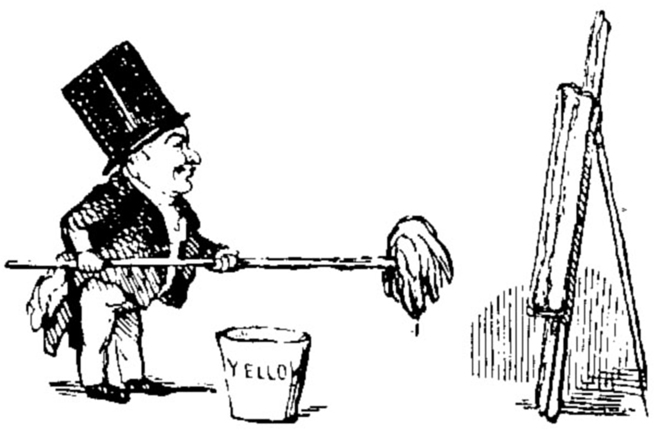
Of course, Mr. Turner's contemporaries were often baffled too. Some of them who liked his earlier work thought he'd gone mad. (A similar reaction to what some devotees of Beethoven - only 4 1/2 years Turner's senior, though he didn't live as long - had to the Ninth Symphony and the Grosse Fuge.) A common view of Turner's late art at the time, reproduced in the exhibit, was this:
So to the DeYoung museum we drove today, only to learn that our tickets were also good for a simultaneous exhibit over at the Legion of Honor that also had some Turner, as well as Constable, Gainsborough, and others. (Did you know that Edward Lear painted? I had not.) So, though tired and arted out, we drove over there too, and were glad we did, for though very interesting it was much smaller and wouldn't have been worth a separate trip.
The main Turner exhibit at the DeYoung is of his late works, from 1835 on. There were several rooms' worth. Even leaving aside the unfinished works of a few shades over white canvas, Turner's art of this period is mostly of very bright colors, with faint and uncontrasting figures and scenery hard to make out. This one is a good example, and to underline the point its title is "Angel Standing in the Sun".

The creativity and daring of this is what's impressive. And to think that Thomas Kinkade called himself "the Painter of Light". He didn't know a photon's worth of light next to the blazing sun of J.M.W. Turner.
Of course, Mr. Turner's contemporaries were often baffled too. Some of them who liked his earlier work thought he'd gone mad. (A similar reaction to what some devotees of Beethoven - only 4 1/2 years Turner's senior, though he didn't live as long - had to the Ninth Symphony and the Grosse Fuge.) A common view of Turner's late art at the time, reproduced in the exhibit, was this:
George Cleve conducts
I wrote yesterday an obituary for George Cleve, and today I thought I would show you a video of him conducting. I picked this one because, despite the shaky sound quality, the video is focused throughout on Cleve's conducting, and because the music - a fine, energetic performance with the Russian National Philharmonic - is Schumann's Fourth Symphony, one of the works Cleve had been scheduled to conduct with Symphony Silicon Valley a little over a month from now, and which now we will not hear him do. (Or his substitute, who has changed the selection to the Second.)
Also for the wincesome moment at the beginning where, just as Cleve is about to begin, a cell phone goes off in the audience, and he gives a little reproving glance behind him. I've seen that happen more than once.If you don't know Schumann's Fourth, I'll just say that it's my favorite of his symphonies, an alternately dark and coy work in D minor, in four movements with a slow introduction, but the most exciting and interesting part to listen for comes between 21:07 and 22:55 on this video, the link passage between the scherzo and the finale, a trick Schumann borrowed without apology from Beethoven's Fifth, which does the same thing for the same reason: to tie the movements more firmly together and keep the audience, which was prone to this in those days, from applauding between them.
Also for the wincesome moment at the beginning where, just as Cleve is about to begin, a cell phone goes off in the audience, and he gives a little reproving glance behind him. I've seen that happen more than once.If you don't know Schumann's Fourth, I'll just say that it's my favorite of his symphonies, an alternately dark and coy work in D minor, in four movements with a slow introduction, but the most exciting and interesting part to listen for comes between 21:07 and 22:55 on this video, the link passage between the scherzo and the finale, a trick Schumann borrowed without apology from Beethoven's Fifth, which does the same thing for the same reason: to tie the movements more firmly together and keep the audience, which was prone to this in those days, from applauding between them.
Thursday, August 27, 2015
George Cleve
Well, one of my favorite conductors just died. George Cleve was 79, and had been a fixture in the Bay Area for well over 40 years, since he first became music director of the San Jose Symphony back in 1972. Over the next 20 years, he transformed it from a part-time local band into a serious regional orchestra, increasing both the number and quality of the concerts. He really came to my attention with the bicentennial season of 1975-6, devoted to 20th-century American music, often with the composers themselves (big names, too: Copland, Thomson, Hovhaness, Chavez) brought in to guest conduct.
But Cleve could be highly abrasive and insanely exacting during rehearsal - B. sang with the orchestra in those years and can testify to the long rehearsals and the tantrums - and, though everyone acknowledged that Cleve led inspiring performances, eventually enough was enough and he was persuaded to retire.
In a sense, Cleve didn't mind. By this time, he had his summer Midsummer Mozart Festival to lead every year, and he kept that going on and on.
A dozen or so years later, the San Jose Symphony had run into the ground and been replaced by Symphony Silicon Valley, and in 2005 they finally invited Cleve back. From the moment he took the stage for an all-Mozart concert, I felt transported back to the 1980s. But it was not quite the same. By this time, Cleve - who had some years earlier survived horrible injuries in a fire that destroyed his house - had matured from the spirited popinjay of his youth into a seasoned, portly figure with a striking resemblance to the older Brahms, white beard and all. He had also mellowed, both in temper towards the orchestra, and in conducting style.
Cleve always specialized in the Viennese classics - Mozart, Beethoven, and Brahms in particular - and in his later years led these works in a broad, expansive, deliberate way, which his deep learning and understanding of the music always made richly rewarding. When reviewing his work, metaphors of hearty meals of meat and potato always came to my mind. There's always room for traditional music-making of this style, so long as someone this good is making it.
Such were the guest concerts he led on his return. He'd found his truest specialty and stuck with it. When he was music director, of course, his programs were more varied, and it wasn't just in the bicentennial year that he explored American music. I have particularly fond memories of Henry Cowell's Fourth Symphony in 1987, the only time I've ever heard one of his symphonies live, and certainly the only time SJS ever did one: when it was over there was as close to complete silence in the audience, except from me, as was compatible with politeness.
And I remember other things as well. The performance of Debussy's La Mer so sparkling that it had me convinced it was really written by Ottorino Respighi. The day in 2006 I was leaving the city library and heard on the car radio that there was about to be a free performance at the symphony hall, so I hastily reparked my car and found George Cleve conducting Mozart's Gran Partita.
Cleve had been ailing in recent years. The last time I saw him conduct, a year ago in June, he was rather frail, moving quite slowly and needing an assist from his concertmaster to make it down from the podium. The music was equally gentle and cautious, but still moving.
I knew his ailment was serious when his name was quietly removed from the Beethoven and Schumann concert he'd been scheduled to open the SSV season with in October. Now it will be played in his memory.
But Cleve could be highly abrasive and insanely exacting during rehearsal - B. sang with the orchestra in those years and can testify to the long rehearsals and the tantrums - and, though everyone acknowledged that Cleve led inspiring performances, eventually enough was enough and he was persuaded to retire.
In a sense, Cleve didn't mind. By this time, he had his summer Midsummer Mozart Festival to lead every year, and he kept that going on and on.
A dozen or so years later, the San Jose Symphony had run into the ground and been replaced by Symphony Silicon Valley, and in 2005 they finally invited Cleve back. From the moment he took the stage for an all-Mozart concert, I felt transported back to the 1980s. But it was not quite the same. By this time, Cleve - who had some years earlier survived horrible injuries in a fire that destroyed his house - had matured from the spirited popinjay of his youth into a seasoned, portly figure with a striking resemblance to the older Brahms, white beard and all. He had also mellowed, both in temper towards the orchestra, and in conducting style.
Cleve always specialized in the Viennese classics - Mozart, Beethoven, and Brahms in particular - and in his later years led these works in a broad, expansive, deliberate way, which his deep learning and understanding of the music always made richly rewarding. When reviewing his work, metaphors of hearty meals of meat and potato always came to my mind. There's always room for traditional music-making of this style, so long as someone this good is making it.
Such were the guest concerts he led on his return. He'd found his truest specialty and stuck with it. When he was music director, of course, his programs were more varied, and it wasn't just in the bicentennial year that he explored American music. I have particularly fond memories of Henry Cowell's Fourth Symphony in 1987, the only time I've ever heard one of his symphonies live, and certainly the only time SJS ever did one: when it was over there was as close to complete silence in the audience, except from me, as was compatible with politeness.
And I remember other things as well. The performance of Debussy's La Mer so sparkling that it had me convinced it was really written by Ottorino Respighi. The day in 2006 I was leaving the city library and heard on the car radio that there was about to be a free performance at the symphony hall, so I hastily reparked my car and found George Cleve conducting Mozart's Gran Partita.
Cleve had been ailing in recent years. The last time I saw him conduct, a year ago in June, he was rather frail, moving quite slowly and needing an assist from his concertmaster to make it down from the podium. The music was equally gentle and cautious, but still moving.
I knew his ailment was serious when his name was quietly removed from the Beethoven and Schumann concert he'd been scheduled to open the SSV season with in October. Now it will be played in his memory.
Sunday, August 23, 2015
the Puppy-free ballot
The Hugo statistics are up as a PDF and linked to from here, and with comparison from the Puppy slates which are linked to from here, it's possible to extrapolate what the Puppy-free ballot would have been.
I'm not sure if anyone else has already done it, but I'm awake and at home and don't have parties to attend, so here are hypotheticals for the four fiction categories and Related Work, all of which were particularly disfigured by puppydom and for which I can be fairly confident that none of the Puppy candidates would have made the ballot without the slates' help. (A judgment that cannot be made for the Best Editor categories, let alone the Best Dramatic Presentation ones.)
Key. A = made the real ballot anyway despite the Puppies' help. B = made the ballot due to the ineligibility or withdrawal of Puppies. Note: There are typos and errors on the statistics (e.g. "Katherine Anderson" for Addison), and I may not have caught others.
BEST NOVEL
Ancillary Sword, Ann Leckie (A)
The Goblin Emperor, Katherine Addison (B)
The Three Body Problem, Cixin Liu (B)
Lock In, John Scalzi
City of Stairs, Robert Jackson Bennett
BEST NOVELLA
"The Slow Regard of Silent Things", Patrick Rothfuss
"The Regular", Ken Liu
"Yesterday's Kin", Nancy Kress
"Grand Jete (The Great Leap)", Rachel Swirsky
"The Mothers of Voorhisville", Mary Rickert
BEST NOVELETTE
"The Day the World Turned Upside Down", Thomas Olde Heuvelt (B)
"Each to Each", Seanan McGuire
"The Devil in America", Kai Ashante Wilson
"The Litany of Earth", Ruthanna Emrys
"The Magician and Laplace's Demon", Tom Crosshill
BEST SHORT STORY
"Jackalope Wives", Ursula Vernon
"The Breath of War", Aliette de Bodard
"The Truth About Owls", Amal El-Mohtar
"When It Ends, He Catches Her", Eugie Foster
"A Kiss With Teeth", Max Gladstone
BEST RELATED WORK
What Makes This Book So Great, Jo Walton
Chicks Dig Gaming, Jennifer Brozek et al
Shadows Beneath: The Writing Excuses Anthology, Brandon Sanderson et al
Invisible: Personal Essays on Representation in SF, Jim C. Hines
Tropes vs. Women: Women as Background Decoration, Anita Sarkeesian
One thing to note is that vol. 2 of Bill Patterson's Heinlein biography still wouldn't have made the ballot; it's 6th place on the Puppy-free list.
Another and most important thing to note is what this does to the male-female ratio of authors in the fiction categories, a topic of which I've written before. The actual ballot had 17 stories by men and 3 by women (15% women). The Puppy slates, taken as an aggregate, had 20 stories by men and 3 by women (13% women). The Puppy-free ballot above has 9 stories by men and 11 by women (55% women), which is in keeping with the post-Racefail numbers of recent years' Hugo nominees, and puts the lie to the Puppies' claim that they're increasing diversity, at least on this axis.
I'm not sure if anyone else has already done it, but I'm awake and at home and don't have parties to attend, so here are hypotheticals for the four fiction categories and Related Work, all of which were particularly disfigured by puppydom and for which I can be fairly confident that none of the Puppy candidates would have made the ballot without the slates' help. (A judgment that cannot be made for the Best Editor categories, let alone the Best Dramatic Presentation ones.)
Key. A = made the real ballot anyway despite the Puppies' help. B = made the ballot due to the ineligibility or withdrawal of Puppies. Note: There are typos and errors on the statistics (e.g. "Katherine Anderson" for Addison), and I may not have caught others.
BEST NOVEL
Ancillary Sword, Ann Leckie (A)
The Goblin Emperor, Katherine Addison (B)
The Three Body Problem, Cixin Liu (B)
Lock In, John Scalzi
City of Stairs, Robert Jackson Bennett
BEST NOVELLA
"The Slow Regard of Silent Things", Patrick Rothfuss
"The Regular", Ken Liu
"Yesterday's Kin", Nancy Kress
"Grand Jete (The Great Leap)", Rachel Swirsky
"The Mothers of Voorhisville", Mary Rickert
BEST NOVELETTE
"The Day the World Turned Upside Down", Thomas Olde Heuvelt (B)
"Each to Each", Seanan McGuire
"The Devil in America", Kai Ashante Wilson
"The Litany of Earth", Ruthanna Emrys
"The Magician and Laplace's Demon", Tom Crosshill
BEST SHORT STORY
"Jackalope Wives", Ursula Vernon
"The Breath of War", Aliette de Bodard
"The Truth About Owls", Amal El-Mohtar
"When It Ends, He Catches Her", Eugie Foster
"A Kiss With Teeth", Max Gladstone
BEST RELATED WORK
What Makes This Book So Great, Jo Walton
Chicks Dig Gaming, Jennifer Brozek et al
Shadows Beneath: The Writing Excuses Anthology, Brandon Sanderson et al
Invisible: Personal Essays on Representation in SF, Jim C. Hines
Tropes vs. Women: Women as Background Decoration, Anita Sarkeesian
One thing to note is that vol. 2 of Bill Patterson's Heinlein biography still wouldn't have made the ballot; it's 6th place on the Puppy-free list.
Another and most important thing to note is what this does to the male-female ratio of authors in the fiction categories, a topic of which I've written before. The actual ballot had 17 stories by men and 3 by women (15% women). The Puppy slates, taken as an aggregate, had 20 stories by men and 3 by women (13% women). The Puppy-free ballot above has 9 stories by men and 11 by women (55% women), which is in keeping with the post-Racefail numbers of recent years' Hugo nominees, and puts the lie to the Puppies' claim that they're increasing diversity, at least on this axis.
Saturday, August 22, 2015
Puppies were harmed in the making of these Hugos
As I stated when reporting on my Hugo voting, I chose the semi-nuclear option of ranking no Puppy slate nominee above No Award, as a principled statement of my opposition to slate nominations. Rather to my surprise, voters of like mind dominated the Hugo voting, and with only one exception, no nominee on either slate won a Hugo. And if that meant "No Award" where there was no other option, then No Award it was, in five categories, which I think doubles the number of "No Award" winners in the entire history of the Hugos. So now we know who it was who bought supporting memberships in such numbers after the nominees were announced. It was outraged loyal fans like me. I was one of them. I'm proud to have played my part in scrubbing this stigma off the history of the Hugos.
Comments on the winners:
Novel: The Three-Body Problem by Cixin Liu. As I noted before, after the opening section it rapidly dropped off in interest for me, though I still think this was the most Hugo-worthy of the nominees in this category.
Novella: No Award. No comment.
Novelette: "The Day the World Turned Upside Down" by Thomas Olde Heuvelt. This was the only short fiction nominee on the entire ballot not to be a Puppy, so, perforce, it was the only one to win a Hugo, and the only one I voted for in first place, though I thought it too whimsical to even be a good fantasy story. That shows, alas, the weakness of a Puppy-filled ballot. It also means that both this year's fiction winners are translations. I'm not sure if the Hugos has ever had one of those before.
Short Story: No Award. No comment.
Related Work: No Award. If any of the categories deserved that result, it was this one.
Graphic Story: Ms. Marvel. The last time I read finalists in this category was in 2011, and while I found some (well, one) of them amusing, the writing quality was amateurish. This year's are much better, and this one is really of professional quality, a thoroughly deserving winner I put in first place. It's about a teenage girl who’s secretly a superhero, but she finds it difficult to go out and perform super deeds because her parents have grounded her. Though she's a Muslim immigrant to the US from Pakistan, rather than a Hindu immigrant to the UK from India, she reminded me of the girl in Bend It Like Beckham, who similarly was sneaking around to pursue her indigenous passion behind the backs of her conservative old-country parents. As the story of this girl's practical life problems, I found it fascinating. When a super villain shows up near the end, I could feel my interest rapidly dwindling, but that's just my lack of interest in superhero comics showing up.
Dramatic Presentation (Long Form): Guardians of the Galaxy. The only nominee appearing on a Puppy slate to take the Hugo. I didn't vote in this category; I haven't seen anything in it.
Dramatic Presentation (Short Form): Orphan Black season 2 finale. I have at least bit and piece familiarity with all the nominees here, and voted in first place for this one, with misgivings. I've seen the first two seasons of the show. Despite the terrific quality of the acting, I'm reluctant to proceed any further, because the plots of the second season seemed to me to be devoted to jerking the viewer around. I wrote about this, and specifically my problems with the finale, here. Nevertheless, I think the series deserves at least a career award for Extreme Cleverness, and this is the only way to get one, though I'm also thinking that the "single episode" Hugo rule for TV shows is due for retirement in this age where an "episode" no longer stands alone but is merely an hour-long chunk of a greater continuity.
Best Editor (Short Form and Long Form): No Award. Well, well. That's what I voted for, because all the nominees were from Puppy slates, but I really expected a couple of the several worthy editors on the ballot, who were in no sense responsible for their Puppy endorsements, to take the award.
Best Professional Artist: Julie Dillon. Her work is good, and she was the only non-Puppy on the ballot, so she gets the nod from me, and the Hugo.
Best Semiprozine: Lightspeed Magazine. In this category there was a choice of non-Puppies, and I put Lightspeed in first place largely because I was impressed with their "Women Destroy Science Fiction" issue, which was the Book of Honor at the last Potlatch.
Best Fanzine: Journey Planet. There were two issues of this zine in the Hugo packet, one about Doctor Who and the other about sports. I'm not very interested in either. Still, they're legitimate topics for fanzines (anything is a legitimate topic for fanzines), and they feature a lot of reliable fanwriters. And it's the only non-Puppy nominee, so it gets my nod and the Hugo.
Best Fancast: Galactic Suburbia Podcast. Three chatty women from Australia natter randomly about SF for a bloody hour and half in each episode. I wish you could browse podcasts; I took to skipping ahead in this one. I listened to the (then) latest episode, hunting for the part where (according to the printed summary on the website) one of the hosts would discuss the Hugo short fiction nominees. Mostly she didn't discuss them, but what really arrested my attention was her description of Gray Rinehart's novelette about humans dying on an alien planet, because the story she was talking about was actually Lou Antonelli's short story about humans dying on an alien planet instead. Oops! Has anybody told her she goofed up? I put this second, and gave my first-place vote to the other non-Puppy fancast, Tea and Jeopardy, which at least is scripted and not so rambling, though the preciously cute premise for the author interviews - that the interviewer is having the guest over for tea, with calling cards and a butler - wears thin after a while, and its plausibility crumbles when the guest's voice is obviously on the phone.
Best Fan Writer: Laura J. Mixon. I put her immediately below No Award. As I noted before, yes, Mixon performed a public service and all, but it's not an achievement I feel like celebrating, nor do I find there's anything about the quality of the writing as such that's award-worthy. Maybe not Mixon's fault, because she had a complex story to untangle, but it was a slog to get through.
Best Fan Artist: Elizabeth Leggett. I've nothing against pretty pictures of horsies, but it's not my own idea of fannish. Possibly she won because she's associated with Lightspeed, which seems generally popular. I gave my first-place to Ninni Aalto, whose work I thought fresh, clever stuff.
John W. Campbell Award for Best New Writer: Wesley Chu. His novel in the Hugo packet, The Deaths of Tao, is a sequel and makes no sense if you haven’t read the precursor. Fortunately, I attended his reading at Borderlands which included an excerpt from the first book, which I found amusing enough. And, sigh, he's the only non-Puppy nominee.
Comments on the winners:
Novel: The Three-Body Problem by Cixin Liu. As I noted before, after the opening section it rapidly dropped off in interest for me, though I still think this was the most Hugo-worthy of the nominees in this category.
Novella: No Award. No comment.
Novelette: "The Day the World Turned Upside Down" by Thomas Olde Heuvelt. This was the only short fiction nominee on the entire ballot not to be a Puppy, so, perforce, it was the only one to win a Hugo, and the only one I voted for in first place, though I thought it too whimsical to even be a good fantasy story. That shows, alas, the weakness of a Puppy-filled ballot. It also means that both this year's fiction winners are translations. I'm not sure if the Hugos has ever had one of those before.
Short Story: No Award. No comment.
Related Work: No Award. If any of the categories deserved that result, it was this one.
Graphic Story: Ms. Marvel. The last time I read finalists in this category was in 2011, and while I found some (well, one) of them amusing, the writing quality was amateurish. This year's are much better, and this one is really of professional quality, a thoroughly deserving winner I put in first place. It's about a teenage girl who’s secretly a superhero, but she finds it difficult to go out and perform super deeds because her parents have grounded her. Though she's a Muslim immigrant to the US from Pakistan, rather than a Hindu immigrant to the UK from India, she reminded me of the girl in Bend It Like Beckham, who similarly was sneaking around to pursue her indigenous passion behind the backs of her conservative old-country parents. As the story of this girl's practical life problems, I found it fascinating. When a super villain shows up near the end, I could feel my interest rapidly dwindling, but that's just my lack of interest in superhero comics showing up.
Dramatic Presentation (Long Form): Guardians of the Galaxy. The only nominee appearing on a Puppy slate to take the Hugo. I didn't vote in this category; I haven't seen anything in it.
Dramatic Presentation (Short Form): Orphan Black season 2 finale. I have at least bit and piece familiarity with all the nominees here, and voted in first place for this one, with misgivings. I've seen the first two seasons of the show. Despite the terrific quality of the acting, I'm reluctant to proceed any further, because the plots of the second season seemed to me to be devoted to jerking the viewer around. I wrote about this, and specifically my problems with the finale, here. Nevertheless, I think the series deserves at least a career award for Extreme Cleverness, and this is the only way to get one, though I'm also thinking that the "single episode" Hugo rule for TV shows is due for retirement in this age where an "episode" no longer stands alone but is merely an hour-long chunk of a greater continuity.
Best Editor (Short Form and Long Form): No Award. Well, well. That's what I voted for, because all the nominees were from Puppy slates, but I really expected a couple of the several worthy editors on the ballot, who were in no sense responsible for their Puppy endorsements, to take the award.
Best Professional Artist: Julie Dillon. Her work is good, and she was the only non-Puppy on the ballot, so she gets the nod from me, and the Hugo.
Best Semiprozine: Lightspeed Magazine. In this category there was a choice of non-Puppies, and I put Lightspeed in first place largely because I was impressed with their "Women Destroy Science Fiction" issue, which was the Book of Honor at the last Potlatch.
Best Fanzine: Journey Planet. There were two issues of this zine in the Hugo packet, one about Doctor Who and the other about sports. I'm not very interested in either. Still, they're legitimate topics for fanzines (anything is a legitimate topic for fanzines), and they feature a lot of reliable fanwriters. And it's the only non-Puppy nominee, so it gets my nod and the Hugo.
Best Fancast: Galactic Suburbia Podcast. Three chatty women from Australia natter randomly about SF for a bloody hour and half in each episode. I wish you could browse podcasts; I took to skipping ahead in this one. I listened to the (then) latest episode, hunting for the part where (according to the printed summary on the website) one of the hosts would discuss the Hugo short fiction nominees. Mostly she didn't discuss them, but what really arrested my attention was her description of Gray Rinehart's novelette about humans dying on an alien planet, because the story she was talking about was actually Lou Antonelli's short story about humans dying on an alien planet instead. Oops! Has anybody told her she goofed up? I put this second, and gave my first-place vote to the other non-Puppy fancast, Tea and Jeopardy, which at least is scripted and not so rambling, though the preciously cute premise for the author interviews - that the interviewer is having the guest over for tea, with calling cards and a butler - wears thin after a while, and its plausibility crumbles when the guest's voice is obviously on the phone.
Best Fan Writer: Laura J. Mixon. I put her immediately below No Award. As I noted before, yes, Mixon performed a public service and all, but it's not an achievement I feel like celebrating, nor do I find there's anything about the quality of the writing as such that's award-worthy. Maybe not Mixon's fault, because she had a complex story to untangle, but it was a slog to get through.
Best Fan Artist: Elizabeth Leggett. I've nothing against pretty pictures of horsies, but it's not my own idea of fannish. Possibly she won because she's associated with Lightspeed, which seems generally popular. I gave my first-place to Ninni Aalto, whose work I thought fresh, clever stuff.
John W. Campbell Award for Best New Writer: Wesley Chu. His novel in the Hugo packet, The Deaths of Tao, is a sequel and makes no sense if you haven’t read the precursor. Fortunately, I attended his reading at Borderlands which included an excerpt from the first book, which I found amusing enough. And, sigh, he's the only non-Puppy nominee.
Sunday, August 16, 2015
review of self-referential book
I Am a Strange Loop by Douglas Hofstadter (Basic Books, 2007)
When Douglas Hofstadter's Gödel, Escher, Bach was published in 1979, it seemed everyone I knew was talking about it. When his Metamagical Themas was published in 1985, most of them were talking about it. But I've never heard anybody discussing this one. Hofstadter's strange disappearance from public discourse is something I've noted before. Purportedly it's due to his continuing insistence on trying to understand human cognition, a task that apparently everyone else has given up as hopelessly impractical. But from this book I sense a deeper problem.
The understanding of human cognition is purportedly the topic of I Am a Strange Loop; I say "purportedly" because it doesn't really engage with the subject. It does have a thesis: that human consciousness and understanding lie within the complexity of the system, not in the accumulation of the individual parts. ("Strange loop" is his term for a system that holds itself up by its own bootstraps.) I'll buy that thesis. The Game of Life (which is mentioned just once, in a footnote) long ago taught us that systems can be built to far greater levels of complexity than any of the rules making them up.
So far so good, but Hofstadter builds his case almost entirely from philosophical principle, rather than scientific research. As a result, there's an airy, detached quality to the whole thing, much of it recycled from his previous books. Mostly he spends his space by getting off on the wrong track philosophically and pursuing it firmly to questionable destinations.
For instance, Hofstadter seems to believe that our brains are not the limit of our consciousness. He advances the notion that bits of our consciousness exist in the minds of everyone who knows us really well, and that we can feel this sense of them inside ourselves. He implies that anyone who doesn't feel this is a psychopath. Well, I like the general notion of interconnectedness - there's an old Jewish proverb (not quoted by Hofstadter unless I missed it) to the effect that nobody is really dead so long as someone lives in body who remembers them, a maxim I've found of comfort - but I feel a huge gap between Hofstadter's hypothetical notion of embracing someone else's soul and the practical reality of just having a pretty good exterior idea of what sort of things they're likely to say, think, and like. Which I guess means that Hofstadter thinks I'm a psychopath. Thanks a lot, Doug.
One of the recycles is a long discussion of Gödel, again (Escher and Bach also make obligatory appearances), for apparently the sole purpose of teaching us that mathematical systems are complex. No kidding. It also reveals the author's burning disdain for Bertrand Russell. Some people think Russell was a credulous peacenik; Hofstadter thinks he was a lousy mathematician. Well, at least that's different. I was modestly entertained by the story of the early 20C amateur math buff who amused himself by counting up the number of syllables required to describe integers, and finding shortcuts. (e.g.: "One hundred forty-four" is 6 syllables, but "twelve squared" is only 2.) With the exception of some landmark numbers ("one trillion"), they tend to get longer with magnitude, and the buff wondered what was the smallest integer whose English-language descriptions always use at least thirty syllables. It would have to be very large. But wait! Once he found it, it could be described as "the smallest integer whose English-language descriptions always use at least thirty syllables," which is only 24 syllables! Oo-ee-oo. If you're tickled by that sort of paradox, go read Metamagical Themas instead: it's full of them.
However, I was so unentertained by the first chapter that I only continued reading the book because it was the only thing handy for the exercise bike one day. There's a lot of personal matter in this book - one chapter is entirely devoted to demonstrating the thesis of others living in us by expressing the author's devotion to the memory of his first wife - and the first chapter contains repeated, mostly irrelevant, references to his vegetarianism.
Normally I have no problems with vegetarians - I'm in favor of the right of any adult (and even, to a large extent, children) to eschew any food for any reason. But Hofstadter is the one kind of vegetarian I dislike: the sanctimonious vegetarian. Not only does he go around preaching, and his loved ones somehow magically convert along the same stages of the path to enlightenment that he does at the same time he does, but he declares that he cannot respect anyone, no matter how otherwise worthy and no matter how far in the past, who is less perfectly vegetarian than he. Most hypocritically, this comes oddly from a guy who freely admits swatting mosquitoes without compunction, and who even provides a chart (it's on page 19) showing a continuous gradation of consciousness level from the mosquito (and lower!) up to "normal adult humans." It doesn't suit someone who proposes such a gradual curve to draw a firm line across it and say, not just "This is where I personally draw the line," but to insist that everyone else draw it in the same place, or else earn his condemnation as immoral for drawing it in a slightly higher place sanctioned by the culture they live in.
He can't keep to the topic; he can't bring himself to relevant conclusions; he operates entirely in philosophical abstractions; he digresses massively; he uses his own brain as the model for everybody else's; he lectures the reader; and he indulges in TMI. This is a once-renowned author gone to seed.
When Douglas Hofstadter's Gödel, Escher, Bach was published in 1979, it seemed everyone I knew was talking about it. When his Metamagical Themas was published in 1985, most of them were talking about it. But I've never heard anybody discussing this one. Hofstadter's strange disappearance from public discourse is something I've noted before. Purportedly it's due to his continuing insistence on trying to understand human cognition, a task that apparently everyone else has given up as hopelessly impractical. But from this book I sense a deeper problem.
The understanding of human cognition is purportedly the topic of I Am a Strange Loop; I say "purportedly" because it doesn't really engage with the subject. It does have a thesis: that human consciousness and understanding lie within the complexity of the system, not in the accumulation of the individual parts. ("Strange loop" is his term for a system that holds itself up by its own bootstraps.) I'll buy that thesis. The Game of Life (which is mentioned just once, in a footnote) long ago taught us that systems can be built to far greater levels of complexity than any of the rules making them up.
So far so good, but Hofstadter builds his case almost entirely from philosophical principle, rather than scientific research. As a result, there's an airy, detached quality to the whole thing, much of it recycled from his previous books. Mostly he spends his space by getting off on the wrong track philosophically and pursuing it firmly to questionable destinations.
For instance, Hofstadter seems to believe that our brains are not the limit of our consciousness. He advances the notion that bits of our consciousness exist in the minds of everyone who knows us really well, and that we can feel this sense of them inside ourselves. He implies that anyone who doesn't feel this is a psychopath. Well, I like the general notion of interconnectedness - there's an old Jewish proverb (not quoted by Hofstadter unless I missed it) to the effect that nobody is really dead so long as someone lives in body who remembers them, a maxim I've found of comfort - but I feel a huge gap between Hofstadter's hypothetical notion of embracing someone else's soul and the practical reality of just having a pretty good exterior idea of what sort of things they're likely to say, think, and like. Which I guess means that Hofstadter thinks I'm a psychopath. Thanks a lot, Doug.
One of the recycles is a long discussion of Gödel, again (Escher and Bach also make obligatory appearances), for apparently the sole purpose of teaching us that mathematical systems are complex. No kidding. It also reveals the author's burning disdain for Bertrand Russell. Some people think Russell was a credulous peacenik; Hofstadter thinks he was a lousy mathematician. Well, at least that's different. I was modestly entertained by the story of the early 20C amateur math buff who amused himself by counting up the number of syllables required to describe integers, and finding shortcuts. (e.g.: "One hundred forty-four" is 6 syllables, but "twelve squared" is only 2.) With the exception of some landmark numbers ("one trillion"), they tend to get longer with magnitude, and the buff wondered what was the smallest integer whose English-language descriptions always use at least thirty syllables. It would have to be very large. But wait! Once he found it, it could be described as "the smallest integer whose English-language descriptions always use at least thirty syllables," which is only 24 syllables! Oo-ee-oo. If you're tickled by that sort of paradox, go read Metamagical Themas instead: it's full of them.
However, I was so unentertained by the first chapter that I only continued reading the book because it was the only thing handy for the exercise bike one day. There's a lot of personal matter in this book - one chapter is entirely devoted to demonstrating the thesis of others living in us by expressing the author's devotion to the memory of his first wife - and the first chapter contains repeated, mostly irrelevant, references to his vegetarianism.
Normally I have no problems with vegetarians - I'm in favor of the right of any adult (and even, to a large extent, children) to eschew any food for any reason. But Hofstadter is the one kind of vegetarian I dislike: the sanctimonious vegetarian. Not only does he go around preaching, and his loved ones somehow magically convert along the same stages of the path to enlightenment that he does at the same time he does, but he declares that he cannot respect anyone, no matter how otherwise worthy and no matter how far in the past, who is less perfectly vegetarian than he. Most hypocritically, this comes oddly from a guy who freely admits swatting mosquitoes without compunction, and who even provides a chart (it's on page 19) showing a continuous gradation of consciousness level from the mosquito (and lower!) up to "normal adult humans." It doesn't suit someone who proposes such a gradual curve to draw a firm line across it and say, not just "This is where I personally draw the line," but to insist that everyone else draw it in the same place, or else earn his condemnation as immoral for drawing it in a slightly higher place sanctioned by the culture they live in.
He can't keep to the topic; he can't bring himself to relevant conclusions; he operates entirely in philosophical abstractions; he digresses massively; he uses his own brain as the model for everybody else's; he lectures the reader; and he indulges in TMI. This is a once-renowned author gone to seed.
Thursday, August 13, 2015
Henry Cowell online
So let me tell you what's excited me in musical recordings and why I wanted to be able to record sound feed off the Internet. (I got it to work by changing to a different default MP3 player.)
It's symphonies by Henry Cowell.
Cowell, who has a local connection - he grew up 14 miles from here, and I drive past his home street all the time - is one of my favorite early/mid 20C composers, and for my tastes the most under-rated. I'm not going to put him on my list of Greatest 20th Century Symphonists, but I do like his music. And not just the symphonies.
Cowell began as a highly imaginative experimentalist composer, particularly for piano. He invented using your palm or entire forearm to play washes of "tone clusters" and dogging the sustain pedal and playing by directly rubbing and plucking the strings. (This piece was played on radio in the 1930s with a large prize offered to any listener who could guess the instrument. No one did.)
Note the pieces' title references to Irish mythology. This interest in his ancestral culture was a root of Cowell's lifelong devotion to ethnomusicology - another was spending childhood time in San Francisco among Chinese and other Asians - and his later music grew more folk-oriented: conservative and accessible on the surface, but still quirky and imaginative. Some of it was pure Americana, and some based on his foreign travels.
But I'm a symphony collector in particular. Cowell wrote 20 symphonies, most in his later years. Seven of these were commercially released in the LP era. I have all of those, and CDs of a few reissued in that era. But that leaves a large gap.
Imagine my delight, then, to discover that - with the latest added quite recently - not only are all seven of those on YouTube, so are more recent performances of two, plus additional recordings - some old vintage radio tapes or private LPs, some recent performances - of five others. This includes the two performed at the American Symphony Orchestra concert five years ago that I considered traveling to New York to attend, but didn't.
The YouTube search results for Cowell symphonies are kind of a mess, so before I ripped recordings off them all - which I wanted in case they disappear later - I made a little web page listing of all of Cowell's symphonies, with links to the recordings.
Which ones should you listen to, if you care for any? Definitely Nos. 4 and 11: they're the best, and they're also the ones with two recordings each. In each case, however, the older recording (listed first), though of poorer sound, is the better performance. Of the five previously unavailable symphonies (2, 8, 9, 13, 14), all new to me, the brightest discovery is No. 9, despite the dreadful (especially at the beginning) sound quality.
So now I have 12 (well, 11.5) of Cowell's symphonies on record. Will we ever complete the set?
It's symphonies by Henry Cowell.
Cowell, who has a local connection - he grew up 14 miles from here, and I drive past his home street all the time - is one of my favorite early/mid 20C composers, and for my tastes the most under-rated. I'm not going to put him on my list of Greatest 20th Century Symphonists, but I do like his music. And not just the symphonies.
Cowell began as a highly imaginative experimentalist composer, particularly for piano. He invented using your palm or entire forearm to play washes of "tone clusters" and dogging the sustain pedal and playing by directly rubbing and plucking the strings. (This piece was played on radio in the 1930s with a large prize offered to any listener who could guess the instrument. No one did.)
Note the pieces' title references to Irish mythology. This interest in his ancestral culture was a root of Cowell's lifelong devotion to ethnomusicology - another was spending childhood time in San Francisco among Chinese and other Asians - and his later music grew more folk-oriented: conservative and accessible on the surface, but still quirky and imaginative. Some of it was pure Americana, and some based on his foreign travels.
But I'm a symphony collector in particular. Cowell wrote 20 symphonies, most in his later years. Seven of these were commercially released in the LP era. I have all of those, and CDs of a few reissued in that era. But that leaves a large gap.
Imagine my delight, then, to discover that - with the latest added quite recently - not only are all seven of those on YouTube, so are more recent performances of two, plus additional recordings - some old vintage radio tapes or private LPs, some recent performances - of five others. This includes the two performed at the American Symphony Orchestra concert five years ago that I considered traveling to New York to attend, but didn't.
The YouTube search results for Cowell symphonies are kind of a mess, so before I ripped recordings off them all - which I wanted in case they disappear later - I made a little web page listing of all of Cowell's symphonies, with links to the recordings.
Which ones should you listen to, if you care for any? Definitely Nos. 4 and 11: they're the best, and they're also the ones with two recordings each. In each case, however, the older recording (listed first), though of poorer sound, is the better performance. Of the five previously unavailable symphonies (2, 8, 9, 13, 14), all new to me, the brightest discovery is No. 9, despite the dreadful (especially at the beginning) sound quality.
So now I have 12 (well, 11.5) of Cowell's symphonies on record. Will we ever complete the set?
Monday, August 10, 2015
it ain't me, babe
I'm not sure whether to tell you that my latest review is up at SFCV or not. Oh, there's a review there, with my name on it, and I wrote large parts of it - and turned it on Friday morning, so why it took till Monday afternoon to appear I know not - but despite it not being overlong it got so drastically cut that an entire composer (André Previn) disappeared, and, a la Peter Jackson cutting down Tolkien, other stuff I didn't write got put in, mostly a strongly-expressed opinion that I do not share.
I've just had a long and rather warm talk with my editor, who's promised to correct some of these problems, so I don't know what you're going to see if and when you click, so I'll leave it at that. That nothing like this happen again is my strong hope and desire.
My boon companion for that concert was Lucy H. A couple days later, I took B. back over there for the final blowout "prelude performance", which didn't precede anything - instead of 2 pieces in 60-70 minutes, it was four pieces and an intermission in 2 1/2 hours - and which was played by the secondary set of artists who deserve no condescension. It featured the brightest and perkiest rendition imaginable of Beethoven's Op. 12 No. 2 violin sonata, with violinist Petteri Iivonen (whose CD was available and which we promptly bought) and pianist Mika Sasaki. Sasaki and Michael James Smith did equal honors to Schubert's Grand Rondo. This was followed by a softly melancholy version of Schumann's Op. 80 piano trio and a chaotic attack on Tchaikovsky's Souvenir de Florence sextet.
I've just had a long and rather warm talk with my editor, who's promised to correct some of these problems, so I don't know what you're going to see if and when you click, so I'll leave it at that. That nothing like this happen again is my strong hope and desire.
My boon companion for that concert was Lucy H. A couple days later, I took B. back over there for the final blowout "prelude performance", which didn't precede anything - instead of 2 pieces in 60-70 minutes, it was four pieces and an intermission in 2 1/2 hours - and which was played by the secondary set of artists who deserve no condescension. It featured the brightest and perkiest rendition imaginable of Beethoven's Op. 12 No. 2 violin sonata, with violinist Petteri Iivonen (whose CD was available and which we promptly bought) and pianist Mika Sasaki. Sasaki and Michael James Smith did equal honors to Schubert's Grand Rondo. This was followed by a softly melancholy version of Schumann's Op. 80 piano trio and a chaotic attack on Tchaikovsky's Souvenir de Florence sextet.
Friday, August 7, 2015
Samsung and the dryer
I am getting used to two new pieces of equipment in my house. Both, as it happens, are by Samsung.
While I was off in Nebraska and Kansas and such places, our washing machine died. I got a distressed call from B. while I was browsing the exhibits at the Eisenhower museum. A repairman told her that the electronics were fried, so repair was not worth the cards. He gave her the names of two retailers known for reliable customer service. I phoned one from the road, the one that opened earlier in the morning. But when I got home to go shopping, it proved to be closed on Monday, so I went to the other one. (Lesson in how to get my business.) This was one of those Men Shopping experiences: took about 20 minutes, including filling out the paperwork.
We're used to top-loading washers, but the salesman convinced me to go for a front-loader. Not only are they more efficient, but machines these days have such large drums that a smaller person would have trouble reaching in a top-loader to get the clothes out. Now we have this thing with a huge bulbous glass eye in front looking out on our garage, not that there's anything to see. When I'm out there I feel like I'm being spied on by the gang from The Prisoner, or by a squat white alien. As a machine, it's proving good, except that I have to get used to using a higher-than-suggested spin cycle to get more water out.
At about the same time, B. insisted on replacing, or more accurately supplementing, my Nook Color with a Samsung Galaxy tablet. The Nook is optimized for reading book files, and it also web browses but it's not very good at it. I'd been using it for my travel computer but with some frustration. The Galaxy is better. In particular it comes installed with the Google Maps app. I could never get Google Maps to display properly on the Nook.
There are, however, some problems with the Galaxy. I spent 3 hours on the phone with their representatives on some of these. For instance, I wanted to turn auto-rotate off, because I like to read in bed and don't want the screen turning 90 degrees on me. Unfortunately I did not know the term "auto-rotate", and my attempt to describe it baffled the guy on the phone, who had no idea what I was talking about. That's part of why it took so long. It turned out that the command is in a second, hidden, settings menu that's totally separate from the menu that comes with an icon on the screen labeled "Settings." Who knew?
The other problem with the Galaxy is that, unlike the Nook, websites recognize it as a mobile device. Southwest Airlines redirects it to their mobile website, which doesn't work. Yelp asked me if I wanted to download the Yelp app. OK, I thought, until I got to the page informing me that the app sought access to the following functions on my computer, including the microphone and the camera. There was no option on that page for saying "No fricking way" or "Are you crazy?" so I terminated it with extreme prejudice. However, when I visit the Yelp page, it asks again.
Nevertheless, it's been very useful and I'm glad to have both now.
While I was off in Nebraska and Kansas and such places, our washing machine died. I got a distressed call from B. while I was browsing the exhibits at the Eisenhower museum. A repairman told her that the electronics were fried, so repair was not worth the cards. He gave her the names of two retailers known for reliable customer service. I phoned one from the road, the one that opened earlier in the morning. But when I got home to go shopping, it proved to be closed on Monday, so I went to the other one. (Lesson in how to get my business.) This was one of those Men Shopping experiences: took about 20 minutes, including filling out the paperwork.
We're used to top-loading washers, but the salesman convinced me to go for a front-loader. Not only are they more efficient, but machines these days have such large drums that a smaller person would have trouble reaching in a top-loader to get the clothes out. Now we have this thing with a huge bulbous glass eye in front looking out on our garage, not that there's anything to see. When I'm out there I feel like I'm being spied on by the gang from The Prisoner, or by a squat white alien. As a machine, it's proving good, except that I have to get used to using a higher-than-suggested spin cycle to get more water out.
At about the same time, B. insisted on replacing, or more accurately supplementing, my Nook Color with a Samsung Galaxy tablet. The Nook is optimized for reading book files, and it also web browses but it's not very good at it. I'd been using it for my travel computer but with some frustration. The Galaxy is better. In particular it comes installed with the Google Maps app. I could never get Google Maps to display properly on the Nook.
There are, however, some problems with the Galaxy. I spent 3 hours on the phone with their representatives on some of these. For instance, I wanted to turn auto-rotate off, because I like to read in bed and don't want the screen turning 90 degrees on me. Unfortunately I did not know the term "auto-rotate", and my attempt to describe it baffled the guy on the phone, who had no idea what I was talking about. That's part of why it took so long. It turned out that the command is in a second, hidden, settings menu that's totally separate from the menu that comes with an icon on the screen labeled "Settings." Who knew?
The other problem with the Galaxy is that, unlike the Nook, websites recognize it as a mobile device. Southwest Airlines redirects it to their mobile website, which doesn't work. Yelp asked me if I wanted to download the Yelp app. OK, I thought, until I got to the page informing me that the app sought access to the following functions on my computer, including the microphone and the camera. There was no option on that page for saying "No fricking way" or "Are you crazy?" so I terminated it with extreme prejudice. However, when I visit the Yelp page, it asks again.
Nevertheless, it's been very useful and I'm glad to have both now.
Subscribe to:
Posts (Atom)