Law profs Lawrence Tribe and Mary Brigid McManamon have convinced me.
By the intended meaning of the U.S. Constitution's requirement for a "natural born Citizen", Ted Cruz is not legally eligible to be President.
McManamon explains the distinction. A natural-born citizen is one born in U.S. territory. (Frustratingly, McManamon doesn't clarify whether this is restricted to the metropolitan U.S. or includes other territory under U.S. control, which would cover Barry Goldwater and John McCain.) Cruz wasn't. He was born in a foreign country. End of story.
But his mother was a U.S. citizen, you object. Here's where McManamon gets ingenious. His mother's status made Cruz a naturalized citizen: naturalized automatically, at birth, instead of having to go through a naturalization procedure later on. But he's not a natural-born citizen.
That's what the Constitution was written to intend. Tribe puts the argument in context. If put to the Court today, the decision would probably go for the more inclusive meaning. But Cruz wants justices who stick to the original intent. Well, then, he can't have them, because they'd have to rule he was ineligible to appoint them.
I have no doubt, however, that if Cruz is nominated and then elected, the question will be just brushed aside.

Kalimac's corner: a journal by DB
Wednesday, January 13, 2016
Tuesday, January 12, 2016
all knowledge
I have another question for the wise minds out there. Never mind for now why I have the photos which I am here showing you scanned versions of (I'm fairly sure that what I have are the only print copies of these specific photos); what I want to know is, who's in them?
I'm fairly sure the photos were taken around 1940. Definitely +/- 10 years. I suspect the people visible in them are movie stars, but I don't recognize them. Well, maybe one, but I'm not saying who I think it is, because I don't want to prejudice other views.
Do you?
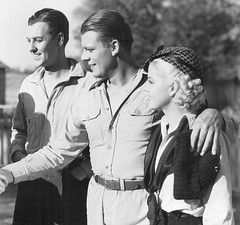
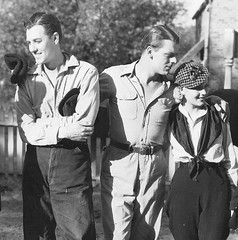
Larger copies are here and here
I'm fairly sure the photos were taken around 1940. Definitely +/- 10 years. I suspect the people visible in them are movie stars, but I don't recognize them. Well, maybe one, but I'm not saying who I think it is, because I don't want to prejudice other views.
Do you?
Larger copies are here and here
Monday, January 11, 2016
I never drink ... wine
Like Treebeard's "I am not very, hm, bendable," this famous line of Bela Lugosi's Count Dracula is a motto of mine, but it's not entirely true. What I really avoid are beer and hard liquor, but I will take an occasional small glass of wine.
Still, most wine I don't much like, so it's worth noting that two bottles that recently came into our house via gift (they come no other way) proved to be rather tasty by my standards, so it's worth recording them.
1) 2014 Round Pond Rosato di Nebbiolo. A Napa Valley wine from our niece & nephew, who live near Round Pond and say it's their favorite winery. (It also produces gourmet olive oil, and I've a small bottle of that too, on our kitchen counter waiting to be used.) In my limited experience, rosé wines tend to suit me, and this was a good one.
2) Ste Chapelle soft red, no vintage. Oh look, it's imported ... from Idaho. Specifically Caldwell, which I suppose is about the most likely part of Idaho for vineyards. B. said of this wine that it's like port, only less strong. Both parts of that sounded good to me, and it was.
Still, most wine I don't much like, so it's worth noting that two bottles that recently came into our house via gift (they come no other way) proved to be rather tasty by my standards, so it's worth recording them.
1) 2014 Round Pond Rosato di Nebbiolo. A Napa Valley wine from our niece & nephew, who live near Round Pond and say it's their favorite winery. (It also produces gourmet olive oil, and I've a small bottle of that too, on our kitchen counter waiting to be used.) In my limited experience, rosé wines tend to suit me, and this was a good one.
2) Ste Chapelle soft red, no vintage. Oh look, it's imported ... from Idaho. Specifically Caldwell, which I suppose is about the most likely part of Idaho for vineyards. B. said of this wine that it's like port, only less strong. Both parts of that sounded good to me, and it was.
Sunday, January 10, 2016
a little lesson
Somewhat more than 25 years ago now, a tempest erupted in C.S. Lewis studies. A respected scholar, Kathryn Lindskoog, wrote an article and then a book (followed by more books and a magazine) charging that the likewise respected and prolifically-publishing literary executor of the Lewis estate, Walter Hooper, had engaged in malfeasance, exaggerating the extent of his own relationship with Lewis, insinuating himself into the position of literary executor, sponsoring false and misleading accounts of Lewis's life and beliefs, tinkering with Lewis's texts, and - most staggeringly - publishing a forgery as Lewis's work and lying about its provenance.
My own reaction to this was that Lindskoog proved her case on some of the charges, particularly the first, but that some of the others were flimsy at best. The forgery claim, for one: a manuscript in Lewis's handwriting existed, but she said it must have been forged, and her main evidence that the story wasn't by Lewis was that it wasn't very good, a terrible argument to make regarding an abandoned incomplete piece by a prolific and inconsistent author. On the other hand, for the provenance Lindskoog showed that it was Hooper's story that was full of holes. And some of the bad smell she detected around other things was evident to me too.
The counter-argument by Hooper's supporters was that Lindskoog had lost her marbles and sent around unjust charges willy-nilly, and she didn't help by being a poor advocate for her own case, failing to distinguish facts from speculations, and rambling terribly. That she was, in their words, a nut did not seem beyond possibility.
During the height of this, I was the editor of the Mythopoeic Society's bulletin, so I had to engage with the topic. I tried to maintain a judicious distance, pointing out both the strengths and weaknesses in the charges (Hooper himself refrained from the fray, and his supporters published no full-length rebuttals, so there was less to respond to there).
What got me was this. During this controversy I received two - one from each side - submissions for publication, each intended to prove the case once and for all, and blow the other side entirely out of the water. But though both authors were sharp and insightful people, both their submissions struck me as very weak, failing to engage with the other side's strong points and not demonstrating their own points. To each submitter I wrote back, outlining what I felt was missing from their polemics and what they'd have to put in to actually prove their case.
I was trying to save them from the embarrassment and grief that would have resulted from publication of their weak arguments that would have led to the conclusion that they had nothing better, and more importantly to encourage them. If either of them really did have a solid argument that the other side was wrong, by all means I wanted to see it, but first they'd have to produce it.
But neither of them took it that way. Each of them assumed that I had completely fallen for the other side's false arguments and that I was beyond reasonable discussion. One of them wrote back denouncing me, and the other just gave up and never responded; I didn't find out until some time later how he'd taken it. At that point I gave up: the assumption that my desire for something better than weak arguments meant I must have fallen for the other side's weak arguments struck me as grotesque.
So now I've found myself similarly engaged in the Peter S. Beagle controversy. Two sides, each accusing the other of bad dealings, false charges, and trying to control Beagle's work and manipulate his person for its own illegitimate profit. Such independent knowledge as I have of the background supports cases for both sides. But when I read the cases, I see on both sides huge gaps in the argument and unexplained questions.
Should I write another post outlining what I don't understand and saying to both sides, "This is what you'll have to explain if you want me to believe your case"? No. Not if I take the Lewis controversy as my guide. If they're like the Lewis camps, I'd be wasting my time trying to get them to shore up their cases; they'd just take my questions as attacks and write me off as an enemy. And thereby they'd only make me think more poorly of them. And since, even to start with, both sides' attacks on the other are more vicious than anything that occurred during the Lewis wars, I don't have my hopes up that they'd be any different, and all I'd accomplish is to get myself shot at.
So I'm writing this instead, to explain why - despite my love for Beagle's work and my personal fondness for him - I'm not joining either camp of self-proclaimed Beagle defenders, at least until somebody actually produces something definitive.
No comments, because I don't want to tempt anybody.
My own reaction to this was that Lindskoog proved her case on some of the charges, particularly the first, but that some of the others were flimsy at best. The forgery claim, for one: a manuscript in Lewis's handwriting existed, but she said it must have been forged, and her main evidence that the story wasn't by Lewis was that it wasn't very good, a terrible argument to make regarding an abandoned incomplete piece by a prolific and inconsistent author. On the other hand, for the provenance Lindskoog showed that it was Hooper's story that was full of holes. And some of the bad smell she detected around other things was evident to me too.
The counter-argument by Hooper's supporters was that Lindskoog had lost her marbles and sent around unjust charges willy-nilly, and she didn't help by being a poor advocate for her own case, failing to distinguish facts from speculations, and rambling terribly. That she was, in their words, a nut did not seem beyond possibility.
During the height of this, I was the editor of the Mythopoeic Society's bulletin, so I had to engage with the topic. I tried to maintain a judicious distance, pointing out both the strengths and weaknesses in the charges (Hooper himself refrained from the fray, and his supporters published no full-length rebuttals, so there was less to respond to there).
What got me was this. During this controversy I received two - one from each side - submissions for publication, each intended to prove the case once and for all, and blow the other side entirely out of the water. But though both authors were sharp and insightful people, both their submissions struck me as very weak, failing to engage with the other side's strong points and not demonstrating their own points. To each submitter I wrote back, outlining what I felt was missing from their polemics and what they'd have to put in to actually prove their case.
I was trying to save them from the embarrassment and grief that would have resulted from publication of their weak arguments that would have led to the conclusion that they had nothing better, and more importantly to encourage them. If either of them really did have a solid argument that the other side was wrong, by all means I wanted to see it, but first they'd have to produce it.
But neither of them took it that way. Each of them assumed that I had completely fallen for the other side's false arguments and that I was beyond reasonable discussion. One of them wrote back denouncing me, and the other just gave up and never responded; I didn't find out until some time later how he'd taken it. At that point I gave up: the assumption that my desire for something better than weak arguments meant I must have fallen for the other side's weak arguments struck me as grotesque.
So now I've found myself similarly engaged in the Peter S. Beagle controversy. Two sides, each accusing the other of bad dealings, false charges, and trying to control Beagle's work and manipulate his person for its own illegitimate profit. Such independent knowledge as I have of the background supports cases for both sides. But when I read the cases, I see on both sides huge gaps in the argument and unexplained questions.
Should I write another post outlining what I don't understand and saying to both sides, "This is what you'll have to explain if you want me to believe your case"? No. Not if I take the Lewis controversy as my guide. If they're like the Lewis camps, I'd be wasting my time trying to get them to shore up their cases; they'd just take my questions as attacks and write me off as an enemy. And thereby they'd only make me think more poorly of them. And since, even to start with, both sides' attacks on the other are more vicious than anything that occurred during the Lewis wars, I don't have my hopes up that they'd be any different, and all I'd accomplish is to get myself shot at.
So I'm writing this instead, to explain why - despite my love for Beagle's work and my personal fondness for him - I'm not joining either camp of self-proclaimed Beagle defenders, at least until somebody actually produces something definitive.
No comments, because I don't want to tempt anybody.

Saturday, January 9, 2016
bearded
There's been a lot of commentary on beards lately, like this. Possibly generated by Paul Ryan's new beard, or the revelation of the strategically political or commercial beard-growing of the Duck Dodgers Dynasty boys, or the Mast Brothers.
I've looked at the book cited in that article, but it disappointed me. Instead of a history of the beard, it's a collection of portraits of men with beards. What I want is to know not about any individual beard, but about beards in general, their rise and fall, and why. I'm particularly fascinated by the Wave of Beards that swept across Europe and the U.S. in the late 19C. Why did it come? Why did it go? Why was its arrival not met with the obloquy that greeted the very tiny revival of beards in the 1960s and 70s?
I've read possible answers to the first two questions. The previous Wave of Beards, in the Renaissance, disappeared coincident with the arrival of the powdered wig, so perhaps beards were thought a follicle too far. When the wigs went out in the early 19C, facial hair reappeared, first in the form of increasingly elaborate muttonchop whiskers, and then beards.
As for why they disappeared, I've read the simple cynical answer that it was because King Gillette wanted to sell razors. Once he'd sold razors to all the men, in the 1910s he created a new market by inventing women's underarm shaving, previously practiced only by the occasional courtesan.
I'm not sure how accurate or full these explanations are, but if I can't trace the reasons, at least I can gather facts. I have this database of U.S. senators from 1789 on, see, and when the Congressional Biographical Directory added portraits of all the senators (they now have most of the House members, too), I thought: this would be a useful database, large enough to be meaningful but not so large as to be wearisome to compile, of the rise and fall of the beard. Of course it says nothing about when the man grew his beard or whether he always kept it, but it has some value as an approximation. What's striking is the rise and fall of the sideburns (alone, without mustache), the beard, and the mustache (with or without sideburns, but without beard), in that order. It's even visible on as rough an approximation as birth decade:
After that the mustache continued to trail on in occasional use through men born in the 1910s, but with one exception of 1910s birth (and he didn't actually grow it until around 1970), the beard didn't reappear in the Senate until a very few men born in the 1940s had them.
But note how ubiquitous facial hair was among men serving between the 1860s and 1910s. A third of men born in the 1800s and 1860s wore facial hair, rising above half in the intervening decades, reaching an astonishing height of 91% of those born in the 1830s.
Beards that I see today are most commonly the neatly-trimmed oval around the mouth, like PNH's, and one sees the occasional wildman (which was once respectable), but my aim in a beard is to emulate General Grant. I emphatically do not view my beard as an ornament. I'm not often asked why I grow a beard, but when I am I say, "I don't consider that a meaningful question. The meaningful question is, why do so many other men shave theirs off?" I stopped shaving in college, because I couldn't think of a reason why I should continue wasting my time at it every morning. Consequently I don't shave around the beard either - what other men do is up to them, but to me both shaving and having a beard would be the epitome of pointlessness - but I do keep it short, because cutting it with scissors every couple of weeks is a lot less trouble, and a lot less messy, than having it get in the way all the time. I wash it with soap and water, like the rest of my face. (Only once did I try shampooing it: I had forgotten that the beard lies below the nostrils, and that was a bit much, so another reason to keep it short.) I did shave it off entirely once, about 20 years ago, because I was curious as to what I looked like underneath. I soon grew it back.

I've looked at the book cited in that article, but it disappointed me. Instead of a history of the beard, it's a collection of portraits of men with beards. What I want is to know not about any individual beard, but about beards in general, their rise and fall, and why. I'm particularly fascinated by the Wave of Beards that swept across Europe and the U.S. in the late 19C. Why did it come? Why did it go? Why was its arrival not met with the obloquy that greeted the very tiny revival of beards in the 1960s and 70s?
I've read possible answers to the first two questions. The previous Wave of Beards, in the Renaissance, disappeared coincident with the arrival of the powdered wig, so perhaps beards were thought a follicle too far. When the wigs went out in the early 19C, facial hair reappeared, first in the form of increasingly elaborate muttonchop whiskers, and then beards.
As for why they disappeared, I've read the simple cynical answer that it was because King Gillette wanted to sell razors. Once he'd sold razors to all the men, in the 1910s he created a new market by inventing women's underarm shaving, previously practiced only by the occasional courtesan.
I'm not sure how accurate or full these explanations are, but if I can't trace the reasons, at least I can gather facts. I have this database of U.S. senators from 1789 on, see, and when the Congressional Biographical Directory added portraits of all the senators (they now have most of the House members, too), I thought: this would be a useful database, large enough to be meaningful but not so large as to be wearisome to compile, of the rise and fall of the beard. Of course it says nothing about when the man grew his beard or whether he always kept it, but it has some value as an approximation. What's striking is the rise and fall of the sideburns (alone, without mustache), the beard, and the mustache (with or without sideburns, but without beard), in that order. It's even visible on as rough an approximation as birth decade:
birth   sideburns beards    mustache   US Presidents (for comparison)
1770s      6%        1%                Harrison (shaven)
1780s     13%        1%                Van Buren (sideburns), Taylor (shaven)
1790s      8%        7%                Tyler (shaven), Polk (shaven), Buchanan (didn't need to shave)
1800s      8%       21%        5%      Fillmore (shaven), Pierce (shaven), Lincoln (beard), Johnson (shaven)
1810s      9%       44%        6%
1820s      4%       67%       15%      Grant (beard), Hayes (beard), Arthur (mustache)
1830s      1%       49%       42%      Garfield (beard), Cleveland (mustache), Harrison (beard)
1840s               27%       46%      McKinley (shaven)
1850s                9%       50%      Roosevelt (mustache), Taft (mustache), Wilson (shaven)
1860s                5%       38%      Harding (shaven)
1870s                          6%      Coolidge (shaven), Hoover (shaven)
After that the mustache continued to trail on in occasional use through men born in the 1910s, but with one exception of 1910s birth (and he didn't actually grow it until around 1970), the beard didn't reappear in the Senate until a very few men born in the 1940s had them.
But note how ubiquitous facial hair was among men serving between the 1860s and 1910s. A third of men born in the 1800s and 1860s wore facial hair, rising above half in the intervening decades, reaching an astonishing height of 91% of those born in the 1830s.
Beards that I see today are most commonly the neatly-trimmed oval around the mouth, like PNH's, and one sees the occasional wildman (which was once respectable), but my aim in a beard is to emulate General Grant. I emphatically do not view my beard as an ornament. I'm not often asked why I grow a beard, but when I am I say, "I don't consider that a meaningful question. The meaningful question is, why do so many other men shave theirs off?" I stopped shaving in college, because I couldn't think of a reason why I should continue wasting my time at it every morning. Consequently I don't shave around the beard either - what other men do is up to them, but to me both shaving and having a beard would be the epitome of pointlessness - but I do keep it short, because cutting it with scissors every couple of weeks is a lot less trouble, and a lot less messy, than having it get in the way all the time. I wash it with soap and water, like the rest of my face. (Only once did I try shampooing it: I had forgotten that the beard lies below the nostrils, and that was a bit much, so another reason to keep it short.) I did shave it off entirely once, about 20 years ago, because I was curious as to what I looked like underneath. I soon grew it back.


Thursday, January 7, 2016
out of pocket expenses
Some years ago I dipped into Jo Walton's Farthing, but I didn't get very far because I'm not enthusiastic for "cozy" country-house murder mysteries. But, having been so impressed by some of her more recent books, I decided to try again.
And true, Farthing does have some of the irritating typical features of that genre, but I should have trusted Jo Walton! It's also captivating and an excellent read in other ways. And its two sequels, Ha'penny and Half a Crown, which I immediately went on to, are not murder mysteries at all but suspense novels, a genre I much prefer. Ha'penny was particularly outstanding in, like Farthing, facing a dire ending unflinchingly.
They're also alternate histories - something that always raises my interest - and they're set in post-WW2 Britain, a time and place of which I've read much. So let's be clear before I go on any further: these are excellent novels, with intricate well-woven plots and some outstanding characters, told in a clear style that runs along like a series of raindrops flowing together, that I recognize as characteristic of Walton's work. I recommend them.
But Farthing in particular contains a number of factual errors about British nobility and political arrangements. These are something of a bugaboo of mine. I was shocked: Jo Walton is knowledgeable and learned, particularly about the country she was born and grew up in; how could she get these elementary facts wrong? There's much less of it in the succeeding books; did someone alert the author after Farthing was published?
The usual American mistake about British nobility is to treat the title "Lord" or "Lady" as a free-floater that can be attached indiscriminately to first name or last. Walton is not American and mostly doesn't do this, though there are a couple of cases where it does happen (Farthing p. 289; Ha'penny p. 277). Farthing is more likely to apply these titles to people who shouldn't have them at all (pp. 101, 124, 165, and others), though in the second book a character chides people who mistakenly do that. There's a character who's mostly a Duke but once an Earl (p. 125). And I don't think anybody says "my lord," even when they should (p. 140).
More seriously, there's a baronet (someone whose moniker looks like this: "Sir Ruthven Murgatroyd, Bt") in the House of Lords (p. 101-2). Surely the author should know that a baronetcy is a hereditary knighthood and not a title of nobility, and has never by itself carried a seat in the Lords.
Nor do the highest-ranking political offices go to commoners as some sort of compensatory privilege in response to those that lords get, as both the omniscient and first-person narrators of Farthing suggest (p. 103, 242-3). Offices like Prime Minister and Foreign Secretary have been pretty much limited to the Commons only since the House of Lords was stripped of most of its power in 1911, and that's not as a privilege but so that they may be questioned by and hence be answerable to the more powerful House. Before then they were as likely to be in the Lords as not, and even since then there've been exceptions (there was a Foreign Secretary in the Lords as late as the Thatcher ministry). And the Lord Chancellor, one of the highest-ranking offices, before the further reforms of 1999 presided over the Lords and consequently was always a member of it. But the Chancellor of the Exchequer, which is the office at issue here, has always sat in the Commons. The Chancellor's main job is to introduce the annual budget, and since finance bills by law must originate there, it would be not just uncustomary but practically impossible to have a Chancellor in the Lords where he couldn't introduce his own budget.
Problems in the succeeding books are more ones of tone, and I'm less sure of my ground with these. Would a civil servant conferring with top ministers address them only with the occasional "sir", as happens in Ha'penny (ch. 26)? Unless I missed something, it isn't until the third book that he says, "Yes, Prime Minister," which is what you would say. What Brit of the era would say "bathroom" when they mean the loo? (Ha'penny p. 158) Is there a Pesach seder tradition in which the children hide the afikoman (Half a Crown p. 257)? I've always known the tradition as an adult hides it; the children's job is to find it. And there's two conversations in the third book (ch. 8 and 29) that I don't believe at all, for what seem to me glaring plot reasons.
Could some of these be errors made by characters? Perhaps some, but in these books most errors made by characters are marked as such, and many of these are by characters who wouldn't make such errors. Others are expository, recounting Scotland Yard reports, and there's no intimation that Scotland Yard research is unreliable.
Could these errors be actual fact in this alternate history? Again, I think not. None of them would be required by the nature of the alternate history; Walton is conservative about postulating changes (Attlee is still leader of the Labour Party in this alternate 1949, which I'd have thought would be unlikely in the circumstances); and one of the points of Half a Crown is that no constitutional changes were necessary to put Britain under a dictatorship.
But these blemishes only stand out because I had such high expectations. I did like these books.
And true, Farthing does have some of the irritating typical features of that genre, but I should have trusted Jo Walton! It's also captivating and an excellent read in other ways. And its two sequels, Ha'penny and Half a Crown, which I immediately went on to, are not murder mysteries at all but suspense novels, a genre I much prefer. Ha'penny was particularly outstanding in, like Farthing, facing a dire ending unflinchingly.
They're also alternate histories - something that always raises my interest - and they're set in post-WW2 Britain, a time and place of which I've read much. So let's be clear before I go on any further: these are excellent novels, with intricate well-woven plots and some outstanding characters, told in a clear style that runs along like a series of raindrops flowing together, that I recognize as characteristic of Walton's work. I recommend them.
But Farthing in particular contains a number of factual errors about British nobility and political arrangements. These are something of a bugaboo of mine. I was shocked: Jo Walton is knowledgeable and learned, particularly about the country she was born and grew up in; how could she get these elementary facts wrong? There's much less of it in the succeeding books; did someone alert the author after Farthing was published?
The usual American mistake about British nobility is to treat the title "Lord" or "Lady" as a free-floater that can be attached indiscriminately to first name or last. Walton is not American and mostly doesn't do this, though there are a couple of cases where it does happen (Farthing p. 289; Ha'penny p. 277). Farthing is more likely to apply these titles to people who shouldn't have them at all (pp. 101, 124, 165, and others), though in the second book a character chides people who mistakenly do that. There's a character who's mostly a Duke but once an Earl (p. 125). And I don't think anybody says "my lord," even when they should (p. 140).
More seriously, there's a baronet (someone whose moniker looks like this: "Sir Ruthven Murgatroyd, Bt") in the House of Lords (p. 101-2). Surely the author should know that a baronetcy is a hereditary knighthood and not a title of nobility, and has never by itself carried a seat in the Lords.
Nor do the highest-ranking political offices go to commoners as some sort of compensatory privilege in response to those that lords get, as both the omniscient and first-person narrators of Farthing suggest (p. 103, 242-3). Offices like Prime Minister and Foreign Secretary have been pretty much limited to the Commons only since the House of Lords was stripped of most of its power in 1911, and that's not as a privilege but so that they may be questioned by and hence be answerable to the more powerful House. Before then they were as likely to be in the Lords as not, and even since then there've been exceptions (there was a Foreign Secretary in the Lords as late as the Thatcher ministry). And the Lord Chancellor, one of the highest-ranking offices, before the further reforms of 1999 presided over the Lords and consequently was always a member of it. But the Chancellor of the Exchequer, which is the office at issue here, has always sat in the Commons. The Chancellor's main job is to introduce the annual budget, and since finance bills by law must originate there, it would be not just uncustomary but practically impossible to have a Chancellor in the Lords where he couldn't introduce his own budget.
Problems in the succeeding books are more ones of tone, and I'm less sure of my ground with these. Would a civil servant conferring with top ministers address them only with the occasional "sir", as happens in Ha'penny (ch. 26)? Unless I missed something, it isn't until the third book that he says, "Yes, Prime Minister," which is what you would say. What Brit of the era would say "bathroom" when they mean the loo? (Ha'penny p. 158) Is there a Pesach seder tradition in which the children hide the afikoman (Half a Crown p. 257)? I've always known the tradition as an adult hides it; the children's job is to find it. And there's two conversations in the third book (ch. 8 and 29) that I don't believe at all, for what seem to me glaring plot reasons.
Could some of these be errors made by characters? Perhaps some, but in these books most errors made by characters are marked as such, and many of these are by characters who wouldn't make such errors. Others are expository, recounting Scotland Yard reports, and there's no intimation that Scotland Yard research is unreliable.
Could these errors be actual fact in this alternate history? Again, I think not. None of them would be required by the nature of the alternate history; Walton is conservative about postulating changes (Attlee is still leader of the Labour Party in this alternate 1949, which I'd have thought would be unlikely in the circumstances); and one of the points of Half a Crown is that no constitutional changes were necessary to put Britain under a dictatorship.
But these blemishes only stand out because I had such high expectations. I did like these books.
Wednesday, January 6, 2016
Pierre Boulez
has died at the impressive age of 90. He conducted a mean Debussy. And, if we're only supposed to say nice things about the recently deceased, I'll leave it at that.
when they battle in a puddle, it's a Peter Beagle puddle battle
What do we know about Peter Beagle? Well ...
After years of being fairly obscure and off the public stage, and fairly indigent too from what I understand, the once-prominent fantasy writer whose older work was still remembered had a late blossoming. He'd gotten a personal manager, Connor Cochran (known in fandom for decades, usually under his artistic pen name Freff), who was devoting himself to the energetic promotion of Peter S. Beagle and his works.
Most notably, he'd gotten the movie adaptation of Beagle's novel The Last Unicorn out of rights limbo. He organized a slow-scale nation-wide tour of screenings of the movie with Beagle in attendance. I went to the first of these, in San Francisco, three years ago and was stunned at the enthusiastic crowds and pleased at seeing Peter feted. It had become a cult movie while I wasn't paying attention. (It was the only time I'd seen the film since its first release, and not only had the suck fairy not withered it, it had if anything improved with age.)
With the same enthusiastic bounce, new Beagle books - new material, new collections of older material not previously reissued, new editions of old books - began blossoming from various presses, and I picked some of these up. There was an email newsletter which I got regularly for a while, though either it ceased some time ago or I fell off the mailing list.
So I was stunned to read this in the new Ansible: "PETER BEAGLE is suing his publisher Conlan Press and its proprietor Connor Freff Cochran; the long list of complaints filed in November begins with 'elder abuse' in various categories, fraud, defamation, breach of fiduciary duty, breach of contract ... Cochran claims the suit is frivolous." Followed by a comment to the effect that the publisher has become infamous for "delayed delivery and non-delivery" - I wouldn't know about that; I've never ordered anything directly from them by mail.
Yikes! At Conlan's website you may read: "Peter is facing a whole new kind of problem: his health. Those of you who have been following the Tour already know we had to suspend our shows last June because Peter was having major issues with his memory. Business and personal matters that he and I had worked on for years had completely vanished from his head, and he was also confabulating — recalling only fragments of events, then filling in the blanks with things that never happened. I certainly wasn’t going to ask him to continue on the road in that condition, so I pulled the plug. Due to continuing problems and Peter’s wish for privacy, his screening appearances are suspended indefinitely. A new version of the tour will launch in 2016 ... But Peter will be unable to attend or sign merchandise." (This is, by the way, considerably revised and somewhat expanded, though the essence is unchanged, from what it said yesterday.)
So what is going on? Whatever it is, it's very sad. Whatever else may be true, Beagle is a great author and - from my experiences with him - a really nice guy; and Freff really has done a tremendous amount of hard work to promote him. Ansible has a link, apparently to the text of the suit, but it's gone dead. I know no more than that, so I'm just passing on what's been written in public.
After years of being fairly obscure and off the public stage, and fairly indigent too from what I understand, the once-prominent fantasy writer whose older work was still remembered had a late blossoming. He'd gotten a personal manager, Connor Cochran (known in fandom for decades, usually under his artistic pen name Freff), who was devoting himself to the energetic promotion of Peter S. Beagle and his works.
Most notably, he'd gotten the movie adaptation of Beagle's novel The Last Unicorn out of rights limbo. He organized a slow-scale nation-wide tour of screenings of the movie with Beagle in attendance. I went to the first of these, in San Francisco, three years ago and was stunned at the enthusiastic crowds and pleased at seeing Peter feted. It had become a cult movie while I wasn't paying attention. (It was the only time I'd seen the film since its first release, and not only had the suck fairy not withered it, it had if anything improved with age.)
With the same enthusiastic bounce, new Beagle books - new material, new collections of older material not previously reissued, new editions of old books - began blossoming from various presses, and I picked some of these up. There was an email newsletter which I got regularly for a while, though either it ceased some time ago or I fell off the mailing list.
So I was stunned to read this in the new Ansible: "PETER BEAGLE is suing his publisher Conlan Press and its proprietor Connor Freff Cochran; the long list of complaints filed in November begins with 'elder abuse' in various categories, fraud, defamation, breach of fiduciary duty, breach of contract ... Cochran claims the suit is frivolous." Followed by a comment to the effect that the publisher has become infamous for "delayed delivery and non-delivery" - I wouldn't know about that; I've never ordered anything directly from them by mail.
Yikes! At Conlan's website you may read: "Peter is facing a whole new kind of problem: his health. Those of you who have been following the Tour already know we had to suspend our shows last June because Peter was having major issues with his memory. Business and personal matters that he and I had worked on for years had completely vanished from his head, and he was also confabulating — recalling only fragments of events, then filling in the blanks with things that never happened. I certainly wasn’t going to ask him to continue on the road in that condition, so I pulled the plug. Due to continuing problems and Peter’s wish for privacy, his screening appearances are suspended indefinitely. A new version of the tour will launch in 2016 ... But Peter will be unable to attend or sign merchandise." (This is, by the way, considerably revised and somewhat expanded, though the essence is unchanged, from what it said yesterday.)
So what is going on? Whatever it is, it's very sad. Whatever else may be true, Beagle is a great author and - from my experiences with him - a really nice guy; and Freff really has done a tremendous amount of hard work to promote him. Ansible has a link, apparently to the text of the suit, but it's gone dead. I know no more than that, so I'm just passing on what's been written in public.
Tuesday, January 5, 2016
world according to cat
I was just starting to write a post about something else altogether when Maia came into the office and began pacing and meowing beneath my feet. This sometimes means she wants another meal, often well before mealtime, but this time it meant she wanted me to follow her into the bedroom. She will sit alert at a specific point at the foot of the bed, and then if, and only if, you stand behind her just there, she will jump up onto the bed. This means she wants you then also to get up on the bed and give her an intense session of petting (or stroking, as I believe it's called in Britain).
When Maia was a kitten, she didn't seem quite sure whether she liked being petted or not, but about a year ago - she's 2 1/2 now - she began this bed-jumping habit, though the demanding meows are much newer. (The vet says it means she's more comfortable with us. Don't get too comfortable there, cat.) She'll settle down in a relaxed pose to be petted, interspersed with getting scratched all around the head, then get up for a bit and settle down in a slightly different spot. Repeat frequently. This desire to keep moving around may explain why she doesn't like to be picked up and held: can't move around while that's going on.
The best part comes in the parts in between being settled. She'll walk back and forth rubbing against my head as I lie there on propped-up elbows. She'll also lick my elbows, or even bump noses. It's an intimate close encounter with a cat.
When I'm playing with Maia with the peacock feather it's sometimes hard to tell if she's still interested. After initial activity, she usually tries to chase the feather while lying down, paws waving desultorily in the air as it comes by. But with the petting sessions, there's no question but that she's fully involved. And when she's had enough, after five or ten minutes, she'll just jump off the bed. Though we have done this as many as five times in a one day.
When Maia was a kitten, she didn't seem quite sure whether she liked being petted or not, but about a year ago - she's 2 1/2 now - she began this bed-jumping habit, though the demanding meows are much newer. (The vet says it means she's more comfortable with us. Don't get too comfortable there, cat.) She'll settle down in a relaxed pose to be petted, interspersed with getting scratched all around the head, then get up for a bit and settle down in a slightly different spot. Repeat frequently. This desire to keep moving around may explain why she doesn't like to be picked up and held: can't move around while that's going on.
The best part comes in the parts in between being settled. She'll walk back and forth rubbing against my head as I lie there on propped-up elbows. She'll also lick my elbows, or even bump noses. It's an intimate close encounter with a cat.
When I'm playing with Maia with the peacock feather it's sometimes hard to tell if she's still interested. After initial activity, she usually tries to chase the feather while lying down, paws waving desultorily in the air as it comes by. But with the petting sessions, there's no question but that she's fully involved. And when she's had enough, after five or ten minutes, she'll just jump off the bed. Though we have done this as many as five times in a one day.
Friday, January 1, 2016
new year's
The flipping of the year brings what is, by my standards at least, an intense bout of socializing, for there are a New Year's Eve party and a New Year's Day party, both.
Both went particularly well this year. There were intelligent and non-contentious discussions of the prospects for the US presidential election. There were anecdotes, personal updatings, convention news, and puns. Conversations went off in various directions. At one point, the topic of library cataloging turned into computer programming, and at another, classical music became nail polish. You never know what you'll get.
As the noisy countdown for the change of year approached, I said to my friend with whom I was then conversing, "Let's continue this next year." And then, as all the hooting and hollering died down, I said, "Picking this up from where we were last year ..."
Both went particularly well this year. There were intelligent and non-contentious discussions of the prospects for the US presidential election. There were anecdotes, personal updatings, convention news, and puns. Conversations went off in various directions. At one point, the topic of library cataloging turned into computer programming, and at another, classical music became nail polish. You never know what you'll get.
As the noisy countdown for the change of year approached, I said to my friend with whom I was then conversing, "Let's continue this next year." And then, as all the hooting and hollering died down, I said, "Picking this up from where we were last year ..."
Subscribe to:
Posts (Atom)