The workmen who've been replacing patio fences all around the complex are finally gone. So is the staging area and work zone that's been occupying where I park for the last five weeks, forcing me to have to trudge in from way out on the street.
And now we have nice new patio fences, painted, with crisp new gates. With luck they won't rot and fall apart like the old ones did. We have our metal house numbers preserved, and securely (I hope) attached to the new fence.
They've also left a vast sheet of dirt all over the driveway road, which won't disappear until the first heavy rains, which could be as much as three months from now. And they never replaced the heavy stepping stone that they moved out of the way on the path to our side patio when they were working out there.
I'm going to photograph it all, the good and the bad, and send a report to our landlord.

Kalimac's corner: a journal by DB
Wednesday, October 11, 2023

Tuesday, October 10, 2023
opera review
Yes, I've been to two operas in one week. That's unprecedented for me. In fact, going to two operas in one year is probably unprecedented for me. This one was worth driving out to Livermore for, and B. came with me.
Of Mice and Men, music and libretto by Carlisle Floyd, Livermore Valley Opera
Carlisle Floyd, like Douglas Moore and Robert Ward, whose works I've also seen, was one of the masters of mid-20C American vernacular opera. His best-known work is Susannah (1955), which sets the biblical story of Susannah and the elders in the Tennessee mountains, but he considered his masterwork to be Of Mice and Men (1970), a straightforward adaptation of the Steinbeck novella.
It's a more chromatic score than I was anticipating, but it's largely lyrical, saving dissonance for crisis scenes, and the presence of a diegetic ballad singing character and a lot of repetition in the lyrics give the music an illusory strophic feel.
Strong singing, easily heard above the (reduced) orchestra, especially from Véronique Filloux as Curley's unnamed wife, Matthew Worth as Slim, and San Jose regular Kirk Eichelberger as Candy. Candy's dog was played by an actual dog, a well-trained golden retriever. Not well-cast for the part, as it didn't act old and sick, but there's only so much you can expect from a dog. Still, an actual dog.
The most remarkable moment musically was a duet between Curley's wife and Lennie (Matthew Pearce), just before she invites him to stroke her hair. It's one of the few extended duets in the opera. Floyd has added Curley's wife deciding to leave him and pursue her dreams of fame in Hollywood, so she sings of that while Lennie sings of his own dreams of having rabbits to pet. It weirdly resonates with all the duets in operatic history between oblivious couples with different dreams, and that these two aren't a couple only makes it weirder. Plus of course that both their dreams are illusory.
There are several other places where the libretto tinkers with the plot. The character of Crooks is gone, partly folded in to Slim and Candy. The farm that George (Robert Mellon) hopes to buy is one he found in a newspaper ad, not that he just knows about somehow. Much of what George says to Lennie is cut. There's no "I got you and you got me" between them. And while, after fighting Curley, Lennie wails to George "You told me to do it," in the opera he never did. Very odd.
Still, a good composition, excellently sung and presented, a pleasant and comfortable theater even with too-narrow seats and a noisy weekend festival going on in the front yard.
Of Mice and Men, music and libretto by Carlisle Floyd, Livermore Valley Opera
Carlisle Floyd, like Douglas Moore and Robert Ward, whose works I've also seen, was one of the masters of mid-20C American vernacular opera. His best-known work is Susannah (1955), which sets the biblical story of Susannah and the elders in the Tennessee mountains, but he considered his masterwork to be Of Mice and Men (1970), a straightforward adaptation of the Steinbeck novella.
It's a more chromatic score than I was anticipating, but it's largely lyrical, saving dissonance for crisis scenes, and the presence of a diegetic ballad singing character and a lot of repetition in the lyrics give the music an illusory strophic feel.
Strong singing, easily heard above the (reduced) orchestra, especially from Véronique Filloux as Curley's unnamed wife, Matthew Worth as Slim, and San Jose regular Kirk Eichelberger as Candy. Candy's dog was played by an actual dog, a well-trained golden retriever. Not well-cast for the part, as it didn't act old and sick, but there's only so much you can expect from a dog. Still, an actual dog.
The most remarkable moment musically was a duet between Curley's wife and Lennie (Matthew Pearce), just before she invites him to stroke her hair. It's one of the few extended duets in the opera. Floyd has added Curley's wife deciding to leave him and pursue her dreams of fame in Hollywood, so she sings of that while Lennie sings of his own dreams of having rabbits to pet. It weirdly resonates with all the duets in operatic history between oblivious couples with different dreams, and that these two aren't a couple only makes it weirder. Plus of course that both their dreams are illusory.
There are several other places where the libretto tinkers with the plot. The character of Crooks is gone, partly folded in to Slim and Candy. The farm that George (Robert Mellon) hopes to buy is one he found in a newspaper ad, not that he just knows about somehow. Much of what George says to Lennie is cut. There's no "I got you and you got me" between them. And while, after fighting Curley, Lennie wails to George "You told me to do it," in the opera he never did. Very odd.
Still, a good composition, excellently sung and presented, a pleasant and comfortable theater even with too-narrow seats and a noisy weekend festival going on in the front yard.
Monday, October 9, 2023
visit to Port Chicago
I was looking at a list of National Park Service sites in the Bay Area, and realized that the only one I'd never been to was the Port Chicago Naval Magazine National Memorial. So I decided to go.
This is not easy to arrange. It's located on an active-duty military base, and is only open when the army isn't doing secure operations in the vicinity. That turned out to be only the first two weeks in October out of a two-month period. Further, you can only get on the base with an NPS escort, so you need to make a reservation. For tours offered once a day, three days a week, even when it's open. I phoned them up, got the availability, and made mine.
You meet up in the parking lot of the visitor center at another NPS property in the area. A few people will fit in the NPS van, and the rest form a caravan on the long drive to the gate, and the somewhat shorter drive to the memorial. There we stand while the ranger asks the two dozen or so of us for our backgrounds, and then tells the story of the memorial.
Most of the people present were there only because they were on quests to visit, not just all the NPS sites in the Bay Area, but the several hundred in all the US. That wouldn't have occurred to me. This one, inevitably, was near the end of their lists.
On the other hand, I had long known the story of Port Chicago, which had been surprising news to most of the others. Port Chicago was - still is - a deepwater dock in the lower Sacramento River. Here all the munitions destined for the Pacific in WW2 were brought by rail and loaded on to ships. The stevedores who did the loading were not adequately trained. There were no safety precautions. They were driven by rewards and punishments to work as fast as possible - "There's a war on!" They were all enlisted Navy men and they were, of course, all Black.
And then one Monday night in 1944 at about 10 PM - because loading went on 24/7 - something went wrong. Nobody knows what because no evidence nor witnesses survived. A spark went off and a nearly-full ship exploded. Debris went over two miles into the air. The seismograph measured 3.4. Most people thought the Japanese had attacked.
No trace of the ship was ever found. Nor of the pier it was docked at. The ship docked on the other side of the pier - another violation of safety regulations - a large piece of it was found out in the bay, upside down. And 320 men were killed and another 390 injured.
There's a sequel. The surviving whites were given time off to recover. The surviving Blacks weren't. They were transferred to another naval yard nearby - because there weren't any facilities at Port Chicago for a while - and a few weeks later were ordered to start loading munitions in more ships. No new training, no new safety regulations. They refused to go. If they'd been civilian stevedores, this would have been a wildcat strike. As it was military, the ones who couldn't be cozened into changing their minds were charged with mutiny,* convicted, imprisoned for a while. Full exoneration didn't come until after they were all dead, about which time the memorial was established.
Nothing's left at the explosion site except the pilings from the base of the pier, a few scraps of metal from the second ship, and the bunkers where the train cars were unloaded - those were cushioned in case of explosion. And now there is a granite monument with the names of all the dead. That's about it. The ranger did not disguise or mince about the racist segregation policies that led Black men to enlist thinking they'd fight the enemy, but set them off in segregated units as dock workers, mess mates, and so on.
Port Chicago is also gone. It was a town. But some years after the war the military decided it was too close to the base, confiscated the land, paid the owners something (some of them had their houses moved), added the land to the base, and tore down the entire town.
I've been to Alcatraz - another grim NPS site nearby - and now here. And that's what I saw.
*Here's something even the rangers didn't know. The prosecutor in the mutiny trial went on, over 20 years later, to become the D.A. who prosecuted the students who famously occupied the U.C. Berkeley administration building in protest against the Vietnam War.
This is not easy to arrange. It's located on an active-duty military base, and is only open when the army isn't doing secure operations in the vicinity. That turned out to be only the first two weeks in October out of a two-month period. Further, you can only get on the base with an NPS escort, so you need to make a reservation. For tours offered once a day, three days a week, even when it's open. I phoned them up, got the availability, and made mine.
You meet up in the parking lot of the visitor center at another NPS property in the area. A few people will fit in the NPS van, and the rest form a caravan on the long drive to the gate, and the somewhat shorter drive to the memorial. There we stand while the ranger asks the two dozen or so of us for our backgrounds, and then tells the story of the memorial.
Most of the people present were there only because they were on quests to visit, not just all the NPS sites in the Bay Area, but the several hundred in all the US. That wouldn't have occurred to me. This one, inevitably, was near the end of their lists.
On the other hand, I had long known the story of Port Chicago, which had been surprising news to most of the others. Port Chicago was - still is - a deepwater dock in the lower Sacramento River. Here all the munitions destined for the Pacific in WW2 were brought by rail and loaded on to ships. The stevedores who did the loading were not adequately trained. There were no safety precautions. They were driven by rewards and punishments to work as fast as possible - "There's a war on!" They were all enlisted Navy men and they were, of course, all Black.
And then one Monday night in 1944 at about 10 PM - because loading went on 24/7 - something went wrong. Nobody knows what because no evidence nor witnesses survived. A spark went off and a nearly-full ship exploded. Debris went over two miles into the air. The seismograph measured 3.4. Most people thought the Japanese had attacked.
No trace of the ship was ever found. Nor of the pier it was docked at. The ship docked on the other side of the pier - another violation of safety regulations - a large piece of it was found out in the bay, upside down. And 320 men were killed and another 390 injured.
There's a sequel. The surviving whites were given time off to recover. The surviving Blacks weren't. They were transferred to another naval yard nearby - because there weren't any facilities at Port Chicago for a while - and a few weeks later were ordered to start loading munitions in more ships. No new training, no new safety regulations. They refused to go. If they'd been civilian stevedores, this would have been a wildcat strike. As it was military, the ones who couldn't be cozened into changing their minds were charged with mutiny,* convicted, imprisoned for a while. Full exoneration didn't come until after they were all dead, about which time the memorial was established.
Nothing's left at the explosion site except the pilings from the base of the pier, a few scraps of metal from the second ship, and the bunkers where the train cars were unloaded - those were cushioned in case of explosion. And now there is a granite monument with the names of all the dead. That's about it. The ranger did not disguise or mince about the racist segregation policies that led Black men to enlist thinking they'd fight the enemy, but set them off in segregated units as dock workers, mess mates, and so on.
Port Chicago is also gone. It was a town. But some years after the war the military decided it was too close to the base, confiscated the land, paid the owners something (some of them had their houses moved), added the land to the base, and tore down the entire town.
I've been to Alcatraz - another grim NPS site nearby - and now here. And that's what I saw.
*Here's something even the rangers didn't know. The prosecutor in the mutiny trial went on, over 20 years later, to become the D.A. who prosecuted the students who famously occupied the U.C. Berkeley administration building in protest against the Vietnam War.
Saturday, October 7, 2023
a little Beethoven
Our friend Jules was going to be in town (high school reunion), so she suggested a meeting. I noted that the Beethoven Center at San Jose State would be having one of their brief noontime concerts, so remembering Jules' agreeability for concerts, I suggested that.
So the three of us - her, me, and B. - met up at the event, fortunately arriving early because the tiny room was packed, and heard a faculty pianist named Frank Lévy play "Für Elise" and the two sonatas in E Major (Op. 14 No. 1 and Op. 109) in a rather heavy, galumphing style. Also, a rare treat, a movement from Beethoven's arrangement of Op. 14 No. 1 for string quartet. This is a full quartet by Beethoven that's almost never played or even heard of. (If you want to hear the whole thing, it's here.) We sat up front so B. could look at the strings. She knew the violist from her brief stint at the Winchester Orchestra, where he's concertmaster. (B. plays both violin and viola herself, not an unusual combination of skills.)
Then we adjourned to Poor House, the best Louisiana-style restaurant in NorCal, where we all had baskets of cornmeal-fried catfish slivers for lunch. A good little outing of the kind that doesn't happen much any more.
So the three of us - her, me, and B. - met up at the event, fortunately arriving early because the tiny room was packed, and heard a faculty pianist named Frank Lévy play "Für Elise" and the two sonatas in E Major (Op. 14 No. 1 and Op. 109) in a rather heavy, galumphing style. Also, a rare treat, a movement from Beethoven's arrangement of Op. 14 No. 1 for string quartet. This is a full quartet by Beethoven that's almost never played or even heard of. (If you want to hear the whole thing, it's here.) We sat up front so B. could look at the strings. She knew the violist from her brief stint at the Winchester Orchestra, where he's concertmaster. (B. plays both violin and viola herself, not an unusual combination of skills.)
Then we adjourned to Poor House, the best Louisiana-style restaurant in NorCal, where we all had baskets of cornmeal-fried catfish slivers for lunch. A good little outing of the kind that doesn't happen much any more.
Friday, October 6, 2023
opera review
The (R)evolution of Steve Jobs, San Francisco Opera
The movie about Steve Jobs - the one with Michael Fassbender - seemed to me to be for people who worship Apple products, who need to have the cult of Jobs taken down a peg. This opera seemed to be for people who want to indulge in the cult of Jobs a little more.
I am not such a person; in fact I detest Apple for their product design and user interface, exactly the things their admirers love. I'm interested in Jobs, though, mostly because I'm from the same town. But I went to see this opera primarily because I like the music of the composer, Mason Bates.
Bates said he wrote this opera with each character having a distinct sonic style and/or instruments associated with them. Some have criticized this, especially for the stereotypical "Magic Buddhist" character. I found the musical cues subtle and shading into each other, certainly in contrast with the classic example of this kind of technique in opera, the leitmotifs of Richard Wagner, who drags them up and hits you over the head with them.
The Jobs music was clangy and crackly, like very early Bates, my least favorite part of his output, but as the other characters emerged, the music varied and became quite attractive. There's two passages of strong dissonance at crisis moments: the one where Steve tells Chrisann to get an abortion, the other when the Apple board (played by the chorus) fires him.
The libretto is by Mark Campbell. After a short prologue in which the ten-year-old Jobs (played briefly by a nonsinging boy) is given his first workbench by his father, the opera begins in 2007 with Jobs (John Moore) giving the product launch of the iPhone (the term is never used, which is good because it's a stupid name, an example of Apple's inept product design), describing it as the "one device" that everyone will do everything on. And it proceeds through an irregularly paced series of flashbacks, in all of which Jobs is Jobs2007 with the grizzled look and the turtleneck, even for scenes taking place as far back as 1973.
It ends with his funeral, during which his wife Laurene (Sasha Cooke, the only performer whose work I knew and the only singer who could be consistently heard above the orchestra) turns to the audience and sings that as soon as this is over, everyone in the auditorium will take out their "one device" and turn it on.
Maybe the others, but not me. I don't own one. My indispensable device is my desktop computer at home, which has a full-sized keyboard and a big screen on which I can view two full documents at once, features denied the iPhone. And the reason I don't carry around such a device was adequately illustrated by the fact that, when gathering up my stuff to leave, I completely forgot the book I'd just checked out of the SF Public Library down the street. (I remembered it before I left the building, and got it back.) If I had such a device, I'd always be absently putting it down and forgetting I'd done so, or it'd fall out of my pocket, or something. Not for me.
Back to the opera. The plot depicts Jobs losing his way as Apple grows, becoming a cruel and soulless mogul, and then - with lapses and imperfections - getting it back again. The fall is depicted through Jobs's over-emphasis on work and ignoring people (thus his rejection of Chrisann and their daughter Lisa, following which he instantly turns around and gives Lisa's name to a computer, which is approximately how it actually transpired in real life), but his redemption is depicted entirely through his meeting and falling in love with Laurene; there's hardly any reference to this carrying itself out in his work. Founding another company? Returning to Apple? Not shown in this story.
The "Magic Buddhist," a spiritual mentor who's already dead most of the times he shows up, is a Jiminy Cricket character who serves as Jobs's conscience, but he's not the only one: Laurene and Woz (a much more minor character) also play that role, so there's three of them.
I can't blame this opera for fomenting the Legend of Jobs; it was already in existence. But at least it made for decent listening and a fairly effective show.
The movie about Steve Jobs - the one with Michael Fassbender - seemed to me to be for people who worship Apple products, who need to have the cult of Jobs taken down a peg. This opera seemed to be for people who want to indulge in the cult of Jobs a little more.
I am not such a person; in fact I detest Apple for their product design and user interface, exactly the things their admirers love. I'm interested in Jobs, though, mostly because I'm from the same town. But I went to see this opera primarily because I like the music of the composer, Mason Bates.
Bates said he wrote this opera with each character having a distinct sonic style and/or instruments associated with them. Some have criticized this, especially for the stereotypical "Magic Buddhist" character. I found the musical cues subtle and shading into each other, certainly in contrast with the classic example of this kind of technique in opera, the leitmotifs of Richard Wagner, who drags them up and hits you over the head with them.
The Jobs music was clangy and crackly, like very early Bates, my least favorite part of his output, but as the other characters emerged, the music varied and became quite attractive. There's two passages of strong dissonance at crisis moments: the one where Steve tells Chrisann to get an abortion, the other when the Apple board (played by the chorus) fires him.
The libretto is by Mark Campbell. After a short prologue in which the ten-year-old Jobs (played briefly by a nonsinging boy) is given his first workbench by his father, the opera begins in 2007 with Jobs (John Moore) giving the product launch of the iPhone (the term is never used, which is good because it's a stupid name, an example of Apple's inept product design), describing it as the "one device" that everyone will do everything on. And it proceeds through an irregularly paced series of flashbacks, in all of which Jobs is Jobs2007 with the grizzled look and the turtleneck, even for scenes taking place as far back as 1973.
It ends with his funeral, during which his wife Laurene (Sasha Cooke, the only performer whose work I knew and the only singer who could be consistently heard above the orchestra) turns to the audience and sings that as soon as this is over, everyone in the auditorium will take out their "one device" and turn it on.
Maybe the others, but not me. I don't own one. My indispensable device is my desktop computer at home, which has a full-sized keyboard and a big screen on which I can view two full documents at once, features denied the iPhone. And the reason I don't carry around such a device was adequately illustrated by the fact that, when gathering up my stuff to leave, I completely forgot the book I'd just checked out of the SF Public Library down the street. (I remembered it before I left the building, and got it back.) If I had such a device, I'd always be absently putting it down and forgetting I'd done so, or it'd fall out of my pocket, or something. Not for me.
Back to the opera. The plot depicts Jobs losing his way as Apple grows, becoming a cruel and soulless mogul, and then - with lapses and imperfections - getting it back again. The fall is depicted through Jobs's over-emphasis on work and ignoring people (thus his rejection of Chrisann and their daughter Lisa, following which he instantly turns around and gives Lisa's name to a computer, which is approximately how it actually transpired in real life), but his redemption is depicted entirely through his meeting and falling in love with Laurene; there's hardly any reference to this carrying itself out in his work. Founding another company? Returning to Apple? Not shown in this story.
The "Magic Buddhist," a spiritual mentor who's already dead most of the times he shows up, is a Jiminy Cricket character who serves as Jobs's conscience, but he's not the only one: Laurene and Woz (a much more minor character) also play that role, so there's three of them.
I can't blame this opera for fomenting the Legend of Jobs; it was already in existence. But at least it made for decent listening and a fairly effective show.
Thursday, October 5, 2023
first concert reviews of the season
Tybalt is lying on my desk, reaching his claw out to snag my hand whenever I touch the trackball. I've had to move the trackball inside the desk drawer. He thinks it's time to be fed. It isn't, yet.
Meantime, I'm going to tell you about the three concerts I've attended in the last week, you lucky people. All of them featured music by Prokofiev, which makes me a lucky person for getting to hear it.
Redwood Symphony began its season first, so it got to be the subject of my first review of the season for the Daily Journal. Nice solid performances of Romeo and Juliet and the Beethoven Fourth Piano Concerto.
Then, the first concert of Symphony San Jose, a review on assignment from SFCV, my first since the Menlo Festival. Again, technically highly solid, but notably unexciting, performances of Wagner's Prelude and Liebestod, which I don't often hear, and another late-period Prokofiev ballet, Cinderella, which I don't think I'd ever heard in concert. Plus a piece by Lera Auerbach, a contemporary composer whose works are of highly variable appeal. This was an early piece, in a style I rather enjoy, or at least find comprehensible. I was annoyed at how many people sitting around and behind me were talking during the music, and this was the highest-priced section of the hall! I thought about admonishing them during the break, but didn't, and then they all kept quiet during the Wagner which followed, so I realized that their discourtesy was not of thoughtless entitlement but because they'd been bored. That's a bad sign for things to come, because SSJ is making a commitment to contemporary music.
The new 7:30 starting time took me by surprise, because I didn't have my tickets in advance and they didn't make a big thing of this on the online schedule. So I missed the pre-concert talk which was at 6:30 instead of the previous 7 PM. I'd made a point of not arriving before 7 because they'd never opened the doors much earlier than that. But I like this change. It had the show over by 9:30, particularly advantageous for venturing back to the car through the hothouse night-club atmosphere of South First Street on a Saturday night, which gets more intense as the evening goes on.
Turning off those video screens which were the previous administration's last and proudest achievement was even more desirable. Now they just show house ads for upcoming programs before the concert and during breaks. They could have been used to keep listeners abreast of the titles of the movements of Cinderella, which would have been nice as it was impractical to read the darkly-printed program listing while the lights were down.
My third concert was purely on my own initiative. I ventured out for my first-ever visit to the Vallejo Symphony, which is a two-hour drive from here. I went that far because they were playing Prokofiev's Seventh Symphony, which I likewise had never heard in concert. Music director Marc Taddei's conducting was a little stiff, but the orchestra's tone colors were vivid. The quiet falling-away ending of the work was so hushed that I had to begin the applause, as nobody else was sure the piece was over. Prokofiev had written the symphony for the same Soviet radio children's department for which he'd written Peter and the Wolf, and the concert's (unsigned) program notes suggested that the ending "is intended to be a kind of lullaby, sending the listening children off to dreamland."
Infamously, authorities suggested to Prokofiev that he'd be more likely to win an official prize if the work had a happy, upbeat Soviet ending, so he tacked on ten seconds of one, asking privately that it disappear after his death. (The work still didn't win a prize, so he sold his soul for nothing.) It's still played - sometimes - when the symphony appears - which is rarely - but though Taddei left it off, he did play it afterwards as a sort of appendix/encore.
Also on the concert, Gershwin's Rhapsody in Blue plus infamous "bad boy of music" George Antheil's A Jazz Symphony, which was written for the same venue as the Rhapsody and, while it doesn't sound much like it, is to the same order: a medium-length single movement with a lot of piano obbligato and solo (Jeffrey LaDeur in this performance), in a jazz-inflected style, plus, in Antheil's case, a lot of admixture of French modernism of the Les Six school.
The orchestra plays in a converted movie theater - as does SSJ, but this one provides no space between your knees and the back of the seat in front, which means that everyone has to get up and move out to the aisle, where there isn't much room either, whenever anyone arrives who needs to get into a middle seat. The woman seated next to me proudly told me she'd been attending Vallejo Symphony for over 15 years, so I asked her about the strange occasion eight years ago when the board mysteriously fired the long-time music director. She knew nothing, nothing.
Around the corner is what reviews proudly proclaimed was Solano County's best Chinese restaurant. All I can say is that, in that case, don't eat Chinese in Solano County.
Meantime, I'm going to tell you about the three concerts I've attended in the last week, you lucky people. All of them featured music by Prokofiev, which makes me a lucky person for getting to hear it.
Redwood Symphony began its season first, so it got to be the subject of my first review of the season for the Daily Journal. Nice solid performances of Romeo and Juliet and the Beethoven Fourth Piano Concerto.
Then, the first concert of Symphony San Jose, a review on assignment from SFCV, my first since the Menlo Festival. Again, technically highly solid, but notably unexciting, performances of Wagner's Prelude and Liebestod, which I don't often hear, and another late-period Prokofiev ballet, Cinderella, which I don't think I'd ever heard in concert. Plus a piece by Lera Auerbach, a contemporary composer whose works are of highly variable appeal. This was an early piece, in a style I rather enjoy, or at least find comprehensible. I was annoyed at how many people sitting around and behind me were talking during the music, and this was the highest-priced section of the hall! I thought about admonishing them during the break, but didn't, and then they all kept quiet during the Wagner which followed, so I realized that their discourtesy was not of thoughtless entitlement but because they'd been bored. That's a bad sign for things to come, because SSJ is making a commitment to contemporary music.
The new 7:30 starting time took me by surprise, because I didn't have my tickets in advance and they didn't make a big thing of this on the online schedule. So I missed the pre-concert talk which was at 6:30 instead of the previous 7 PM. I'd made a point of not arriving before 7 because they'd never opened the doors much earlier than that. But I like this change. It had the show over by 9:30, particularly advantageous for venturing back to the car through the hothouse night-club atmosphere of South First Street on a Saturday night, which gets more intense as the evening goes on.
Turning off those video screens which were the previous administration's last and proudest achievement was even more desirable. Now they just show house ads for upcoming programs before the concert and during breaks. They could have been used to keep listeners abreast of the titles of the movements of Cinderella, which would have been nice as it was impractical to read the darkly-printed program listing while the lights were down.
My third concert was purely on my own initiative. I ventured out for my first-ever visit to the Vallejo Symphony, which is a two-hour drive from here. I went that far because they were playing Prokofiev's Seventh Symphony, which I likewise had never heard in concert. Music director Marc Taddei's conducting was a little stiff, but the orchestra's tone colors were vivid. The quiet falling-away ending of the work was so hushed that I had to begin the applause, as nobody else was sure the piece was over. Prokofiev had written the symphony for the same Soviet radio children's department for which he'd written Peter and the Wolf, and the concert's (unsigned) program notes suggested that the ending "is intended to be a kind of lullaby, sending the listening children off to dreamland."
Infamously, authorities suggested to Prokofiev that he'd be more likely to win an official prize if the work had a happy, upbeat Soviet ending, so he tacked on ten seconds of one, asking privately that it disappear after his death. (The work still didn't win a prize, so he sold his soul for nothing.) It's still played - sometimes - when the symphony appears - which is rarely - but though Taddei left it off, he did play it afterwards as a sort of appendix/encore.
Also on the concert, Gershwin's Rhapsody in Blue plus infamous "bad boy of music" George Antheil's A Jazz Symphony, which was written for the same venue as the Rhapsody and, while it doesn't sound much like it, is to the same order: a medium-length single movement with a lot of piano obbligato and solo (Jeffrey LaDeur in this performance), in a jazz-inflected style, plus, in Antheil's case, a lot of admixture of French modernism of the Les Six school.
The orchestra plays in a converted movie theater - as does SSJ, but this one provides no space between your knees and the back of the seat in front, which means that everyone has to get up and move out to the aisle, where there isn't much room either, whenever anyone arrives who needs to get into a middle seat. The woman seated next to me proudly told me she'd been attending Vallejo Symphony for over 15 years, so I asked her about the strange occasion eight years ago when the board mysteriously fired the long-time music director. She knew nothing, nothing.
Around the corner is what reviews proudly proclaimed was Solano County's best Chinese restaurant. All I can say is that, in that case, don't eat Chinese in Solano County.
Wednesday, October 4, 2023
my comment on the latest political news
He acquired the position through monumental effort, he did nothing effective with it, he got thrown out in record time, he’s not even interested in returning.
But from now on, for the rest of history, every list of Speakers of the House of Representatives will have Kevin McCarthy’s name on it.
Is that all he really wanted?
But from now on, for the rest of history, every list of Speakers of the House of Representatives will have Kevin McCarthy’s name on it.
Is that all he really wanted?
California pioneers
1992: California becomes the first state to elect two women Senators. Here they are:

Left, Dianne Feinstein; right, Barbara Boxer
2023: California has one Black woman, one Hispanic man:
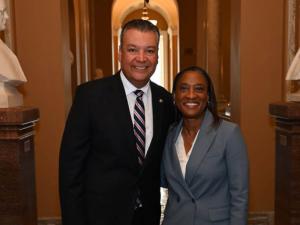
Left, Alex Padilla; right, Laphonza Butler
Left, Dianne Feinstein; right, Barbara Boxer
2023: California has one Black woman, one Hispanic man:
Left, Alex Padilla; right, Laphonza Butler
Tuesday, October 3, 2023
just stop it
Washington Post on the new Senator from California:
Can we just stop using this kind of phrasing, which occurs all the time, or at least put a couple of commas around "after Harris" so it doesn't look dependent on "second Black woman"?
She will become the second Black woman after Harris to represent California in the SenateDoes that make you think what it makes me think? So who was the first after Harris?
Can we just stop using this kind of phrasing, which occurs all the time, or at least put a couple of commas around "after Harris" so it doesn't look dependent on "second Black woman"?
Monday, October 2, 2023
lleetttteerrss
Avast, all ye Tolkien readers! Here is a preview of the opening chunk of the expanded edition of J.R.R. Tolkien's Letters, with contents up into 1944.
Not only are there newly-published letters interweaved into the existing ones (numbered, e.g. 8a, so as not to disturb the existing numbers), but there's newly added material to existing letters. And, though the notes are not included in the except, it is clear from the numbering that there are some new notes to existing material.
Lots of interesting stuff in here. Thrill to Tolkien telling his publisher in September 1939 that The Lord of the Rings is about 3/4 written! Considering that at this time he was finally, after repeated traversals, ironing out Book I, the journey as far as Rivendell, one shudders at what he thought at this time the remaining quarter of the story would be like.
Not only are there newly-published letters interweaved into the existing ones (numbered, e.g. 8a, so as not to disturb the existing numbers), but there's newly added material to existing letters. And, though the notes are not included in the except, it is clear from the numbering that there are some new notes to existing material.
Lots of interesting stuff in here. Thrill to Tolkien telling his publisher in September 1939 that The Lord of the Rings is about 3/4 written! Considering that at this time he was finally, after repeated traversals, ironing out Book I, the journey as far as Rivendell, one shudders at what he thought at this time the remaining quarter of the story would be like.
Subscribe to:
Posts (Atom)