At last, on my way home in the third hotel of this trip, I've finally found one with a working guest-usable computer, so I can cross-post to all the versions of my blog at once, because copying and pasting is beyond anything I can do on a tablet.
But I'm going to leave the reason I was in Portland, Oregon - for the Le Guin exhibit at a local museum - aside until I get home, and write now about my thoughts about Portland:
1. Not a sign of the hellhole that some people claim the city is. I saw a busy and prosperous city.
2. And the people are cheerful despite the weather. The regular Saturday farmer's market downtown was happy and bustling despite the cold and rain.
3. Powell's Books has changed utterly. They've moved a lot of sections around since I was last there, but the big change is this. It used to be a used book store with some new books salted in. Now it's a new book store with some used books salted in. The only part I saw where the used books outnumbered the new ones was the small section for books on comic strips.
4. Millennium Music long ago abandoned its separate classical store, but now the classical section has been reduced to one long row. Still, there was a lot of interesting stuff in there.
5. Portland specializes in road signs that point in the wrong direction, e.g. left where it should be right.
6. And its slower drivers prefer to be in the left lane.
7. The commuter-time traffic is really grim. I stayed out near the airport (it's cheaper there). where a hidden back road (Columbia Blvd) gave me a straight shot to the museum, but to get anywhere else at those hours was a puzzle.
Tuesday, February 10, 2026
concert review: Oregon Symphony
Yes, I’m in Portland, and this concert in the large and old-fashionedly ornate (it doesn’t have restrooms, it has “lounges”) Schnitzer Concert Hall downtown turned out to be the perfect way to spend a rainy Sunday afternoon. Music Director David Danzmayr led his crackerjack orchestra through Anna Clyne’s Color Field, a typically imaginative Clyne work with some evocative open harmonies, and concluded with a thoroughly robust rendering of the Ravel orchestration of Mussorgsky’s Pictures at an Exhibition, in which the tuba struggled a little in “Bydlo, “ but there were otherwise no problems. The orchestra has newly acquired a custom-made bell, and this clanged out like nothing you’ve heard before in the grand conclusion.
But the highlight of this concert came in between: the Bruch Violin Concerto, and it wasn’t the highlight just because the estimable Gil Shaham was soloist. I just heard this concerto last month from San Francisco, and the soloist was smooth-toned but rather characterless, while the orchestra was even bland and dull. Not this time. Here we heard why this is one of the most popular concertos in the repertoire. The orchestra was as burstingly robust as they would be in Pictures, and Shaham, though I’ve heard him perform wonders before, was simply amazing, a standing rebuke to plainer soloists. Every note had character, and his mostly high and dry tone varied tremendously, including some of the tenderest soft passages that could still be heard over the orchestra. Thrilling.
Saturday, February 7, 2026
Lee Speth
One of my oldest friends died a couple days ago. He was in his early 80s. You can read the factual details about him on the File 770 website, in entry 4 in the miscellaneous post for February 6. I am away from home and posting on my pokey little tablet, so I can’t provide links or even write much, so I shall just say that Lee and I became friends about 50 years ago when we were both single and were regularly cast together as roommates at Mythcons.
Our friendship was not much about serious mythopoeic literature, but centered on politics in which we were both interested, him professionally as an elections supervisor. Lee also enticed me, and later B., to attend the Oz conventions which were a regular part of his schedule. For many years they were held annually at Asilomar near here. Lee and Dolores, whom he had delightfully married, would fly from LA to San Jose or Monterey and I would pick them up. We’d have dinner at Fisherman’s Wharf in Monterey and then proceed to the conference center. I also visited them regularly whenever I ventured south. Neither of them drove, not as much of a rarity in Angelinos as you might think, but having a driver at his disposal didn’t alter Lee’s invariable preference for eating at the same burger/pasta/salad place a block from their apartment, where he was an esteemed regular.
As he was also in the Mythopoeic Society, where he handled back issue orders for many years and spent Mythcons mostly sitting behind the Society sales table. I shall miss his acute intelligence and occasional wicked sense of humor.
Our friendship was not much about serious mythopoeic literature, but centered on politics in which we were both interested, him professionally as an elections supervisor. Lee also enticed me, and later B., to attend the Oz conventions which were a regular part of his schedule. For many years they were held annually at Asilomar near here. Lee and Dolores, whom he had delightfully married, would fly from LA to San Jose or Monterey and I would pick them up. We’d have dinner at Fisherman’s Wharf in Monterey and then proceed to the conference center. I also visited them regularly whenever I ventured south. Neither of them drove, not as much of a rarity in Angelinos as you might think, but having a driver at his disposal didn’t alter Lee’s invariable preference for eating at the same burger/pasta/salad place a block from their apartment, where he was an esteemed regular.
As he was also in the Mythopoeic Society, where he handled back issue orders for many years and spent Mythcons mostly sitting behind the Society sales table. I shall miss his acute intelligence and occasional wicked sense of humor.
Thursday, February 5, 2026
dissing on sf cons, again
Here's yet another characterization of sf cons as unwelcoming and elitist. I find that a very strange charge. In my youth I was stepped on by all sorts of elites, but I never had any trouble finding sf cons welcoming and joyous.
But I know why this is. It's because I didn't go to sf cons with a chip on my shoulder. I had figured out that literary sf cons are about written sf literature. If you go to a focused special-interest con, you have to focus on what interest you have in that, and put other interests in abeyance for the weekend. I once went to a festival celebrating Peter Jackson's Tolkien movies. I'm famously excoriating on those, but I shut up about that for the weekend and accepted the celebration of what's good about them (and there are good things about them, just not anything having to do with Tolkien). Last month I went to a Clark Ashton Smith conference. I'd never paid more attention to Clark Ashton Smith than the length of time it took to read one or another short story by him, but for that weekend I focused on Clark Ashton Smith - and learned a lot.
And the reason these small specialty conferences are hostile to other interests is because they feel beleaguered. They're a community and they have an interest. There's a lot more comics fans than there are literary sf fans, as the size of comics cons will reveal, and they've got plenty of conventions of their own. Same with movies. If they come in to the small specialty cons, they'll drown out what the con is there for. Decades ago there was a joke in the Mythopoeic Society that Star Wars was the black hole of conversation; that once it came up, it took over the discussion.
I don't expect these cons to change their focus for me. I don't march into a literary sf con and demand to be taken as a comics fan, as the poster did. They're a community; you can join that community if you have any interest in its subject. (Some of the Clark Ashton Smith attendees had barely begun reading his work, and they weren't denigrated by the hoary old specialists, because they were showing interest; they weren't demanding the con be about something else.) Blend into the environment you're in, if you have any interest in it at all. There'll be a chance for a different environment next weekend.
PS: Kayla Allen corrected a small factual error in the post.
But I know why this is. It's because I didn't go to sf cons with a chip on my shoulder. I had figured out that literary sf cons are about written sf literature. If you go to a focused special-interest con, you have to focus on what interest you have in that, and put other interests in abeyance for the weekend. I once went to a festival celebrating Peter Jackson's Tolkien movies. I'm famously excoriating on those, but I shut up about that for the weekend and accepted the celebration of what's good about them (and there are good things about them, just not anything having to do with Tolkien). Last month I went to a Clark Ashton Smith conference. I'd never paid more attention to Clark Ashton Smith than the length of time it took to read one or another short story by him, but for that weekend I focused on Clark Ashton Smith - and learned a lot.
And the reason these small specialty conferences are hostile to other interests is because they feel beleaguered. They're a community and they have an interest. There's a lot more comics fans than there are literary sf fans, as the size of comics cons will reveal, and they've got plenty of conventions of their own. Same with movies. If they come in to the small specialty cons, they'll drown out what the con is there for. Decades ago there was a joke in the Mythopoeic Society that Star Wars was the black hole of conversation; that once it came up, it took over the discussion.
I don't expect these cons to change their focus for me. I don't march into a literary sf con and demand to be taken as a comics fan, as the poster did. They're a community; you can join that community if you have any interest in its subject. (Some of the Clark Ashton Smith attendees had barely begun reading his work, and they weren't denigrated by the hoary old specialists, because they were showing interest; they weren't demanding the con be about something else.) Blend into the environment you're in, if you have any interest in it at all. There'll be a chance for a different environment next weekend.
PS: Kayla Allen corrected a small factual error in the post.
Tuesday, February 3, 2026
in the files
John Scalzi found himself in the Epstein files. (It was a reference to his "Lowest Difficulty Setting" essay in an article included there.)
It occurred to me to look up Tolkien, because I'm historically beholden to look up Tolkien in everything. And besides a couple of references in clippings included there, he's quoted in an e-mail sent to "undisclosed recipients" by someone named Will Ford. I don't know who that is; probably not William Clay Ford Jr. of the eponymous motor company, as according to Wikipedia he's called Bill, not Will.
Anyway, it's from a daily "tidbits & quotes" e-mail, and among the entries is: "The road goes ever on and on..." - J.R.R. Tolkien. Probably one of his better-known lines (the poem it comes from has been set to music an amazing number of times), but what it means in this context I can't say.
It occurred to me to look up Tolkien, because I'm historically beholden to look up Tolkien in everything. And besides a couple of references in clippings included there, he's quoted in an e-mail sent to "undisclosed recipients" by someone named Will Ford. I don't know who that is; probably not William Clay Ford Jr. of the eponymous motor company, as according to Wikipedia he's called Bill, not Will.
Anyway, it's from a daily "tidbits & quotes" e-mail, and among the entries is: "The road goes ever on and on..." - J.R.R. Tolkien. Probably one of his better-known lines (the poem it comes from has been set to music an amazing number of times), but what it means in this context I can't say.
Sunday, February 1, 2026
your favorite Tolkien
I missed this when it was published a year ago, but in a list of File 770's best articles of the last year I found Cat Eldridge surveying a bunch of authors on the question, "What's Your Favorite Tolkien?"
Most of them picked either The Hobbit or The Lord of the Rings, indeed some hadn't read anything else by him, and a few who picked one of those two didn't like the other. A few went for the tale of Beren and Lúthien or The Children of Húrin.
The respondent who's closest to my own views is Elizabeth Hand, who picked The Lord of the Rings because "it imprinted on me at such an early age ... it was still a cult novel, and you had a real sense that you were in some secret, marvelous group of insiders who had visited a place not everyone knew about." Sort of, for me: I'm Hand's age and also imprinted on it from an early age in the 1960's. But I didn't feel part of a group of insiders; I felt terribly alone and clutched the book by myself. From my first reading at eleven, I never found anybody else who'd read Tolkien's work and wanted to talk about it until I was seventeen.* Six years, with no expectation that the durance will end, is a long time when you're that young. As a result, when I did finally find the Tolkien fans - remember that this was long before the public internet - I wanted never to leave, and I never have. Half of what makes up my life has been built around this.
As a result of that intense interest, I have, like Hand, been drawn to Tolkien's other works. She particularly notes the "History of Middle-earth" series, and says "I'm continually so amazed by what this one man came up with, the intensity and single mindedness of his obsession. And I get sucked into it all over again." And that is quite close to what I feel. Not the intensity so much as the sheer boundless creativity of one mind, its ability to deploy the illusion of reality so profoundly.
But one reason to focus on The Lord of the Rings is that it's so large. It'd probably be my choice of desert island book. But word for word, because it's quite short, my favorite Tolkien is something that nobody on the list mentioned: Smith of Wootton Major. I once wrote an article explaining why I thought it was a perfect fairy-story: partly because of what the author chose to leave out.
*I identified with a line about Gollum in The Hobbit (my introduction to Tolkien, and also a favorite): he "always spoke to himself through never having anyone else to speak to." That sums up my childhood relation to peers in a nutshell.
Most of them picked either The Hobbit or The Lord of the Rings, indeed some hadn't read anything else by him, and a few who picked one of those two didn't like the other. A few went for the tale of Beren and Lúthien or The Children of Húrin.
The respondent who's closest to my own views is Elizabeth Hand, who picked The Lord of the Rings because "it imprinted on me at such an early age ... it was still a cult novel, and you had a real sense that you were in some secret, marvelous group of insiders who had visited a place not everyone knew about." Sort of, for me: I'm Hand's age and also imprinted on it from an early age in the 1960's. But I didn't feel part of a group of insiders; I felt terribly alone and clutched the book by myself. From my first reading at eleven, I never found anybody else who'd read Tolkien's work and wanted to talk about it until I was seventeen.* Six years, with no expectation that the durance will end, is a long time when you're that young. As a result, when I did finally find the Tolkien fans - remember that this was long before the public internet - I wanted never to leave, and I never have. Half of what makes up my life has been built around this.
As a result of that intense interest, I have, like Hand, been drawn to Tolkien's other works. She particularly notes the "History of Middle-earth" series, and says "I'm continually so amazed by what this one man came up with, the intensity and single mindedness of his obsession. And I get sucked into it all over again." And that is quite close to what I feel. Not the intensity so much as the sheer boundless creativity of one mind, its ability to deploy the illusion of reality so profoundly.
But one reason to focus on The Lord of the Rings is that it's so large. It'd probably be my choice of desert island book. But word for word, because it's quite short, my favorite Tolkien is something that nobody on the list mentioned: Smith of Wootton Major. I once wrote an article explaining why I thought it was a perfect fairy-story: partly because of what the author chose to leave out.
*I identified with a line about Gollum in The Hobbit (my introduction to Tolkien, and also a favorite): he "always spoke to himself through never having anyone else to speak to." That sums up my childhood relation to peers in a nutshell.
Saturday, January 31, 2026
things I learned
from reading the Feb. 2 New Yorker
1. Nancy Kerrigan is now 56 and still skating.
2. Another reason to be happy I'm married: dating apps would not be for me. The sort of things they focus on have nothing to do with what I looked for in a partner.
3. Despite what they tell you about protest marches sparking political change, they don't amount to much. Disorganized movements that allow local groups to foster independent home-grown leadership are the way to go, despite the groups often developing contradictory principles. The article doesn't explain how it succeeds despite that.
4. Japan's leading political party has ties to the Moonies. That was why Shinzo Abe was assassinated: the assailant was angry because his mother had given all the family's money to the Moonies. And he blamed Abe ... how does that follow?
5. Research into chemicals in breast milk is corrupt and unreliable.
6. Tucker Carlson is evil. Sorry, I already knew that.
7. Maybe now I'll remember who David Foster Wallace is. I'd vaguely heard of him, but if you'd presented the name without context I'd have drawn a blank.
8. I'm missing something by never having heard Morton Feldman's music performed live, only on records.
9. Tolkien's "Ent" is a favorite word for crossword-puzzle makers. It keeps showing up.
Thing I learned from another article on the same subject as a New Yorker article:
1. The Easter Island statues should be called "statues." The word moai is probably inauthentic.
The time it takes to put out a weekly magazine is long enough, and the speed of events is fast enough, that it seems quaint that the issue's current events piece is about Greenland. Now we're talking about the murder of Alex Pretti and the possibly game-changing effect of all those videos on the narrative. My thought on that is, "Once, there was just Abraham Zapruder."
1. Nancy Kerrigan is now 56 and still skating.
2. Another reason to be happy I'm married: dating apps would not be for me. The sort of things they focus on have nothing to do with what I looked for in a partner.
3. Despite what they tell you about protest marches sparking political change, they don't amount to much. Disorganized movements that allow local groups to foster independent home-grown leadership are the way to go, despite the groups often developing contradictory principles. The article doesn't explain how it succeeds despite that.
4. Japan's leading political party has ties to the Moonies. That was why Shinzo Abe was assassinated: the assailant was angry because his mother had given all the family's money to the Moonies. And he blamed Abe ... how does that follow?
5. Research into chemicals in breast milk is corrupt and unreliable.
6. Tucker Carlson is evil. Sorry, I already knew that.
7. Maybe now I'll remember who David Foster Wallace is. I'd vaguely heard of him, but if you'd presented the name without context I'd have drawn a blank.
8. I'm missing something by never having heard Morton Feldman's music performed live, only on records.
9. Tolkien's "Ent" is a favorite word for crossword-puzzle makers. It keeps showing up.
Thing I learned from another article on the same subject as a New Yorker article:
1. The Easter Island statues should be called "statues." The word moai is probably inauthentic.
The time it takes to put out a weekly magazine is long enough, and the speed of events is fast enough, that it seems quaint that the issue's current events piece is about Greenland. Now we're talking about the murder of Alex Pretti and the possibly game-changing effect of all those videos on the narrative. My thought on that is, "Once, there was just Abraham Zapruder."
Friday, January 30, 2026
concert review: San Francisco Symphony
Jaap van Zweden, formerly of the NY Phil, conducted SFS's opening gala this year and is returning twice (this is his second of the three), making him and James Gaffigan, who's also conducting three programs, the closest things to a regular conductor that this director-less (and direction-less) orchestra has this season.
This week he was joined by the storied pianist Emanuel Ax for Mozart's Concerto No. 25, K. 503. Ax played lovely little sheens of notes, particularly shining in his delicate renditions of Mozart's curling phrases, and in some striking tone colors in the perkier moments of the finale. The orchestra was a bit more stolid. As with most other C Major orchestral works of this era, this concerto is heavy on the trumpets and the horns. Combine that with the stolidity and you get some rather dull and routine Mozart. But Ax made a good impression. He didn't play an encore, instead grabbing concertmaster Sasha Barantschik by the hand to drag him (and by courtesy the rest of the orchestra) offstage after the fourth curtain call. I've seen conductors make that move before, but never a soloist.
If Mozart was mixed, Bruckner's Seventh Symphony came out pretty well. Conducting Bruckner with skill means focusing on shaping those big paragraphs, and van Zweden had a good handle on that and on inserting the proper punctuation marks. Fairly brisk but not hurried in tempo, the music made coherent sense, though it could sometimes be less than seamless in flow. Van Zweden's only real quirk was a tendency to drop the volume suddenly in order to build it up afterwards. Balance was mostly good, though the brass in full cry would drown everybody else out even if they were all playing. The first two movements of the Seventh have more lush melodies for strings than any other Bruckner symphony, and these came out with full weight that eschewed opulence.
Most of my SFS concerts this season have been pretty packed, but for this one, though the main floor and terraces were full, the balconies were almost empty.
Usually I leave home for an SFS concert about 3.30, but I had a phone call from my doctor scheduled for 4 pm that couldn't be moved. So I was an hour later and the traffic was that much heavier. I'm driving all the way in instead of taking public transit for the last leg these days, parking in the Civic Center underground garage, and I arrived in time to have dinner at my favorite nearby Chinese place, at the cost of missing the pre-concert lecture.
This week he was joined by the storied pianist Emanuel Ax for Mozart's Concerto No. 25, K. 503. Ax played lovely little sheens of notes, particularly shining in his delicate renditions of Mozart's curling phrases, and in some striking tone colors in the perkier moments of the finale. The orchestra was a bit more stolid. As with most other C Major orchestral works of this era, this concerto is heavy on the trumpets and the horns. Combine that with the stolidity and you get some rather dull and routine Mozart. But Ax made a good impression. He didn't play an encore, instead grabbing concertmaster Sasha Barantschik by the hand to drag him (and by courtesy the rest of the orchestra) offstage after the fourth curtain call. I've seen conductors make that move before, but never a soloist.
If Mozart was mixed, Bruckner's Seventh Symphony came out pretty well. Conducting Bruckner with skill means focusing on shaping those big paragraphs, and van Zweden had a good handle on that and on inserting the proper punctuation marks. Fairly brisk but not hurried in tempo, the music made coherent sense, though it could sometimes be less than seamless in flow. Van Zweden's only real quirk was a tendency to drop the volume suddenly in order to build it up afterwards. Balance was mostly good, though the brass in full cry would drown everybody else out even if they were all playing. The first two movements of the Seventh have more lush melodies for strings than any other Bruckner symphony, and these came out with full weight that eschewed opulence.
Most of my SFS concerts this season have been pretty packed, but for this one, though the main floor and terraces were full, the balconies were almost empty.
Usually I leave home for an SFS concert about 3.30, but I had a phone call from my doctor scheduled for 4 pm that couldn't be moved. So I was an hour later and the traffic was that much heavier. I'm driving all the way in instead of taking public transit for the last leg these days, parking in the Civic Center underground garage, and I arrived in time to have dinner at my favorite nearby Chinese place, at the cost of missing the pre-concert lecture.
Thursday, January 29, 2026
say it right
Daniel Craig schools Stephen Colbert on how to pronounce his name. (It's "Craig" not "Cregg". "Cregg" is C.J. from The West Wing.)
Now, if only some guest would teach Colbert how to pronounce "Gollum" ...
Wednesday, January 28, 2026
happy Mozart
In lighter news, yesterday was Wolfgang Mozart's 270th birthday anniversary. Somehow this is a significant number, or more likely any number is an excuse to play Mozart, so the SF Symphony is going to be playing a lot of his music over the next few weeks. Meanwhile the local classical radio station, KDFC, celebrated the birthday itself by playing some music surrounding Mozart. Such as a piano variations on a Mozart aria by Carl Czerny, a composer of the next generation not noted for scintillating genius. And what they claimed was the best-known work of Wolfgang's father Leopold, the "Toy Symphony." What an insult to Leopold, who did claim the Toy Symphony at one point but is no longer considered a likely author, any more than various Haydn brothers to whom it's also been attributed. Besides, nobody should really want to take credit for this thoroughly uninspired work. Even lesser Mozarts deserve better than that.
Incidentally, it's properly pronounced in English as "mote zart," with a T in it, an approximation of the German pronunciation. I often hear non-musicians saying "moe's art," which is understandable but not au courant.
Monday, January 26, 2026
ahem
"FEMA told not to use the word 'ice' in storm mesaging to avoid confusion and online mockery" - CNN.
Yeah, because then this will happen:
concert review: Symphony San Jose
I don't often get to SSJ, despite its geographic convenience, but I wanted this one because they were playing Schumann's Fourth Symphony. Besides being my favorite Schumann, it's been cursed for the SSJ. George Cleve was going to lead it in 2015, but he canceled due to what proved to be his final illness, and his replacement substituted another Schumann symphony. Then in 2020 they scheduled it for a concert which disappeared into the pandemic.
But today it finally got played, under the baton of François López-Ferrer. And it was worth the trouble to come: a firm, energetic, and zippy performance, especially notable for not letting the slow interlude sections get drippy. Concertmaster Sam Weiser was especially good in the soft middle section of the Romanze movement.
This symphony exists in two forms; Schumann originally wrote it just after his light First "Spring" Symphony, and that version bears the same air, but he set it aside and reworked it ten years later. Though the second version is more often played, it's gotten a lot of criticism for being clotted and murky, but López-Ferrer likes it better this way (as do I), calling it heavier and deeper. It's in D Minor, and ought to sound that way; it's also built on the same template as Beethoven's Fifth, and it ought to sound that way too.
Similarly, or maybe not so similarly, there are two entirely different works known as Schubert's Rosamunde Overture, both of them repurposed from other operas, both of which Schubert may have used for different performances of Rosamunde. Or maybe not; it isn't clear. Anyway, López-Ferrer wasn't sure which one SSJ had until he got here. We heard the better-known one, the one from Die Zauberharfe, and maybe it ought to be called that. It was a crisp but rather blatty rendition.
Sibelius's Violin Concerto also comes in two versions, but the revised one is always the one that's played. Despite gorgeous tone from soloist Geneva Lewis, matching her gossamer sky-blue dress, it was a dull and flaccid performance under the baton, even the finale which is supposed to be jaunty. This is what we had to sit through to get to the Schumann.
But today it finally got played, under the baton of François López-Ferrer. And it was worth the trouble to come: a firm, energetic, and zippy performance, especially notable for not letting the slow interlude sections get drippy. Concertmaster Sam Weiser was especially good in the soft middle section of the Romanze movement.
This symphony exists in two forms; Schumann originally wrote it just after his light First "Spring" Symphony, and that version bears the same air, but he set it aside and reworked it ten years later. Though the second version is more often played, it's gotten a lot of criticism for being clotted and murky, but López-Ferrer likes it better this way (as do I), calling it heavier and deeper. It's in D Minor, and ought to sound that way; it's also built on the same template as Beethoven's Fifth, and it ought to sound that way too.
Similarly, or maybe not so similarly, there are two entirely different works known as Schubert's Rosamunde Overture, both of them repurposed from other operas, both of which Schubert may have used for different performances of Rosamunde. Or maybe not; it isn't clear. Anyway, López-Ferrer wasn't sure which one SSJ had until he got here. We heard the better-known one, the one from Die Zauberharfe, and maybe it ought to be called that. It was a crisp but rather blatty rendition.
Sibelius's Violin Concerto also comes in two versions, but the revised one is always the one that's played. Despite gorgeous tone from soloist Geneva Lewis, matching her gossamer sky-blue dress, it was a dull and flaccid performance under the baton, even the finale which is supposed to be jaunty. This is what we had to sit through to get to the Schumann.
Sunday, January 25, 2026
two and a half concerts
San Francisco Symphony, Thursday
What do you do if you're conducting Beethoven's Fifth, the best-known symphony ever written? John Storgårds' answer is, lead it as if it's never been played before. The crispness, the intensity, and the variations in tempo and flow made this an exciting, even riveting, performance of the old masterworks. It helps to remember that, familiar as it now is, it's the most startling and revolutionary symphony ever written, which is what made it so iconic in the first place.
Seong-Jin Cho was probably badly cast as soloist in Shostakovich's Piano Concerto No. 1. He's good with lyrical music, but this is a clangy and rigid concerto. Cho vamped ineffectively all over the keyboard while the string orchestra got to do the lyrical part. In the back, standing up whenever he was playing, was SFS principal trumpet Mark Inouye in the second soloist part. He was billed as a soloist and got to share an encore with Cho, but he came out with the orchestra as well as was seated with them.
And the US premiere of The Rapids of Life by 40-year-old Finnish composer Outi Tarkiainen. This is perhaps the first piece of music ever written depicting the experience of giving birth: cascading down rapids is what the composer describes her rather quick labor as resembling. The comparison was not obvious from the music, which was ten minutes of fast-moving soundscape.
Sarah Cahill, Friday
Brief (one set, 70 minutes) piano recital featuring elegies and homages. Designed by the performer to bring us together in a time of loss and oppression. (The news out of the occupied territory that was formerly the state of Minnesota keeps getting worse.) I didn't attend this concert up in the City in person, but bought a livestream ticket; Old First's technicians have improved greatly since I last tried this during the pandemic. Cahill specializes in newer music, and there were pieces by the likes of Maggi Payne (written mostly for the foot pedals) and Sam Adams; also a Fugue to David Tudor by Lou Harrison that was twelve-tone (why, Lou, why?). But the bulk of the program, with each movement outweighing any other piece on the program, was Ravel's Tombeau de Couperin, which besides evoking Couperin's baroque elegance is in memory of a series of Ravel's friends who were killed in WW1.
California Symphony, Saturday
This concert was about the winds. Began with excerpts from Mozart's Don Giovanni arranged for the standard wind ensemble of the time (2 each of oboe, clarinet, bassoon, and horn), which is what they did in those days instead of playing it on the radio. Concluded with Schubert's Great C Major Symphony. Conductor Donato Cabrera pointed out that, unusually for the time, nearly all the themes are introduced by the winds, so he had the woodwind section seated in front around him (though the horns, which are just as important, stayed in back with the brass). This both magnified the sound of the winds and emphasized the parts where only the strings were playing. Pretty lively but not revelatory performance.
And the Cello Concerto by Friedrich Gulda, best-known as a pianist (he was Martha Argerich's teacher), with Nathan Chan as soloist, written in 1980 and one of the strangest and goofiest pieces of music I've ever heard. The orchestra was winds and a few brass, plus a drum kit, a bass player, and a guitarist who was mostly on acoustic but switched to an electric guitar for one section where those three played jazz/rock to alternate with the more sedate winds while the solo cello tried to keep up. Other sections included a stately minuet where the drummer switched to tambourine, and a raucous marching-band finale. Amused the audience no end.
What do you do if you're conducting Beethoven's Fifth, the best-known symphony ever written? John Storgårds' answer is, lead it as if it's never been played before. The crispness, the intensity, and the variations in tempo and flow made this an exciting, even riveting, performance of the old masterworks. It helps to remember that, familiar as it now is, it's the most startling and revolutionary symphony ever written, which is what made it so iconic in the first place.
Seong-Jin Cho was probably badly cast as soloist in Shostakovich's Piano Concerto No. 1. He's good with lyrical music, but this is a clangy and rigid concerto. Cho vamped ineffectively all over the keyboard while the string orchestra got to do the lyrical part. In the back, standing up whenever he was playing, was SFS principal trumpet Mark Inouye in the second soloist part. He was billed as a soloist and got to share an encore with Cho, but he came out with the orchestra as well as was seated with them.
And the US premiere of The Rapids of Life by 40-year-old Finnish composer Outi Tarkiainen. This is perhaps the first piece of music ever written depicting the experience of giving birth: cascading down rapids is what the composer describes her rather quick labor as resembling. The comparison was not obvious from the music, which was ten minutes of fast-moving soundscape.
Sarah Cahill, Friday
Brief (one set, 70 minutes) piano recital featuring elegies and homages. Designed by the performer to bring us together in a time of loss and oppression. (The news out of the occupied territory that was formerly the state of Minnesota keeps getting worse.) I didn't attend this concert up in the City in person, but bought a livestream ticket; Old First's technicians have improved greatly since I last tried this during the pandemic. Cahill specializes in newer music, and there were pieces by the likes of Maggi Payne (written mostly for the foot pedals) and Sam Adams; also a Fugue to David Tudor by Lou Harrison that was twelve-tone (why, Lou, why?). But the bulk of the program, with each movement outweighing any other piece on the program, was Ravel's Tombeau de Couperin, which besides evoking Couperin's baroque elegance is in memory of a series of Ravel's friends who were killed in WW1.
California Symphony, Saturday
This concert was about the winds. Began with excerpts from Mozart's Don Giovanni arranged for the standard wind ensemble of the time (2 each of oboe, clarinet, bassoon, and horn), which is what they did in those days instead of playing it on the radio. Concluded with Schubert's Great C Major Symphony. Conductor Donato Cabrera pointed out that, unusually for the time, nearly all the themes are introduced by the winds, so he had the woodwind section seated in front around him (though the horns, which are just as important, stayed in back with the brass). This both magnified the sound of the winds and emphasized the parts where only the strings were playing. Pretty lively but not revelatory performance.
And the Cello Concerto by Friedrich Gulda, best-known as a pianist (he was Martha Argerich's teacher), with Nathan Chan as soloist, written in 1980 and one of the strangest and goofiest pieces of music I've ever heard. The orchestra was winds and a few brass, plus a drum kit, a bass player, and a guitarist who was mostly on acoustic but switched to an electric guitar for one section where those three played jazz/rock to alternate with the more sedate winds while the solo cello tried to keep up. Other sections included a stately minuet where the drummer switched to tambourine, and a raucous marching-band finale. Amused the audience no end.
Saturday, January 24, 2026
world according to cat on top
Tybalt has different habits for the two of us. For one thing, he doesn't bug me when I'm sleeping, but he does bug B. As a result, we lock him out of the bedroom at night. This means that if I'm up and about, he pays me even more attention than he would otherwise.
He likes to climb up onto my shoulders and perch around the back of my neck for a while. (Usually he puts his front paws up on my chest, and I lift him up.) That way he can lick my hair. But he does this only when I'm standing; if I sit down he jumps off. When I'm working at the computer, he likes to prowl around my desk and knock things off. Like the trackball. If he's too annoying, I pick him up. Usually he climbs off me onto the table behind, then jumps down to the floor and back up on the desk again.
But sometimes when I pick him up, he will settle down and cuddle on my chest. He was doing that last night while I was registering for a ticket, and it wanted to send a confirmation code to my cell phone. Blast; the phone was in another room. So I got up, still holding Tybalt to my chest. He was quite startled at this, and climbed up onto his usual position on my shoulders. Then he jumped down when I sat down at the computer again.
He likes to climb up onto my shoulders and perch around the back of my neck for a while. (Usually he puts his front paws up on my chest, and I lift him up.) That way he can lick my hair. But he does this only when I'm standing; if I sit down he jumps off. When I'm working at the computer, he likes to prowl around my desk and knock things off. Like the trackball. If he's too annoying, I pick him up. Usually he climbs off me onto the table behind, then jumps down to the floor and back up on the desk again.
But sometimes when I pick him up, he will settle down and cuddle on my chest. He was doing that last night while I was registering for a ticket, and it wanted to send a confirmation code to my cell phone. Blast; the phone was in another room. So I got up, still holding Tybalt to my chest. He was quite startled at this, and climbed up onto his usual position on my shoulders. Then he jumped down when I sat down at the computer again.
Friday, January 23, 2026
fighting minor frustrations
1. Our tv set has been misbehaving. It was refusing to connect to the wifi on which we get streaming channels like Netflix, although our wifi is otherwise working fine. B., who has 95% of the tv set usage in the household, thinks it may be a lemon. Nevertheless I contacted AT&T, our ISP and cable provider (some people will say AT&T doesn't provide tv service, but it does) to fix it. And eventually a technician came by who fixed the problem. (Mostly: another streaming channel we just subscribed to isn't working right.) "What did you do?" I asked. He didn't really know. "Magic hands," he suggested, holding them up, and indeed he even looked rather like Ben Carson.
An earlier interaction on the phone had produced a suggestion that our router (modem) and receiver (the box that attaches to the tv) needed to be replaced. I doubted this would fix the problem, but I said OK and they shipped the boxes. I was immediately stuck when the instructions for the router showed you where to plug in the coaxial cable, but the actual router contained no such plug. So forget that. I asked Mr Magic Hands what to do with them, since we'd received conflicting instructions on whether to return or discard the old ones. He said return them, which meant take them in to a UPS store, which would ship them without charge to me.
So I took them in. They took one of the two boxes but refused to accept the other one, for reasons unclear. I refused to take it back. I said my job was to take them in to a UPS store; shipping was their responsibility. So I just left it there and walked out.
Then I called AT&T and reported this, and they promised not to charge me for failure to return equipment.
2. For a long time, one of my regular lunches has been a can of menudo soup supplemented with albóndigas, Mexican meatballs, which are lighter and tastier than Anglo meatballs. (They contain rice as binder.) I would defrost a handful from a bag of frozen albóndigas that I'd buy at Smart & Final.
But alas, it seems that Smart & Final no longer carries these. I've checked quite a few large Mexican groceries - a species quite common in this area - and none of them carry albóndigas in any form other than canned albóndiga soup, which is not what I want.
So I found a recipe online and made my own. They're not a match for the ones I used to buy, but good enough.
An earlier interaction on the phone had produced a suggestion that our router (modem) and receiver (the box that attaches to the tv) needed to be replaced. I doubted this would fix the problem, but I said OK and they shipped the boxes. I was immediately stuck when the instructions for the router showed you where to plug in the coaxial cable, but the actual router contained no such plug. So forget that. I asked Mr Magic Hands what to do with them, since we'd received conflicting instructions on whether to return or discard the old ones. He said return them, which meant take them in to a UPS store, which would ship them without charge to me.
So I took them in. They took one of the two boxes but refused to accept the other one, for reasons unclear. I refused to take it back. I said my job was to take them in to a UPS store; shipping was their responsibility. So I just left it there and walked out.
Then I called AT&T and reported this, and they promised not to charge me for failure to return equipment.
2. For a long time, one of my regular lunches has been a can of menudo soup supplemented with albóndigas, Mexican meatballs, which are lighter and tastier than Anglo meatballs. (They contain rice as binder.) I would defrost a handful from a bag of frozen albóndigas that I'd buy at Smart & Final.
But alas, it seems that Smart & Final no longer carries these. I've checked quite a few large Mexican groceries - a species quite common in this area - and none of them carry albóndigas in any form other than canned albóndiga soup, which is not what I want.
So I found a recipe online and made my own. They're not a match for the ones I used to buy, but good enough.
Thursday, January 22, 2026
Oscar the grouch
Good lord, the only Oscar-nominated film of this year that I've seen so far is K-pop Demon Hunters, which was on some streaming service that I get, and since I'd read some buzz about it, I decided to watch it. I thought it not a bad film, certainly watchable. It reminded me of the movie of Josie and the Pussycats - incoherent premise (do they fight the demons with their voices, or not? Seems to have it both ways), enjoyable camaraderie among the band (which is also what I liked about the all-female Ghostbusters), not-intolerable music. In fact the songs here were much more agreeable than anything I've previously been handed with the label "K-pop" on it, though I don't plan on running out and listening to any more of it.
But looking at the films nominated for major awards, nothing grabs my interest. I don't want to see horror movies, which leaves out Sinners and Weapons, I don't want to see movies about torturing people or people in great suffering, which leaves out Bugonia and It Was Just an Accident and If I Had Legs I'd Kick You, I don't want to see movies about sports, which leaves out Marty Supreme and F1, I don't want to see a faithful adaptation of a novel I found terminally boring, which leaves out Frankenstein. I like Shakespeare so I ought to be interested in Hamnet, but the reviews make it sound dire; I like musical theater and its history so I ought to be interested in Blue Moon but the trailer made it sound whiny. If I were to see any of these, it'd probably be One Battle After Another, but the new films I've noted as possible watches haven't gotten Oscar nominations. I'm curious about The Choral, but it got bad reviews.
Wednesday, January 21, 2026
news comment
1. Some gadfly is objecting to a congressman running for governor on the grounds that he isn't a California resident. That strikes me as unfair. A member of Congress is functionally the local area's ambassador to the federal government. That person has to have their usual residence near the federal government, since that's where their job is. On the other hand, the whole point of their being there is that they're a citizen of their district. The congressman maintains a California address and uses it as his voting address. He's legitimate, and so are many other members of Congress who've run for governor of various states before now (e.g. our Pete Wilson was a senator when he was elected governor in 1990).
2. An apartment building a few blocks away from us - about 1/4 mile - had a major fire yesterday. News report: "A two-alarm fire ripped through a Sunnyvale apartment complex Tuesday morning, displacing two-dozen residents, authorities said. ... “Preliminary information indicates that three of the eight units sustained significant fire and smoke damage,” authorities said, “and the building as a whole was damaged.” No injuries were reported. The American Red Cross is providing assistance to the displaced residents." And it's not the only recent local one.
And I wonder if the displaced residents will be allowed access to their belongings, or if the building will be torn down and hauled away along with everything in it. I'm not impressed with the 'be grateful you're alive' argument. That has nothing to do with it. If your belongings were burned in the fire, that's fate. But if the authorities can't find a way for you to retrieve your belongings, the authorities are to blame.
3. So let's say the US does something that causes NATO to "collapse." What's left? Well, the EU plus the UK and Norway are already acting together for defense of NATO territory, so that's basically the European side of NATO. If Canada joins in, that means NATO hasn't collapsed, just that the US has flounced out of it.
2. An apartment building a few blocks away from us - about 1/4 mile - had a major fire yesterday. News report: "A two-alarm fire ripped through a Sunnyvale apartment complex Tuesday morning, displacing two-dozen residents, authorities said. ... “Preliminary information indicates that three of the eight units sustained significant fire and smoke damage,” authorities said, “and the building as a whole was damaged.” No injuries were reported. The American Red Cross is providing assistance to the displaced residents." And it's not the only recent local one.
And I wonder if the displaced residents will be allowed access to their belongings, or if the building will be torn down and hauled away along with everything in it. I'm not impressed with the 'be grateful you're alive' argument. That has nothing to do with it. If your belongings were burned in the fire, that's fate. But if the authorities can't find a way for you to retrieve your belongings, the authorities are to blame.
3. So let's say the US does something that causes NATO to "collapse." What's left? Well, the EU plus the UK and Norway are already acting together for defense of NATO territory, so that's basically the European side of NATO. If Canada joins in, that means NATO hasn't collapsed, just that the US has flounced out of it.
Tuesday, January 20, 2026
son of Smith post
So I wrote about the conference on Clark Ashton Smith that I attended. I've now had the chance to follow a link that I took note of during the panels. It's a (virtually?) complete file of Smith's writings online. If you've never tried his writings, here's your chance. One story of his that I found searingly memorable will make a bracing introduction to whether Smith is an author for you. Unusually for Smith, the main character of this one is the hero, not the villain, but nothing goes well for anybody in this story. I'm reminded as much of Tiptree's "The Last Flight of Dr. Ain" as of anything else by this story.
Sunday, January 18, 2026
concert review: Saratoga Symphony
Once the bargain basement of local community orchestras, the Saratoga Symphony has improved tremendously in recent years. They did a pretty good job with the obscure but enormous Busoni Piano Concerto a couple years ago, and brought back the same pianist, local star Tamami Honma, in the very famous and also very large Rachmaninoff Second Concerto for a concert in a nearby church which, contrary to Saratoga's tradition of wreathing their programs in complete obscurity, they advertised heavily.
Honma played in a clotted but compelling manner, and the orchestra surged effectively. Music director Jason Klein craftily put the concerto after intermission, so as to force the audience that had come for it to also hear the other major piece, Sibelius's Fourth Symphony. This is by all odds the most inscrutable of all Sibelius symphonies, and a real challenge for the orchestra: not that it's particularly hard to play, but that it's very hard to interpret coherently. But this worked pretty well, especially keeping the drive up in the finale, and technically it did quite well for the community orchestra level.
Friday, January 16, 2026
concert review: San Francisco Symphony
My first concert of the calendar year, and almost a month since the last one.
The first time I heard Edward Gardner guest conduct SFS, I thought he led hot and sizzling performances. Half of that Edward Gardner showed up this time.
The half that didn't led the Bruch G-minor Violin Concerto. Soloist Randall Goosby had a remarkably light and smooth tone, and drove his part forward pretty well, but as an orchestral piece this was bland and dull. I wasn't too excited by the rendition of Vaughan Williams's Overture to The Wasps either, though the sound of the orchestra was unusually broad and shiny, especially in the winds.
This sound quality reappeared in places like the flute choir passages of Holst's "Saturn," and yes, The Planets was the good half of the concert. Hot and sizzling it was when the score called for it, but the most remarkable movement was the quietest, "Neptune," a most crisp and clear but delicate performance of an often-fuzzy piece. I left stripped of the forebodings I'd felt during intermission.
The first time I heard Edward Gardner guest conduct SFS, I thought he led hot and sizzling performances. Half of that Edward Gardner showed up this time.
The half that didn't led the Bruch G-minor Violin Concerto. Soloist Randall Goosby had a remarkably light and smooth tone, and drove his part forward pretty well, but as an orchestral piece this was bland and dull. I wasn't too excited by the rendition of Vaughan Williams's Overture to The Wasps either, though the sound of the orchestra was unusually broad and shiny, especially in the winds.
This sound quality reappeared in places like the flute choir passages of Holst's "Saturn," and yes, The Planets was the good half of the concert. Hot and sizzling it was when the score called for it, but the most remarkable movement was the quietest, "Neptune," a most crisp and clear but delicate performance of an often-fuzzy piece. I left stripped of the forebodings I'd felt during intermission.
Wednesday, January 14, 2026
ubiquitous comic strips
A discussion elsewhere of the death of Scott Adams led to a consideration of how culturally ubiquitous Dilbert was in its heyday, however astonishing that may seem to those who only know it in its sad decline.
It's one of a series of strips that have held that status, with a new one close to waiting in the wings when the previous honoree begins to fade away.
I'm not sure how culturally ubiquitous early strips now honored as pioneers were - like The Yellow Kid (1895-98) and Krazy Kat (1913-44). The earliest one that I expect hit that status was Little Orphan Annie, which premiered in 1924, followed by Popeye the Sailor Man (first appeared in Thimble Theatre 1929). Those two are still cultural touchstones today, and I suspect they were heavily popular at the time; certainly Popeye soon made the jump to animated cartoons.
The next one I know about was Barnaby by Crockett Johnson (later of Harold and the Purple Crayon fame). This strip about a little boy and his louche fairy godfather Mr. O'Malley had a short run (1942-52) and is now pretty much forgotten except among those who've collected reprint volumes of it. But it was a big hit among commentators and SF fans, at least: the Berkeley SF club, founded in 1949 and still around when I joined in the late '70s, adapted its name - the Elves', Gnomes', and Little Men's Science Fiction, Chowder and Marching Society ("Little Men" for short) - from the name of Mr. O'Malley's social club in the strip.
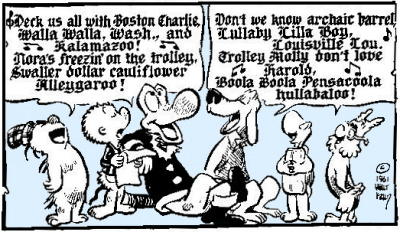
Barnaby kind of puttered off in its later years, and allegiance switched to Pogo by Walt Kelly, which started in 1948 and quickly became very popular, not least for its wicked political commentary, with characters like Simple J. Malarkey, a parody of Joe McCarthy. Kelly wrote songs for the strip which were published and recorded, both originals and his still-famous fractured Christmas carol lyrics, "Deck Us All With Boston Charlie."
Pogo had its several-year run as the cultural ubiquity and then faded a bit into the background, to be replaced by the biggest cultural powerhouse of them all, Peanuts by Charles M. Schulz, which started in 1950 but took a few years to hit its stride. But during the 1960s, at least, it pervaded American culture to an extent hard to believe if you didn't experience it. And its pervasiveness popped up spontaneously from outside sources. There were books about it (this one, from 1965, was a collection of Christian sermons using the strip as textual illustrations, and this unlikely thing became a bestseller); there were songs (I first heard this one sung by the kids on the bus to camp in 1966 and I still know all the lyrics); NASA even named manned spacecraft after Peanuts characters.
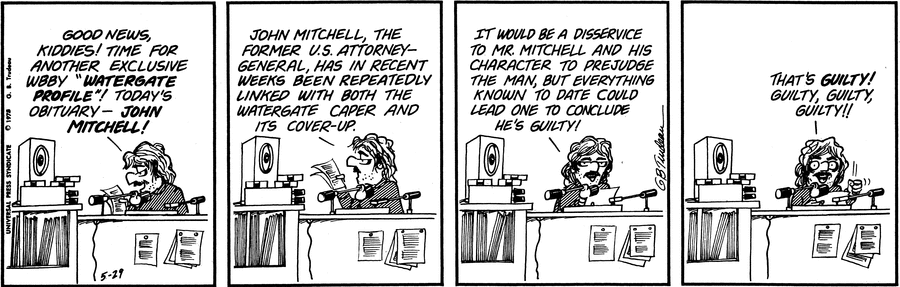
But the strip faded from cultural intensity quickly after 1970, despite having another 30 years to run during which it maintained its prominence on the comics page. The cultural hit of the 1970s was undoubtedly Doonesbury by Garry Trudeau, which began in 1970. Plotted more like a soap opera than any of its predecessors, Doonesbury was even more explicit politically than Pogo. (This one, among others, won Trudeau the Pulitzer Prize for editorial cartooning.)
Doonesbury took a hiatus in 1983-4 and then rebooted itself; it was still popular, but the torch of cultural ubiquity quickly passed to Calvin and Hobbes by Bill Watterson, which ran 1985-95; uniquely among these creators, Watterson stopped the strip before he could run out of steam. And then Dilbert, which began in 1989 and had built up its renown by the time Calvin and Hobbes signed off.
Dilbert started to fade by the mid-2000s. Since then, I dunno - newspaper strips as a cultural icon have faded with the fall of print. In my circles, maybe xkcd by Randall Munroe, which came along in a very timely fashion in 2005, but I'm not sure how commonly-known it is generally, and it's not even a strip in the traditional fashion. But that's where I think we are now.
It's one of a series of strips that have held that status, with a new one close to waiting in the wings when the previous honoree begins to fade away.
I'm not sure how culturally ubiquitous early strips now honored as pioneers were - like The Yellow Kid (1895-98) and Krazy Kat (1913-44). The earliest one that I expect hit that status was Little Orphan Annie, which premiered in 1924, followed by Popeye the Sailor Man (first appeared in Thimble Theatre 1929). Those two are still cultural touchstones today, and I suspect they were heavily popular at the time; certainly Popeye soon made the jump to animated cartoons.
The next one I know about was Barnaby by Crockett Johnson (later of Harold and the Purple Crayon fame). This strip about a little boy and his louche fairy godfather Mr. O'Malley had a short run (1942-52) and is now pretty much forgotten except among those who've collected reprint volumes of it. But it was a big hit among commentators and SF fans, at least: the Berkeley SF club, founded in 1949 and still around when I joined in the late '70s, adapted its name - the Elves', Gnomes', and Little Men's Science Fiction, Chowder and Marching Society ("Little Men" for short) - from the name of Mr. O'Malley's social club in the strip.
Barnaby kind of puttered off in its later years, and allegiance switched to Pogo by Walt Kelly, which started in 1948 and quickly became very popular, not least for its wicked political commentary, with characters like Simple J. Malarkey, a parody of Joe McCarthy. Kelly wrote songs for the strip which were published and recorded, both originals and his still-famous fractured Christmas carol lyrics, "Deck Us All With Boston Charlie."
Pogo had its several-year run as the cultural ubiquity and then faded a bit into the background, to be replaced by the biggest cultural powerhouse of them all, Peanuts by Charles M. Schulz, which started in 1950 but took a few years to hit its stride. But during the 1960s, at least, it pervaded American culture to an extent hard to believe if you didn't experience it. And its pervasiveness popped up spontaneously from outside sources. There were books about it (this one, from 1965, was a collection of Christian sermons using the strip as textual illustrations, and this unlikely thing became a bestseller); there were songs (I first heard this one sung by the kids on the bus to camp in 1966 and I still know all the lyrics); NASA even named manned spacecraft after Peanuts characters.
But the strip faded from cultural intensity quickly after 1970, despite having another 30 years to run during which it maintained its prominence on the comics page. The cultural hit of the 1970s was undoubtedly Doonesbury by Garry Trudeau, which began in 1970. Plotted more like a soap opera than any of its predecessors, Doonesbury was even more explicit politically than Pogo. (This one, among others, won Trudeau the Pulitzer Prize for editorial cartooning.)
Doonesbury took a hiatus in 1983-4 and then rebooted itself; it was still popular, but the torch of cultural ubiquity quickly passed to Calvin and Hobbes by Bill Watterson, which ran 1985-95; uniquely among these creators, Watterson stopped the strip before he could run out of steam. And then Dilbert, which began in 1989 and had built up its renown by the time Calvin and Hobbes signed off.
Dilbert started to fade by the mid-2000s. Since then, I dunno - newspaper strips as a cultural icon have faded with the fall of print. In my circles, maybe xkcd by Randall Munroe, which came along in a very timely fashion in 2005, but I'm not sure how commonly-known it is generally, and it's not even a strip in the traditional fashion. But that's where I think we are now.
Tuesday, January 13, 2026
men who sank their own reputations
1. Scott Adams, having alerted the world that he had terminal cancer and not much longer to live, has died, according to an announcement released today. Adams was the creator of Dilbert, one of a short list of iconic newspaper comic strips that successively defined their eras. Dilbert was a startlingly satirical strip, a standing refutation of the notion that business, because it has to make a profit, is more efficiently run than government agencies. But like other strips, even iconic ones, it outlasted its own brilliance and became tired out and hectoring, but no more so than did Adams himself, who fell down the right-wing rathole, not just in supporting DT but by being disingenuously nasty about topics like racial identification and the Holocaust. The snark that once served him well had gone rancid.
2. Neil Gaiman. I don't have to elaborate on the grief that this once-esteemed author became revealed as a truly toxic sexual predator. But if you want an elaboration on his background, and on not the origins of his offenses but on how the seeds of what made him the kind of person who could do that could be found in even his most spectacular early successes, there is an astonishing book-length (over 70,000 words) online essay by Elizabeth Sandifer on Gaiman's career. It's full of digressions: it starts with a full explanation of the background of Scientology: Gaiman's father was a leading Scientologist, and it must have affected Gaiman, though it's not clear exactly how, and even once you get past that, there are plenty more digressions on the backgrounds of Tori Amos and others who appear in Gaiman's career. But the main thread is about his writings and his career as a writer. Sandifer's thesis is that Gaiman always wanted to be a celebrated big-name author, but unlike those who just dream of it, he worked hard to make his writings deserve that status, and there's much on his innovations and creativity. But there are also warnings, of which the echoes of the author in Ric Madoc of "Calliope" are only the most obvious. But then there was a turning point when Gaiman achieved that full celebrity status, around the time of American Gods and Coraline in 2001-2. It was then, Sandifer says, that the sexual abuse which had probably been going on long already became obsessive and even more toxic, and victims described the experience as if Gaiman were enacting a script. And, Sandifer says, his writing fell off and lost its savor at the same time: the cruelest literary remark in the essay is that The Graveyard Book "feels like the sort of thing a generative AI would come up with if asked to write a Neil Gaiman story."
Sunday, January 11, 2026
an author named Smith
So I attended the one-day Clark Ashton Smith conference yesterday, held in the old Carnegie Library - now just a historical site, devoid of books or historical displays - in Smith's hometown of Auburn, California, in the foothills of the Sierras. In Smith's day this was still the city library, and the self-educated author probably got most of his education from books here.
But despite the local boosterism, accentuated by a panel discussing Smith's life here, neither Smith nor any of the panelists hailing from Auburn liked the place much. They thought it a tiresome backwater of a town. I found it charming as a one-day visitor. And my sandwich from a local deli (the con offered to fetch lunch for us if we'd order and pay in advance) was delicious.
The programming was held in the library's one large room. The organizers said the attendance was 80-90; I counted closer to 50. The attendance was largely but not entirely male. And almost all white. And largely but not overwhelmingly old.
Besides writing ornate fantasy stories, Smith also wrote SF, and he began as a once-promising poet, and he also was an artist (drawing and sculpture). The day was occupied with panels discussing all these things, and full of enlightenment on Smith's style, artistic goals, and ethos. Despite his obscurity, a case was made that he was a substantial artist worth studying.
Two panelists were particularly interesting to hear. S.T. Joshi, the well-known weird fiction scholar, is - as you'd guess from his writing - lucidly voluble and erudite. He regaled us with tales of Smith's amorous adventures, and challenged the otherwise universally-held belief that the reason Smith stopped writing weird fiction in the late 1930s was as a reaction to the deaths in short order of both his parents and his colleague/friends H.P. Lovecraft and Robert E. Howard. I guess we'll find out when Joshi's biography of Smith is published later this year. I got a glimpse at a proof copy; it is not as overwhelmingly large as Joshi's Lovecraft biography.
The other liveliest panelist was the fiction author Cody Goodfellow, who read aloud the opening paragraph of Smith's "The Abominations of Yondo" in a voice so sepulchral that I'd buy a full-length recording of him reading Smith stories.
Downstairs in the basement were book dealers, but the two books I wanted to buy were only in one copy and sold to someone else before I could get them.
There wasn't a single person there I already knew, but the attendees were friendly, and I didn't feel downgraded for not being a real connoisseur or expert; there were others there who clearly had only just begun reading Smith. This was fun, the panels were all interesting throughout (including the other participants) and since this was not a far drive from home, I'm glad I took the trouble to come.
But despite the local boosterism, accentuated by a panel discussing Smith's life here, neither Smith nor any of the panelists hailing from Auburn liked the place much. They thought it a tiresome backwater of a town. I found it charming as a one-day visitor. And my sandwich from a local deli (the con offered to fetch lunch for us if we'd order and pay in advance) was delicious.
The programming was held in the library's one large room. The organizers said the attendance was 80-90; I counted closer to 50. The attendance was largely but not entirely male. And almost all white. And largely but not overwhelmingly old.
Besides writing ornate fantasy stories, Smith also wrote SF, and he began as a once-promising poet, and he also was an artist (drawing and sculpture). The day was occupied with panels discussing all these things, and full of enlightenment on Smith's style, artistic goals, and ethos. Despite his obscurity, a case was made that he was a substantial artist worth studying.
Two panelists were particularly interesting to hear. S.T. Joshi, the well-known weird fiction scholar, is - as you'd guess from his writing - lucidly voluble and erudite. He regaled us with tales of Smith's amorous adventures, and challenged the otherwise universally-held belief that the reason Smith stopped writing weird fiction in the late 1930s was as a reaction to the deaths in short order of both his parents and his colleague/friends H.P. Lovecraft and Robert E. Howard. I guess we'll find out when Joshi's biography of Smith is published later this year. I got a glimpse at a proof copy; it is not as overwhelmingly large as Joshi's Lovecraft biography.
The other liveliest panelist was the fiction author Cody Goodfellow, who read aloud the opening paragraph of Smith's "The Abominations of Yondo" in a voice so sepulchral that I'd buy a full-length recording of him reading Smith stories.
Downstairs in the basement were book dealers, but the two books I wanted to buy were only in one copy and sold to someone else before I could get them.
There wasn't a single person there I already knew, but the attendees were friendly, and I didn't feel downgraded for not being a real connoisseur or expert; there were others there who clearly had only just begun reading Smith. This was fun, the panels were all interesting throughout (including the other participants) and since this was not a far drive from home, I'm glad I took the trouble to come.
Saturday, January 10, 2026
quotation
So I'm reading this book, An Immense World by Ed Yong (Random House, 2022), about animal senses, some of which are very different from our own. (But what kind of book about animals says virtually nothing about cats?) And this chapter concerns the sense of temperature, and this section is discussing animals which live under extreme temperatures.
When scientists study these so-called extremophiles, they tend to focus on adaptations like heat-reflecting hairs in their bodies or self-made antifreeze in their blood. But such adaptations would be useless if an animal's sensory system were constantly screaming it it, triggering feelings of pain. If you want to live in the Sahara, or at the bottom of the ocean, or on a glacier, you'd better tweak your sense to like it.I hope I don't have to ...
This concept is intuitive, and yet when we watch extremophiles, from emperor penguins braving the Antarctic chill to camels trekking over scorching sands, it's easy to think that they are suffering throughout their lives. We admire them not just for their physiological resilience but also for their psychological fortitude. We project our senses onto theirs and assume that they'd be in discomfort because we'd be in discomfort. But their sense are tuned to the temperatures in which they live. A camel likely isn't distressed by the baking sun, and penguins probably don't mind huddling through an Antarctic storm. Let the storm rage on. The cold doesn't bother them anyway.
Wednesday, January 7, 2026
Grant
Ron Chernow, Grant (Penguin, 2017)
Chernow is the author whose biography of Alexander Hamilton inspired Lin-Manuel Miranda. I decided to see what he could do with a thousand pages on U.S. Grant, most of my reading on whom had been quite succinct.
What interests me about Grant is this: after brave and intrepid service as a junior officer in the Mexican War, he was a complete failure in the peacetime army and then in civilian occupations after he resigned his commission. But when the Civil War broke out, and men with military experience were at a premium, no matter how shoddy they might seem, as soon as he reached command level Grant showed instant assuredness and promptly became the most successful general on the Union side, a status he kept to the end despite various setbacks. How did he do this?
My conclusion is that Grant had what might be called moral courage. This is, as Grant discovered the first time he led troops into action, a different thing from personal bravery under fire. It's the courage to lead and order other men into battle, knowing that many will be wounded or killed, and then to do it again the next day. Many of the generals either shied at the idea of exposing their troops to injury or death, or were so appalled at the results when they did that they withdrew and did not press the attack - which only, Grant felt, made the war last longer and become even bloodier.
The problem with this book is that Chernow never discusses where Grant's moral courage came from or how he developed it. The very first time Grant led troops into combat was early on in the Civil War. He was a colonel looking for the camp of some Confederate raiders led by one Col. Harris, and he was extremely nervous about commanding an attack on the enemy, but when he got to the camp he found that the rebels had learned he was coming and vamoosed.
In his memoirs, Grant writes two key sentences: "It occurred to me at once that Harris had been as much afraid of me as I had been of him. This was a view of the question I had never taken before; but it was one I never forgot afterwards." Chernow quotes the first of these but not the second. He doesn't address the question of Grant's moral courage at all until he gets to the Overland Campaign of 1864, when Grant for the first time faced an opposing general with as much moral courage and tactical skill as his own, and the results were an impasse leading to grisly slaughter. But Grant carried on, despite the toll, knowing that, if he was to prevail, to withdraw and lick his wounds would be worse. Here Chernow quotes from Grant defining this courage in the way I did above, but he doesn't analyze or discuss it.
The questions that interest Chernow are very different. He is absolutely absorbed by the rumors of Grant's alcoholism. This is probably the book's major theme. Repeatedly Chernow quotes testimony swearing that Grant had been seen falling-down drunk, and repeatedly he insists that other evidence renders these stories extremely doubtful. So were these malicious lies, or what? We never learn.
In the postwar part of the book, a recurrent theme is Grant trying to make up to the Jews for an injudicious order he'd issued early in the war, expelling all Jews from the territory he controlled on the grounds of the actions of some rapacious Jewish merchants. His subsequent regret for this becomes a major theme.
Of course by the end of the war, Grant's sad earlier life had vanished from his personality. Now he was the Army's chief general, then President of the U.S., and he was used to being in command. Chernow depicts Grant as chief peacetime general in the Johnson administration as developing a degree of political savvy he'd never previously had to show, but then he depicts Grant as president and afterwards as politically naive and the constant victim of scoundrels and shysters - something that had happened during the war too, but only as a minor feature. Chernow does not attempt to reconcile the savvy and the naive Grant.
I was also puzzled by some fragmentary material testifying to hints in Grant's earlier life of the greatness he would only display later. There's a story of Gen. Taylor, the army commander in the Mexican War, coming across Lt. Grant taking charge of his men in clearing a waterway, and saying "I wish I had more officers like Grant." Wow, what a testimony. But what is the source? Endnotes reveal it's from a newspaper article published on the occasion of Grant's death 40 years later. Somehow I doubt its veracity. Elsewhere Chernow is sometimes cautious about accepting unverified stories, but not here.
There's a lot of useful and well-researched material in this book, but for all its extent I do not find that this book captures the man.
Chernow is the author whose biography of Alexander Hamilton inspired Lin-Manuel Miranda. I decided to see what he could do with a thousand pages on U.S. Grant, most of my reading on whom had been quite succinct.
What interests me about Grant is this: after brave and intrepid service as a junior officer in the Mexican War, he was a complete failure in the peacetime army and then in civilian occupations after he resigned his commission. But when the Civil War broke out, and men with military experience were at a premium, no matter how shoddy they might seem, as soon as he reached command level Grant showed instant assuredness and promptly became the most successful general on the Union side, a status he kept to the end despite various setbacks. How did he do this?
My conclusion is that Grant had what might be called moral courage. This is, as Grant discovered the first time he led troops into action, a different thing from personal bravery under fire. It's the courage to lead and order other men into battle, knowing that many will be wounded or killed, and then to do it again the next day. Many of the generals either shied at the idea of exposing their troops to injury or death, or were so appalled at the results when they did that they withdrew and did not press the attack - which only, Grant felt, made the war last longer and become even bloodier.
The problem with this book is that Chernow never discusses where Grant's moral courage came from or how he developed it. The very first time Grant led troops into combat was early on in the Civil War. He was a colonel looking for the camp of some Confederate raiders led by one Col. Harris, and he was extremely nervous about commanding an attack on the enemy, but when he got to the camp he found that the rebels had learned he was coming and vamoosed.
In his memoirs, Grant writes two key sentences: "It occurred to me at once that Harris had been as much afraid of me as I had been of him. This was a view of the question I had never taken before; but it was one I never forgot afterwards." Chernow quotes the first of these but not the second. He doesn't address the question of Grant's moral courage at all until he gets to the Overland Campaign of 1864, when Grant for the first time faced an opposing general with as much moral courage and tactical skill as his own, and the results were an impasse leading to grisly slaughter. But Grant carried on, despite the toll, knowing that, if he was to prevail, to withdraw and lick his wounds would be worse. Here Chernow quotes from Grant defining this courage in the way I did above, but he doesn't analyze or discuss it.
The questions that interest Chernow are very different. He is absolutely absorbed by the rumors of Grant's alcoholism. This is probably the book's major theme. Repeatedly Chernow quotes testimony swearing that Grant had been seen falling-down drunk, and repeatedly he insists that other evidence renders these stories extremely doubtful. So were these malicious lies, or what? We never learn.
In the postwar part of the book, a recurrent theme is Grant trying to make up to the Jews for an injudicious order he'd issued early in the war, expelling all Jews from the territory he controlled on the grounds of the actions of some rapacious Jewish merchants. His subsequent regret for this becomes a major theme.
Of course by the end of the war, Grant's sad earlier life had vanished from his personality. Now he was the Army's chief general, then President of the U.S., and he was used to being in command. Chernow depicts Grant as chief peacetime general in the Johnson administration as developing a degree of political savvy he'd never previously had to show, but then he depicts Grant as president and afterwards as politically naive and the constant victim of scoundrels and shysters - something that had happened during the war too, but only as a minor feature. Chernow does not attempt to reconcile the savvy and the naive Grant.
I was also puzzled by some fragmentary material testifying to hints in Grant's earlier life of the greatness he would only display later. There's a story of Gen. Taylor, the army commander in the Mexican War, coming across Lt. Grant taking charge of his men in clearing a waterway, and saying "I wish I had more officers like Grant." Wow, what a testimony. But what is the source? Endnotes reveal it's from a newspaper article published on the occasion of Grant's death 40 years later. Somehow I doubt its veracity. Elsewhere Chernow is sometimes cautious about accepting unverified stories, but not here.
There's a lot of useful and well-researched material in this book, but for all its extent I do not find that this book captures the man.
Tuesday, January 6, 2026
astronaut memoirs: a supplement
Back in 2021, I reviewed here the memoirs of every moonshot-era astronaut who'd written one. Soon afterwards, another one came out that I didn't find out about until recently. So I'm adding it.
Fred Haise (Apollo 13, STS-ALT-9, 11, 12, 14, 16), Never Panic Early: An Apollo 13 Astronaut's Journey, with Bill Moore (Smithsonian Books, 2022)
Fairly brief as these memoirs go. Haise says that at the time he was wrapped up in the nitty-gritty details of his job, and that's what this book is like too. There are occasional piercing insights into astronaut personalities (Jim Lovell under the stress of Apollo 13 started to act like the martinet Frank Borman) or of what experiences felt like to Haise, and excursions into externalities like what his living situation was like (e.g. napping in the simulator because it was too much trouble to take the time to go back to his hotel room), but no emotional reactions to problems - that's the point of his title, which he takes as a frequently-repeated personal motto - and though he notes the births of his children, there's virtually nothing about his life with them or his wife.
That's because he was so busy working he didn't have one, and that, he says, is the reason he eventually got divorced: no connection with his family. But Haise's workaholic attitude has its virtues in this book. Like other astronauts, he found that flying came naturally to him when he first undertook it, but unlike most he goes into detail about what learning to do it actually consisted of. His detail on the Apollo 13 mission is a useful supplement to the movie version, but he only mentions the movie once briefly and makes no direct comparisons or corrections.
After Apollo 13, Haise plunges into equal detail on the subsequent publicity junkets before going back to work on flight training, including flying many of the space shuttle's approach and landing tests, though he retired from NASA before any actual shuttle missions flew, then going to work as an administrator for the aerospace firm that he knew well because they'd built the lunar module. He also recounts the detail of his gruesome medical recovery from a plane crash.
But the hasty tone and lack of some detail remains a flaw. Haise recounts being told, after serving as backup on Apollo 8, that he'd be backup again for Apollo 11, without mentioning that he was bumped from the prime crew (the usual followup) or why - he was pre-empted by the more senior Mike Collins, who returned to flight status following surgery (Collins tells that story apologetically in his book).
previous posts on astronaut memoirs
introduction
Mercury Seven
Next Nine
Group Three
Original Nineteen
Fred Haise (Apollo 13, STS-ALT-9, 11, 12, 14, 16), Never Panic Early: An Apollo 13 Astronaut's Journey, with Bill Moore (Smithsonian Books, 2022)
Fairly brief as these memoirs go. Haise says that at the time he was wrapped up in the nitty-gritty details of his job, and that's what this book is like too. There are occasional piercing insights into astronaut personalities (Jim Lovell under the stress of Apollo 13 started to act like the martinet Frank Borman) or of what experiences felt like to Haise, and excursions into externalities like what his living situation was like (e.g. napping in the simulator because it was too much trouble to take the time to go back to his hotel room), but no emotional reactions to problems - that's the point of his title, which he takes as a frequently-repeated personal motto - and though he notes the births of his children, there's virtually nothing about his life with them or his wife.
That's because he was so busy working he didn't have one, and that, he says, is the reason he eventually got divorced: no connection with his family. But Haise's workaholic attitude has its virtues in this book. Like other astronauts, he found that flying came naturally to him when he first undertook it, but unlike most he goes into detail about what learning to do it actually consisted of. His detail on the Apollo 13 mission is a useful supplement to the movie version, but he only mentions the movie once briefly and makes no direct comparisons or corrections.
After Apollo 13, Haise plunges into equal detail on the subsequent publicity junkets before going back to work on flight training, including flying many of the space shuttle's approach and landing tests, though he retired from NASA before any actual shuttle missions flew, then going to work as an administrator for the aerospace firm that he knew well because they'd built the lunar module. He also recounts the detail of his gruesome medical recovery from a plane crash.
But the hasty tone and lack of some detail remains a flaw. Haise recounts being told, after serving as backup on Apollo 8, that he'd be backup again for Apollo 11, without mentioning that he was bumped from the prime crew (the usual followup) or why - he was pre-empted by the more senior Mike Collins, who returned to flight status following surgery (Collins tells that story apologetically in his book).
previous posts on astronaut memoirs
introduction
Mercury Seven
Next Nine
Group Three
Original Nineteen
Monday, January 5, 2026
Eric Larson
Fr John R Blaker posted on FB that his close friend, and sometime my friend also, Eric Larson, "has taken his own life. His wife Pat Larson had cardiac arrest on December 23 and was 20 minutes without pulse. She was on life support with no brain function until a few days ago."
I'm so very sorry about all of this. I hadn't seen Eric in many years - probably since before he was married; I knew he had been but I don't recall ever having met Pat - but he and John and I were part of a circle of undergraduate science-fiction fans at UC Berkeley in the late 1970s. That's where I knew Eric best from.
We had two Erics in the group. The other was called Eric the Red for his hair color. Eric Larson was Eric the Large. He was very tall, and broadly built, and he had an immeasurably deep voice, which he later parlayed into a role as the PA Voice of God at various sf convention costume presentations.
Eric was a friendly guy, pleasant to be around, a valued member of our little community. Bless his memory.
I'm so very sorry about all of this. I hadn't seen Eric in many years - probably since before he was married; I knew he had been but I don't recall ever having met Pat - but he and John and I were part of a circle of undergraduate science-fiction fans at UC Berkeley in the late 1970s. That's where I knew Eric best from.
We had two Erics in the group. The other was called Eric the Red for his hair color. Eric Larson was Eric the Large. He was very tall, and broadly built, and he had an immeasurably deep voice, which he later parlayed into a role as the PA Voice of God at various sf convention costume presentations.
Eric was a friendly guy, pleasant to be around, a valued member of our little community. Bless his memory.
Sunday, January 4, 2026
Smith and Tolkien and Dunsany
A while ago I saw a notice that a day's conference on the works of Clark Ashton Smith was being held in January. I've never read much of Smith's fiction, though I've collected several books of it, and since attendance was limited I decided to sign up: I might learn something, if I was able to go. It's next weekend, and it looks as if I can. It's in Auburn, the Sierra foothills town where Smith lived most of his life, about 3 hours drive from here.
The organizers are asking each of their attendees to name their favorite Smith story. I never really thought in terms of having a favorite Smith story, but I decided on the one with a contemporary setting - a rarity for Smith, who usually preferred lost continents or decadent future ones - whose first line reads "I have seldom been able to resist the allurement of a bookstore." I can identify with that.
Concurrently, in the context of a Zoom meeting commemorating Tolkien's birthday, which was yesterday, we were asked for favorite moments from the legendarium, and I chose for a favorite single line one of Treebeard's from The Lord of the Rings: "I am not very, hm, bendable." I can identify with that one too, and I quote it often.
Renewing and extending my acquaintance with Smith, I find that I like him to the extent that he resembles Dunsany, which he occasionally does. (I have similar feelings about Lovecraft.) Smith's language is more ornate than Dunsany's, which is already ornate enough; and he's more caustic than Dunsany, who is already caustic enough. His plots don't quite land with Dunsany's punch. But despite Smith's esoteric vocabulary, I find his storytelling to be gratifyingly clear: I always understand where I am and what's going on, not true of many of today's highly-touted fantasy authors. My biggest problem with Smith is that, after a few impressive repetitions, I get a little wearied of his favorite recurrent plot, which is of greedy or power-mad people getting their due comeuppance in a truly nasty supernatural manner.
Though I can think of one greedy and power-mad person today who really deserves a due comeuppance in a truly nasty supernatural manner. O for a Clark Ashton Smith to chronicle it.
The organizers are asking each of their attendees to name their favorite Smith story. I never really thought in terms of having a favorite Smith story, but I decided on the one with a contemporary setting - a rarity for Smith, who usually preferred lost continents or decadent future ones - whose first line reads "I have seldom been able to resist the allurement of a bookstore." I can identify with that.
Concurrently, in the context of a Zoom meeting commemorating Tolkien's birthday, which was yesterday, we were asked for favorite moments from the legendarium, and I chose for a favorite single line one of Treebeard's from The Lord of the Rings: "I am not very, hm, bendable." I can identify with that one too, and I quote it often.
Renewing and extending my acquaintance with Smith, I find that I like him to the extent that he resembles Dunsany, which he occasionally does. (I have similar feelings about Lovecraft.) Smith's language is more ornate than Dunsany's, which is already ornate enough; and he's more caustic than Dunsany, who is already caustic enough. His plots don't quite land with Dunsany's punch. But despite Smith's esoteric vocabulary, I find his storytelling to be gratifyingly clear: I always understand where I am and what's going on, not true of many of today's highly-touted fantasy authors. My biggest problem with Smith is that, after a few impressive repetitions, I get a little wearied of his favorite recurrent plot, which is of greedy or power-mad people getting their due comeuppance in a truly nasty supernatural manner.
Though I can think of one greedy and power-mad person today who really deserves a due comeuppance in a truly nasty supernatural manner. O for a Clark Ashton Smith to chronicle it.
Friday, January 2, 2026
sports snark
This is the way I wish more commentators would write about sports (from a roundup of the new year's highlights by Dieter Kurtenbach in the Mercury News yesterday, and thanks to B. for spotting it):
Super Bowl LX - Billionaires' BBQ (Feb. 8): The Super Bowl returns to Levi's Stadium. Get ready for two weeks of national media complaining about the lack of shade in a game played at night, and the fact that San Francisco is actually a 45-minute drive from the stadium (on a good day, which this won't be). It's the biggest party in the world for a bunch of people you'd never invite to a party, hosted in a corporate office park. Fitting.
But, hey, maybe the 49ers will be in it.
Thursday, January 1, 2026
technical hell again
This is technical hell, not bureaucratic hell, because the bureaucracy is not really the problem, the technology is the problem.
A few days ago our tv set stopped working. If we turned it on, we got an error message saying it couldn't connect to the wireless network. (The wireless network is otherwise fine, a point I had to keep making to the technicians I talked with.)
Having been otherwise occupied earlier, I've spent most of my New Year's Day in phone calls and chats, first with my ISP (AT&T), which had me cancel the network and try to reinstall it, which didn't work. They said they could find no problem, so it must be the tv set. The tv manufacturer couldn't find any problem with the tv set, so they said the ISP must have updated to 5G, which my tv set (which is only two years old) can't handle. I should have known enough to point out to them that we're on copper wire, which AT&T told me couldn't handle 5G, so we were on exactly the broadband width that the manufacturer told me to tell the ISP to put me on.
Impasse. AT&T is going to send me new equipment, which will come in over a week. I doubt that will help either.
A few days ago our tv set stopped working. If we turned it on, we got an error message saying it couldn't connect to the wireless network. (The wireless network is otherwise fine, a point I had to keep making to the technicians I talked with.)
Having been otherwise occupied earlier, I've spent most of my New Year's Day in phone calls and chats, first with my ISP (AT&T), which had me cancel the network and try to reinstall it, which didn't work. They said they could find no problem, so it must be the tv set. The tv manufacturer couldn't find any problem with the tv set, so they said the ISP must have updated to 5G, which my tv set (which is only two years old) can't handle. I should have known enough to point out to them that we're on copper wire, which AT&T told me couldn't handle 5G, so we were on exactly the broadband width that the manufacturer told me to tell the ISP to put me on.
Impasse. AT&T is going to send me new equipment, which will come in over a week. I doubt that will help either.
Subscribe to:
Comments (Atom)