
A discussion elsewhere of the death of Scott Adams led to a consideration of how culturally ubiquitous Dilbert was in its heyday, however astonishing that may seem to those who only know it in its sad decline.
It's one of a series of strips that have held that status, with a new one close to waiting in the wings when the previous honoree begins to fade away.
I'm not sure how culturally ubiquitous early strips now honored as pioneers were - like The Yellow Kid (1895-98) and Krazy Kat (1913-44). The earliest one that I expect hit that status was Little Orphan Annie, which premiered in 1924, followed by Popeye the Sailor Man (first appeared in Thimble Theatre 1929). Those two are still cultural touchstones today, and I suspect they were heavily popular at the time; certainly Popeye soon made the jump to animated cartoons.
The next one I know about was Barnaby by Crockett Johnson (later of Harold and the Purple Crayon fame). This strip about a little boy and his louche fairy godfather Mr. O'Malley had a short run (1942-52) and is now pretty much forgotten except among those who've collected reprint volumes of it. But it was a big hit among commentators and SF fans, at least: the Berkeley SF club, founded in 1949 and still around when I joined in the late '70s, adapted its name - the Elves', Gnomes', and Little Men's Science Fiction, Chowder and Marching Society ("Little Men" for short) - from the name of Mr. O'Malley's social club in the strip.
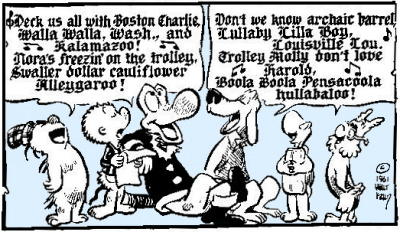
Barnaby kind of puttered off in its later years, and allegiance switched to Pogo by Walt Kelly, which started in 1948 and quickly became very popular, not least for its wicked political commentary, with characters like Simple J. Malarkey, a parody of Joe McCarthy. Kelly wrote songs for the strip which were published and recorded, both originals and his still-famous fractured Christmas carol lyrics, "Deck Us All With Boston Charlie."
Pogo had its several-year run as the cultural ubiquity and then faded a bit into the background, to be replaced by the biggest cultural powerhouse of them all, Peanuts by Charles M. Schulz, which started in 1950 but took a few years to hit its stride. But during the 1960s, at least, it pervaded American culture to an extent hard to believe if you didn't experience it. And its pervasiveness popped up spontaneously from outside sources. There were books about it (this one, from 1965, was a collection of Christian sermons using the strip as textual illustrations, and this unlikely thing became a bestseller); there were songs (I first heard this one sung by the kids on the bus to camp in 1966 and I still know all the lyrics); NASA even named manned spacecraft after Peanuts characters.
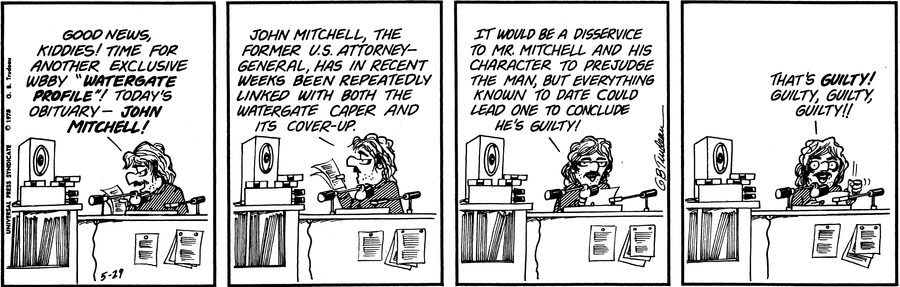
But the strip faded from cultural intensity quickly after 1970, despite having another 30 years to run during which it maintained its prominence on the comics page. The cultural hit of the 1970s was undoubtedly Doonesbury by Garry Trudeau, which began in 1970. Plotted more like a soap opera than any of its predecessors, Doonesbury was even more explicit politically than Pogo. (This one, among others, won Trudeau the Pulitzer Prize for editorial cartooning.)
Doonesbury took a hiatus in 1983-4 and then rebooted itself; it was still popular, but the torch of cultural ubiquity quickly passed to Calvin and Hobbes by Bill Watterson, which ran 1985-95; uniquely among these creators, Watterson stopped the strip before he could run out of steam. And then Dilbert, which began in 1989 and had built up its renown by the time Calvin and Hobbes signed off.
Dilbert started to fade by the mid-2000s. Since then, I dunno - newspaper strips as a cultural icon have faded with the fall of print. In my circles, maybe xkcd by Randall Munroe, which came along in a very timely fashion in 2005, but I'm not sure how commonly-known it is generally, and it's not even a strip in the traditional fashion. But that's where I think we are now.


No comments:
Post a Comment