I've just finished - I think - editing and sprucing up a paper of mine into a form where it's ready for scholarly submission.
This one began life several years ago as a conference presentation, and I usually take a lot of shortcuts with those to avoid getting bogged down in documentation when the writing inspiration is high. I tend, for instance, to give bibliographic citations only for references I fear I might have trouble finding again. That often puts me, at this later point, looking up a lot of basic things over and over. And making sure the quotes are right. Occasionally I'll quote from memory, so that has to be corrected. And occasionally I'll remember a reference without being sure where it's from. Just now I had an allusion to what I thought was Book 1, Chapter 2 of The Lord of the Rings, but it turned out to be Book 5, Chapter 9.
Then there needs to be consideration of remarks that are fine before an audience but whose tone needs to be reconsidered before committing them to scholarly print. So there's a lot to do here.
I also needed to salt in reference to an article, published since I gave the paper, which attempts to overturn the chronology of the authorial events discussed. I don't quite believe it, so I stuck the reference in a footnote.
As I often do while final-drafting, I pulled the Works Cited out into a separate file, so I could jump back and forth between them to ensure that everything cited in the text is in the bibliography (amazing how many authors who submit to Tolkien Studies don't do that) and vice versa (ditto), without having to paw up and down through the file. Then I put it back when I'm done.

Kalimac's corner: a journal by DB
Tuesday, June 30, 2020

Monday, June 29, 2020
better not take down this statue
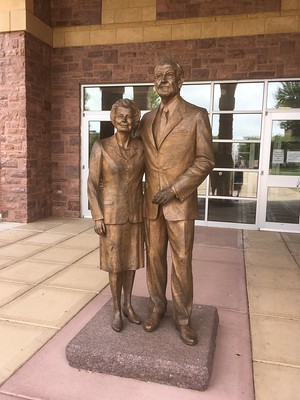
It's George and Eleanor McGovern, in front of the McGovern Library, dedicated in 2006 on the campus of Dakota Wesleyan University, where they both were students, in Mitchell, South Dakota.
I'm not making any trips myself, but I can be vicarious. My brother is driving through South Dakota, and last night he phoned me from Sioux Falls, which he reported to have nothing much of interest except the smell of cow lots. He mentioned he'd be passing through Mitchell today, and I said, "That's George McGovern's home town, you know," so we hastily checked to see if there was anything commemorating that fact, and found this. And here we are, and here is the visual record of his visit there today. We collect presidential historical sites, and there's room in our interest for a few should-have-beens.
Sunday, June 28, 2020
Shakespeare alive
I just want to direct your attention to some fabulously good performances of Shakespeare online, both of them from productions at the Bridge Theatre in London. One comedy, one tragedy.
One is this week's National Theatre Live free performance: it gets taken down on Thursday, so watch it now. It's A Midsummer Night's Dream. This is in some respects a highly experimental production, and there is one really major plot change which I will not reveal here. In some ways the alteration works and in some it doesn't; but what mostly makes it work is the sheer quality of the acting. Everybody in it is just fabulously good; you should know you're in for a good time from the very beginning with the peerlessly haughty Theseus played by Oliver Chris, the same actor who played Orsino in the Twelfth Night that NTL had on earlier this year. What happens after that ... just watch it.
The Bridge's Julius Caesar is, so far as I know, not online in full. But there's three long scenes from it online, all featuring Ben Whishaw as Brutus. I would not have picked him for this part; I'd be more likely to have cast him as Antony. But he does it stunningly well. Act 2, Scene 1, in which the conspirators meet (cut off just before the end). Act 3, Scene 1, the assassination (abridged at the beginning). Act 4, Scene 3 (with a bit of scene 2 at the beginning), Brutus confronts Cassius and the Ghost of Caesar.
One is this week's National Theatre Live free performance: it gets taken down on Thursday, so watch it now. It's A Midsummer Night's Dream. This is in some respects a highly experimental production, and there is one really major plot change which I will not reveal here. In some ways the alteration works and in some it doesn't; but what mostly makes it work is the sheer quality of the acting. Everybody in it is just fabulously good; you should know you're in for a good time from the very beginning with the peerlessly haughty Theseus played by Oliver Chris, the same actor who played Orsino in the Twelfth Night that NTL had on earlier this year. What happens after that ... just watch it.
The Bridge's Julius Caesar is, so far as I know, not online in full. But there's three long scenes from it online, all featuring Ben Whishaw as Brutus. I would not have picked him for this part; I'd be more likely to have cast him as Antony. But he does it stunningly well. Act 2, Scene 1, in which the conspirators meet (cut off just before the end). Act 3, Scene 1, the assassination (abridged at the beginning). Act 4, Scene 3 (with a bit of scene 2 at the beginning), Brutus confronts Cassius and the Ghost of Caesar.
Saturday, June 27, 2020
cube shelving
The wooden pressboard stackable cubes that I use to store the material for current and continuing projects were rather precariously balanced in the first place, and have finally fallen apart after at least 20 years use.
Besides spilling debris everywhere that I now have no place to put, they created a need for a replacement. So, for my first shopping outing since the virus shutdown that wasn't for food, pharmaceuticals, or hardware, I drove to the container store at Santana Row for a replacement. Social distancing was strictly enforced, and in fact I had to abandon my first attempt because of the line to get into the store that didn't look like it was about to get shorter any time soon.
There were several possible items, and on advice I bought two wooden structures composed of four vertically stacked foot-square cubes each. They came unassembled, in boxes, which did mean I could (barely) fit them in my car, but I also had to assemble them, and in my condition that was a slow and painstaking process. Day one: drive them home, leave them overnight in the car. Day two: unpack the boxes outside and bring them piece by piece inside to the living room. Day three: carry them piece by piece upstairs, where my office is, but take them to the master bedroom instead. Day four: assemble them on the bed. Day five: move them into the office.
We're on day four now. Fortunately the instructions, though wordless, were not hard to follow. Lots of dowels and cam locks. Only tool required, supposedly: a screwdriver, though I ran into a snag with the little screws intended to fasten the back panel on. There are holes in the panel, but none in the wooden structure it's to be attached to. I guess you're supposed to drive the screws straight in, but that trick never works. I need pilot holes. Retrieve ancient power drill that my father gave me when I left home. Select appropriate-sized drill bit and attach. Put on glasses for safety. (I wonder if the men who think they're too macho to wear masks in the time of virus also eschew safety glasses when using drills.) Plug in the cord, make the little holes, scare off the cat. Continue where you'd left off.
Besides spilling debris everywhere that I now have no place to put, they created a need for a replacement. So, for my first shopping outing since the virus shutdown that wasn't for food, pharmaceuticals, or hardware, I drove to the container store at Santana Row for a replacement. Social distancing was strictly enforced, and in fact I had to abandon my first attempt because of the line to get into the store that didn't look like it was about to get shorter any time soon.
There were several possible items, and on advice I bought two wooden structures composed of four vertically stacked foot-square cubes each. They came unassembled, in boxes, which did mean I could (barely) fit them in my car, but I also had to assemble them, and in my condition that was a slow and painstaking process. Day one: drive them home, leave them overnight in the car. Day two: unpack the boxes outside and bring them piece by piece inside to the living room. Day three: carry them piece by piece upstairs, where my office is, but take them to the master bedroom instead. Day four: assemble them on the bed. Day five: move them into the office.
We're on day four now. Fortunately the instructions, though wordless, were not hard to follow. Lots of dowels and cam locks. Only tool required, supposedly: a screwdriver, though I ran into a snag with the little screws intended to fasten the back panel on. There are holes in the panel, but none in the wooden structure it's to be attached to. I guess you're supposed to drive the screws straight in, but that trick never works. I need pilot holes. Retrieve ancient power drill that my father gave me when I left home. Select appropriate-sized drill bit and attach. Put on glasses for safety. (I wonder if the men who think they're too macho to wear masks in the time of virus also eschew safety glasses when using drills.) Plug in the cord, make the little holes, scare off the cat. Continue where you'd left off.
Friday, June 26, 2020
federal enclave
So the latest news is another attempt to make Washington, D.C., into a state. Right now it has electoral votes (which it was granted by constitutional amendment in 1964), but only a non-voting delegate in the House and no senators. Supposedly it is unique this way among federal enclaves (I haven't checked other countries).
Why is it this way at all? Because in the early republic, the states were jealous of each other and nobody wanted control of the federal capital to be under the control of any state other than their own. So they put it in no state. The Constitution provided for, and acts of Congress established, a ten mile square zone along the Potomac River between Maryland and Virginia, taken from bits of both states, exact site chosen by George Washington, who besides being a resident of the general region and the President, was also a surveyor by profession. They called it the District of Columbia. And in that zone, on the Maryland side of the river, they erected a Capitol and a Presidential Mansion (later called the White House) and a few other buildings, and that was about it for a long time. It was a manifestation of the 18th century passion for conquering swamps, which also gave us Versailles and Saint Petersburg. None were healthy places to live, and in the sketchy town of Washington for many years pretty much the only permanent residents were service personnel (including slaves, because this was the South). Congressmen rented rooms in boarding houses during the short Congressional sessions, and then went home.
So little was made of the District that the part on the other side of the river, which the feds were making no use of at all, was retroceded to Virginia. Meanwhile Washington, over on the other side, slowly became a city, and eventually a majority Black one. Many more government buildings were built, quasi-governmental institutions like the Smithsonian were established, other institutions dependent on government like lobbyists and think tanks took root, and more people began living there permanently. It passed 100,000 in 1870 and 500,000 in 1940.
The big change came with the New Deal and WW2, with the growth of the federal government and the development of air conditioning (which was also transforming Florida at the same time). During the war a huge new five-sided building was constructed to put the entire military bureaucracy under one roof, and due to lack of room in D.C. it was placed on the Virginia side of the river, in the retroceded section. Nowadays the metonym for the federal government and its appurtenances is "inside the Beltway," the Beltway being a highway loop that goes far outside the D.C. limits, encompassing establishments like the NIH in suburban Maryland, the Pentagon in retroceded Virginia, and the CIA in Virginia outside the retrocession.
So it no longer really matters what state the government is in - that state isn't going to control the government - and the idea of a federal enclave is obsolete; the central government is half outside it anyway. They could just retocede the rest to Maryland and have done with it, but that isn't considered practical. Instead, the idea of making it a state of its own, often thought of before, has been resurrected. Republicans are opposed, supposedly for constitutional reasons, but since those are easily brushed aside, it's because they don't want a state full of Democratic-voting Blacks. (D.C.'s electoral votes have gone to every Democratic candidate since they were granted, even McGovern and Dukakis.) Ironically, D.C. is getting less Black all the time. The city is rapidly gentrifying, and Blacks are moving out to the suburbs, especially Prince Georges County, Maryland, which is now far more Black than D.C. is. The city is now just under half Black; it used to be 70%.
One problem is the name. "District of Columbia" isn't suitable for a state, it honors Columbus whom we're not celebrating any more, and nobody calls it that anyway, it's "D.C." or "Washington, D.C." Some of the proposers are suggesting "Douglass Commonwealth," which sounds cool: it honors Frederick Douglass, much more honorable, and several existing states are already officially called Commonwealths, including Virginia. Another suggestion is "New Columbia" which is much less good; it preserves Columbus and doesn't preserve D.C., instead changing to N.C. which is already taken.
What interests me, as a geographic trivia nerd, is what happens to the federal enclave? The proposal is to limit it to a few central government buildings, but exactly what will be the extent? This article from a D.C. real estate site has one; here's a slightly revised version that annexes the Trump Hotel. Here's an earlier proposal encompassing much more area. And a much earlier one, from 1970, very close to the current plan.
The one genuine constitutional problem is that the reduced federal enclave of virtually nil resident population,* will, by virtue of the 23rd Amendment, still have 3 electoral votes, but the sponsors say it can be repealed.
I would ask, though, why do we need a federal enclave at all? Unless I missed something, the only constitutional provision regarding the location of the seat of government is in Article 1, Section 8, giving Congress jurisdiction "over such District (not exceeding ten Miles square) as may, by Cession of particular States, and the Acceptance of Congress, become the Seat of the Government of the United States." It permits one, but it doesn't read to me as if it requires it. And I don't think we need one any more, unless it were to include the entire Beltway, which is exactly what we're trying to avoid.
*Some comments say this includes the president and family. Not legally. All presidents have kept their voting addresses at their personal homes elsewhere, though DT tried to list the White House as his residence when he re-registered himself in Florida; Florida sent it back saying, "You idiot, you need a Florida residence to vote in Florida," so DT returned it listing Mar-a-Lago, which is what he'd been thinking of when he chose Florida in the first place.
Why is it this way at all? Because in the early republic, the states were jealous of each other and nobody wanted control of the federal capital to be under the control of any state other than their own. So they put it in no state. The Constitution provided for, and acts of Congress established, a ten mile square zone along the Potomac River between Maryland and Virginia, taken from bits of both states, exact site chosen by George Washington, who besides being a resident of the general region and the President, was also a surveyor by profession. They called it the District of Columbia. And in that zone, on the Maryland side of the river, they erected a Capitol and a Presidential Mansion (later called the White House) and a few other buildings, and that was about it for a long time. It was a manifestation of the 18th century passion for conquering swamps, which also gave us Versailles and Saint Petersburg. None were healthy places to live, and in the sketchy town of Washington for many years pretty much the only permanent residents were service personnel (including slaves, because this was the South). Congressmen rented rooms in boarding houses during the short Congressional sessions, and then went home.
So little was made of the District that the part on the other side of the river, which the feds were making no use of at all, was retroceded to Virginia. Meanwhile Washington, over on the other side, slowly became a city, and eventually a majority Black one. Many more government buildings were built, quasi-governmental institutions like the Smithsonian were established, other institutions dependent on government like lobbyists and think tanks took root, and more people began living there permanently. It passed 100,000 in 1870 and 500,000 in 1940.
The big change came with the New Deal and WW2, with the growth of the federal government and the development of air conditioning (which was also transforming Florida at the same time). During the war a huge new five-sided building was constructed to put the entire military bureaucracy under one roof, and due to lack of room in D.C. it was placed on the Virginia side of the river, in the retroceded section. Nowadays the metonym for the federal government and its appurtenances is "inside the Beltway," the Beltway being a highway loop that goes far outside the D.C. limits, encompassing establishments like the NIH in suburban Maryland, the Pentagon in retroceded Virginia, and the CIA in Virginia outside the retrocession.
So it no longer really matters what state the government is in - that state isn't going to control the government - and the idea of a federal enclave is obsolete; the central government is half outside it anyway. They could just retocede the rest to Maryland and have done with it, but that isn't considered practical. Instead, the idea of making it a state of its own, often thought of before, has been resurrected. Republicans are opposed, supposedly for constitutional reasons, but since those are easily brushed aside, it's because they don't want a state full of Democratic-voting Blacks. (D.C.'s electoral votes have gone to every Democratic candidate since they were granted, even McGovern and Dukakis.) Ironically, D.C. is getting less Black all the time. The city is rapidly gentrifying, and Blacks are moving out to the suburbs, especially Prince Georges County, Maryland, which is now far more Black than D.C. is. The city is now just under half Black; it used to be 70%.
One problem is the name. "District of Columbia" isn't suitable for a state, it honors Columbus whom we're not celebrating any more, and nobody calls it that anyway, it's "D.C." or "Washington, D.C." Some of the proposers are suggesting "Douglass Commonwealth," which sounds cool: it honors Frederick Douglass, much more honorable, and several existing states are already officially called Commonwealths, including Virginia. Another suggestion is "New Columbia" which is much less good; it preserves Columbus and doesn't preserve D.C., instead changing to N.C. which is already taken.
What interests me, as a geographic trivia nerd, is what happens to the federal enclave? The proposal is to limit it to a few central government buildings, but exactly what will be the extent? This article from a D.C. real estate site has one; here's a slightly revised version that annexes the Trump Hotel. Here's an earlier proposal encompassing much more area. And a much earlier one, from 1970, very close to the current plan.
The one genuine constitutional problem is that the reduced federal enclave of virtually nil resident population,* will, by virtue of the 23rd Amendment, still have 3 electoral votes, but the sponsors say it can be repealed.
I would ask, though, why do we need a federal enclave at all? Unless I missed something, the only constitutional provision regarding the location of the seat of government is in Article 1, Section 8, giving Congress jurisdiction "over such District (not exceeding ten Miles square) as may, by Cession of particular States, and the Acceptance of Congress, become the Seat of the Government of the United States." It permits one, but it doesn't read to me as if it requires it. And I don't think we need one any more, unless it were to include the entire Beltway, which is exactly what we're trying to avoid.
*Some comments say this includes the president and family. Not legally. All presidents have kept their voting addresses at their personal homes elsewhere, though DT tried to list the White House as his residence when he re-registered himself in Florida; Florida sent it back saying, "You idiot, you need a Florida residence to vote in Florida," so DT returned it listing Mar-a-Lago, which is what he'd been thinking of when he chose Florida in the first place.
Wednesday, June 24, 2020
ecce homines, pars XII
As the public libraries are reopening, it's time to resume my three-volumes-at-a-time survey of the American Presidents series, edited by Arthur M. Schlesinger, Jr. This installment covers the presidencies of 1961-1974.
These are the presidents of the war in Vietnam, which gets a full chapter in two volumes and much consideration in the third. They're also the presidents of my childhood, the first ones I remember being in office. The authors of these books remember them too: Brinkley remembers Kennedy's image from his boyhood; Drew eschews personal reminiscence, but draws from her own magazine reporting at the time for her portrait of Nixon.
Alan Brinkley on John F. Kennedy gives more space - about a third of the book - to the pre-presidential period than the previous couple books did. Brinkley, an academic known for books of serious popular history, essentially gives us a vivid and lucid tour of JFK's brain. The best parts of the book are the focused and detailed looks at Kennedy's thought on some critical issues: the greater experience with which he approached the Cuban Missile Crisis after dealing with the Bay of Pigs; his gradual evolution to full support of the civil rights movement; and Vietnam, on which Brinkley says JFK held two mutually inconsistent positions: that the Vietnamese were going to have to defend themselves, and that the U.S. couldn't let them down. JFK never reached the crisis point where he'd have to choose between them, so it's impossible to say what he would have done if he did. If this is a book on JFK's brain, it admits that he had a body also, but Brinkley doesn't think that JFK's health issues or his sexual adventures had much of an effect on how he conducted his presidency.
Charles Peters on Lyndon B. Johnson is the blandest book of the three on the most colorful of the three presidents. Peters, a journalist and founding editor of the Washington Monthly, gives full consideration to LBJ's earlier life, but you can see him following Robert Caro's biography both in what he puts in and what he leaves out. The result is rather bloodless, particularly anemic in describing the programs of the Great Society without enthusiasm. Peters' answer to why LBJ persisted in Vietnam is simple: he was afraid he'd seem weak if he pulled out. There's no consideration of what he seemed by not doing it. Though Peters can be critical of LBJ, there are sudden defensive spasms: he reaches fundamental dishonesty by accusing the press of falsely portraying Tet as a defeat when the US won the battle. This misses the point. It matters less that the US eked out a win than that the invasion itself revealed how badly the war was going: if US reports had been true, the North should never have been able to mount the offensive at all, let alone take the Americans by surprise. Peters pulls a similar shady trick with the 1968 New Hampshire primary, which technically LBJ won, but so narrowly that that became the story. There's also an irritating tendency to refer to politicians by offices they didn't yet hold at the time referred to.
Elizabeth Drew on Richard M. Nixon is an awesomely sharp portrait of a very peculiar man. As with Truman and Ike, this book disposes of the subject's pre-presidential years with a very abbreviated summary (there's far more detail on his post-presidential comeback tour). Unlike with them, though, the presidency here is treated thematically rather than chronologically. A chapter on Nixon's governing style depicts him as both smart and skilled yet disorganized, presiding over a shambles of an administration, self-obsessed and paranoid, and even addled by drugs and alcohol. On domestic affairs, Drew says Nixon was no progressive, as he's now sometimes pictured; he was an opportunist and pragmatist in a progressive age. On foreign affairs, Drew credits Nixon (and Kissinger) with some brilliant high diplomacy, yet with foolishness and incompetence in other areas and brushing off ones that didn't interest them. On Vietnam, Nixon had no plan, but he had a lot of lies implying he did. And then there's Watergate. Drew is mostly content to narrate the events lucidly, without getting lost in detail, but she does conclude that the whole sordid mess stemmed from Nixon's personality and governing style; you can't separate it from the rest of his presidency because it was an expression of his fundamental traits. She finishes by stating that he was a talented man who was not fit to be president.
These are the presidents of the war in Vietnam, which gets a full chapter in two volumes and much consideration in the third. They're also the presidents of my childhood, the first ones I remember being in office. The authors of these books remember them too: Brinkley remembers Kennedy's image from his boyhood; Drew eschews personal reminiscence, but draws from her own magazine reporting at the time for her portrait of Nixon.
Alan Brinkley on John F. Kennedy gives more space - about a third of the book - to the pre-presidential period than the previous couple books did. Brinkley, an academic known for books of serious popular history, essentially gives us a vivid and lucid tour of JFK's brain. The best parts of the book are the focused and detailed looks at Kennedy's thought on some critical issues: the greater experience with which he approached the Cuban Missile Crisis after dealing with the Bay of Pigs; his gradual evolution to full support of the civil rights movement; and Vietnam, on which Brinkley says JFK held two mutually inconsistent positions: that the Vietnamese were going to have to defend themselves, and that the U.S. couldn't let them down. JFK never reached the crisis point where he'd have to choose between them, so it's impossible to say what he would have done if he did. If this is a book on JFK's brain, it admits that he had a body also, but Brinkley doesn't think that JFK's health issues or his sexual adventures had much of an effect on how he conducted his presidency.
Charles Peters on Lyndon B. Johnson is the blandest book of the three on the most colorful of the three presidents. Peters, a journalist and founding editor of the Washington Monthly, gives full consideration to LBJ's earlier life, but you can see him following Robert Caro's biography both in what he puts in and what he leaves out. The result is rather bloodless, particularly anemic in describing the programs of the Great Society without enthusiasm. Peters' answer to why LBJ persisted in Vietnam is simple: he was afraid he'd seem weak if he pulled out. There's no consideration of what he seemed by not doing it. Though Peters can be critical of LBJ, there are sudden defensive spasms: he reaches fundamental dishonesty by accusing the press of falsely portraying Tet as a defeat when the US won the battle. This misses the point. It matters less that the US eked out a win than that the invasion itself revealed how badly the war was going: if US reports had been true, the North should never have been able to mount the offensive at all, let alone take the Americans by surprise. Peters pulls a similar shady trick with the 1968 New Hampshire primary, which technically LBJ won, but so narrowly that that became the story. There's also an irritating tendency to refer to politicians by offices they didn't yet hold at the time referred to.
Elizabeth Drew on Richard M. Nixon is an awesomely sharp portrait of a very peculiar man. As with Truman and Ike, this book disposes of the subject's pre-presidential years with a very abbreviated summary (there's far more detail on his post-presidential comeback tour). Unlike with them, though, the presidency here is treated thematically rather than chronologically. A chapter on Nixon's governing style depicts him as both smart and skilled yet disorganized, presiding over a shambles of an administration, self-obsessed and paranoid, and even addled by drugs and alcohol. On domestic affairs, Drew says Nixon was no progressive, as he's now sometimes pictured; he was an opportunist and pragmatist in a progressive age. On foreign affairs, Drew credits Nixon (and Kissinger) with some brilliant high diplomacy, yet with foolishness and incompetence in other areas and brushing off ones that didn't interest them. On Vietnam, Nixon had no plan, but he had a lot of lies implying he did. And then there's Watergate. Drew is mostly content to narrate the events lucidly, without getting lost in detail, but she does conclude that the whole sordid mess stemmed from Nixon's personality and governing style; you can't separate it from the rest of his presidency because it was an expression of his fundamental traits. She finishes by stating that he was a talented man who was not fit to be president.
Tuesday, June 23, 2020
Tolkien notes and others
1. Hey there, all those who want to keep up with the latest posthumous Tolkien writings, look out next year for The Nature of Middle-earth (which I hope the publisher decides to spell that way). A few of the contents have already appeared in obscure scholarly sources, so I can say that, like much of the later History of Middle-earth volumes, this volume will delve into the very roots of the mountain, the basic concepts (or "nature") of Middle-earth itself. For the editing of the world-creation, this should be very cool.
2. They're looking for self-defined Tolkien fans to be interviewed for three minutes (to keep you concise, my dear) for The Tolkien Fandom Oral History Collection. You can also listen to (or read) a batch of interviews already entered. I've signed up; should you?
3. No, I don't know what this is about - I wasn't there - and the account does not clarify for me what was going on. Ergo silencio.
4. The cancellation of concerts is now infecting September-December. The San Francisco Symphony is out; so are many others. (By the way, have you noticed how to pronounce "2020-2021 season"? Twenty-twenty-twenty-twenty-one. We may be better off without it.) A few institutions have embarked on social-distance concerts; here's a review that may be behind a paywall. I think I'll pass for now, and that applies to dine-in restaurants also.
4. Looking at what we have come to in the quest to cease memorializing evil, I regret to say that the best comment is Macaulay's, "We know no spectacle so ridiculous as the British public in one of its periodical fits of morality." Unless it's American. It's disrespectful to the original protests to take them to a level of parody.
4a. But I'll make an allowance for the equestrian statue of Theodore Roosevelt, with ethnic retainers, at the American Museum of Natural History. It's located immediately in front of the main door to the museum, facing outwards. As a result, when you leave the museum, you open the door to find yourself immediately faced with the biggest bronze horse's ass you have ever seen. I always thought that was a better comment on the statue than any act of taking it down could be, but yeah, better that it should go.
2. They're looking for self-defined Tolkien fans to be interviewed for three minutes (to keep you concise, my dear) for The Tolkien Fandom Oral History Collection. You can also listen to (or read) a batch of interviews already entered. I've signed up; should you?
3. No, I don't know what this is about - I wasn't there - and the account does not clarify for me what was going on. Ergo silencio.
4. The cancellation of concerts is now infecting September-December. The San Francisco Symphony is out; so are many others. (By the way, have you noticed how to pronounce "2020-2021 season"? Twenty-twenty-twenty-twenty-one. We may be better off without it.) A few institutions have embarked on social-distance concerts; here's a review that may be behind a paywall. I think I'll pass for now, and that applies to dine-in restaurants also.
4. Looking at what we have come to in the quest to cease memorializing evil, I regret to say that the best comment is Macaulay's, "We know no spectacle so ridiculous as the British public in one of its periodical fits of morality." Unless it's American. It's disrespectful to the original protests to take them to a level of parody.
4a. But I'll make an allowance for the equestrian statue of Theodore Roosevelt, with ethnic retainers, at the American Museum of Natural History. It's located immediately in front of the main door to the museum, facing outwards. As a result, when you leave the museum, you open the door to find yourself immediately faced with the biggest bronze horse's ass you have ever seen. I always thought that was a better comment on the statue than any act of taking it down could be, but yeah, better that it should go.
Saturday, June 20, 2020
news items
1. Just in case anyone's still tempted to use the term "a few bad apples" to describe those cops, here's an article on how a bad apple really does rot the entire barrel. (I'm also reminded of the line, "You catch more flies with honey than with vinegar; actually vinegar makes an excellent fly trap.)
1a. And hey, all you cops protesting your erring fellows' punishment: You're just proving the point, racism is endemic.
2. My favorite line from the late great Sir Ian Holm's entire career. The Madness of King George: Lord Thurlow (John Wood) comes across the recovering king (Nigel Hawthorne) with his doctor, Willis (Ian Holm), reading Shakespeare. He's a doctor, not a literary man.
THURLOW (startled): King Lear? Was that wise?
WILLIS (defensively): I'd no idea what it was about, sir.
3. Headline reads: "SEC, NCAA Threaten to Pull Events From Mississippi if Confederate Emblem Isn’t Removed From State Flag." I know what the NCAA is, but am I the only American reader to wonder what the Securities and Exchange Commission has to do with this? Turns out to be the Southeastern Conference, which from its name I presume to be a college sports league.
4. The hate on for the public health officials who are, as far as I'm concerned, the only thing keeping us at all safe. If it weren't for their severe restrictions, I wouldn't dare take the necessary errands I do perform.
5. The latest campaign to tear down the statues of slavers and their advocates, which began joyously enough at a riverside in Bristol, has jumped the shark. True, General Grant was a seriously flawed president, but really? And Nancy Pelosi ordered the removal of the portraits of four former Speakers associated with the Confederacy. This wasn't a Confederate memorial; it's intended as a display of every Speaker, good, bad, or otherwise. (Is Denny Hastert there?) Unlike with the statues, editing this is to erase history. The removal even included Charles Crisp. Unlike the others, he wasn't a high CSA official; as a very young man (he was 16 when the war broke out), he joined its army. Ordinary soldiers were not considered traitors if they'd swear allegiance to the Union afterwards, without which forgiveness Crisp couldn't have then served in Congress, years later, at all. Should we be more censorious than the Radical Republicans were at the time?
1a. And hey, all you cops protesting your erring fellows' punishment: You're just proving the point, racism is endemic.
2. My favorite line from the late great Sir Ian Holm's entire career. The Madness of King George: Lord Thurlow (John Wood) comes across the recovering king (Nigel Hawthorne) with his doctor, Willis (Ian Holm), reading Shakespeare. He's a doctor, not a literary man.
THURLOW (startled): King Lear? Was that wise?
WILLIS (defensively): I'd no idea what it was about, sir.
3. Headline reads: "SEC, NCAA Threaten to Pull Events From Mississippi if Confederate Emblem Isn’t Removed From State Flag." I know what the NCAA is, but am I the only American reader to wonder what the Securities and Exchange Commission has to do with this? Turns out to be the Southeastern Conference, which from its name I presume to be a college sports league.
4. The hate on for the public health officials who are, as far as I'm concerned, the only thing keeping us at all safe. If it weren't for their severe restrictions, I wouldn't dare take the necessary errands I do perform.
5. The latest campaign to tear down the statues of slavers and their advocates, which began joyously enough at a riverside in Bristol, has jumped the shark. True, General Grant was a seriously flawed president, but really? And Nancy Pelosi ordered the removal of the portraits of four former Speakers associated with the Confederacy. This wasn't a Confederate memorial; it's intended as a display of every Speaker, good, bad, or otherwise. (Is Denny Hastert there?) Unlike with the statues, editing this is to erase history. The removal even included Charles Crisp. Unlike the others, he wasn't a high CSA official; as a very young man (he was 16 when the war broke out), he joined its army. Ordinary soldiers were not considered traitors if they'd swear allegiance to the Union afterwards, without which forgiveness Crisp couldn't have then served in Congress, years later, at all. Should we be more censorious than the Radical Republicans were at the time?
Friday, June 19, 2020
logic for Juneteenth
Here's somebody else who's finally making the point that B. has been making about the slogan "Black Lives Matter" and those who object to it. The somebody else is a sports broadcaster named Max Kellerman, who said on TV,
Black Lives Matter has always meant Black Lives Matter parenthetically 'too.' In other words, we already know that white lives matter. Black Lives Matter too.The context was a college football coach who wears a shirt reading "Football Matters." Kellerman said,
I think a lot of people think football matters -- probably too much. So to have a "football matters" shirt and play on Black Live Matters shows maybe not a tone-deafness, but a lack of comprehension.BLM isn't some sort of ra-ra cheer for Black people, suitable to be played with by adapting it to a ra-ra cheer for anything you like. It's a desperate plea to take Black lives seriously, to treat them with respect instead of as something that can casually be snuffed out by any cop with a gun, or a knee. To put something popular (e.g. football) or well-defended ("blue lives") on that level is a studied insult and denigration, and if the coach doesn't realize it, his incomprehension is monumental.
Thursday, June 18, 2020
Tolkien Studies 17: a correction
A change has been made in the contents of Tolkien Studies 17, and the previous announcement has been corrected to adjust for it. - David Bratman, co-editor
Subscribe to:
Posts (Atom)