I attended three more online concerts over the weekend. All were ones I'd gotten publicity emails for and which I signed up for because the programs looked interesting. The results varied.
First was the Neave Trio (violin, cello, piano), who play at Bard College in New York state, so I wouldn't be too likely to come across them at home. They gave a soft, gentle version of Clara Schumann's Piano Trio in G Minor, followed by as close to a similar style as they could get with Shostakovich's Trio No. 1, the one that's rarely played, and Jennifer Higdon's Trio, a work I hadn't heard.
A much more vigorous and incisive version of the Clara Schumann came from the Delphi Trio, in the Noe Music concert series, recorded in a church in San Francisco where I've often been for concerts. (So I appreciated the intro, a montage of arriving at the church for a concert.) Equally fine was their Brahms Op. 87 Trio. These were separated by a new piece by Danny Clay called Circle Dash, because it was written as an animation of those symbols, the dashes meaning rests and the circles meaning notes, their placement and size indicating pitch and volume. The result was a series of thumps which was mildly amusing to hear, especially between two masterworks.
Both these concerts were excellently recorded in both sound and video. The third was ... not. This was the Stenberg-Cahill duo, two local specialists in new music as part of Old First Concerts, another church-based series in San Francisco. I was late for this, and when I tuned in, Kate Stenberg was playing an eerie and mesmerizing piece for unaccompanied violin by Ronald Bruce Smith. That worked pretty well, but subsequent pieces with Sarah Cahill on piano revealed technical issues. There's nothing wrong with the venue, where I've been before, but the sound quality of the recording was awful, the microphones flickered off and on and interfered with the acoustic pickup, the video was dully staged and badly lit, and the performers couldn't figure out whether to leave the stage between pieces. (After one piece, Cahill stood up, moved forward, looked around, sat down again, stood up again ...) They concluded with the Brahms Op. 100 Sonata, and I think that modern music specialists should stick to their last. I'm not taking any more of this series online unless they learn to make better recordings, and I think I'll write the publicist who sent me the notice.

Kalimac's corner: a journal by DB
Monday, October 12, 2020

Sunday, October 11, 2020
movies
all on Amazon Prime, because I don't really have anywhere else to get movies
The Glorias
I was looking forward for this one to come out, because while I don't know that much about Gloria Steinem, I've been very impressed with past movies by Julie Taymor, the director. And it's got the surreal Taymor touches. The Glorias are five women and girls who portray her at different ages, including the real one; occasionally two or more of them meet up on Greyhound buses in black and white and discuss their life. There's also some striking montage scenes, and one spectacular one embodying Gloria's fantasy about what she'd like to do to a male tv interviewer who tells her how sexy she looks: he goes through a nightmarish melange of the witches from Macbeth and the twister from The Wizard of Oz.
One thing I learned from this movie is that Steinem was very much opposed to being taken as the one pre-eminent public face of the women's movement. That being the case, why is there a movie about her? Ironically, it's less about her than a bio-pic should be. Much of the early part (while not in chronological order, it's not entirely out of sequence either) focuses on her eccentric and colorful father (played by Timothy Hutton), and much of the later part is devoted to speeches by other women (Flo Kennedy, Bella Abzug, Wilma Mankiller) while Gloria applauds or takes notes. If it were framed as a history of the women's movement and not as a bio-pic of Gloria Steinem it wouldn't feel as curiously vacant. Still, it was a striking movie, even sometimes inspiring.
Bombshell
I'd found a no-additional-charge miniseries, The Loudest Voice, about Roger Ailes, starring Russell Crowe in a fat suit. I watched the first episode and thought it spread thinly enough that I wouldn't want to watch seven of them. And then I remembered, wasn't there a feature film about Ailes that might be better than this? Indeed, so I watched that instead. This time John Lithgow plays Ailes in a more decrepit fat suit than Crowe is in, but to be fair this takes place at a later stage than the first episode of The Loudest Voice does. But most of it is about the women newscasters of Fox News. They're all glamorous blondes in similar clothes, so despite the fact that I know previous work by all the actresses I found them pretty interchangeable in appearance. It ends with Gretchen Carlson's suit against Ailes for sexual harassment; but though Ailes is classically sexist in trumpeting his demand that women show off their bodies on-air (always wear short dresses, etc.), there's only one scene of pure sexual harassment, a horrifying moment of a leering Ailes and a tearful composite character played by Margot Robbie. But if Ailes falls, Fox News goes on; so, like The Social Network, this is a film about evil in which evil wins.
Mission Impossible: Fallout
I'd liked the original Mission: Impossible tv show, way back when, but I'd never seen any of the movie remakes. But then this film was on a list of the 100 best movies currently on Amazon Prime, and even though the list includes some movies I thought were dreadful, it was no additional charge, so I thought why not? If your desires for an action movie include taut pacing without relentless pushing, a comprehensible plot without too many nonsensical twists, precision teamwork among the heroes, a minimum of endless shootout scenes, and exciting music that doesn't just whirl in place (references to the old Mission: Impossible tv show themes a plus), then this one will fit the bill. There was one big plot twist that involved a substitution that, even on rewatching, I couldn't see how the characters did it; and in the big helicopter chase scene I wasn't entirely sure on first viewing who was in which helicopter; but the movie was exciting and kept me occupied during some of those lonely hours when I'm awake in the middle of the night.
The Glorias
I was looking forward for this one to come out, because while I don't know that much about Gloria Steinem, I've been very impressed with past movies by Julie Taymor, the director. And it's got the surreal Taymor touches. The Glorias are five women and girls who portray her at different ages, including the real one; occasionally two or more of them meet up on Greyhound buses in black and white and discuss their life. There's also some striking montage scenes, and one spectacular one embodying Gloria's fantasy about what she'd like to do to a male tv interviewer who tells her how sexy she looks: he goes through a nightmarish melange of the witches from Macbeth and the twister from The Wizard of Oz.
One thing I learned from this movie is that Steinem was very much opposed to being taken as the one pre-eminent public face of the women's movement. That being the case, why is there a movie about her? Ironically, it's less about her than a bio-pic should be. Much of the early part (while not in chronological order, it's not entirely out of sequence either) focuses on her eccentric and colorful father (played by Timothy Hutton), and much of the later part is devoted to speeches by other women (Flo Kennedy, Bella Abzug, Wilma Mankiller) while Gloria applauds or takes notes. If it were framed as a history of the women's movement and not as a bio-pic of Gloria Steinem it wouldn't feel as curiously vacant. Still, it was a striking movie, even sometimes inspiring.
Bombshell
I'd found a no-additional-charge miniseries, The Loudest Voice, about Roger Ailes, starring Russell Crowe in a fat suit. I watched the first episode and thought it spread thinly enough that I wouldn't want to watch seven of them. And then I remembered, wasn't there a feature film about Ailes that might be better than this? Indeed, so I watched that instead. This time John Lithgow plays Ailes in a more decrepit fat suit than Crowe is in, but to be fair this takes place at a later stage than the first episode of The Loudest Voice does. But most of it is about the women newscasters of Fox News. They're all glamorous blondes in similar clothes, so despite the fact that I know previous work by all the actresses I found them pretty interchangeable in appearance. It ends with Gretchen Carlson's suit against Ailes for sexual harassment; but though Ailes is classically sexist in trumpeting his demand that women show off their bodies on-air (always wear short dresses, etc.), there's only one scene of pure sexual harassment, a horrifying moment of a leering Ailes and a tearful composite character played by Margot Robbie. But if Ailes falls, Fox News goes on; so, like The Social Network, this is a film about evil in which evil wins.
Mission Impossible: Fallout
I'd liked the original Mission: Impossible tv show, way back when, but I'd never seen any of the movie remakes. But then this film was on a list of the 100 best movies currently on Amazon Prime, and even though the list includes some movies I thought were dreadful, it was no additional charge, so I thought why not? If your desires for an action movie include taut pacing without relentless pushing, a comprehensible plot without too many nonsensical twists, precision teamwork among the heroes, a minimum of endless shootout scenes, and exciting music that doesn't just whirl in place (references to the old Mission: Impossible tv show themes a plus), then this one will fit the bill. There was one big plot twist that involved a substitution that, even on rewatching, I couldn't see how the characters did it; and in the big helicopter chase scene I wasn't entirely sure on first viewing who was in which helicopter; but the movie was exciting and kept me occupied during some of those lonely hours when I'm awake in the middle of the night.
Friday, October 9, 2020
litmus test
Classical music listeners, this will either delight and amuse you, or horrify and offend you.
En el Salón del Rey de la Montañam
En el Salón del Rey de la Montañam
Thursday, October 8, 2020
online concert review: Tetzlaff Quartet
This one was sponsored by Cal Performances, with the Tetzlaff Quartet from Germany, in Germany because of the virus, and not live but recorded last week, but they pretended as if it were live. The intermission video was a time-lapse of the upper Zellerbach lobby, but I hope they hadn't planned on holding the actual concert there if it were real. Chamber music goes in Hertz, please.
What attracted me to this concert was the awesome program: Opp. 130/133 and 132, the two most monumental and difficult of Beethoven's quartets. I'd never heard them put together like this before. I had some problems with the sound quality - more on that below - but the performances had me riveted throughout.
They were actually rather different. The Tetzlaffs approached Op. 130 with gravity. Even the lighter inner movements were given the same weight and seriousness as the first movement and the Grosse Fuge, as a result of which the piece expanded and felt even vaster and more all-encompassing than it otherwise would.
Op. 132 was more textured and varied. The Andante interludes in the Heilige Dankgesang were so warm and tender, and the final appearance of the Adagio so emotionally fulfilled, as to make an ideal rendition of the movement. There were other bright spots, particularly the march which was almost as off-kilter as Op. 130's danza tedesca, which is supposed to be that way. Growls from the inner instruments in the finale likewise stood out. It made a great conclusion.
I put my good headphones on to listen to this, but the sound nevertheless seemed a little hollow and stale. It definitely wasn't the performers, nor could it have been the venue, which was wood-lined, so it must have been in the recording or transmission. That, and a few pops in the playback, aside, it was a good recording. A separate microphone for each instrument assured that each could be heard individually. All around it was pretty satisfying.
What attracted me to this concert was the awesome program: Opp. 130/133 and 132, the two most monumental and difficult of Beethoven's quartets. I'd never heard them put together like this before. I had some problems with the sound quality - more on that below - but the performances had me riveted throughout.
They were actually rather different. The Tetzlaffs approached Op. 130 with gravity. Even the lighter inner movements were given the same weight and seriousness as the first movement and the Grosse Fuge, as a result of which the piece expanded and felt even vaster and more all-encompassing than it otherwise would.
Op. 132 was more textured and varied. The Andante interludes in the Heilige Dankgesang were so warm and tender, and the final appearance of the Adagio so emotionally fulfilled, as to make an ideal rendition of the movement. There were other bright spots, particularly the march which was almost as off-kilter as Op. 130's danza tedesca, which is supposed to be that way. Growls from the inner instruments in the finale likewise stood out. It made a great conclusion.
I put my good headphones on to listen to this, but the sound nevertheless seemed a little hollow and stale. It definitely wasn't the performers, nor could it have been the venue, which was wood-lined, so it must have been in the recording or transmission. That, and a few pops in the playback, aside, it was a good recording. A separate microphone for each instrument assured that each could be heard individually. All around it was pretty satisfying.
undebated
The vice-presidential debate was less chaotic than the presidential one, but I still could only stand to watch about half an hour of it. I think what bothers me most is the irksome, though necessary under the conditions, practice of candidates responding to questions by reaching into their shelf of prerecorded answers, picking one that's at least tangentially related to the question, or sometimes not even that, plugging it in to their speech circuit, and rattling it off. There was no communication or response going on here, just robotic speechifying. The last candidate to actually respond to what another was saying at a debate was Chris Christie taking on the robot Marco Rubio, and that was a while ago.
So I left the tv set, went upstairs to my computer, and joined a live online event I'd actually bought a ticket for, a club concert in NYC by Suzanne Vega and her band. Then I rewound and watched the part that I'd missed, which included Vega thanking her unseen audience for watching this live and not something else. Oh well. As with other pop music artists I enjoy, I haven't been following Vega's new work for some years - it's not them, it's me - but even though I knew less than half the songs she played, I enjoyed listening to all of them. It felt more alive, as if the audience were actually there, than the Richard Thompson solo concert I heard online last week. Possibly the venue helped. Vega has changed in appearance a lot since I last saw her, but she still sounds the same, and the band (electric guitar, bass, keyboards) was restrained and good. I imagined myself being at the concert, and thinking of my last actual visit to NYC, and that helped too.
Also on my online calendar for Wednesday, a two-scholar lecture for alumni of what used to be my library school, on issues of misinformation, social media, and the US presidential election. One of the presenters said that, though she'd been studying misinformation for many years, she only recently learned the difference between misinformation and disinformation. I found that a little hard to credit, but it may be true, because her examples of disinformation were really more misinformation, so she may still not be entirely clear on it. The other scholar was studying ads on social media, and how users may click on them without entirely realizing they're ads, and whether they contain mis- or disinformation (it turns out not to matter the nature of the site on which you see them). She added that if you use an ad blocker you may not see this stuff anyway. I always do, unless the site won't let me in with one.
Other news of the day includes an announcement that yet another scientist from my undergraduate alma mater, UC Berkeley, has won a Nobel Prize. I think we have some kind of a record. The real kicker came at the end of the article, where it noted that the university has awarded her a free parking space on campus. Now that's worth striving for a Nobel Prize for.
So I left the tv set, went upstairs to my computer, and joined a live online event I'd actually bought a ticket for, a club concert in NYC by Suzanne Vega and her band. Then I rewound and watched the part that I'd missed, which included Vega thanking her unseen audience for watching this live and not something else. Oh well. As with other pop music artists I enjoy, I haven't been following Vega's new work for some years - it's not them, it's me - but even though I knew less than half the songs she played, I enjoyed listening to all of them. It felt more alive, as if the audience were actually there, than the Richard Thompson solo concert I heard online last week. Possibly the venue helped. Vega has changed in appearance a lot since I last saw her, but she still sounds the same, and the band (electric guitar, bass, keyboards) was restrained and good. I imagined myself being at the concert, and thinking of my last actual visit to NYC, and that helped too.
Also on my online calendar for Wednesday, a two-scholar lecture for alumni of what used to be my library school, on issues of misinformation, social media, and the US presidential election. One of the presenters said that, though she'd been studying misinformation for many years, she only recently learned the difference between misinformation and disinformation. I found that a little hard to credit, but it may be true, because her examples of disinformation were really more misinformation, so she may still not be entirely clear on it. The other scholar was studying ads on social media, and how users may click on them without entirely realizing they're ads, and whether they contain mis- or disinformation (it turns out not to matter the nature of the site on which you see them). She added that if you use an ad blocker you may not see this stuff anyway. I always do, unless the site won't let me in with one.
Other news of the day includes an announcement that yet another scientist from my undergraduate alma mater, UC Berkeley, has won a Nobel Prize. I think we have some kind of a record. The real kicker came at the end of the article, where it noted that the university has awarded her a free parking space on campus. Now that's worth striving for a Nobel Prize for.
Tuesday, October 6, 2020
Wagnerism
I listened to, rather than watched (for the audio and video were ludicrously unsynced) a talk, rather than an interview, between critic Alex Ross and composer John Adams on Ross's new and epically-researched book Wagnerism, which is not about Wagner's music but about the cultural impact it's had, concentrating (Ross said) on the era 1885-1915.
Adams quoted a number of extreme praises of Wagner, mostly from that era, which passed beyond the ludicrous to the actively nauseating. But he and Ross also offered a possible explanation: the rarity in that era of encounters with Wagner's music. A full opera at the push of a button was impossible then; indeed, it was practically impossible to fit a regular orchestra, let alone a Wagnerian one, in front of an acoustic horn of the day, so no recordings existed. Piano reductions weren't the same thing, not with Wagner, so you had to encounter it live or not at all. The rare chance to hear it could be transporting; ok, I can see that.
Adams cited an excerpt played from Hagen's music in Götterdämmerung as an example of Wagner's emotional depth; that it depicts malignancy in a way music had never done before. Other composers had written evil in music, but next to this, he said, Berlioz's Symphonie fantastique sounds comic. Objections from the Berliozians in the audience, I'm sure, and what about Weber? But yes, I can see the point; but to me it's outweighed by shallowness elsewhere in Wagner's conception. A stretch like this isn't integrated with its surrounding music; Wagner has no sense of symphonic development. One might say, this is opera and not a symphony; but if no, so much the worse for opera, and that's why I rarely get anything out of it.
Furthermore, the one other excerpt played was of Tristan and Isolde having manic emotional orgasms over saying "Good morning" to each other. Half overwrought, half marking time; that's Wagner.
Still, I intend to read the book. Even if Wagner isn't good, it's important.
I found it helpful in tolerating the pauses and slow exposition in the talk by running simultaneously another window, quietly with some other music playing. Not by Wagner.
Adams quoted a number of extreme praises of Wagner, mostly from that era, which passed beyond the ludicrous to the actively nauseating. But he and Ross also offered a possible explanation: the rarity in that era of encounters with Wagner's music. A full opera at the push of a button was impossible then; indeed, it was practically impossible to fit a regular orchestra, let alone a Wagnerian one, in front of an acoustic horn of the day, so no recordings existed. Piano reductions weren't the same thing, not with Wagner, so you had to encounter it live or not at all. The rare chance to hear it could be transporting; ok, I can see that.
Adams cited an excerpt played from Hagen's music in Götterdämmerung as an example of Wagner's emotional depth; that it depicts malignancy in a way music had never done before. Other composers had written evil in music, but next to this, he said, Berlioz's Symphonie fantastique sounds comic. Objections from the Berliozians in the audience, I'm sure, and what about Weber? But yes, I can see the point; but to me it's outweighed by shallowness elsewhere in Wagner's conception. A stretch like this isn't integrated with its surrounding music; Wagner has no sense of symphonic development. One might say, this is opera and not a symphony; but if no, so much the worse for opera, and that's why I rarely get anything out of it.
Furthermore, the one other excerpt played was of Tristan and Isolde having manic emotional orgasms over saying "Good morning" to each other. Half overwrought, half marking time; that's Wagner.
Still, I intend to read the book. Even if Wagner isn't good, it's important.
I found it helpful in tolerating the pauses and slow exposition in the talk by running simultaneously another window, quietly with some other music playing. Not by Wagner.
Monday, October 5, 2020
ballots arrived
Our postal ballots arrived from the county in the mail today. California is a little slower with this than some states. But not too slow.
The ballots arrived tucked up in envelopes. Pull it out of the envelope, unfold it a few times, and you have four long, floppy sheets of heavy paper.
Looking over the races, I already have a handle on the state propositions, the booklet for which arrived last week and which I was able to annotate with half a dozen voting recommendations. Local props and the legislative posts are easy; I've watched the LWV forum for our city's mayor. That leaves two multi-seat school boards (elementary and junior college) which I had to research. Voter's Edge gave me basic info, endorsements, and links to candidate websites; then Googling all the candidates' names at once turned up one local paper which gave voting recommendations, plus - even more useful - some user comments below. And I think I have my voting decisions settled from that.
The ballots arrived tucked up in envelopes. Pull it out of the envelope, unfold it a few times, and you have four long, floppy sheets of heavy paper.
Looking over the races, I already have a handle on the state propositions, the booklet for which arrived last week and which I was able to annotate with half a dozen voting recommendations. Local props and the legislative posts are easy; I've watched the LWV forum for our city's mayor. That leaves two multi-seat school boards (elementary and junior college) which I had to research. Voter's Edge gave me basic info, endorsements, and links to candidate websites; then Googling all the candidates' names at once turned up one local paper which gave voting recommendations, plus - even more useful - some user comments below. And I think I have my voting decisions settled from that.
Sunday, October 4, 2020
panels online
The Bay Area Book Festival, which has presented occasional interesting programs in the past, had an online festival called Berkeley Unbound today, with enough intriguing topics that I decided to listen in. The ones I heard consisted of interviews of one or two people. But while it might have been effective to read what they had to say, and it might have been pleasant to actually sit in a room listening to them, I found that taking it in on Zoom, podcast-style, expressing their ideas very slowly, was more tedious than involving. (I didn't watch all of any of them.)
On the other hand, the one of them I've actually tried to read writings by is more comprehensible as a speaker than as a writer. This was Judith Butler, who was supposed to be talking about nonviolence, but instead argued against the philosophical idea of pure individual autonomy (would that this were a straw man, but it isn't), pointing out that other people's actions affect us, and this is no more obvious than in a pandemic, where their actions affect our health and our very lives.
This was eventually succeeded by "Embracing the Other," in which Arlie Hochschild seemed to boil down understanding people to simply listening to them, while a fellow interviewee who wants to be identified as john a. powell pointed out that you can't engage with them if they won't engage with you, citing the uniform hostility of Republicans to any approaches by Obama as an example.
Next, a session on food. Asked what's a current matter of concern regarding this topic, activist Saru Jayaraman unleashed a tirade about restaurant reopenings in the pandemic, making servers risk their lives for derisory wages, and (due to the size of the customer base) getting measly tips; while famed chef Alice Waters tried to tie this in to the demand for inexpensive mass-market food, as vs. her advocacy of local food and farm-to-table (which she'd previously said was actually less expensive due to the absence of distributor costs, but whatever). If they got into the question of how to feed people who have little money, that was after I left.
The dean of Berkeley Law addressed the Supreme Court issue, but he seems to have been recorded before Barrett's nomination, so if these shows aren't live, what's the point of watching them at a particular moment? He favors restoring balance by expanding the Court under Democrats, and 18-year-terms for justices, and I've heard all that before.
On the other hand, the one of them I've actually tried to read writings by is more comprehensible as a speaker than as a writer. This was Judith Butler, who was supposed to be talking about nonviolence, but instead argued against the philosophical idea of pure individual autonomy (would that this were a straw man, but it isn't), pointing out that other people's actions affect us, and this is no more obvious than in a pandemic, where their actions affect our health and our very lives.
This was eventually succeeded by "Embracing the Other," in which Arlie Hochschild seemed to boil down understanding people to simply listening to them, while a fellow interviewee who wants to be identified as john a. powell pointed out that you can't engage with them if they won't engage with you, citing the uniform hostility of Republicans to any approaches by Obama as an example.
Next, a session on food. Asked what's a current matter of concern regarding this topic, activist Saru Jayaraman unleashed a tirade about restaurant reopenings in the pandemic, making servers risk their lives for derisory wages, and (due to the size of the customer base) getting measly tips; while famed chef Alice Waters tried to tie this in to the demand for inexpensive mass-market food, as vs. her advocacy of local food and farm-to-table (which she'd previously said was actually less expensive due to the absence of distributor costs, but whatever). If they got into the question of how to feed people who have little money, that was after I left.
The dean of Berkeley Law addressed the Supreme Court issue, but he seems to have been recorded before Barrett's nomination, so if these shows aren't live, what's the point of watching them at a particular moment? He favors restoring balance by expanding the Court under Democrats, and 18-year-terms for justices, and I've heard all that before.
Friday, October 2, 2020
update
re Kroeber ranch
Here's a map of hotspots from 9 pm Thursday, 6 hours ago as I write.
There's a hotspot in the hills immediately above the Kroeber place, maybe half a mile away. It's orange around that area with a little red back in the middle. There's no caption saying exactly what the colors mean, though you can kind of guess.
So you can see why the immediate area has been evacuated, and anything could happen next.
Of the sites of Kesh towns in Always Coming Home, Wakwaha is on the edge of the fire and Chukulmas is completely engulfed.
Re DT having the virus, what I seriously want to know is: when did he last test negative? I'd like to know how long he may have been spreading this around. He was talking loudly for 90 minutes in a room with Joe Biden in it just a couple of days ago.
Here's a map of hotspots from 9 pm Thursday, 6 hours ago as I write.
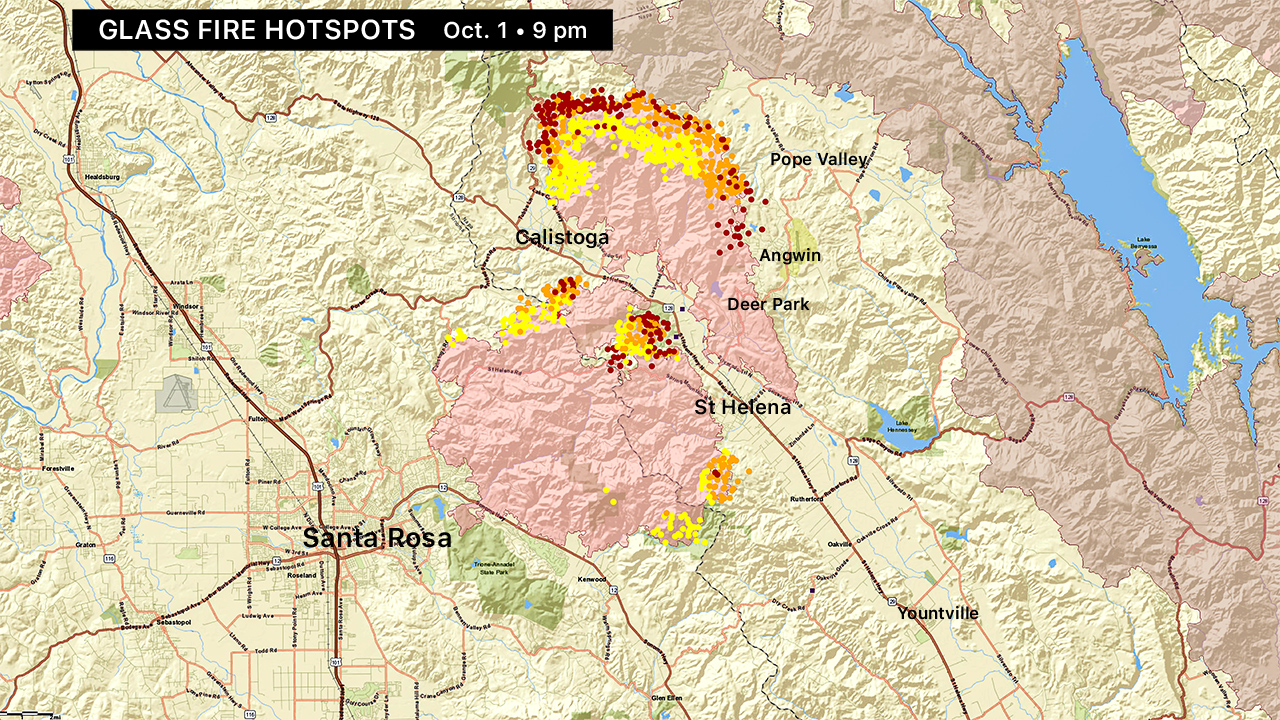
There's a hotspot in the hills immediately above the Kroeber place, maybe half a mile away. It's orange around that area with a little red back in the middle. There's no caption saying exactly what the colors mean, though you can kind of guess.
So you can see why the immediate area has been evacuated, and anything could happen next.
Of the sites of Kesh towns in Always Coming Home, Wakwaha is on the edge of the fire and Chukulmas is completely engulfed.
Re DT having the virus, what I seriously want to know is: when did he last test negative? I'd like to know how long he may have been spreading this around. He was talking loudly for 90 minutes in a room with Joe Biden in it just a couple of days ago.
Thursday, October 1, 2020
fire in the valley
What I'm watching the Glass Fire in Napa/Sonoma for is whether it's going to overtake the old Kroeber homestead, where Ursula Le Guin grew up in the summers and which forms the center of the setting of Always Coming Home. But as usual I'm having trouble getting up-to-date information. The most recent article I've seen, dated today, has an excellent map but the map is three days old! More recent maps are either too small-scale or too "approximate" to be of much use. What I can see suggests the fire perimeter is no more than a mile or two away, but hasn't overtaken the area yet. However, I've found one road closure map which shows the road to the homestead as closed, though the branch road on the far side from the fire isn't. So I take that as precautionary at this point, not as a sign of where the fire is.
We have relatives of our own in the Napa Valley, but they're much further away. It was last year's fire that worried us more.
We have relatives of our own in the Napa Valley, but they're much further away. It was last year's fire that worried us more.
Subscribe to:
Posts (Atom)